
1 / Sketchy Stuff: The Smokestack of Keskkatlamaja
2 / Editors’ Observations: The Old Elevator and the New City
3 / Observe a Tartuvian: Ruslana Romaneskul
4 / Linguistically Accessible Culture Recommendations for September
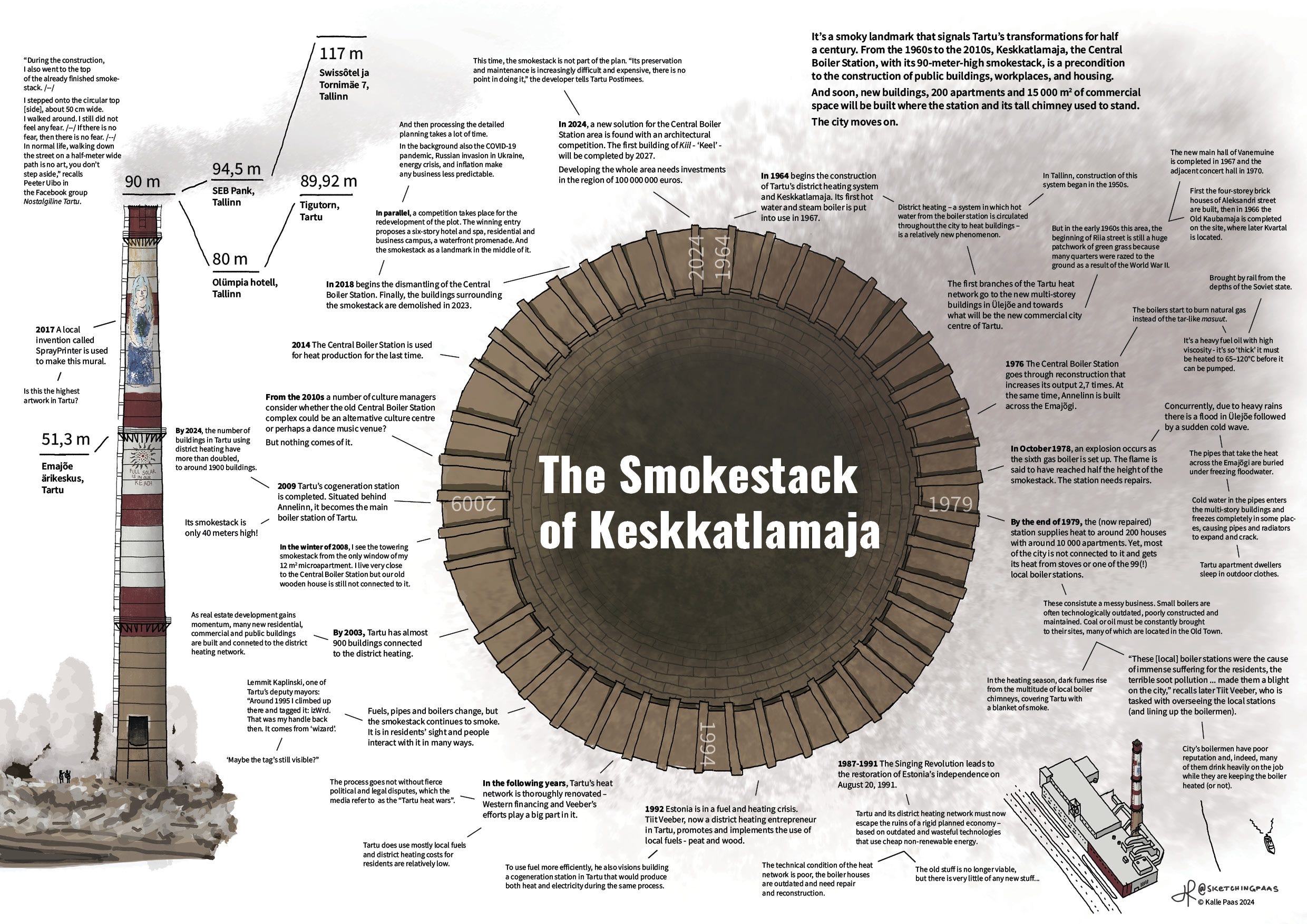
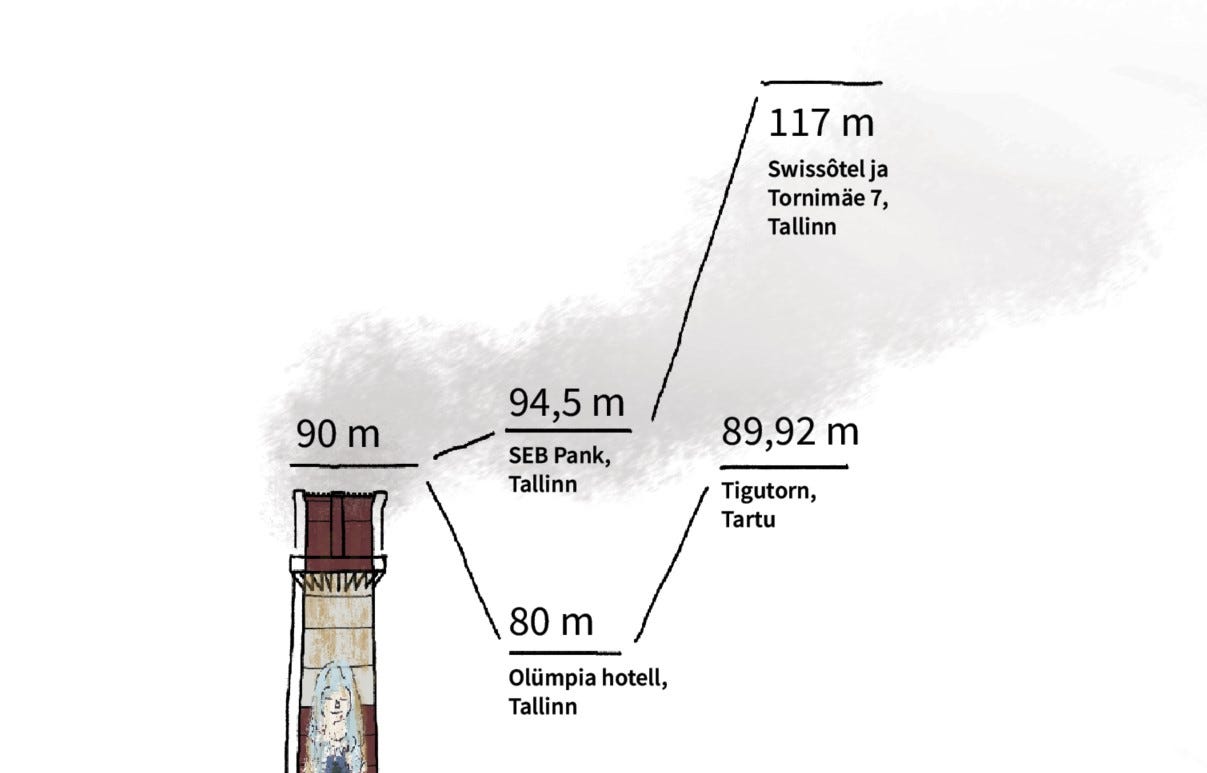
Tartu's vertical growth is slow. After regaining independence, only once in 10 years a building rises that's a head above the others: Emajõe Ärikeskus in 1998, Tigutorn in 2008, and Paju 2, the Pipedrive building, in 2020.
Some tall ones fall, too. The 90-meter-high smokestack of Keskkatlamaja, the Central Boiler Station, has towered on the edge of the city center since the 1960s. Soon it will be demolished.
A sense of impending change is what pushed me to capture this smokestack.
I had seen it for many years. It used to be my daily sight from the only window of a nearby micro-apartment where I lived from 2007-2008. But I had never looked at this smokestack with the curiosity and ambition of the owner of a pen display and an Instagram artist account.
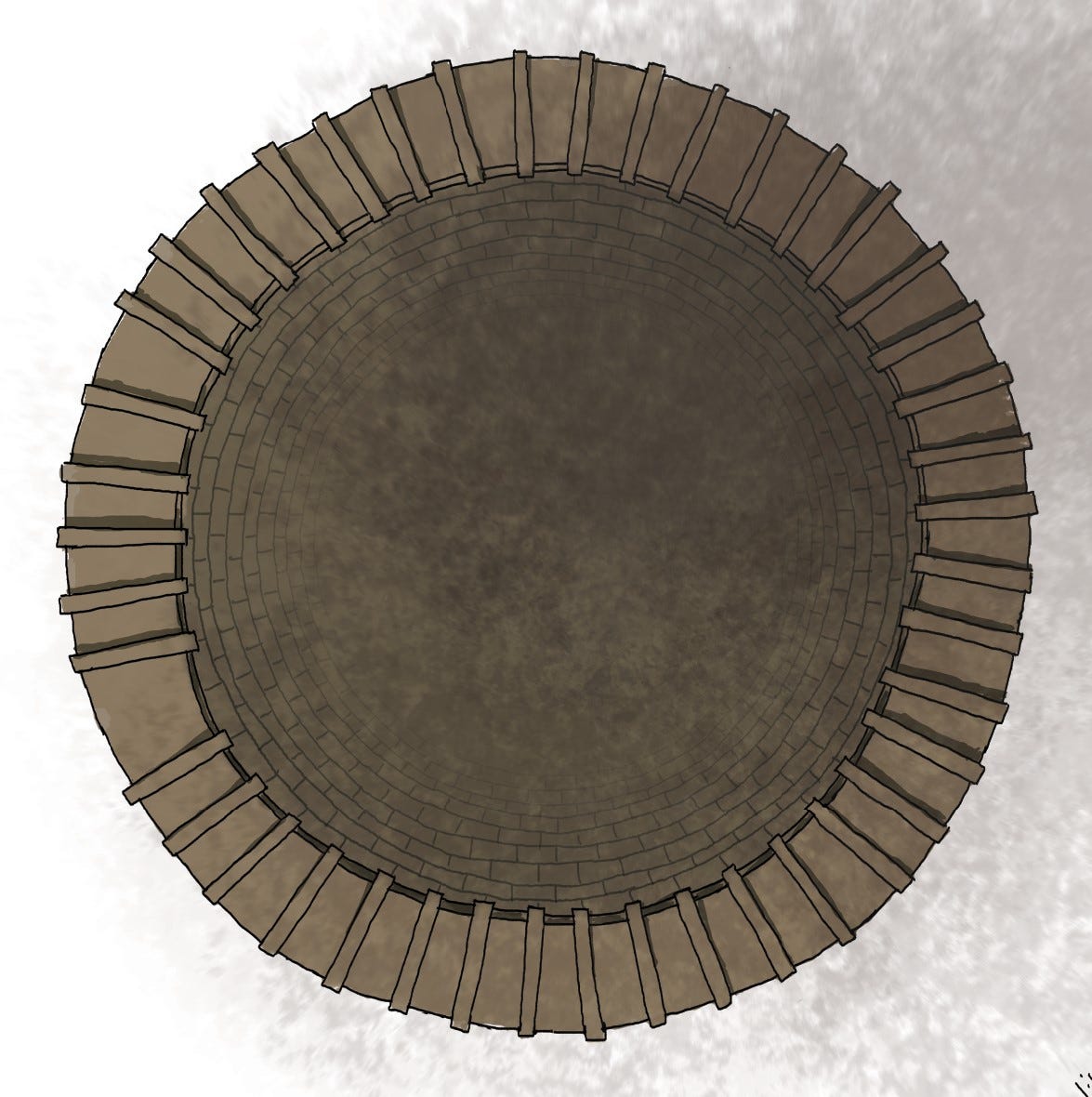
Visibly this smokestack is not the most interesting big chimney in the world – apart from the murals –, so part of the creative challenge was finding interesting angles on how to show it.
At first, I knew very little about district heating, boiler stations, or the actual history of this big chimney. Then I got a lot of information from the newspaper Tartu Postimees [1, 2, etc], and the Taltech district heating textbook. I browsed online forums such as the Nostalgiline Tartu group on Facebook. I visited photo archives through Ajapaik and paid a few visits to the newly opened Tartu room in the main building of Tartu Linnaraamatukogu, especially for Tiit Veeber’s “Tiidu suits”.
As always, through the particular place or object that I depict, I try to speak about Tartu’s transformations on a larger scale. The 60-year-long story of the Central Boiler Station and its smokestack allow me to speak about two major construction booms in Tartu: one in the 1960s-1970s, and another one from the 2000s onwards.
Perhaps in the future, I will create another work that focuses exactly on these topics, so that I can offload some of that text from the somewhat overcrowded “The Smokestack of Keskkatlamaja”.
But for now - I hope you enjoy the drawing and its stories as they are!
→ If chimneys aren't your thing, then maybe bridges? Find another work of mine, the postcard set ‘The Bridges of Tartu’ in the Rahva Raamat online store or at Tasku Rahva Raamat!
“Our Tartu”, the new permanent exhibition of Tartu City Museum, lifted me up.
On the second floor, representing Annelinn, they have a genuine old elevator (or at least half of it). It's from the 1970s-1980s, just like the elevator in the 7-story building where my city grandmother lived. Shiny brown wooden panels with metallic silver rims for doors and interior. Round plastic buttons on the control panel. A magic ride from my childhood.
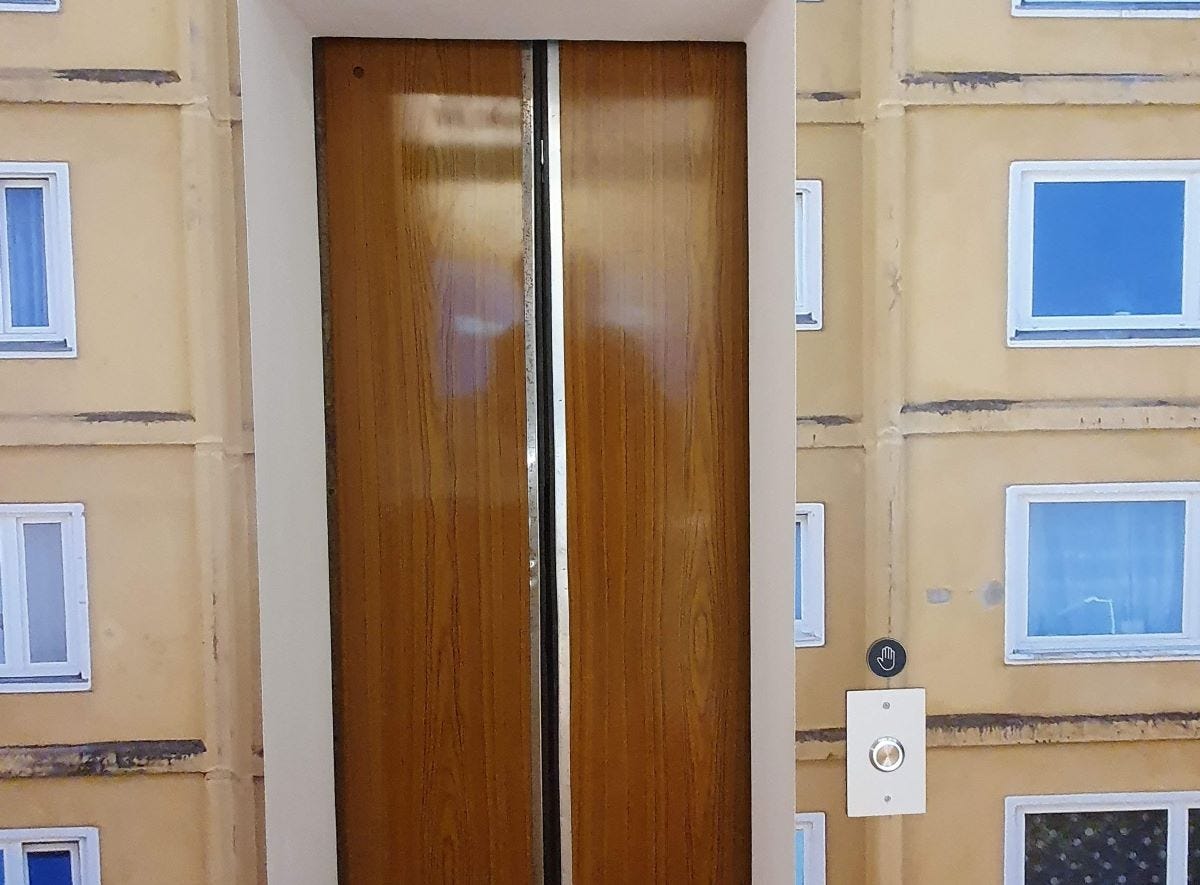
I wish museum director Risto Lehiste and his team could also make the elevator smell like that elevator! And that one did not smell bad. For a country boy, it smelled like a big and exciting city!
In addition to a nostalgic elevator, “Our Tartu” makes use of other methods to paint the portraits of the 19 neighbourhoods of Tartu.
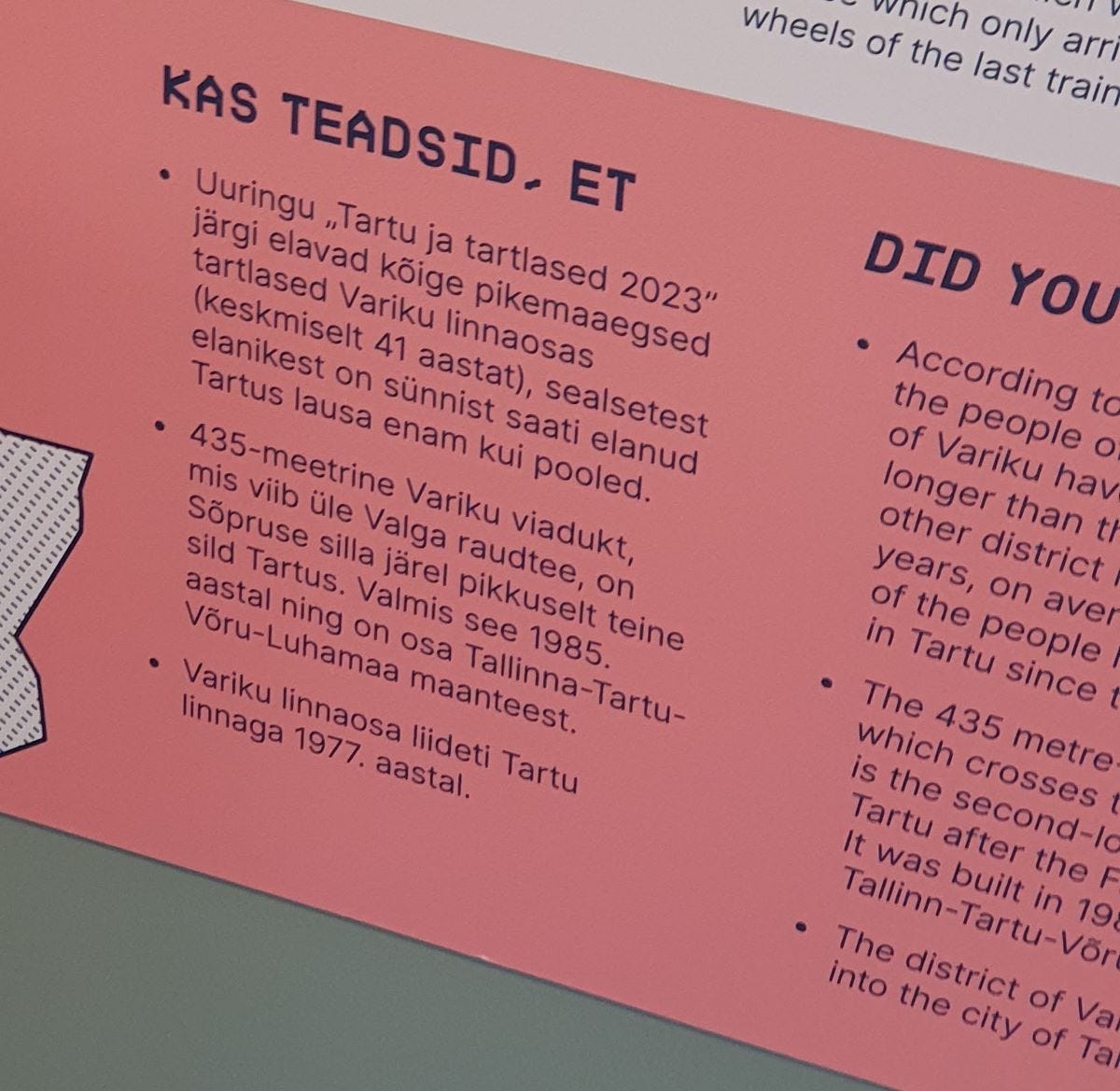
For example, statistics. The information board about the Variku neighbourhood (have you ever been there?!) says that according to a survey, its residents have on average lived in Tartu the longest, 41 years. (That's the real old town of Tartu!) Or that more than half of Raadi inhabitants have lived in Tartu since birth.
The other Saturday I was in the sunny yard of Ula, attending a beautiful yet bittersweet Ukrainian Independence Day celebration. A major thing about the Ukrainians in Tartu is that while there are Estonian Ukrainians who have as well lived in Raadi or Variku for 41 years, there are also a couple of thousand newly-arrived Ukrainians who have lived in Tartu for some period after the beginning of the full-scale war in 2022.
I lost my grandmother's elevator from my childhood because she had to sell her apartment to move closer to us. The Ukrainians who arrived in Tartu in recent years had to in most cases leave their homely places, things, or people because of the russian violence. And for many of them, Tartu has become – or could become – their new home.
One of the things my wife and I did when hotels in Tartu turned into refugee centres in the spring of 2022 was to compile and publish weekly Tartu culture recommendations in the Ukrainian language. We did it to encourage all these people who had lost their everyday surroundings and networks to go out and see this unknown new city, and its people and start getting in touch with them.
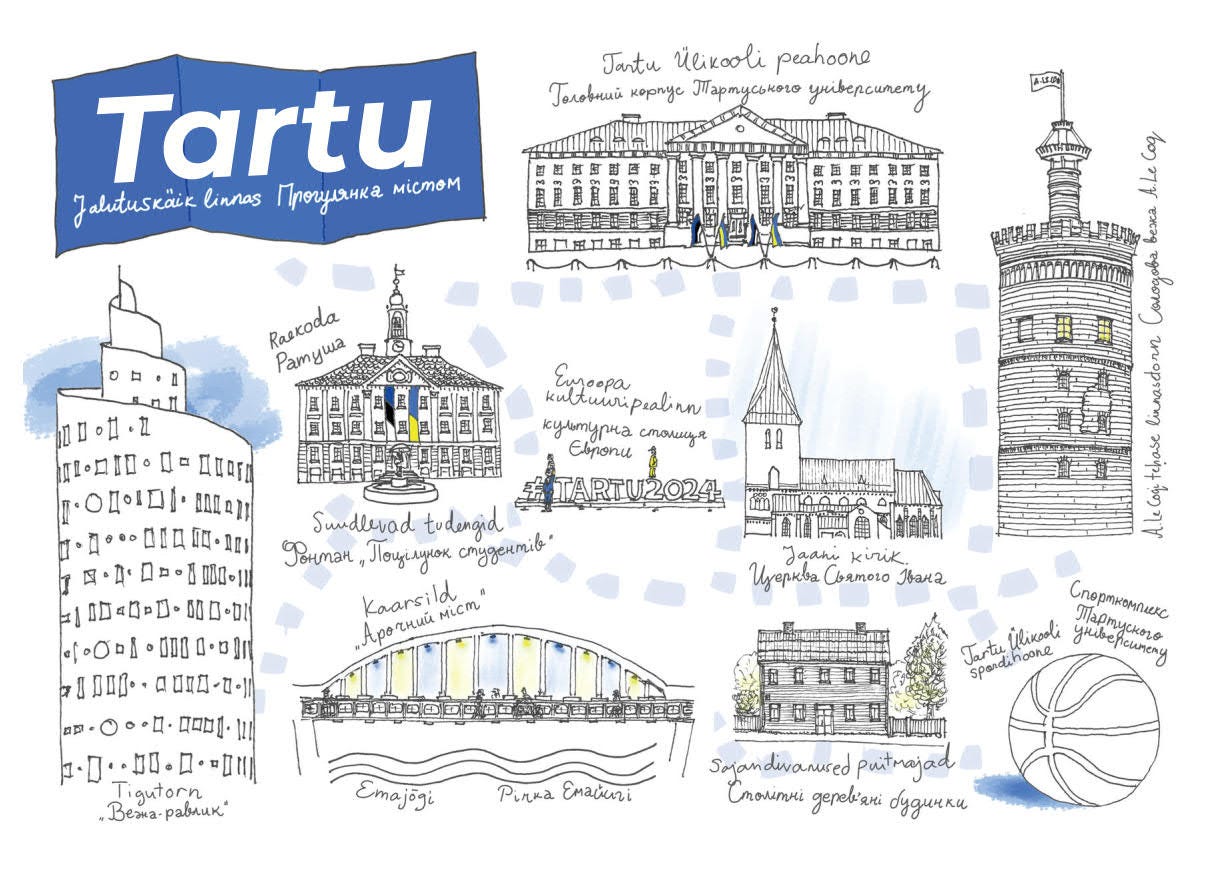
And that is why I appreciate that even though “Our Tartu” is also very local and grassroots-y it is almost entirely accessible in English.
I think this is one good way how to reach out and invite people to get in touch with the Tartu that is outside everyone's personal or expat bubbles.
If we want our Tartu to be bigger, it needs exactly these small but effective stepping stones and bridges.
→ The exhibition team also commissioned Tartu-based artist Sashami to create original illustrations of all Tartu neighbourhoods - see them on her Instagram page.
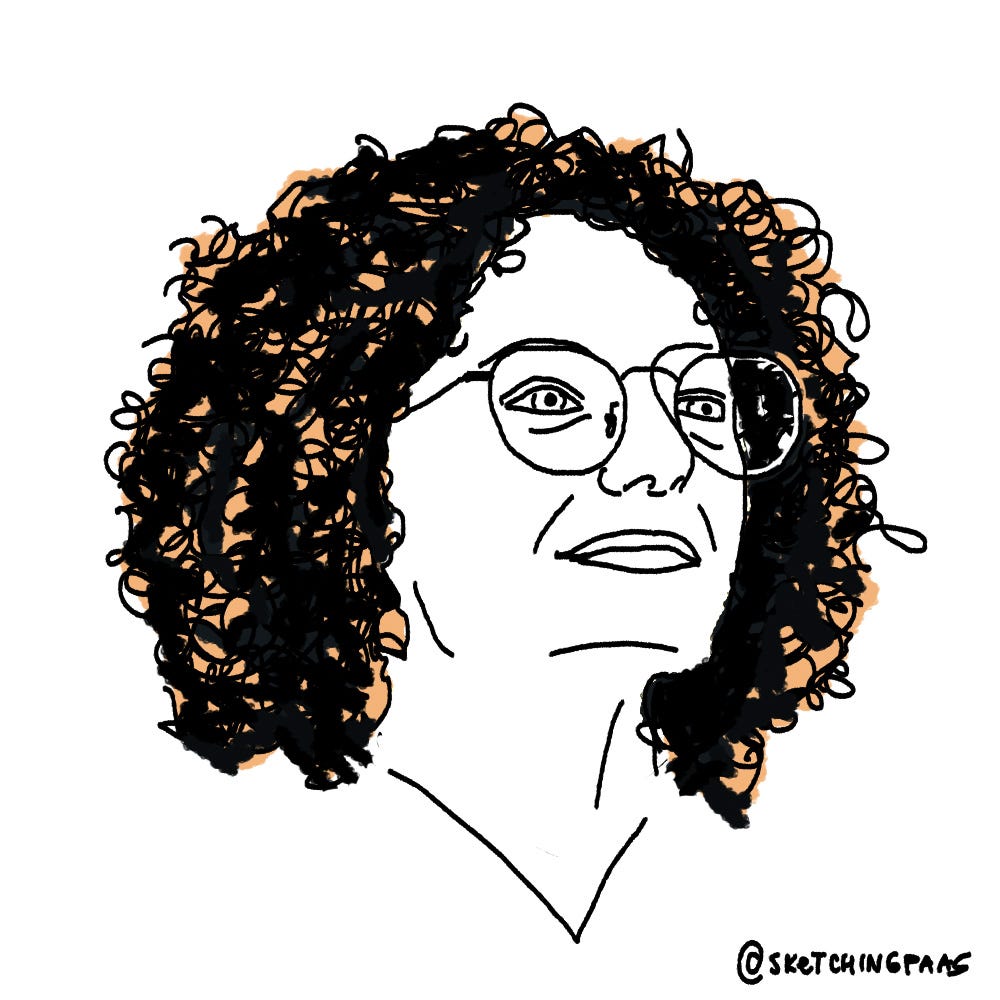
Ruslana Romaneskul's weekly yoga classes were the first events carried out by a newly arrived Ukrainian that I could put into my weekly Tartu culture recommendations in spring 2022. Most recently she was involved as a psychologist at “Kaleidoscope of Emotions”, an art therapy project by and for Ukrainians in Tartu.
Ruslana, you moved to Tartu in early spring 2022. You are very active here – I have seen you singing at Ukrainian charity concerts. I have followed your Instagram page and seen how you give courses that promote people's mental and physical health. I have seen you studying and participating in entrepreneurship programs and cultural life. What makes you so active? What drives you?
I am a dynamic and energetic person by nature. To be active, I strengthen my health physically and mentally. I want to share this calmness and support with others because they are so needed now!
What are your favourite places in Tartu for food? Why?
My favourite places to eat are Vapiano in Kvartal and Aparaaditehas. Vapiano is close by and I love the pumpkin soup there. At Aparaaditehas, I like the history, design, and the food is very tasty.
What are your favourite places in Tartu for drinks? Why?
I am a coffee addict. I love coffee! I like coffee and matcha at Aparaaditehas. I often take coffee in Coffein in the center, but the taste depends on the shift and the barista. I demand quality because I was a barista myself in the past.
What's your general favourite place in Tartu. Why?
My favorite places are near the water and places where there is a lot of space, places where you can breathe "fully." For example, I like to go to the Emajõgi beach and walk near the University of Tartu Museum. I like ERM – Eesti Rahva Muuseum.
In your opinion, which one is the most boring neighbourhood in Tartu (out of the areas you've seen)? Why?
I will say that I have not seen all the districts of Tartu. I find neighborhoods with gray, shabby tall buildings boring. It causes a contrast both in appearance and in the value of color in life.
What is missing in Tartu? What would you add to Tartu?
There is enough of everything in Tartu! I haven't even seen everything in Tartu, but I have plans to do so! Honestly, this place looks like my dream place. In winter, there are snow-covered Christmas trees. In summer, it looks like a cozy resort town, it's lively and the nights are white.
Finally, please share your favourite story about getting to know Tartu or Tartuvians.
My first story in Tartu – It is March 5, 2022. It took us five days to get to Tartu with our daughter. The road was long and hard.
When I got to Tartu bussijaam, I took a deep breath and really wanted a coffee. My English words were confusing because of fatigue. But the man behind the counter understood me. He made a coffee and gave it to me with a smile.
I wanted to pay him, but he didn't take any money. I was touched by the friendliness and generosity of the Tartu people. They seemed so understanding and calm. Since then, my opinion of the people of Tartu has not changed.
→ Follow Ruslana’s stories about her work and life in Tartu on Instagram.
Maarjalaat
The history of fairs in Tartu goes back many centuries as the city’s been both an international and regional trade centre. To this day, fairs are a big deal, and this can be seen all over the city centre during Maarjalaat on 7 September, from Raekoja plats to Küüni street to the river bank.
unda festival
…celebrates club culture, connection, and the power of dance from 19 to 22 September at the Estonian National Museum (ERM). Among other things, it has a partnership with Tresor (Berlin) which meant nothing to me, but my wife was very impressed! In addition to great dance music being played, there is also a conference where the connections of club culture with other areas of life will be discussed by Dimitri Hegemann (founder of Tresor), Irvine Welsh, author of “Trainspotting”, and others.
And you know, this won't even be the first big dance party at the Estonian National Museum this year. During the opening of Tartu 2024, I was deeply amazed when over 1000 people danced in front of the ERM while Sigma et al. gave live performances in the cold of the winter night! And there was an even bigger party indoors! So I hope Unda will be another such once-in-a-lifetime Tartu event.
→ See Tartu and Southern Estonian events at kultuuriaken.tartu.ee and Tartu2024.ee. The latter has also a handy list of top events.
Due to changes in my work arrangements, I will, unfortunately, have to take an indefinite break from the Tartu Observer after the next issue. I am very thankful to all of my subscribers – whether paid or free – and I hope you find the remaining Observer issues interesting! ❤️
No posts
Comments
Nothing yet. Say the first thing.
Sign in to join the conversation.