

1 / Editor’s Observations: How to Experience Summer in Tartu?
2 / Observe a Tartuvian: Oksana Osadcha
3 / Sketchy Stuff: How to Capture Rüütli Street?
4 / Culture Recommendations for May-June: Linguistically Accessible Tartu Events
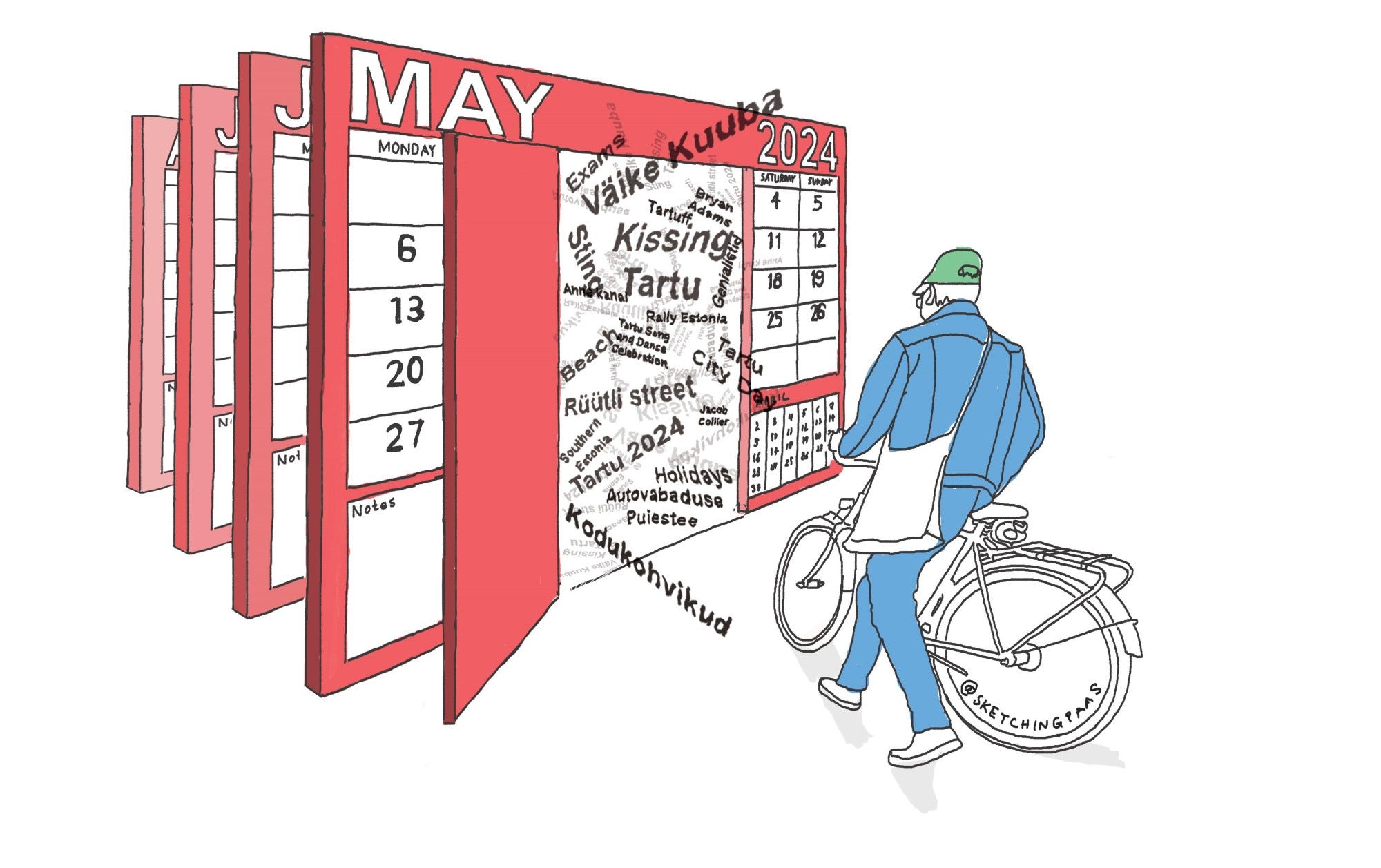
This summer I wish I could be everywhere in Tartu. It will be a unique season – with all the European Capital of Culture events on top of the usual hits such as Tartuff, Tartu City Day, Rally Estonia, Autovabaduse Puiestee, or home cafe days in Tammelinn.
Such a summer cannot be experienced without preparation! I have briskly walked the streets of Tartu with the baby stroller and renewed my Tartu city bike subscription. I am fit to capture what Tartu has to offer and will equip myself with some extra wheels if needed!
Sometimes I still come across this curious myth that ‘in summer Tartu dies out’ and ‘nothing happens’. This is simply not true, because from May to August, about 100,000 tourists stay overnight in Tartu. This is around 40% of the annual stays, so these warm nights are the busiest time for hotels and guest apartments in Tartu.
It’s rather that Tartu changes in summer. There are fewer students, at times also fewer native Tartuvians in the city - they go ‘maale’ or ‘suvilasse’ -, while more folks arrive from elsewhere in Estonia, Latvia, Finland, Germany, etc.
For those who remain in Tartu, this gradual change may be unnoticeable, but for others who leave and return after a while, it provides surprises. I asked on social media about it. Here’s a take by Juhan:
“For the past 30+ years, the best thing to do during the summer is to leave Tartu. And if you come back for some event you will find the town filled with the strangest people you never see during the winter (ex-cons fresh out of prison, drunks, homeless weirdos, etc) and you get a cognitive dissonance that this is not Tartu, but it still is part of it.”
Berk, another a long-time Tartuvian:
“I'll be back here for the food and wine festival [in August] and more sunbathing and swimming + the continued high season of Tartu 2024!”’
Inkeri listed her Tartu summer favourites that I suppose many of us agree with:
“Taking a boat ride on the river. Grabbing a mojito in one of the riverside bars. Strolling in the botanical garden. Long bike rides by the water.”
Following what Juhan said, here’s my take on how to experience summer in Tartu in a more liminal way. I used to host morning shows at Ring FM, a regional radio station. It was an intense gig fuelled by coffee and cigarettes. (You know why some A-list songs are 5 minutes long? Because they let the on-air person take a smoke break.)
I woke up every day at either 5 or 6 in the morning. A bit of my commute to the studio was on foot. At 5.30 the city is already very sunny, but calm and quiet. The brief shade of night is long gone, but the morning busyness is still far away. It’s a fascinating time in between, a special way how to experience Tartu in summer. Give it a try!
Of course, getting up at 5 a.m. to experience the city can be difficult if you docked at Vein ja Vine for too long the night before. But that would have actually been my next recommendation on how to experience summer in Tartu!
→ See Tartu and Southern Estonian summer events at kultuuriaken.tartu.ee and Tartu2024.ee. The latter has also a handy list of top events.
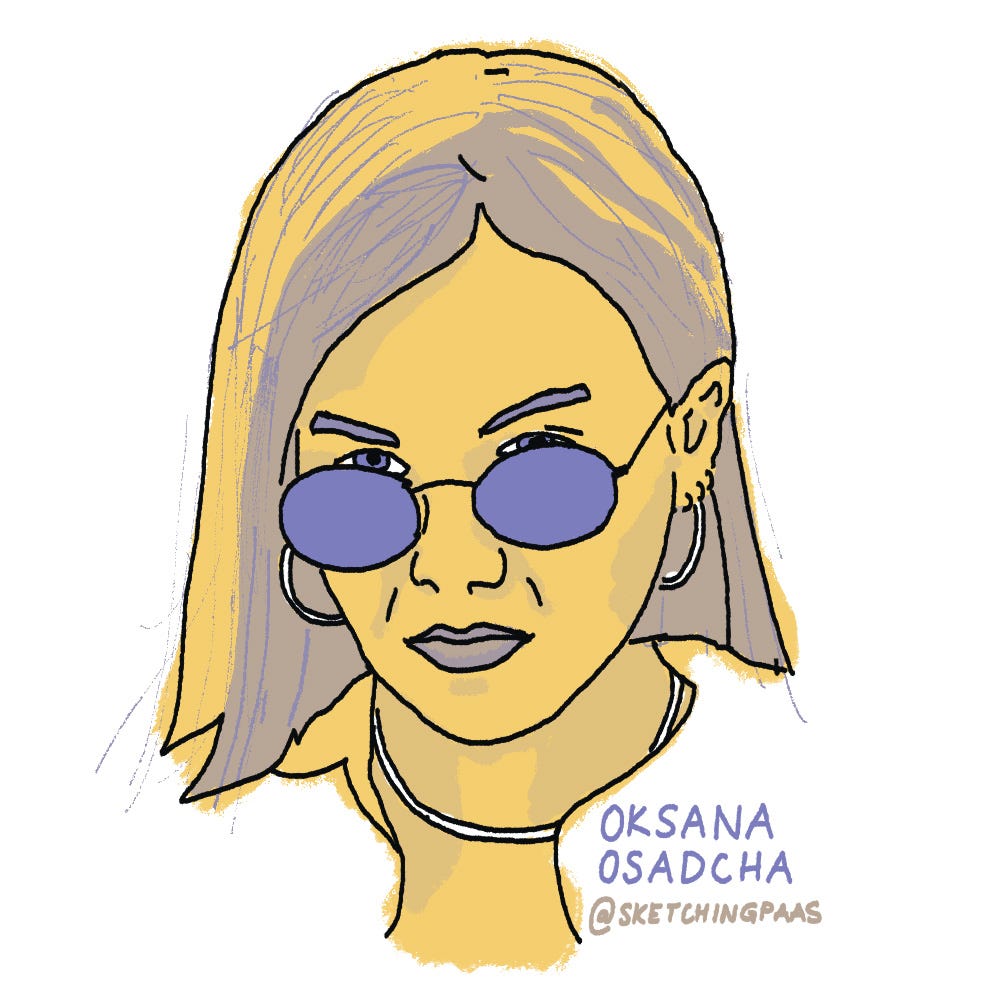
Oksana Osadcha is a Ukrainian photographer who uses Tartu and Southern Estonia as a canvas for her beautiful and intimate photos of individuals and couples. I first met her when volunteering for Ukraina Maja events which she also often documents with her photography, retaining her distinct style even when capturing crowds of people.
Oksana, hi! When we asked if you would photograph our family's baby expectancy photos you knew a perfect place for that photoshoot. A stunning beach on the northern coast of Lake Peipsi! Even many Estonians have never been there. The other time I saw you photographing someone in a cool courtyard in Tartu's old town. What is your method for finding such locations for photoshoots?
Well. If you take into account the fact that I speak Estonian only superficially, then this is probably my talent: to feel where to turn in order to find yourself in a beautiful place.
Where would you turn in Tartu for food? What are your favourite places?
Kolm Tilli in Aparaaditehas. Nokk in Karlova. And I like to visit Astri Köök by Lõunakeskus for a home-cooked meal.
What's your favourite place in Tartu for drinks?
Väike Kuuba by the river, and wine bar Vint at Ülikooli street.
What's your general favourite place in Tartu. Why?
This question requires an answer longer than one sentence, but I will try very briefly: my favorite neighborhood is Karlova: I like to walk there, turn to cozy courtyards, and look into windows - I know it's not nice, but it won't work any other way! And in general: there is something special in almost every district of Tartu: I can tell you when we meet!
In your opinion, which one is the most boring neighbourhood in Tartu? Why?
Annelinn. I don't like the grayness and stone jungle that hangs over me and seems to prevent me from breathing.
What is missing in Tartu? What would you add to Tartu?
A cool, atmospheric photo studio like in Ukraine. A restaurant with delicious Georgian cuisine. And a Zara store.
Please share your favourite story about getting to know Tartu or Tartuvians.
Tartu is an incredible city, which welcomed me in a wonderful way in 2019 and continues to impress and delight me to this day.
→ See Oksana’s work and ask if she’s available for a photoshoot on her Instagram page.
I’m following some Tartu streets like people follow influencers on the internet. I visit them regularly to check if they have any updates. Streets such as Kuperjanovi — I think it has the most delightful variety of building shapes and styles in Tartu in the category of ‘short streets’. Or Tähtvere, a good contender in the ‘medium-length’ category.
But before everything, I’m following Rüütli street.
After all, Rüütli is the Rome of Tartu’s evening and night life. Eventually, all the roads lead you there. Also, it is our Pompeii. A site of well-preserved memories from a bygone golden age. Find a 30-something-year-old (former) Tartuvian and (s)he will tell you about the ‘Bermuda Triangle’ and how big was Rüütli in the early 2010s. I know I would.
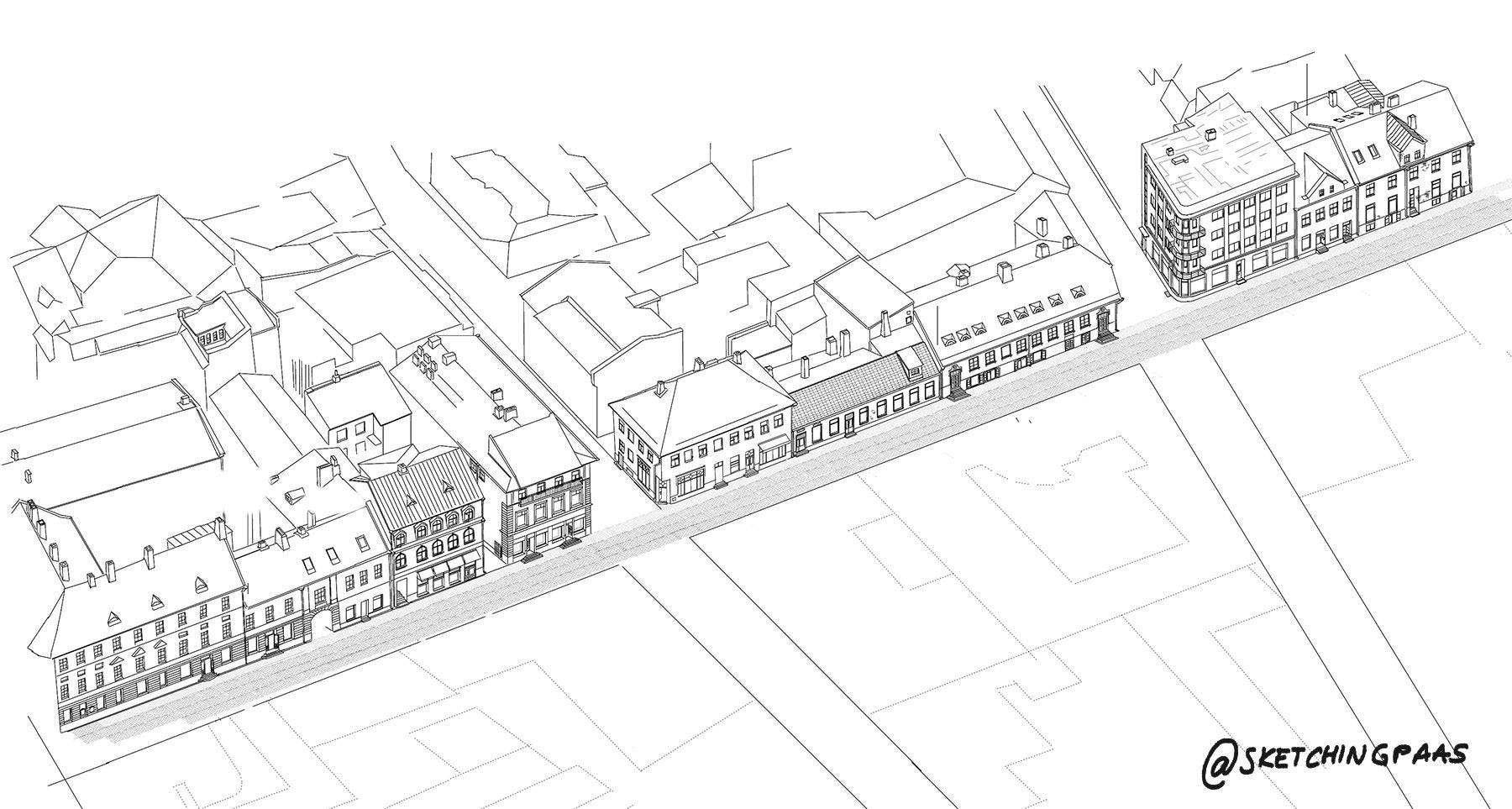
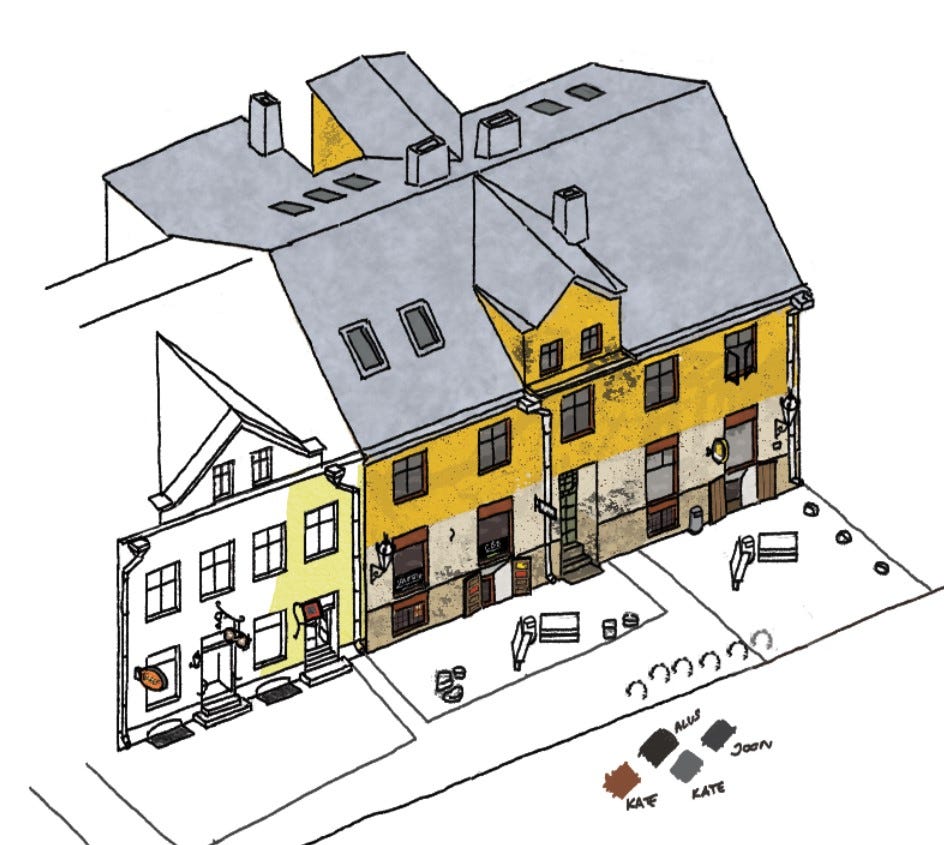
For two years I have had an idée fixe to capture Rüütli street in a panoramic drawing just like I did with the Town Hall Square and the Bridges of Tartu. While those are finished, this one is still literal sketchy stuff. I've been working on it with small, slow steps for so long that I've migrated the project twice - I moved all my drawing from one very limited app first to Krita, and then to Photoshop.
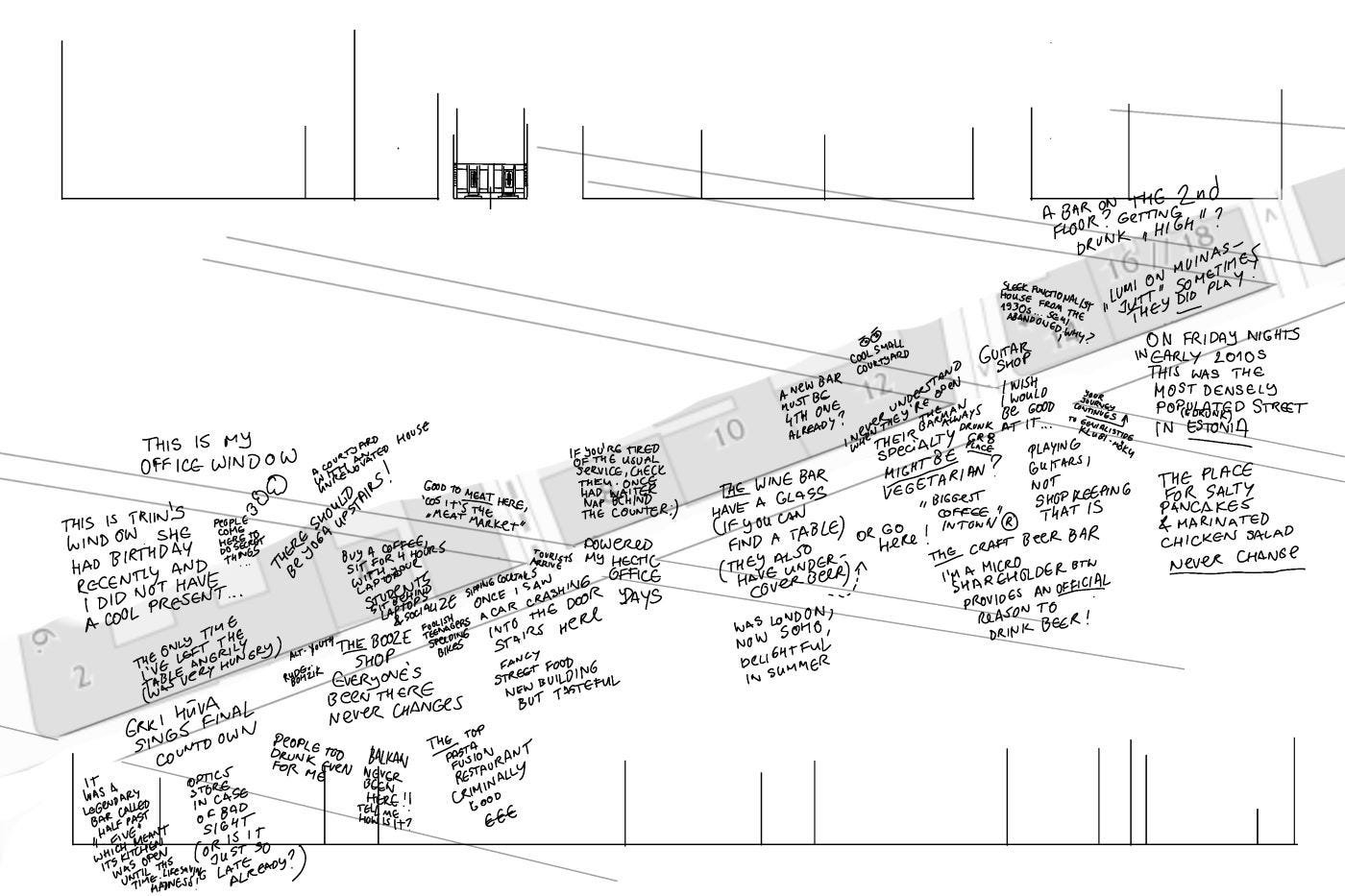
What I know about this slowly emerging drawing is that it won’t be Rüütli street of 2011 or 2024, but rather a time-fluid mind map of facts and feelings I get when I look at this house or that. Like the ones I recorded in the draft above. My subjective atlas of Rüütli street.
What I don’t know yet is: how much stuff should happen on the streets? How large a color palette should I use? How much text can be accommodated by the drawings? Sometimes these decisions come quickly, but this one has been a real grind.
This drawing has been in development for so long that it starts to have spin-offs. In a brush test gone wild, Rüütli 8, the building of Kohvipaus, Vein ja Vine, and Space Bar became an asteroid in animated space. This scene surely has some roots in a cult song from the 90s, “Maailma lõpus on kohvik, kus kunagi kohtume kõik” - ‘At the end of the world there is a cafe where we all meet someday’ - by Vennaskond.
Thinking about how to capture Rüütli street, I keep taking reference photos for drawing. I have different seasons and street conditions. Drinkers in the evening, emptiness in the morning. Snow and sunshine. Changes.
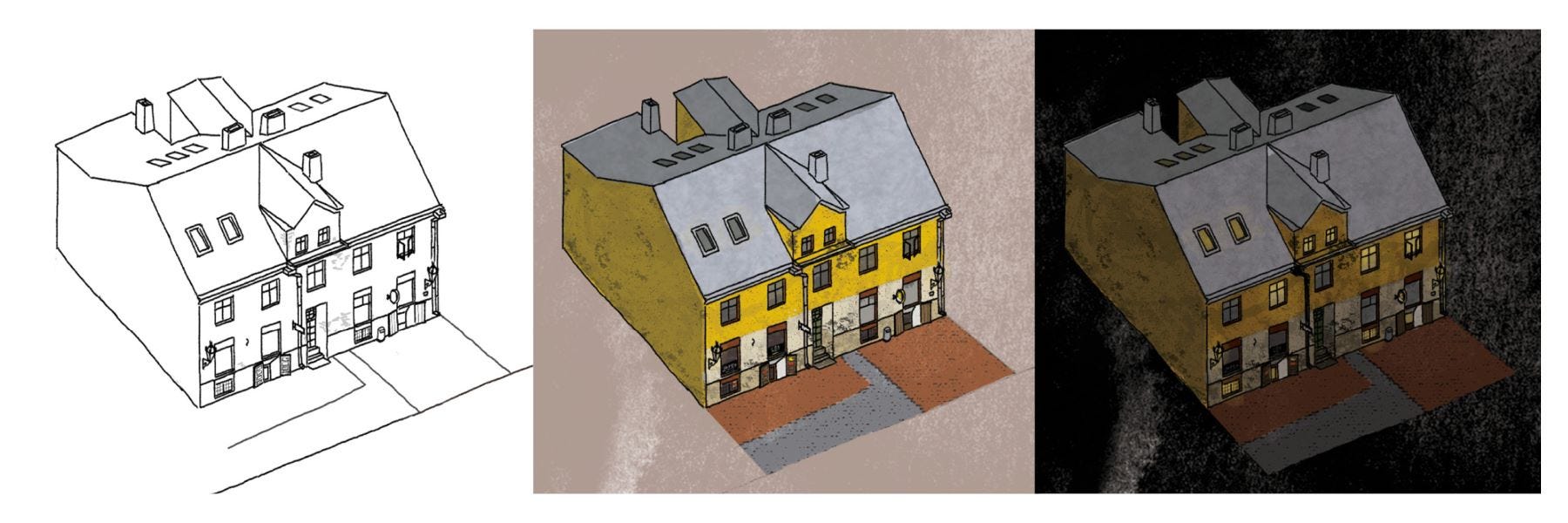
Has it all enhanced also my own experience of eating and drinking at Rüütli Street? Well, I do feel more homely there. As if I knew the houses more personally. Like, how many chimneys are up on the roof or where are the biggest cracks in the façade.
The houses over there I may know better, but nowhere yet have I been offered drinks on the house! Maybe when I’ve finally captured Rüütli street, then?
→ I do have captured the bridges of Tartu. Find this set of storytelling postcards at Rahva Raamat online store or at Tasku Rahva Raamat!
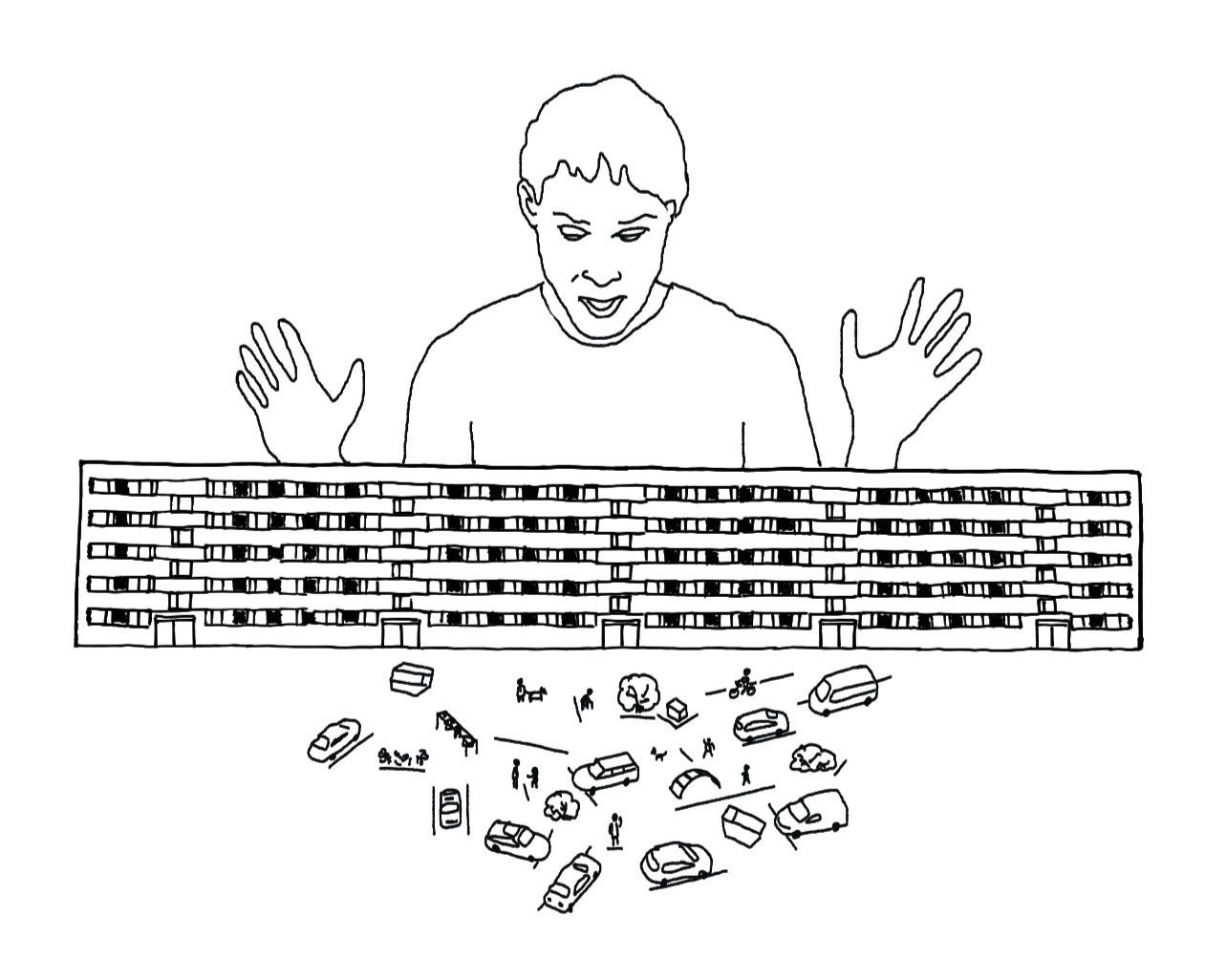
The Läbi Linna team has reached Annelinn! After successful years of collecting neighbourhood stories and turning them into on-foot theatre plays in Karlova, Supilinn, and Ülejõe, they’re presenting theatrically our biggest panel district.
The setup is the same: the audience experiences the play by walking through the district and meeting actors and scenes along the way, right in the middle of whatever is going on in Annelinn. And, for the first time, the entire piece is played also in English. Check it out, only on eight evenings between June 1st and 15th!
In a long list of things that started in Tartu and were relocated to Tallinn, the Estonian Song Celebration is not the least. Having started in Tartu in 1869, it’s taken place in Tallinn since 1896. That’s why there are also separate Tartu Song Celebration and Tartu Dance Celebration. They take place on June 22nd and June 16th and will attract thousands of performers and spectators. It’s a great opportunity to see and feel here in Tartu, what makes these kinds of celebrations so special for Estonians.
On June 15th, the choir of Paris Philharmonic from France will perform 'Forgotten Peoples', song cycles by quintessential Estonian composer Veljo Tormis, based on the folklore of almost forgotten Finno-Ugric nations who are close to Estonians. This one-time Tartu 2024 performance takes place in the Estonian National Museum. As of May 27, there are still tickets available.
→ See Tartu and Southern Estonian summer events at kultuuriaken.tartu.ee and Tartu2024.ee. The latter has also a handy list of top events.
The Tartu Observer is written and drawn by @sketchingpaas. If you feel this issue was well worth your time, consider buying a print from me, becoming a paid subscriber, or buy me a drink.
No posts
Comments
Nothing yet. Say the first thing.
Sign in to join the conversation.