

Back when I started in 2005, I built hundreds of blogs, sometimes up to 10 a day. Eventually I had over 1,000,000 pages indexed in Google, do you think for a moment that I wrote all of those?
Did I Hell! I used an early 2000s version of AI, the word spinner.
Which basically worked like this:
This {Morning|Afternoon |Evening} I took my {wife| daughter| dog} to the {beach|park|pub}
That line above alone gives me 27 different opening sentences.
If I add the following: Unfortunately, it was {raining | cloudy | closed |snowing}
We now have 108 possible opening sentences. I could go on, but I am sure you get the idea. LLM’s and AI are nothing new.
I just wanted you to know where I am coming from with this today, especially when I say | think | worry (joking!), we’re approaching AI and writing all wrong, and it might be time for a straight conversation about it, because the debate keeps getting treated as black and white when it really isn’t.
I checked the first few articles in my Medium feed, and they were all AI, 100% pure AI, there was no effort to even make them look human. Let’s start there, in anyone’s book that should be classed as AI slop, there was nothing human in them.
On the other hand, lot’s of good, useful and interesting articles have elements of AI in them, information pulled from previous content the writer has written, a framework that gives the writer somewhere to start from.
I used AI to lay out and plan my content for a few months, each morning it would give me a topic and the key points that I should cover. For the past month I’ve written with no AI input.. It hasn’t improved my writing one bit… in fact, my writing is probably worse because of it.
We’ve all known for months who uses AI. You spot the same tells often enough (Random Tuesday again!) that you start recognising AI content from the opening paragraph. In fact I’ve noticed that I used to use the em-dash quite a lot , now I feel compelled to remove it, and it sucks!
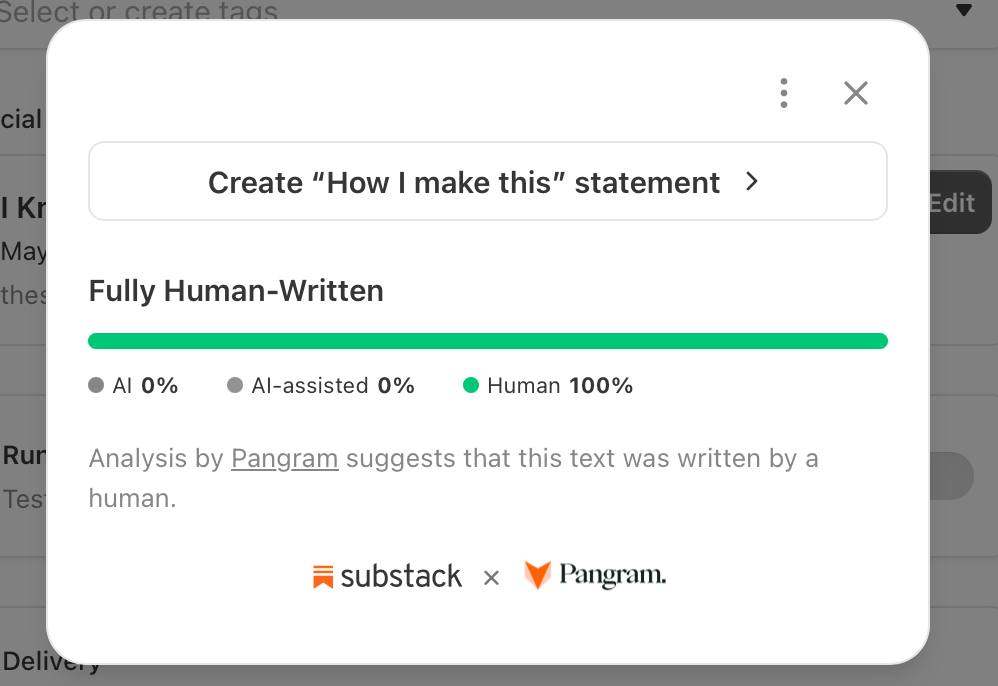
Now, on Substack you know for certain if someone is using AI, because they have turned off the ability to check with Pangram and added a statement about what they use AI for.
AI detectors have been notoriously bad up to now, but the latest versions (i.e Pangram) work differently and are scarily accurate. I know this because I have been testing it relentlessly for the past 2 weeks.
I’ve tested my own content against AI versions of my content, I’ve taken an AI article and changed almost every line, and every time its verdict has been closer than I’d expect.
There is no hiding place, now your content is either AI, AI-assisted, or 100% human.
So this is where the black and white comes in there is no room for anything else, and that’s a problem, because AI can help you to write better content when used properly.
A lot of AI content really is slop, there is no denying that. You can usually spot it a mile away, it’s bland, with no flavour or seasoning, and looks nothing like a human would write… it’s boring and it won’t help you to retain readers.
But a lot of AI-assisted content reads no differently from something written by hand, and I don’t think most readers could tell the two apart if you put them side by side.
This brings us to the important question, do people actually care whether an article was improved by AI along the way, or do they just care whether they got some value or insights from it?
Could AI genuinely make some writing better, and are we too busy arguing about everything being AI slop to recognise the nuances?
As I said earlier, I used to get AI to map my content out for me based on what I’d written before and what I knew worked, then I’d write the actual piece myself. These days I write everything, start to finish, and AI doesn’t come anywhere near it. I honestly don’t think it’s improved my writing by one iota.
With all the testing I’ve been doing and documenting in the community, I’ve spent the best part of 2 hours a day for two weeks running different types of articles through Substack’s built-in AI scanner, I’ve been watching the score swing from 80% AI down to 28%, back up to 88%, then down again, over simple changes.
I’ve managed to take a 100% human article I wrote 10 years ago and get it to 64% AI-assisted by simply breaking a paragraph up into single lines and adding a closing sentence.
I learned a lot about how it works, but none of it has helped me to improve my writing.
AI hasn’t had your experience and working knowledge of what’s worked for you and what hasn’t, it will never (maybe I shouldn’t say never) be able to add your special sauce to an article, so why worry so much about it.
Instead, let’s focus on whether an article is useful or a waste of time.
So.. let’s get to the point… I’m considering turning the detector off on my own account, not because I use AI to write my content but because it is a distraction, and sometimes it might improve an article to have AI refine my chaotic style. I mean the article I published yesterday would definitely have been improved by Claude giving it a better shape.
Simplicity: A Short Guide To Building An Online Business
·
Aug 16

Something a little longer than usual today, but I promise it’s worth it…It's my guide to building an online business from 21 years of experience. I’ve liberally scattered share buttons if you get anything from it please consider using them!
I’d replace the ability to detect my articles with a statement saying exactly how I use AI and howI don’t.
Tell me what you think, are the constant assumptions of AI slop getting tiring or is there a balance we should strive for between the use of AI to improve your writing and using it to write your content?
I’m genuinely curious…
In case you were wondering…
Paid subscribers also get access to all my communities, courses, and books.
Comments
Nothing yet. Say the first thing.
Sign in to join the conversation.