

For the first years of my life, I had protectors. My sisters.
They could not shield me from everything. No child can shield another child from everything. But they could hold back most of it, and most of it was enough. Especially at night, which is when our house became dangerous. For a long time one of my sisters shared my room, and having her a few feet away in the dark was the difference between a night I could sleep and one I could not. She was my buffer. They all were. As long as they were near, I was mostly safe.
Then they grew up, the way older sisters do. One moved to another room. Then, over time, they moved out of the house entirely. It did not happen all at once. It happened the way a wall comes down, one section at a time, until you look up and the thing that stood between you and the threat is simply not there anymore.
When the last buffer was gone, I was left unprotected. And the rest of my childhood, at night, I was abused by another person in that family. No one a few feet away in the dark. No one to hold back things that children should not have to hold back. I learned what it is to be the smallest and most vulnerable person in a house.
I will not reopen the specifics here. They belong to me, and to the child I was. What I will tell you is what that absence built, because that is the lesson.
It built in me the fiercest protective instinct I have ever met in another person. Not for myself. I was past being able to protect myself. It grew instead toward anyone vulnerable, anyone smaller, anyone being hurt while the people who should have stood between them and the harm looked the other way. Show me a child who has no one in the doorway, and something in me goes certain and immovable. I know that doorway. I know what it is to stand in it alone and lose. So I became the one who steps in front of it for someone else.
That instinct is why I went into social work. And it is why I had to leave. I could not protect all the children. No one can. But my nervous system did not accept that. It had been forged in a house where the failure to protect a child was absent. And in social work, I was being asked, every day, to witness that same failure of protection but be unable to stop it. I could only help clean up the mess it left behind. Always after. Never before. It tore me to pieces little by little. Every child I could not reach landed in the exact place inside me where no one had reached for me. I did not burn out. I bled out, slowly, protecting people I was never given the power to save.
That was the Protector.
This week we go into the fifth of the six shapes.
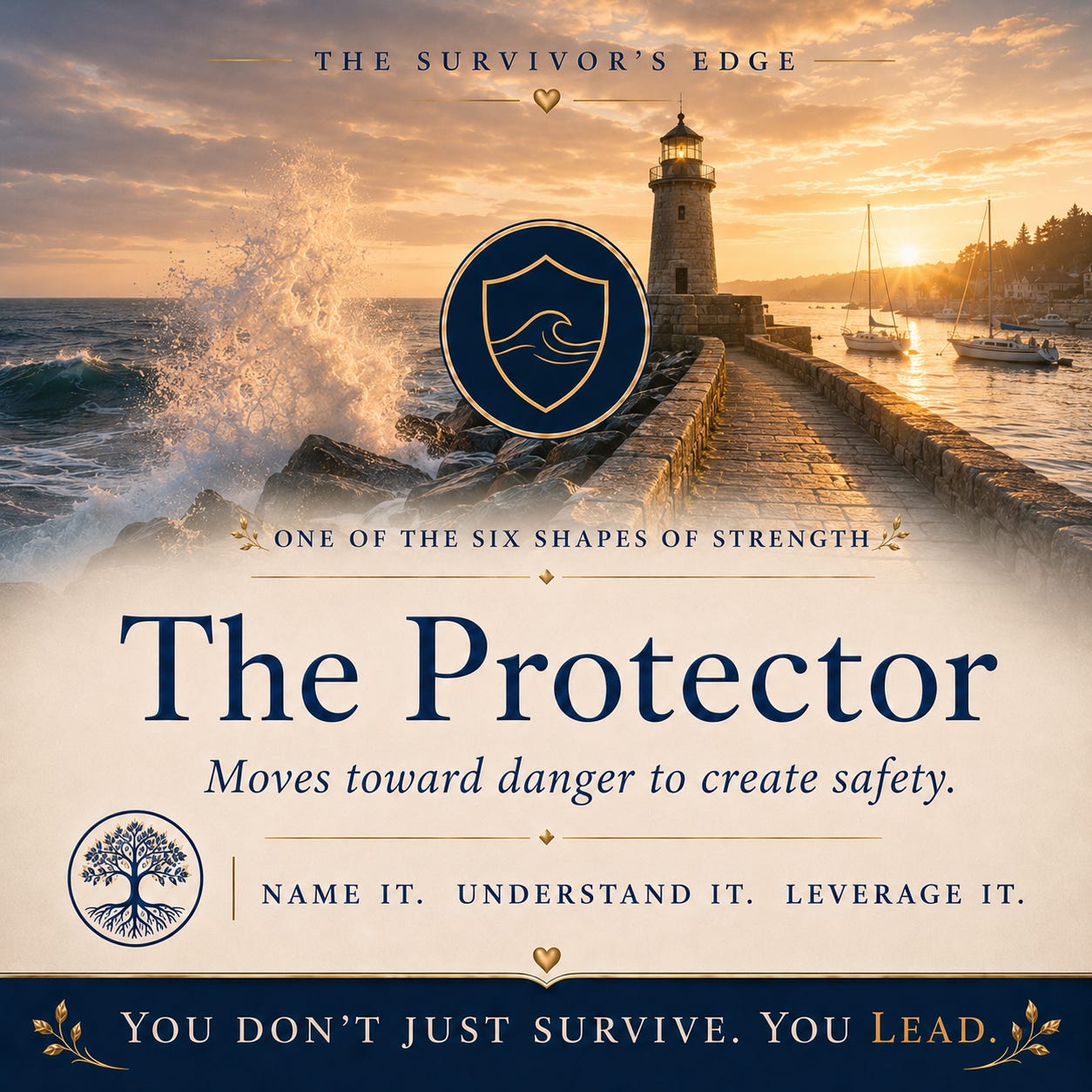
The Protector. The one who steps between other people and harm, and stands in the way so someone else does not have to.
This pattern grows in the child who had no one in the doorway, and who swore, too young to put into words, that no one smaller than her would ever stand there alone if she could help it. The unprotected child often becomes the fiercest protector of all, because she is guarding, in every person she defends, the child no one guarded.
And the Protector does not always look like standing in a doorway. Sometimes it lives in a person as an unflinching commitment to fairness. A judgment that will not bend when someone weaker is being wronged. You may not think of yourself as fierce. You may even think this is not your loudest shape. And still, something in you goes rigid and clear the moment you watch the vulnerable be treated as though they do not matter. That is the Protector too. It is the same instinct, aimed through fairness instead of force.
But the Protector also pays. You cannot stand between people and in front of harm for a lifetime without taking some of the harm yourself. You cannot care that fiercely about the ones you cannot save and stay whole. If you have ever been torn apart by the people you could not protect, you are not weak. You are a Protector.
The fierceness is real, and it is a gift. So is the cost of being the one who always stands in the way.
This week’s question to carry: what have you fiercely protected, because no one protected you?
This is Week 6 of The Six Shapes of Strength. Subscribe for free to The Survivor’s Edge on Substack.
You’re not broken. You’re just built differently.
No posts
Comments
Nothing yet. Say the first thing.
Sign in to join the conversation.