
I wonder whether Thornton Wilder’s estate knows precisely how many times Our Town, his perfect and brutal assessment of human distraction, has been staged. Since its premiere in 1938, the play has been translated into several languages, performed around the world, and ranked in the top five most produced plays in U.S. high schools in each decade except in the 2000s, when it temporarily dropped to sixth place. The total number of performances must be at once astonishing in its hugeness, and also entirely unsurprising; Edward Albee deemed Our Town, “the finest American play ever written.”
Wilder was, in the most literal sense, “a man of letters” (thousands of pages of his correspondence reside in Yale University’s Beinecke Rare Book and Manuscript Library). And when he died December 7, 1975, fifty years ago today, he did so in the Hamden, Connecticut home he built with the royalties of his 1927 bestseller The Bridge of San Luis Rey. He authored an additional six novels, plus dozens of plays, including The Skin of Our Teeth, which earned him his third Pulitzer Prize, following awards for Our Town and The Bridge of San Luis Rey, and he remains the only writer to win in two separate categories. He penned the screenplay for Alfred Hitchcock’s Shadow of a Doubt, plus libretti for two operas. He was a lecturer, teacher, essayist, and soldier who worshipped James Joyce and Lope De Vega, and counted Getrude Stein and Ernest Hemingway among his friends. His life was extraordinary.
With the support of the Foundation of the American Theatre Critics/Journalists Association’s Terry Helbing Fellowship, I’ve spent much of the past year thinking and writing about his life, particularly how the persistent rumors of his same-sex attractions relate to his major plays (those essays will be available here next month, stay tuned). When I talk about this project with others, the most frequent response is, “Who is that?”
A mention of Our Town increases the odds of recognition. A second offering—that his play The Matchmaker is the basis for the musical Hello, Dolly!—helps a little more. If Wilder sensed his once-worldwide fame would eventually come to this, he did a good job hedging for it:
“You know as well as I do that the dead don’t stay interested in us living people for very long. Gradually, gradually, they lose hold of the earth…and the ambitions they had…and the pleasures they had…and the things they suffered…and the people they loved. They get weaned away from earth—that’s the way I put it,—weaned away.”
Our Town’s Stage Manager walks the audience through the rituals of daily life, love, marriage, and death in Grover’s Corners, New Hampshire near the turn of the 20th century. A young woman, Emily Webb, is often at the center of such experiences and, after dying in childbirth, is granted her wish of returning to Earth to relive her twelfth birthday. She quickly realizes her error. Time flies, no one looks at each other in the hubbub, and the reappearance of their long lost youth only amplifies the wear-and-tear on their current bodies.
“Oh earth, you’re too wonderful for anybody to realize you,” she concludes, before settling into the final ritual of weaning herself away from the world. “Do any human beings ever realize life while they live it?—every, every minute?”
In some corners, Our Town has wrongfully developed a patina of sentimentality, tucked behind Grandma Moses and Norman Rockwell paintings in our collective cultural attic. The play’s prominence in schools, where well-suited performers are ill-suited for its message, has likely exacerbated that phenomenon. And I admit that until Shakespeare Theatre Company’s 2022 production, one of their first after COVID-19 shuttered theaters for a year and half, I shared that thinking. How could time ever be squandered to people who believe it is limitless? Naturally, that’s Wilder’s point.
The scenery of modern life has changed to the degree that Wilder may not recognize this material world, not that he ever had much use for scenery (Our Town famously broke with its contemporaries by rejecting realistic sets in favor of ladders and chairs). Drug store strawberry phosphates are now Starbucks Pink Drinks. Forty percent of local newspapers like the Grover’s Corners Sentinel have shuttered in the past twenty years, according to the Local News Initiative. And a love that was once socially unspeakable is now legally binding for more than 800,000 married U.S. same-sex couples, per UCLA’s Williams Institute.
Though his name recognition may have wavered, his prescience has not, and if Wilder were to rise today, he would most certainly recognize us, the human beings, burying our faces in screens, turning shyly toward virtual chatbots for companionship, and pumping think-pieces on loneliness into a digital void.
Our Town’s success was no fluke. Wilder’s plays and novels consistently demonstrate his understanding of humanity at its core, and for years he’d carefully honed his ideal vessel for delivery in shorter plays like Pullman Car Hiawatha, The Long Christmas Dinner, and The Happy Journey to Trenton and Camden, which Harper Perennial have collected in a new edition titled Our Town and the Cosmic One Acts.
“Aloof from the 20th century’s preoccupation with politics, psychology and sex, Thornton Niven Wilder concentrated in his novels and plays on what he construed as the universal verities in human nature,” wrote Alden Whitman for Wilder’s New York Times obituary. “He seemed to be examining mankind from an Olympian platform, more concerned with the over‐all topographical features than with geographical details.”
From that platform, the same “windy hilltop” above Grover’s Corners where Emily accepts her fate, Wilder ultimately rescues us from our earthly despair:
“We all know that something is eternal, and it ain’t houses and it ain’t names, and it ain’t earth, and it ain’t even the stars…everybody knows in their bones that something is eternal, and that something has to do with human beings. All the greatest people ever lived have been telling us that for five thousand years and yet you’d be surprised how people are always losing hold of it. There’s something way down deep that’s eternal about every human being.”
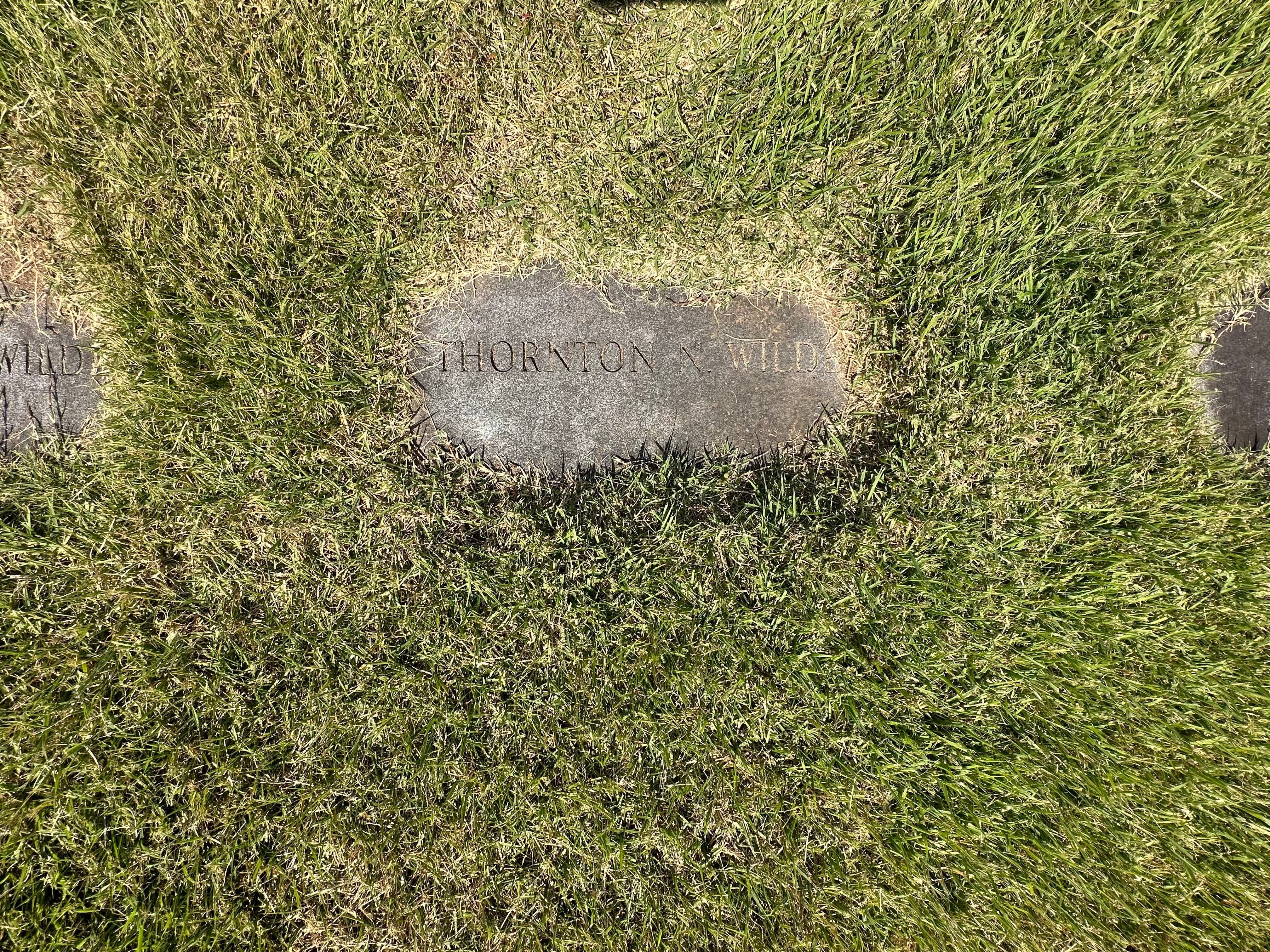
When I visited Wilder’s grave in Hamden’s Mount Carmel Burying Ground in September 2024, the grass had encroached on his headstone to the point of claiming the “r” in his surname. It said, “Thornton Wilde,” which I like to think was a cosmic nod to one of his literary forebears. In another fifty years, more letters may disappear. At some point, his name may be lost to the earth altogether.
But, as she has practically every day since January 22, 1938, Emily Webb will still revisit her twelfth birthday, wonder why it all had to go by so quickly, and implore those of us who are left to pause, look each other in the eye, and realize life as we’re living it. Today, she will do so at Vashon Island High School in Washington, The Group Rep in California, the Worcester County Light Opera Company in Massachusetts, and the College of Staten Island in New York. But 90 minutes or so before she does, a Stage Manager will first step forward, look at the audience, and say:
“This play is called Our Town. It was written by Thornton Wilder.”
For a fleeting moment, fifty years into his weaning away from Earth, everyone will recognize his name, and remember that eternal part of us, and of him.
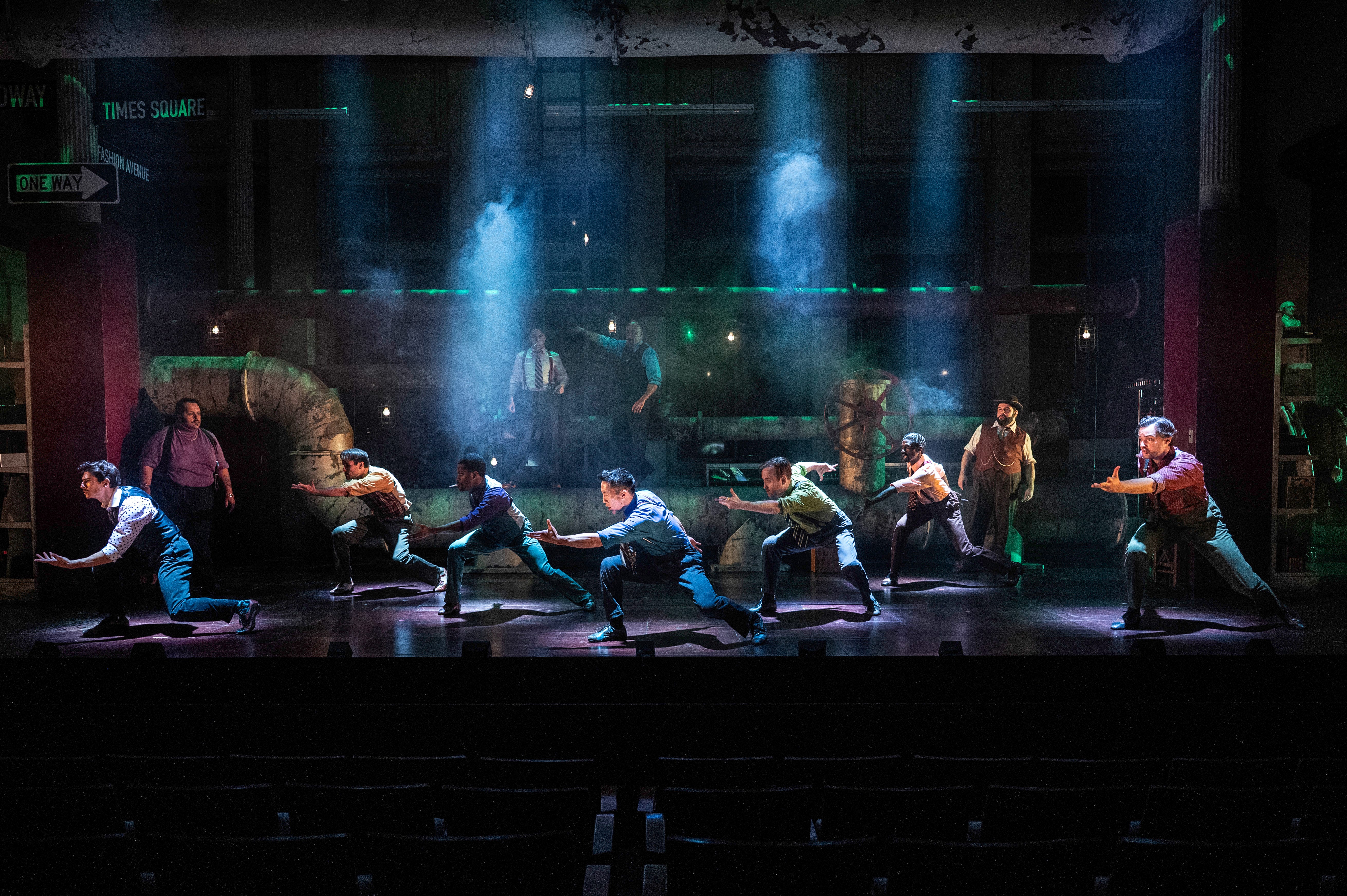
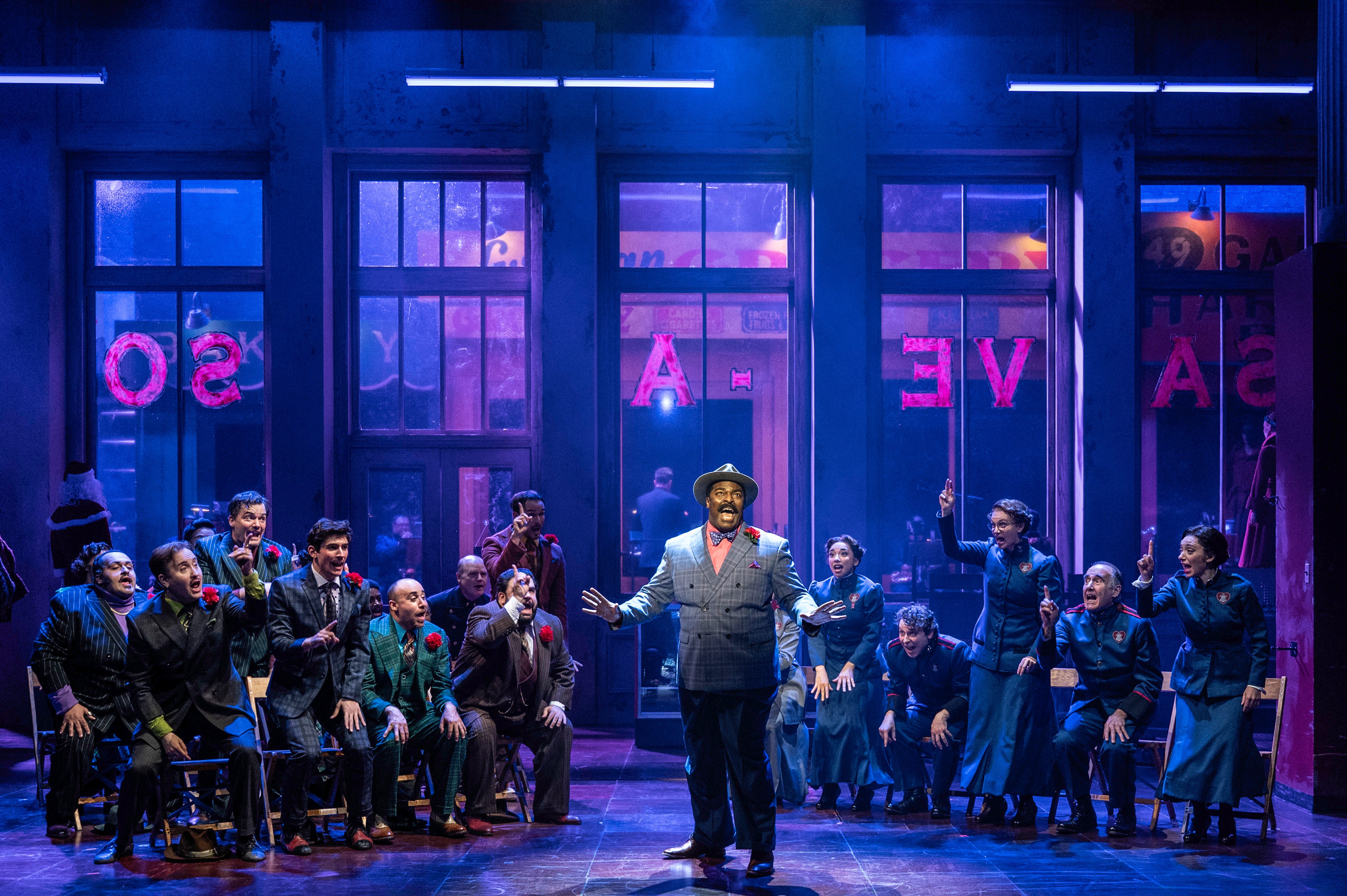
If descending into a sewer is half as fun as Shakespeare Theatre Company’s Guys & Dolls (extending through January 8) makes it out to be, spelunking may just end up on my list of New Year’s resolutions (it won’t). That subterranean journey, however brief, is one of several coups in director Francesca Zambello’s glorious, fresh staging of this much loved warhorse with a sterling book by Jo Swerling and Abe Burrows, and indomitable Frank Loesser score. She sets it in a Salvation Army-style thrift shop (set design by Walt Spangler), with racks of clothing and discarded goods lining the shelves (a bust of the Bard stares straight at the audience), and a Santa perched in the window. Guys and Dolls may seem like an untraditional choice for both STC and the holiday season, but it works magnificently here (another coup). Like Clara entering the world of the Nutcracker, the present quickly dissolves into Damon Runyon’s long-lost Times Square fantasyland, with the characters emerging from the racks. Mice and sugar plum fairies are swapped for gamblers and Hot Box girls. But there’s plenty of good cheer to go around, as well as festive reds and greens (Constance Hoffman’s costumes are sublime), and astonishing choreography (by Joshua Bergasse). The performances are strong throughout, but Hayley Podschun’s Adelaide and Julie Benko’s Sarah Brown are particularly wonderful. When Sarah has her first taste of alcohol on a day trip to Havana, Loesser gives us one of musical theater’s best songs, “If I Were a Bell.” More than any I’ve seen, Benko captures the bubbly unawareness of being tipsy for the first time, with endearing believability. That song is always buoyant, though often too sober, and she elevates it (coup coup coup). It’s a balm for the soul these cold, dark nights as much as any Andy Williams or Nat King Cole song, and though we’re only partway through the theatre season, STC is sending out 2025 with a bang. You’d be wise to see it.
When a work of live theatre is recorded and repackaged for broadcast, is it still the actor’s medium? In the case of Maria Friedman’s Merrily We Roll Along, a live capture of her 2023 Tony-winning Broadway revival that hit cinemas nationwide this week, the answer is no.
Based on George S. Kauffman’s play of the same name, Stephen Sondheim and George Furth’s musical Merrily follows three artist friends (composer Frank, playwright and lyricist Charley, and novelist Mary) across roughly thirty years of an ever-ebbing relationship. Beginning with one final falling out between a drunk Mary and Frank, who has sold out for Hollywood, the story is told in reverse, ending with their initial introduction, when they are bursting with hope. It flopped on Broadway in 1981 and, after decades of tinkering and trying, Friedman’s blowout revival is as good a treatment as the tricky show can expect. Ultra-chic and propulsive, Friedman’s staging moves easily across time. And though Sondheim’s score is uneven, the show’s best songs (“Our Time,” “Opening Doors,” and “Old Friends”) are euphoric.
Wide cinema releases of live shows (especially ones with tickets as expensive as Merrily’s were) are an achievement for access and should be encouraged. But they also show the limits of retooling a purpose-built product. Friedman’s film Merrily takes an approach much closer to that of Disney’s Hamilton than the PBS version of Sondheim and James Lapine’s Into the Woods. It is decidedly cinematic, the director imposing herself on her own staging with rapid cuts (often in time with the music) and extreme close-ups. The former feels like an overcompensation for more stationary solo turns like “Gussie’s Opening Number,” where the camera has little place to go. More than in the theatre, those numbers drag on screen.
The close-ups have their own winners and losers. Jonathan Groff, who won the Tony for his performance as Frank, is the champion here, and the shots work well for the character, who is corrupt from greed on our first introduction. Slowly, you see the life come back into Groff’s eyes as the show carries on, and though he’s well known for public weepiness, his place on the verge of tears is evident here in a way that was impossible to see from the back of Hudson Theatre balcony. He was stellar from back there, believe me, but he’s even better in this medium.
As Mary, Lindsay Mendez fares less well, at no fault of her own. Mary’s primary motivation is an unyielding, unrequited romantic devotion to Frank, and despite her professional success, she succumbs to alcoholism in her yearning. When she’s not trying to keep the friendship together, she’s trying to get Frank to notice her, and though Mendez plays sad well, in closeup the relentless sadness quickly turns melodramatic. Friedman seems to sense this in “Like It Was,” where Mary laments her warped memory of the past and all they’ve lost, employing various angles that inadvertently reveal another challenge with the form, where Daniel Radcliffe (who plays Charley) falls victim.
Theatre audiences enjoy wide views of the stage. A director is able to channel focus on various areas of the space through blocking and lighting, but ultimately audiences are free to allow their eyes to wander. They are flies on the wall, which is one of the best parts of the experience. Those secondary reactions are where subtext really flourishes and silent performers inform the world of the play. Friedman robs the audience of some of that joy by often leaving actors out of frame (especially Radcliffe, who has the smallest of the three principal roles), but in other cases tries frantically to capture others in quick succession (Reg Rogers, who is deeply expressive as producer Joe Josephson, is often featured in this style). The actors are at the mercy of the edit. The audience, unfortunately, is too.
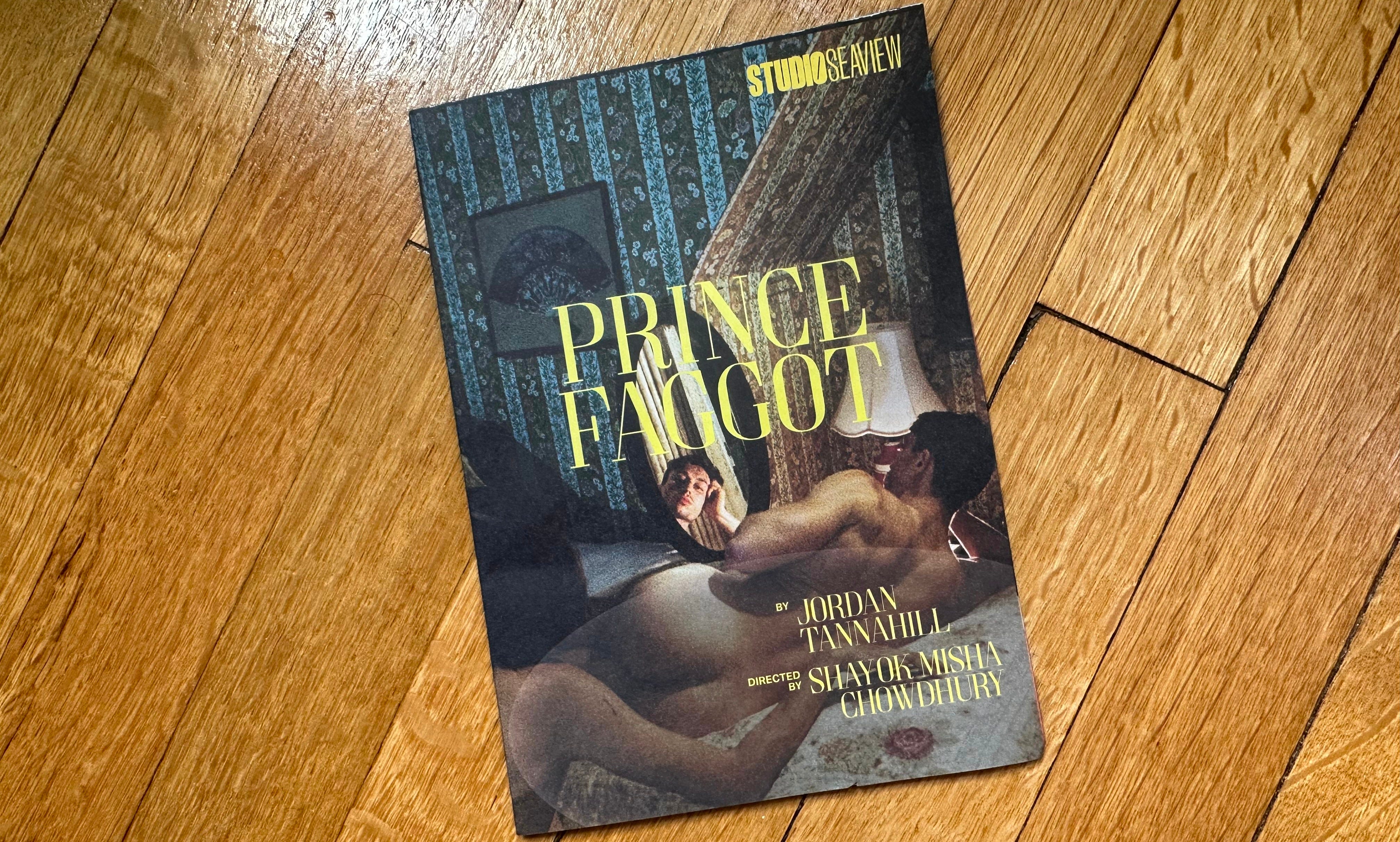
Earlier this week, Erik Piepenburg wrote about the proliferation of the f-slur in New York theatre for the Times. I don’t want to color his analysis and experience of the phenomenon, but it’s a great read and I put it forward here for you to read for yourself.
I wanted to love Hamnet. It has beautiful visuals! It has grief! It has Shakespeare! But let’s call Hamnet what it is: a vehicle, and with a less compelling actor than Jessie Buckley in the lead role of Agnes, the film would collapse. I understand the comment on people coping with their grief in different ways (ostensibly absent husband Shakespeare channels the grief from his son Hamnet’s death into writing his masterpiece, Hamlet), but there are too many uncanny elements in this veritable fan fiction to work. Agnes is clairvoyant and a little witchy. An 11-year old Hamnet makes a bargain with God (???) for his sister’s life to be spared. Agnes crashes a performance and the famously rowdy groundlings are somehow attuned to the Shakespeare family’s sadness. It might all have been more successful with a lighter touch, but the film is almost aggressively insistent on its own artfulness. Presumably, we should acknowledge its greatness because we are told this is greatness and it is connected to greatness. But it’s shamelessly slick. Shakespeare isn’t regarded as the greatest dramatist of the last half-century because we’ve all agreed to some social pact. The proof is in the pudding. The plays (for the most part…let me never see a Winter’s Tale again, I beg) sing and tell us something true and universal. Hamnet is striving for the same, but doesn’t reach it, and tries to get a leg up by glomming onto something much stronger. The effect is inadvertently diminishing.
No posts
Comments
Nothing yet. Say the first thing.
Sign in to join the conversation.