
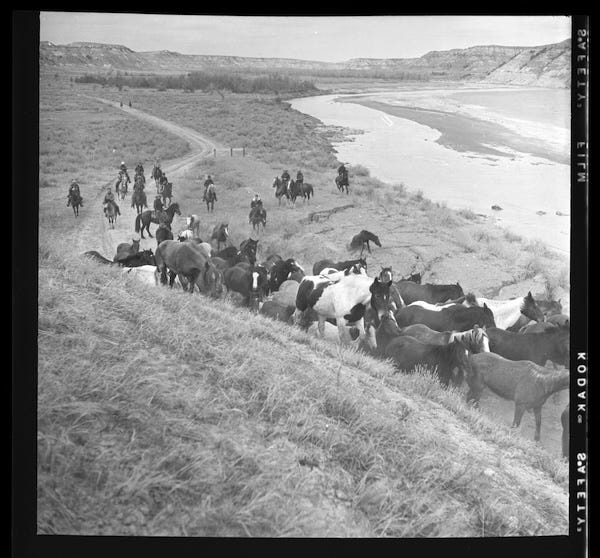
Local cowboys had already been tracking the bands and were familiar with their feeding areas and favorite haunts. Just as their open-range predecessors did, cowboys were divided into teams, each assigned to a zone, since horses bunched together in scattered bands led by a stallion, each sticking to its preferred territory. In another touch of authenticity, cowboys slept on the ground in bedrolls at night, camping in the same fashion as during open-range roundups.
“The park is bisected by the Little Missouri River and many of the small herds had to be driven across it to the corrals,” a reporter for The New York Times wrote. “This was accomplished with great splashings. Horses slipped and slid on the muddy banks and rocky bottom of the river.”
The mad pursuit of cowboys chasing horses had its moments of rough-and-tumble humor that provided material for ribbing around the campfire. Rancher Alvin Tescher, who had chased horses since boyhood, and his horse took a bad fall while galloping after a group of horses, rolling down an embankment. Louis Pelissier, gray, weathered, and sardonic, gave a droll eyewitness report. “Well, we saw him fall, and if he was dead, we couldn’t help him,” he told the Bismarck Tribune, “so we just chased the horses until they lost us and then came back and picked him up.” Tescher and his brothers were part of a group that swept an area of the park known as “wild horse country” between Jules Creek and Jones Creek and along Government Creek. Along with Pelissier, whose grandmother had known Theodore Roosevelt, another member of the group was Dean Armstrong, a rodeo star. Another light moment came when a white mare with an “almost identical” colt came running into the corral area, side by side. One rancher, Walter Coop, asked another, Walt Ray, “What is my colt doing with your brand on it?” Ray replied, “That isn’t your colt, it just happens to be running with your mare.”
Most of the captured horses were placed in the main corral at Peaceful Valley Ranch. Those taken from more southerly sections of the park were moved into a corral in Medora. When the roundup was complete, horses at Peaceful Valley Ranch were driven across the river and along U.S. Highway 10 to the Medora corral. During the roundup, some local ranchers reclaimed their stray horses. Between 125 and 150 horses — and a few mules — were gathered. Quite a few horses eluded capture. By one rancher’s estimate, 99 percent of the captured horses were branded stock, although opinions varied about how many of the captured horses were genuinely wild. One cowboy considered only four qualified as wild, while others held that any horse that had been running wild for several years was legitimately considered wild. “Many of the captured horses broke from the herd and disappeared back into the wildness of the park,” the Fargo Forum reported. “Most of the wild horses — horses born and running free in the park — evaded the cowboys, and probably will be left in the park as a wild herd.” The Bismarck Tribune reporter came to a similar conclusion: “There was talk that most of the wild ones were still in the park.”
Most of the horses that were caught belonged to local ranchers, including Barnhart and Alvin Tescher and his brothers, Tom and Jim, both rodeo champions. The most famous horse to be caught was a buckskin colt known later as “Whizz Bang,” that became one of the best-known bucking horses of the era. Barnhart sold him to Casey Tibbs, a World Champion saddle bronc rider from Fort Pierre, South Dakota, and friendly rival of the Teschers who traveled with him to Japan to give bucking exhibitions. Whizz Bang was the offspring of a branded buckskin mare and an unknown stallion.
Although the atmosphere of the roundup was celebratory, it came tinged with sadness. The roundup signified the end of an era. It was widely regarded as probably the last major old-style roundup reminiscent of those from the open range era ever to be conducted in North Dakota. Many of the riders had years of experience chasing wild horses; some of the old-timers died a few years later. The joint effort brought together park officials and local ranchers after the years of friction over trespass stock. The roundup was a pragmatic mix of old traditions and modern adaptation. One of the handful of female riders was Jo Rosseau, the Billings County superintendent of schools, who rode her favorite horse, Stormy Weather.
At the end of each of the first two days of the roundup, Jim Barnhart served a chuckwagon dinner to participants and reporters. On the night of the second day, a Saturday, a dance was held at the Medora Town Hall. On the last day, the captured horses were herded from the park several miles to the stockyards in Medora, where branded horses were sorted and returned to the owners. The “slicks,” or unbranded horses, were given to the men who caught them with only a handful deemed “truly wild horses.” Some of the horses were sold as rodeo stock, and two yearlings were given to Home on the Range, a therapeutic working ranch for boys near Sentinel Butte. One colt that was auctioned, re- donated to the March of Dimes and auctioned again raised more than $300 for the charity. Last-day festivities wound up with an impromptu bucking horse contest at the Medora Rodeo Grounds, where cowboys tested some of the spicier horses’ suitability as rodeo stock.
A few months after the roundup, in August of 1954, Ethel Roosevelt Derby, Theodore Roosevelt’s youngest daughter, visited the park, accompanied by her husband, two daughters, and four grandchildren. Her visit was the first from any member of the Theodore Roosevelt family to see Theodore Roosevelt National Memorial Park. Three days later, Antoine Vallombrosa, a grandson of the Marquis and Marquise de Morès, visited the park. Soon after, the family donated the chateau and packing plant site. They were the most prominent features of about thirty-nine acres transferred to state ownership. The chateau and “Chimney Park,” as the slaughterhouse ruins are called, today are sites on the western edge of Medora maintained by the State Historical Society of North Dakota.
By the time of the 1954 roundup, crews had installed all of the perimeter fence for the south unit of the park, except for a seventeen-mile stretch along the southern boundary, in preparation for reintroducing large native wildlife species. The fence paralleling U.S. Highway 10, later replaced by Interstate 94, was finished in November of 1956. The south unit was now ready to begin its wildlife restoration campaign. On December 14, 1956, trucks rolled into the park to deliver twenty-nine bison from Fort Niobrara National Wildlife Refuge in Nebraska: twelve adult cows, twelve yearling heifers, and five yearling bulls. They quickly adapted to their new home. Plans also were being made to reintroduce bighorn sheep, and elk, all native species.
But the wild horses that evaded capture and were fenced inside the park, mostly wily survivors that descended from generations of free-roaming range horses, were still considered trespass animals. After the fence was finished, park administrators stuck to their goal of eradicating all of the horses from the park — ironic, since the park was set aside to honor Theodore Roosevelt, who wrote about seeing wild horses all over the Badlands and even brought in some wild horses for use on his ranches.
After the roundup, the park superintendent told reporters he thought the remaining mustangs would “lend color for tourists visiting the park.” He did not mention, however, that the edict to evict any trespass horses remained in effect; wild horses, when caught, would be removed from the park until all were gone.
© Forum Communications Co.
Patrick Springer worked as a reporter for The Forum in Fargo for almost 40 years, specializing in stories about North Dakota's politics, culture and history. A graduate of South Dakota State University, he holds a master's degree in creative nonfiction writing from Emerson College in Boston.
Comments
Nothing yet. Say the first thing.
Sign in to join the conversation.