
Hello and welcome back to The Student Eye, a publication for university students and those interested in higher education across the UK.
This week, we bring you a scoop about Oxford’s Vice-Chancellor travelling to Peking to accept an honorary degree. The move comes at a time of increased scrutiny on China’s influence in UK higher education and has not been reported by any other UK media outlets.
We hope you enjoy this week’s edition of The Student Eye, and please share with anyone who may be interested!
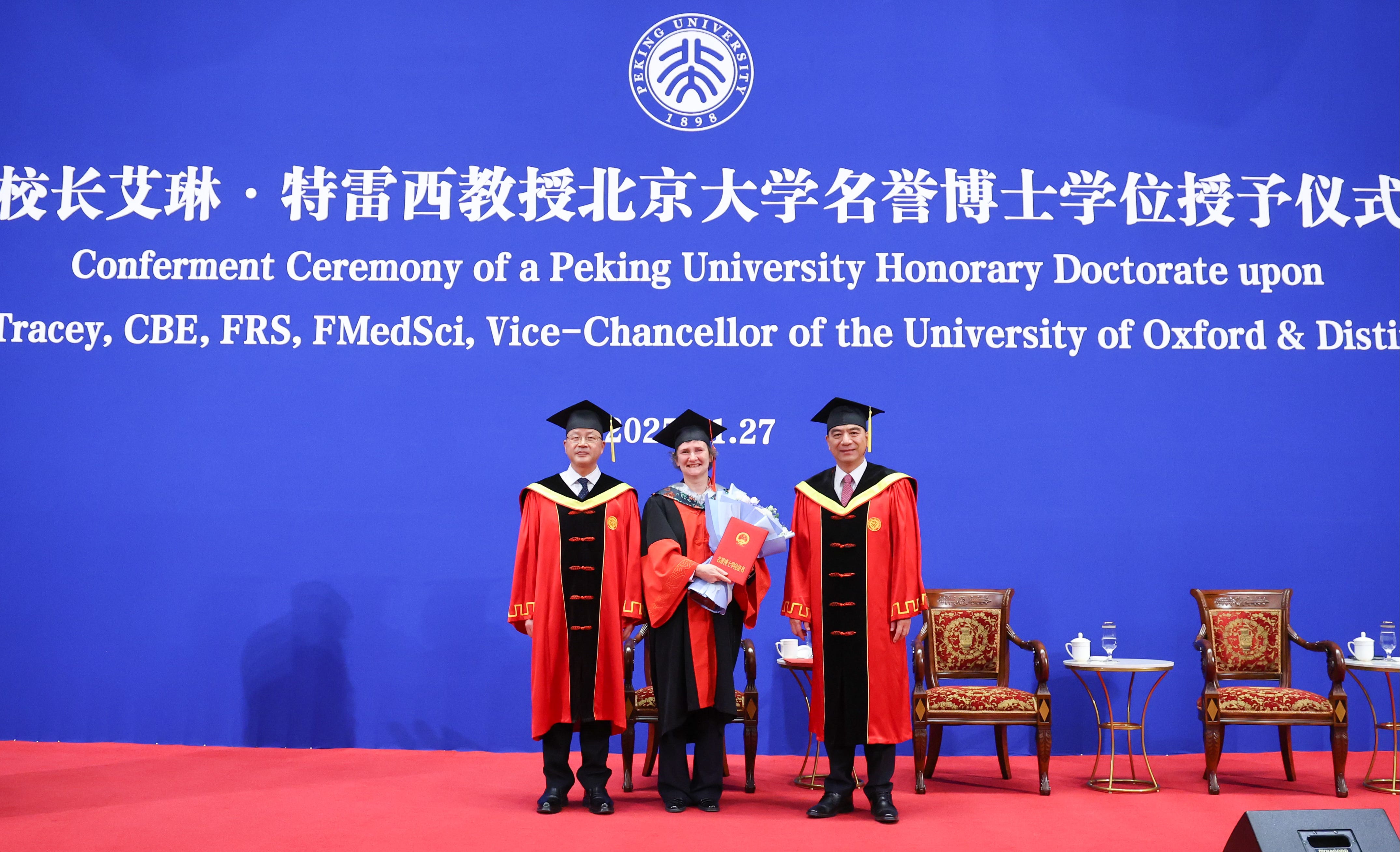
Oxford University’s Vice-Chancellor, Irene Tracey, has accepted an honorary degree from a Chinese Communist Party (CCP) backed university.
Chair of Peking University Council, He Guancai, conferred the degree to Oxford’s vice-chancellor last week. Guancai was previously a member of the Central Committee of the CCP for “publicity, ideological and cultural work” and served as Vice Minister for Education. His role at Peking University is directly approved by the central CCP.
Conferring the degree, Guncai referred to Tracey’s aspiration to “deepen strategic ties between the two institutions”.
Tracey also announced that the Oxford Institute of Population Ageing and the Peking Institute of Population Research have extended their partnership for an additional three years, to 2029.
A spokesperson for Oxford University told The Student Eye that the degree was conferred “in recognition of Professor Irene Tracey’s outstanding academic achievements in the field of international neuroscience”, rather than in her capacity as VC.
At the time of publication, neither Oxford University nor Irene Tracey have publicised information about the event. Unlike her honorary titles at numerous other institutions, it is not listed on the University’s official website.
Oxford has a number of Chinese partnerships, including the Oxford Suzhou Centre for Advanced Research in eastern China, The Chinese Academy of Medical Sciences Oxford Institute in Oxford, and The University of Oxford China Centre. Oxford’s Saïd Business School also has a history of collaboration with Guanghua School of Management, at Peking University.
The University attracts significant funding from China through Oxford Science Enterprises (OSE), the investment fund that commercialises University research, with Huawei holding shares in the fund.
Huawei’s investment came shortly before Oxford publicly cut ties with the company, saying it would not accept any more research funding or philanthropy from them. While the University is not officially affiliated with OSE, it was set up to fund Oxford research and directly partners with scientists from the University to spin out research.
“Unlike her honorary titles at numerous other institutions, it is not listed on the University’s official website.”
The Financial Times has reported that Huawei’s stake in OSE gives it access to the portfolio of companies, which include companies in AI, computation, energy, defence, and health. A spokesperson for OSE told The Student Eye that the Chinese tech-giant holds a stake of less than 1%, and “receives only the basic information provided to investors.”
Sir Ken McCallum, director-general of MI5, briefed vice-chancellors last year that hostile states were targeting British research to boost their military efforts and undermine the UK’s national security.
Tom Tugendhat, former security minister, told The Sunday Times that “UK institutions have now been warned frequently by both this government and those before to be aware of the reality of working with CCP institutions… They have been warned that the UK is vulnerable and they have responsibilities to the taxpayers who fund the research.”
Tugendhat said he met with vice-chancellors who “demonstrated remarkable naivety as to their partnerships and complained that government security requirements interrupted their financial support.”
A spokesperson for Oxford University told The Student Eye: “We take the security of our academic work seriously, and work closely with the appropriate Government bodies and legislation. Much of our overseas collaborative research addresses global challenges… where international involvement is important in delivering globally relevant solutions.”
Last month, The Guardian revealed that Sheffield Hallam University had complied with demands from Beijing to halt research into human rights abuses in China. Laura Murphy, the academic leading the research, claims that Sheffield Hallam were “explicitly trading [her] academic freedom for access to the Chinese student market,” though the University denies that the decision was taken to protect its commercial interests.
By Oliver Hall
UK Erasmus deal: Negotiations are ongoing between the UK government and the European Union (EU) over participation in the student exchange scheme ERASMUS+. The i reported on Wednesday that there was increased optimism on both sides and that some expected a deal to be reached soon. That would likely allow UK students to participate again from January 2027. Since the end of the Brexit transition period in 2020, Britain has run the Turing Scheme, which gives students varying amounts of money for their studies abroad. You can read about its shortcomings here.
Fossil fuel industry banned from job fairs: Eighteen universities now ban fossil fuel companies from attending campus job fairs or internal advertising, according to reporting by the Guardian. Eight more have signed a pact this year on the People and Planet league table. Manchester Metropolitan University ranked first and Ravensbourne was judged to be the least sustainable.
International postgraduate decline: Data from the British Universities International Liaison Association (BUILA) suggests fewer people are applying for UK postgraduate degree courses from abroad. Sixty-one percent of the universities they surveyed reported a decrease from last year and overall enrollment is down six percent. Postgraduates are vital to the economic survival of many universities and made up 71% of full-time postgraduate enrollment in 2023-24.
Vice-chancellors’ Reform fears: Varsity and The Sunday Times obtained audio recordings of a Cambridge University Council meeting in which vice chancellor Deborah Prentice said Russel Group leaders had begun discussions with Reform UK. In the recording, she says that the party have made clear that“any consultations are happening now”. She also spoke to fears of ‘Trump-style’ funding cuts for higher education institutions.
“Cash for confidentiality” at LSE: One LSE student was offered £200 cash if they promised not to speak out when they refused to remark their dissertation. The Beaver published a piece on Thursday that details the situation, which took place in 2023. It is another example of universities using so-called ‘non-disclosure agreements’ before they were outlawed in the Higher Education Freedom of Speech Act, which took effect this August.
Comments
Nothing yet. Say the first thing.
Sign in to join the conversation.