
Hello and welcome back to The Student Eye, a publication for university students and those interested in higher education across the UK.
This week, we bring you analysis of student disability registrations at UK universities. We are also the first UK publication to report on the Durham Vice-Chancellor’s tour of Chinese universities - scroll down to our round-up for that.
We hope you enjoy this week’s edition of The Student Eye, and please share with anyone who may be interested!
Subscribe now to get us in your inbox every week!
By Oliver Hall
Last month, findings about the number of students claiming disability accommodations caused consternation in the United States. There, up to 40% of students are now registered as having a disability of some kind.
Whilst the picture in the UK is less dramatic, Equality, Diversity, and Inclusion reports from leading universities reveal a similar trend.
Faced with a hyper-competitive job market, students are increasingly exercising their rights to disability-based accommodations. Meanwhile, providers are making it easier than ever to receive dispensations.
The data in government-mandated reports point not just to a reduced stigma, but a radically new landscape.
EDI reports confirm an upward trajectory in disability declarations among students at top-tier UK universities, mirroring American trends. At the University of Oxford, the proportion of UK-domiciled admitted undergraduates declaring a disability doubled from 9.5% in 2019 to 19.0% in 2023.
“The types of disabilities being declared have also shifted towards cognitive and environmental accommodations”
Similarly, the University of Cambridge reported that 19.3% of its undergraduate student body declared a disability in 2023-24. King’s College London reported a student disability disclosure rate of 15%.
The types of disabilities being declared have also shifted towards cognitive and environmental accommodations. At the University of Manchester, Specific Learning Difficulties (SpLDs, such as dyslexia or ADHD) account for 31.4% of declared disabilities, while mental health conditions account for 27.8%.
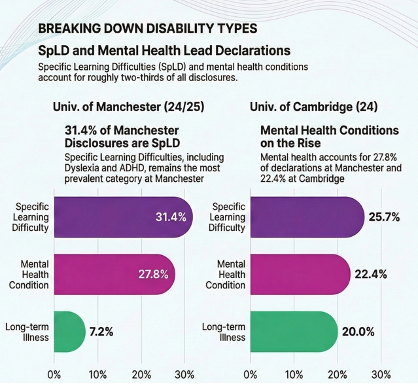
Oxford’s data echoes this, showing that SpLDs and mental health conditions are the overwhelmingly dominant categories of disability among its applicants.
The goalposts are also moving for what might count as a disability, the accommodations offered, and how students obtain them. The University of Cambridge told The Student Eye that they have “changed” processes “in the last two years to make it easier for students to request exam allowances”.
That has, in part, led to the 9% annual increase in “number of students with a registered disability” in the last year of available figures.
In that vein, students increasingly ask for support and universities have adapted their structures accordingly. Historically, securing accommodations like extra time in exams might have required navigating a labyrinth of paperwork. The increased volume of requests has prompted changes.
Much like the University of Cambridge, the University of Southampton has implemented a “Special Consideration project for supportive student measures”, explicitly designed to streamline support.
At Oxford, the Disability Advisory Service (DAS) remains in high demand, registering more than 25% of the student population.
“Some universities are focusing on universal design to reduce the need for individual accommodations altogether”
To help cope with this, Oxford implemented a new Student Support Plan (SSP) model in 2023-24, where an inclusion statement is issued as soon as evidence is verified, setting out “inclusive practices and reasonable adjustments recommended as standard”.
Other universities are focusing on universal design to reduce the need for individual accommodations altogether. The University of Bristol’s new Temple Quarter Enterprise Campus is being built with “neurodiversity-aware colours/internal design” and “low distraction student study rooms”.
Bristol’s Centre for Teaching and Learning is also actively working with departments to “redesign summative assessments, resulting in more diverse assessments”. That is a move that directly aligns with a more skills-based approach to evaluating student capability and reduces reliance on high-pressure, timed exams.
This is exceptionally difficult ground to navigate for universities. They are forced to balance fairness with those seeking to gain advantages. Without them, disabled students are less likely to do well. Equally, those with accommodations often outperform those without them.
At the University of Cambridge, 27.1% of students with no declared disability achieved first-class examination results in 2023-24, compared to 23.3% of students with a declared disability.
In a hyper-competitive job market, that gap represents a significant advantage for students in the next stage of their lives. The University of Oxford is actively tracking similar metrics, aiming to eliminate the gap in attainment rates for disabled students achieving ‘good degree’ outcomes, which currently sits at 2.7%.
The narrative of this debate is often framed as a controversial generational phenomenon. It is understandably difficult for some to grasp the dramatic increase in students with a registered disability.
“Those with accommodations often outperform those without them.”
This generation, however, is also one that was most disrupted by the COVID-19 pandemic and whose early childhoods were shaped by social media. It is unsurprising that, as a body, they have different cognitive challenges.
This generation of students is evidently aware of their cognitive profiles and mental health needs, navigating an educational system that is still catching up.
Alongside that, they enter a competitive job market where employers demand diverse skill sets and still filter candidates by degree classifications. Students are, naturally, utilising every available tool at their disposal to maximise their academic outcomes.
As always, The Student Eye reached out for comment to all of the universities mentioned in this piece with a series of clarifying questions. Only the University of Cambridge responded.
By Oliver Hall
Durham VC’s unpublicised China visit: Karen O’Brien, Vice Chancellor of Durham University, has been on a tour of China this month. According to one publication, she visited Wuhan University and “expressed hope for closer education cooperation” between the UK and China. Wuhan University is a public university and, therefore, heavily controlled by the Chinese Communist Party (CCP).
A delegation from Wuhan visited Durham in December in a meeting planned to “strengthen the relationship between [the] institutions”. According to PKU News, O’Brien also visited Peking University with a delegation “in an effort to expand cooperation between the two institutions”.
The visits have not been publicised by Durham, other than an alumni event in Wuhan last week. Wuhan University posted about the trip on Instagram.
This all comes after increased scrutiny of the security risks of Chinese relations in recent years. Oxford’s Vice Chancellor, Irene Tracey, visited Peking University late last year to receive an honorary degree.
Visa “brakes” come into effect: Visa restrictions announced at the start of the month will come into effect on Wednesday. No more study visas will be issued to applicants from Afghanistan, Cameroon, Myanmar or Sudan. Home Secretary Shabana Mahmood stated the measure is intended to prevent the "exploitation" of legal routes. Critics say it will harm the UK’s international reputation. Read more here.
Kent meningitis crisis: The University of Kent was the epicentre of a meningitis B outbreak earlier this week. Two students died, one from the university, and more than 27 cases were reported. Students were subsequently offered vaccines, but some were initially turned away due to high demand.
Science research funding drain: Dr Simon Williams took to The Guardian this week to criticise underinvestment. He warned that the government risked wasting quantum computing talent, writing, “Ambition in quantum is welcome, but it cannot succeed without sustained investment in people and fundamental science. If the UK wants to lead in the technologies of the future, it must also protect the research base that makes them possible.”
EU tuition fee debate: The Financial Times reported that students from the European Union studying in Britain could have their fees reduced under a “post-Brexit reset” proposal. Student numbers from European countries have dramatically reduced since Brexit but a UK official told the paper that a “big offer” would be needed from Brussels.
Europe’s Silicon Valley? Rachel Reeves used a set-piece speech in the City this week to set out her plans for regional devolution. She also took the opportunity to namecheck the “OxCam Arc”, which we have covered extensively in the past. Oxford Vice-Chancellor Irene Tracey will be pleased to hear that the Chancellor still believes it can be “Europe’s answer to Silicon Valley”.
Comments
Nothing yet. Say the first thing.
Sign in to join the conversation.