
This was supposed to form part of a long essay, but it didn’t get published in the end, and the timing of it has now passed, so I’m going to post fragments of it on here.
There are new demands and desires for land beginning to flourish on these islands. The likes of Guy Shrubsole and Andy Wightman highlighted the unequal ownership of land in England and Scotland respectively, the BPOC collective Land in Our Names has highlighted the colonial racialisation of agrarian space, the Right to Roam campaign brings attention to unequal recreational access to land, in Scotland community land reforms were passed, in Ireland a new land observatory research centre is in development, and a growing British land justice movement gathers yearly. Earlier this year there was the 20 year follow up to the first International Conference on Agrarian Reform and Rural Development (ICARRD) which was held in São Paulo in 2006.
Demands for land reform are emerging across the globe — but lacking the size and scope of the armed revolutionary movement for decolonisation of the mid 20th century, and the spectre of the Soviet Union, it means we are beginning in a weaker place. Land reform has mostly taken the place of land back. But not everywhere.
The Movimento dos Trabalhadores Rurais Sem Terra (MST), in Brazil, is one counter example. A mass movement of landless, rural workers they have been taking back land from large estates, the latifundios, that are a colonial legacy across Latin America. To do this MST is exploiting a law that came into Brazilian legislature, after the downfall of the military dictatorship of the 60s/70s, which states that land must serve a social good, and if not, you have the right to squat. It began in 1984 and has surpassed more than 2500 land occupations, with 370,000 families settled on more than 7.5 million hectares (3x the size of Wales). Currently, there are more than 900 encampments holding 150,000 families. With the land they grow food for local populations, not export, they construct schools and villages, and they engage in Marxist popular political education. Ideologically they draw upon the history of revolutionary Latin American Marxism, liberation theology, and a history of peasant struggles. We can’t copy and paste MST but we can use the example to educate our desire and expand our sense of agrarian struggles.
In case you’re thinking direct land occupations are only a strategy in a colonial context, let’s look closer to home at two examples in Europe. Firstly, there is the example of El Humoso in Marinaleda, in Andalucía, Spain. The village itself isn’t totally unknown thanks to the book by Dan Hancox, The Village Against the World. One of their achievements is the occupation of 1200 hectares of land on the outskirts of the village. They seized the land in 1992 after a long struggle. The land had belonged to the Duke of Infantado, a royal title that dates to the 15th century. As Hancox recounts in his book:
‘The people of Marinaleda formed a political party and a trade union, and began fighting for land and freedom. There followed a decade of unceasing struggle, in which they occupied airports, train stations, government buildings, farms and palaces; went on hunger strike, blocked roads, marched, picketed, went on hunger strike again; were beaten, arrested and tried countless times for their pains.’
Eventually, the government, partly trying to look good for the 1992 olympics in Seville, acquiesced and gave them the land. They set up a cooperative farm where everyone is paid the same hourly wage, whether they are seasonal workers from the village or those who run and live on the farm.
The second instructive European example can be found at the 170 hectare cooperative farm, Mondeggi Bene Comune, near Florence, in Italy. They go by the slogan of la fattoria senza padroni, the farm without bosses. Their land occupation dates back a decade and involved around 300 people. Taking advantage of a dilapidated Medici villa left languishing outside the town of Grassina in Tuscany. This farm was once run as an agricultural college in the mid 20th century, ironically, showcasing the supposed benefits of the so-called green revolution, which had been abandoned and fallen into disrepair. They squatted it and immediately got the local community involved, which assured local support. As a result, the municipal authorities tried and failed to evict them. Their position still isn’t assured but they are currently going through a process of legalisation. With the land they have vast olive orchards, vines and land for grazing, growing cereals and fruit and vegetables. There are a collection of villas where people live and manage the commune. The orchards are managed with the local community who have a form of ownership over the orchards and are involved in managing their own plots. When I visited last October it was olive harvest day and there were around 100 people congregated to celebrate a day of harvesting together.
Contrast this Italian experience with that of an attempt at establishing a community farm local to me in Pembrokeshire, Wales. The local council was flogging one of their farms and a local community group pulled together a workable plan for a community farm, including tabling a sizeable bid at the public auction. Instead of accepting this, Pembrokeshire County Council went with a slightly higher bid from a farming family in Gloucester. Looking back, I wonder if in this circumstance a farm occupation, backed by locals, would’ve twisted the arm of the council? Is our reliance on market norms impeding our ability to contest bourgeois property?
What if land occupations became a focus of the stalled climate movement? What if the stirrings of an anti-land grabbing protest movement in Scotland, being organised by the Landworkers’ Alliance, started to take back land from the aristocracy, both of the old and new varieties? In Wales we have the ‘Nid yw Cymru ar Werth’ (Wales is Not for Sale) campaign, which is currently focused (and to me seems to have largely stalled) on housing and Welsh language rights, but I see no reason why this campaign cannot expand, to embrace anti-land grabbing, whilst folding that into a demand for housing.
What the movement for agroecology and food sovereignty offers ecosocialism is already-existing struggles over rural land — the very basis for all struggles against capital and climate breakdown. A basis for re-imagining socio-ecological relations. What ecosocialism can offer agroecology and food sovereignty is a politics that allows small-and local-scale struggles to be connected to a wider class struggle. It helps to break through an often uncritical acceptance of private property, which can open space for a much wider and more emancipatory array of land-relations. And more than anything, it points beyond ethical consumerism as a primary means of effecting change, to approaches that recognise the futility of seeking change via the market, ultimately broadening the horizon of possibility from a sometimes stagnant reformism to that of potentially revolutionary change.
Occupations contest bourgeois law. The question isn’t if people will eventually break bourgeois law, but when. As Sam Kelly highlights in his piece for New Socialist, about the struggle to resist #CopCity in Atlanta, USA, more and more people are becoming willing to break the law in order to fight for a liveable future. That said, it’s important to note that any move towards land occupations would likely elicit a heavy response from the state, property owners and their enforcers, the police. Choosing the right site of battle and the right strategy will be crucial. On the other hand, clashes with an increasingly authoritarian state, seem unavoidable in this conjuncture.
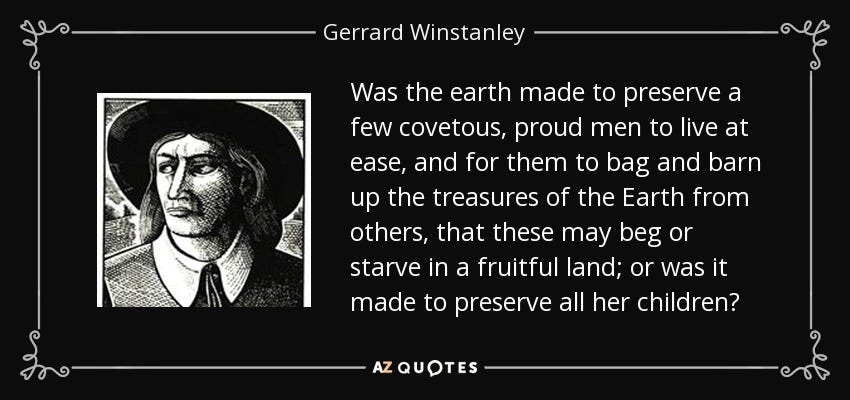
The future of agroecology lies in abolitionism and ecosocialism, not in the defence and reification of the law of bourgeois property. The 17th century Diggers may have ultimately fought a losing battle, but they sought to show that the law was not serving the mass of people. They showed a vision for a society in common built from the desires of the poorest who do the back-breaking work that capital accumulation depends upon.
Which land? This is a question for movements to consider and is contextually dependent. As with the examples above with El Humoso and Mondeggi Bene Commune – there is a strategic opportunism that is necessary. I think the council farm in Pembrokeshire, mentioned above, would’ve made an interesting opportunity. The important consideration for me at least is to put the land question back on the table and not to shy away from contesting the current legal settlement. Private property as a regime was forged through violent dispossession – but it can also be unforged through radical action – by repossession.
No posts
Comments
Nothing yet. Say the first thing.
Sign in to join the conversation.