
Official government statistics will tell you that the UK imports roughly 40% of its food. This is an estimate, as the true figure isn’t actually fully known, as they don’t fully take into account all exports and imports. But even then is this figure really accurate? What is meant by self-sufficiency?
It’s usually taken at face value but this figure obscures some very important realities. If the protein comes from imported feed can we really claim the food is domestically produced? What about the diesel, the fertilisers, the tools, the packaging etc.? The very idea of national food self-sufficiency is a myth.
For ease, I’m going to focus on pig and poultry production. In 2023 the UK’s production to supply ratio for poultry meat was approximately 82% and 87% for eggs. For pork it was around 64%. These figures don’t state how much of the poultry and pork consumed in the UK was produced here but gives a kind of hypothetical possibility. In reality we export and import poultry and pork for a variety of reasons. For example, the idea of ‘balancing the carcase’, whereby we export the cuts we don’t consume so much, like brown chicken meat, and import the cuts we consume more of, like the breasts. Other reasons might be things like speciality products (think of prosciutto or salami) and ready meals.
Looking at animal feed, the UK imported just over 1,000,000 tonnes of soya in 2024-25. Predominantly soya comes from the Americas. It is associated with earth-shattering levels of environmental degradation and genocide of Indigenous peoples. It contributes to a major global metabolic rift in nitrogen whereby soils in the Americas are depleted of nitrogen and an accumulation of excess nitrogen in places like the UK where it ends up polluting watercourses like the River Wye.
How can the idea of ‘self-sufficiency’ have much valence if it can ignore the feed that is shipped across the world. I haven’t done the maths to work it out (maybe another day) but I’m pretty sure the UK drops below 50% self-sufficiency once you factor this in.
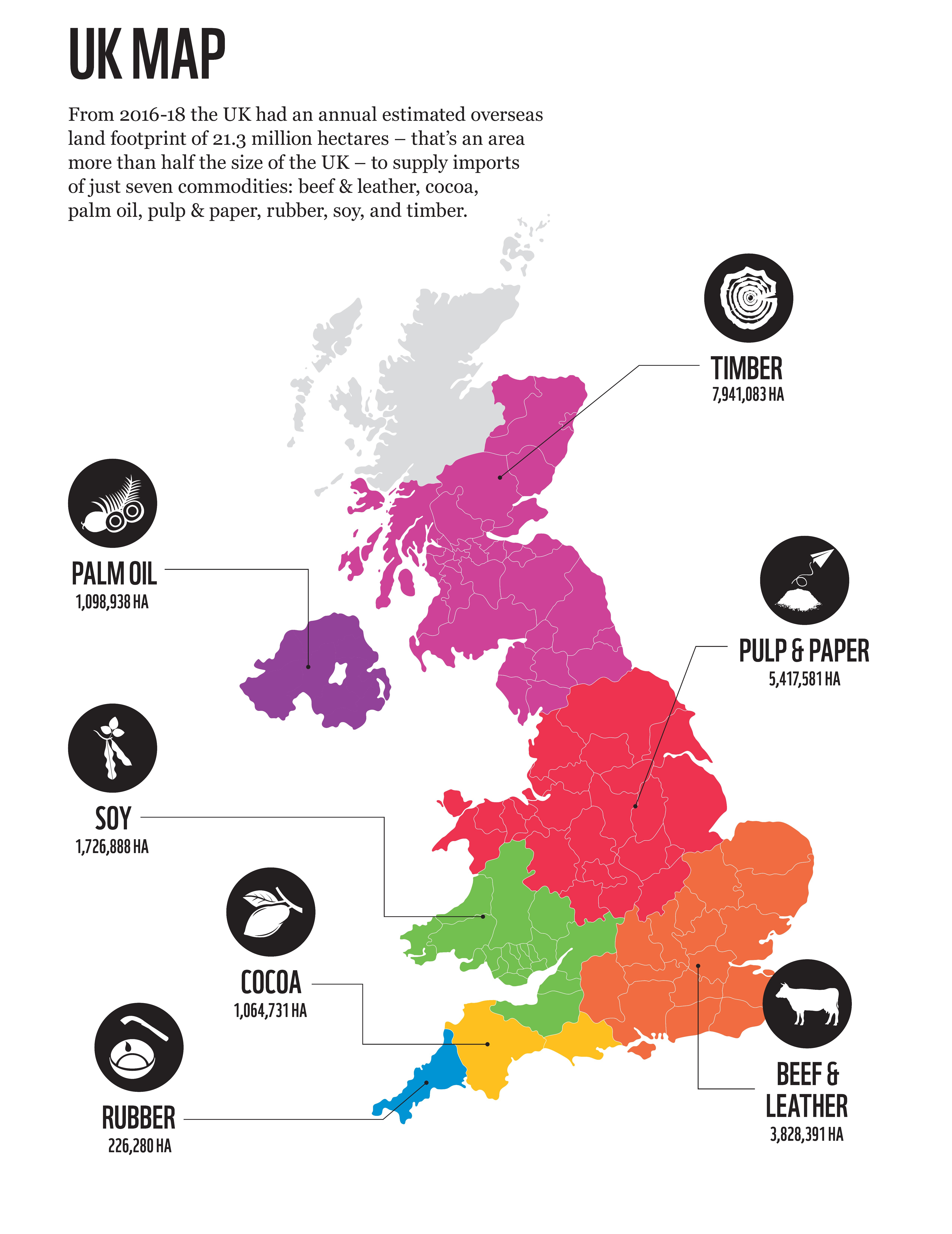
There are some farmers out there raising pigs and chickens without soya-based feeds. You can speak to local mills to get them to put together a blend for you which I assume uses field beans as protein. My understanding is that modern breeds do much better with soya due to its complete amino acid profile (and high levels of lysine) but that doesn’t mean you can’t use alternative protein sources. There are a handful of farms doing soya-free these days and we gave it a go ourselves with our pigs and chickens in the past but yields do drop.
And all of this is before you get onto the source of fertilisers, gas, diesel, materials etc. that all farms (including agroecological) are also reliant on to at least some extent. Where does the energy come from that powers the vehicles that ferries produce (and punters) to local markets? Where does the wealth come from that allows a very small fraction of the population to participate in purchasing expensive local products? What about the material origins of the packaging?
The British food sovereignty world has recently tried to argue in favour of ideas like food security as a form of national security. I’m guessing the idea is to sneak a version of food sovereignty in through the back door. I’ve written a little before about why I think this is an error of judgement. I think it is our job in the world of food sovereignty to articulate a vision that doesn’t neatly dovetail with nationalistic discourse that feeds a world built on borders and bombs. It is our job to articulate an alternative vision and strategy that rejects nationalism.
Following on, can a concept of self-sufficiency ever make sense in a globalised world? To some that means we should somehow reverse processes of globalisation – an idea now dominated by the far right – but surely at a time of global climate breakdown, murderous borders, US concentration camps, and imperialist wars, we need to hold onto ideas of internationalism? Localism has always been a myth. A false oasis that never has and never can exist in reality. The only world in which localism can actually manifest in any sense is one in which disaster feudalism has taken over. Perhaps there is a need to once and for all see localism as a regressive idea.
British food production needs to rely less on importing feed and fuel from across the globe not because of the myth of localism but because of the destruction it causes elsewhere. To argue and strategise for this does not, and must not, require utilising the language of national security. The UK causes insecurity all over but especially right now in besieged places like Iran and Palestine. We don’t get to claim national security. The British nation is a source of global insecurity. British anti-imperialism cannot be about defending the nation, it has to be about undermining its power on the world stage.
Food sovereignty has to be about internationalism but I think this word itself taken superficially causes confusion because it’s imagined as cooperation between nations1 – whereas in places like the imperialist core we need to be thinking about cooperation between populations who are cut off and oppressed by national borders and militaries2. We don’t need to focus on the idea of strengthening the nation – we can focus on people, especially those who are at the sharpest end – the workers and the oppressed. If we want to mention security at all it should be focused on a strategy to end food insecurity, which in the UK is 1 in 6 households, and globally 1 in 12 people go to bed hungry.
As Kai Heron has argued in a paper on Capitalist Catastrophism and Eco-Apartheid:
Global apartheid, in other words, is a means of creating the conditions to sustain an imperialist structure of capital accumulation at a world scale… Eco-apartheid is the accumulation strategy proper to capitalist catastrophism. In order to act on their promise to protect at least some of the imperial core’s population from the worst — without of course changing anything essential about capitalist and colonial relations of power — imperial states distribute social and ecological harms to their internal and external peripheries. The cancellation of the future for the world’s working class and racialized majority, the putting in harm’s way of the oppressed, is at the same time the building of a future for the minority.
When the food sovereignty movement tries to superficially/opportunistically tap into discourses of food security, national security and national resilience it ends up (unwittingly) lending support to the structures of global eco-apartheid which are maintained by military power. In fact, I think it (unintentionally) helps to strengthen nationalistic, fascistic and imperialistic responses at a time when we must be opposing them with everything we have. Our job is to work to reverse the distribution of social and ecological harms to the racialised majority. Appeals to the nation aren’t going to do that. Even if what we have in mind is something radically different. Improving food production in this part of the world needs to be done because food production pretty much everywhere needs improvement.
The local very easily slides into the national – because they are structured by a lot of the same logics. Neither the nation – nor the local – provides a shortcut to food sovereignty3. They’re obstructing mystifications steeped in reactionary mythology. The days of think global, act local, are gone. Too often it functioned as an excuse for turning away from the global or other localities: an escape fantasy. A new guiding philosophy is required at a time of global breakdown and global eco-apartheid.
This idea itself is fuelled by a poor reading of neoliberalism, quite prevalent in food sovereignty, that sees neoliberalism as the triumph of global capital over nation-states, rather than seeing the global power dynamics within an imperialist world system which requires an interplay between the national and the global. The UK – including the British state – is a central node in that system of global capital. The mistake made is to imagine that all nation states are equally subordinated – and to miss that some nation states are the ones doing the subordination on behalf of the global capitalist class. A global class that very much resides in certain key locations like the UK and the US, and its satellite of tax havens like Dubai.
Or to put it more concretely and polemically, Palestinian national liberation or the defence of the Cuban revolution are inherently anti-imperialist, whereas Welsh or Scottish independence movements are fundamentally bourgeois projects. Their differential position within the world system matters greatly as does their political aims and movement composition. (Btw, I’m not saying they cannot be progressive – but they are mildly reformist projects that entirely miss the conjuncture we’re now in and are ultimately oriented towards a Europeanism that I fail to see as anything but imperialist.)
A project that was always rooted in popular sovereignty – the sovereignty of workers, the oppressed – not national sovereignty, outside of those places in the world where national sovereignty was inherently anti-colonial and anti-imperialist as mentioned above. These confusions are now leading to problematic symptoms like conflating food security and food sovereignty and even national security.
No posts
Comments
Nothing yet. Say the first thing.
Sign in to join the conversation.