
(1) Faster than a speeding bullet…
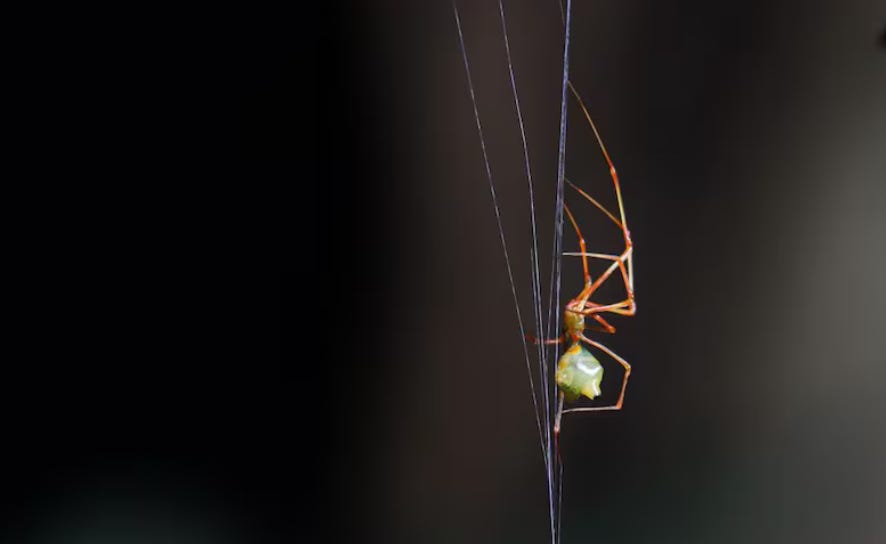
Actually, 100x that of a Formula One racecar. That’s the speed with which an interesting species of spider in Australia (where else?), Propostira, ensnares its favourite ant prey, an inspiration to engineers everywhere.
Researchers from Australia and Germany recently published evidence of this predatory strategy, inferring its development as the result of the necessity of isolating individual ants from the supportingly aggressive other tribe members.
“Predator–prey interactions are a major selective force shaping kinematic performance, driving the evolution of extreme speed and power in animal movements1. Small animals such as mantis shrimps, trap-jaw ants and slingshot spiders achieve some of the fastest biological movements to capture prey by using latch-mediated spring actuation mechanisms that produce power outputs several orders of magnitude greater than muscle alone2,3,4. These known power-amplified systems are actively controlled by the predator and act on non-specific prey. Here, we report a unique spring-actuated snare in the Australian ballista spider Propostira sp. that is selectively triggered by the defensive behavior of a specific prey — the green tree ant, Oecophylla smaragdina. We argue that the prey specialization of the ballista spider has driven the evolution of exceptional snare performance.”*
* Narendra A, et al., Ballistic high-powered spider webs overcome dangerous prey defenses, Current Biology, 36, R691-R692 (June 22 2026); https://www.cell.com/current-biology/fulltext/S0960-9822(26)00570-1
Comments
Nothing yet. Say the first thing.
Sign in to join the conversation.