
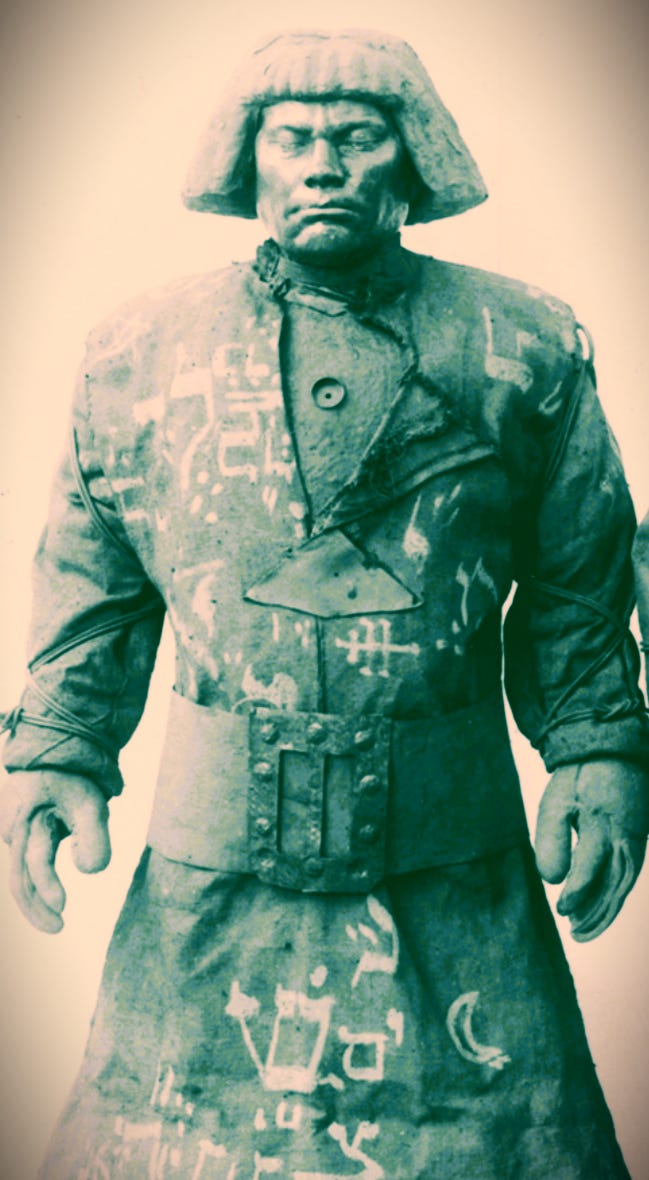
Joschka, gatekeeper to the Ulmach stronghold, upon hearing the foreboding stomp-stomp of something so massive and then seeing the great clay man approach his doorway, opens his eyes wide from mingled dread and startlement. His mouth gapes to display the broken shards of his rotted molars and some half-chewed sausage.
Things are moving fast, a situation for which this humble lackey has never been prepared. The doorman’s voice debates between a shriek and a groan, his legs between a swift bolt and a jelly collapse. In the event his voice remains silent and his legs opt for the immobility of doubt.
Seven-and-a-half feet tall, its flesh a moist terracotta clay that somehow does not crease or crumble when in motion, the Golem steps up towards the paralyzed Joschka and twists his head off as if it were a ripe raspberry on a bush.
Blood fountains from the twisted neckstump all over the pliant clay of the Golem’s fingers, which makes no difference to anything. The Golem’s clay-flesh remains impollute, infused as it is with impervious magic, and the blood merely skitters off, dripping to the ground and leaving no mark at all, no stain behind.
The Golem has few opinions, few thoughts. In the strictest sense it has none, really, given that an unshakeable compulsion that the wishes of Master be carried out to the letter isn’t so much an independent thought or opinion but an adamantine imperative.
Take the Master’s order just now to deal with the man standing before the stronghold’s door. Executed without pity, without fury, without hesitation. Done just like that with no inner decision-tree to run through.
Likewise the teeming experience of life, that scars us and mars us, which in turns will wound us to the quick and bloom through our hearts bursting blossoms of joy, makes no impression whatsoever for the Golem. A slab of action with no agency, the gleaming turquoise gemstones of his eyes void of any will or passion.
So the Golem stands: splay-footed, dense, the agonized fruit of the doorman’s twisted-off gurning head in that left hand, manus sinistra, bleeding its libation of lifejuice into the dusty ground in front of the door.
Then the Golem drops the head like so much garbage, like nothing. Awaiting now the Master, awaiting some direction. Here it stands, the thick blood dripping and already fading away. A monster would lick its fingers. A moral man would be revulsed by shame. The Golem does neither.
It’s not so very interesting really, this our tale so far, except for a quick taste of manslaughter. Storywise we’ve lucked out with Joschka, who was stilled by terror and whose part was in any event brief and insignificant, and with the Golem, who has no inner life whatsoever. What then of the Master?
Here he comes, stepping dainty over the deadheaded corpse of the doorkeeper, lifting the hem of his dark gray necromancer’s robes so as to clear the puddle of gore at the gateway. Surely the Master must be thrilled with the awesome power of his mighty Golem, must he not?
Just now Master Letmontoff, watching safely from some distance, has urged himself to cackle aloud as the doorkeeper’s head was plucked away. A master of dark arts should laugh, if only to himself. But he could only manage a hesitant snigger.
He thinks of his power, his unrivalled mastery of the magic of necromancy, and tries to feel some joy at it. He fails on all counts, assailed rather by a sour disappointment, some null vacancy gnawing at the pit of his belly.
Now he commands the Golem to break down the door. The thing steps one impossible pace forward and with clammy clayey fists clasped together, fists that do not squidge or distort in any way but rather land like iron cannonballs, bursts the door’s oaken heaviness to flinders.
Planking and splintery timber wreckage scatters all about the portal. Necromancer Letmontoff comes out of his crouch, uncovers his head, and steps behind his creature through the shattered doorway and into Ulmach Stronghold.
===
Nomination is domination. If I name you, I’ve mastered you.
The magic of the Primal Sign, that creating word, told the Golem into existence like an obscene poem, like a promise coerced from the Lord – a violation, a case of blackmail. Necromancer Letmontoff pushed the Tetragrammaton glyph into the clay figure’s forehead, murmured the incantations, and – wonder of wonders! – those turquoise glass eyes came then to life. Except not really, for there was no life behind them.
This was the first of Letmontoff’s disappointments, the beginning of that hollow pit in the belly which has become a constant gnawing at his soul.

Inside the entrance hall the Master stands, taking in the damp clay smell of the Golem, that slab petrichor scent which has lingered ever since he sculpted this thing. He looks up at the creature but its turquoise eyes remain fixed on the end of the passageway, awaiting its order. Letmontoff senses its heavy breathing, but then corrects himself: the Golem does not breathe. That desperate panting sound comes from the Master himself.
He gestures ahead: the creature marches with a dull thunking tread down the dark hallway.
At certain points along their journey, bunches of armed men appear from doorways, wielding rapiers, or great thwacking blades, or buckshot blunderbusses. They do their worst, but the Golem’s clay flesh smoothes over every wound. At once he deals them retribution, unspeaking and unruffled. Backhanded into stone walls, their skulls caving in with a nutcracker pop, or else swatted down like bugs, the dense ochre hand of the giant thing come blatting down upon them. Shards of cranium and stray eyeball, teeth and undifferentiated goo, go skittering out through the passageway and splash all over the creature. But all the time the Golem remains unstained, the terracotta smoothness impeccable.
One man charges out from a corner, just behind the Golem and right in front of the Master, a wild-eyed ruffian with a huge crude hardwood club, fragments of glass and rusted nails embedded in its splintery great head. This man doesn’t see the necromancer there, his panicky gaze fixed solely on the Golem, and as he swings his weapon backward with both hands, Master Letmontoff has to execute a smartish backstep so as not to be brained. The ugly head of the club, chunks of rotted flesh hooked onto the nails, swooshes past the Master’s face. He feels the foul breeze of it as it swings forward again in a fatal arc, gaining vast momentum as it whumps down onto the Golem’s head.
===
When the Golem first moved, when the enchantment had done its work and this grotesque violation of God’s creation was complete, Master Necromancer Letmontoff felt nothing at all. Not even triumph, not even the satisfaction of a piece of work crafted with such great skill. Though the animation of this huge creature was indeed a masterwork of the occult art, its sheer obscenity left it worthless in his eyes. It was like an ugly piece forged by a master jeweler gone insane, left with a repugnant ornament for which he’d invested everything in life but which in the end had no value in the marketplace.
He roared to the Golem’s blank slab of a face, its unblinking turquoise eyes: “Tell me I’m your Master! Tell me I’m right! That I’m right to create you!” The face which he’d moulded so crudely, which he now saw resembled an uncanny version of himself, stared his way empty of intent and spoke nothing at all to him.
Man has the knowledge to create a new creature by the means of Sefer Yezirah, but he cannot confer speech upon it.
===
Does the Golem even feel the atrocious barbed club thunking into that thick mass of head? Something has surely been noticed, because it raises a hand to feel into the clay for the jagged mass impacted there. The creature graps the head of the club and pulls, glooping out the weapon’s hooks and glass, snatching the handle of the club from the man’s hands as it does so, and slowly turns around. Raw chunks of terracotta clay seem to come out attached to the barbs, and the surface of the Golem’s crown is seen to be chaotically pitted, but the deep irregularities smooth over instantly. The Golem reverses its grip on the club, holding it now by its handle, and swings upward.
The wild-eyed ruffian has seen enough. Empty-handed and dreadstruck he turns, as if making to escape, but sees Master Letmontoff right in front of him, a mere two paces away in the stone corridor. He starts to run, but the necromancer pushes him hard with both hands in the chest and again steps smartly back... just in time.
The Golem plunges the hooked and splintered hardwood weapon down onto the man. The force is such that it snaps along its handle, but the heavy head of the club slams into him with a juddering jolt and a blasting splashing noise of liquid-and-leather that annihilates the victim’s skull. Bone, tissue and blood spatter out across the hallway; an eyeball and a fragment of jaw with rotted molars impact hard against the necromancer’s chest. The broken remnant of torso-and-legs simply skitters along a floor now awash in visceral refuse.
Though the backblast of stains will vanish magically from the ochre clay flesh of the Golem, the Master is not quite so fortunate. He’s utterly befouled, clothing and flesh, with offal and the contents of burst skulls and intestines. He tastes the iron sweetness of blood and something salty like oysters in his mouth.

The Golem pushes open a final pair of doors at the end of the charnel corridor. And with that they are both of them, both gore-polluted man and impollute abomination, at last within the stronghold’s main chamber, its unwindowed heart. The Golem, lacking any further instruction, comes to a motiveless halt just inside this huge and undecorated interior room, lit by a wealth of candelabras and whale-sperm oil lamps that scatter crazed glows on the shifting shadows of the walls and alcoves.
And there she is: Master Necromancer Isaiah Oriel Letmontoff has come for her, and there she is. There she is, he tells himself, there she is!
And there indeed she is, draped stylishly over a divan and clad in odalisque pantaloons of mauve and a gold-coin brassiere, on her head a dinky turban of gold lamé. A sheer gossamer veil of ultramarine is draped across her unseen-but-insane lips, which Master Letmontoff from prior acquaintance knows indeed to be full and bee-sting alluring. For has he not violated God’s creation, brought mayhem to this place, condemned his immortal soul in a descent into murderous passions... and all so he might see again those veiled lips, the thighs beneath the satin pantaloons, those ching-ching breasts?
Ma’amoiselle Violetta does not appear to be in any way fazed by the huge clay man sculpted so crudely who stands before her with these unliving turquoise eyes and their emanation of inhuman mineral energy. She makes as if to yawn and stretches herself upon the couch more languidly than before, if such a thing were possible. Master Letmontoff recalls the thighs beneath these voluminous trousers, hears the gold coins, these pirated doubloons, jingle-jangle so generously across her breasts and her ankle-bangles of opal and electrum tinkle in tiny rhyme.
Beneath his befouled necromancer’s gown his male member stirs itself toward some nostalgic form of erection, which otherwise he would have to spend a fortune in rhino-horn powder and essence of monkey-gland to achieve. The stirring of his nether blood makes him woozy and he drops into an ottoman facing this vision, his quest.
Once before, this woman then a captive, he beheld these thighs, these breasts, those lips. And he did not touch her; nay, not even a hair of her raven tresses did he once disturb. He simply stood and stared at her in her iron cage, drinking in her perfection, sniffing up her tiger-and-lily scent, and lost himself in a fleshly reverie. He hopes now she remembers his kindness in merely looking, merely tasting her presence, and in never going farther. Her perfection it seemed then would not brook of his imperfection upon her in a tangible way. Noli me tangere said her lustrous nakedness to him – dare not to touch me, defiler!
To become worthy of a touch like that of Ma’amoiselle Violetta, he would by necessity have to create something monstrous and grandiose, a creation as unnecessary and beautiful in its superfluity as that which the Lord undertook on those six days at the commencement of time. Perhaps, thinks Lermontoff now, lost in his fleshly blasphemy, perhaps God made all the universe and all the races of living beings, all those howling stretches of lost humanity, only to have the excuse to gaze upon Eve in her nakedness.
Maybe, urges the Master’s heretical imagination in its frenzy, could it be...? That God was really the Serpent, snaking through the Garden to stare at woman Eve’s sublime being, his own creation? The Creator scaly and incarnate in the coldness of his assumed serpentine flesh, hissing in quiet satisfaction as he drank in Eve’s special womanscent, licking it in through that flickering tongue of His? And with greatest of good fortune, a divine miracle no less, to become a snake trampled over by those perfect feet!
The Master’s idling imagination, as his eyes rest upon Violetta, now conjures an idyll in Eden: the hapless Adam off somewhere delving and harrowing, while God the Serpent squirms underfoot, relishing in Eve’s gracefully curved soles. Perhaps that snaky head, that flickering tongue, might process up between those thighs and reach a warm haven, a ticklish place where He would please her and she delight Him.
Only, unfortunately, it was not to be. The Lord’s sick mind got in the way of such a beautiful arrangement. He had to pry and poke and test; He is one sick puppy. And yet He, for all His sickness, never quite created anything as vile and as crude as Master Necromancer Letmontoff’s slapdash hand-sculpted Golem. Leave it to Letmontoff to beat even The Lord in grotesquerie.
“Watcha thinking, freak?” asks the woman on the divan. She doesn’t seem very interested, neither in him and his bloodied robes, nor in the giant sculpted mud-man, nor even yet in his reply. It’s something she asks as if to pass the time in this candle-lit vaulted chamber so much like a mausoleum. Her scent crosses the uneasy space between them and inflames yet more Letmontoff’s feverish fancy.
“Well, you see, Eve – Violetta – I was im- imagining us, together, in a peaceful, beautiful place,” stammers the Master. “A garden where there was just beauty, and us together, and, and... im- imagination!” He is aware that he’s repeating himself like a nervous schoolboy facing his first exam. He can’t help it. He’s lost all his mastery.
“Yah,” she twangs, “sounds real good, ‘bout like when you kept me all nekkid in a cage.” Her drawl is vulgar, it’s true, but still that peasant mountain dialect of hers is mellifluous enough, and if one overlooks the common accent, her honeyed voice still stirs something in him.
For some reason he looks over to the Golem before going on. Does he need reassurance from this graven lump of clods?
“Not so, Violetta, my sweet, it was not I who held you in that cage, remember? It was my lord the Duke. I was there only to observe.”
“Yah,” she giggles. “You observed right enough, playing with yourself beneath your special magic-man robe.”
“It’s not true... I didn’t... I kept...” stutters Letmontoff, all pretense of control now vanished. He stammers out the beginnings of a few replies but fails to get anywhere... “My viewings of you were quite completely chaste!” he somehow squeezes out in the end. The necromancer blushes at the stupidity of his outburst. And crumpled by this girl’s disdain and stained by the spilled innards of so many victims, he sits back on the ottoman, vanquished by shame.
===
When he learned that the captive Violetta had been transferred to the Duke’s remote stronghold of Ulmach, high in the mountains, Master Letmontoff knew that he finally had a use for his Golem. For months the thing had stood in his laboratory among the alembics and the retorts, neglected simply because, having created this affront to the Lord, having ventured to birth his own obscene and majestic form of life, the Master simply didn’t know what to do with it.
The Golem, undirected by his Master, had stood silent and without purpose in that shadowy corner gathering a patina of neglect. He was a presence without presence, waiting silent with his turquoise eyes boring twin tunnels of vacuity into the dusty air. His sculpting could have been improved in all that time, but no work was undertaken and the thing remained crude and rudimentary, a child’s clay doll made huge and atrocious in its rustic bulk. Likewise his Master, having demonstrated the ultimate in Godlike power, had no clue about the next step to take. He waited and waited as if himself expecting some instruction from an unseen Master somewhere whose orders had yet to arrive.
So it was that when he learned that the gorgeous Ma’amoiselle Violetta had been spirited from the Duke’s bedroom cage to Stronghold Ulmach he felt some obscure stirring that may have been a sought-for purpose, or may have been a vague unacknowledged movement of lustful desire, or may have been even a cry to the Long-Gone Creator to come back once and for all and rectify the ugly unbalanced universe He’d left behind in all His laziness and His sloppy negligence.
Whatever it was, it launched him towards the stronghold and caused him to set his killing thing on a horde of luckless lackeys.
Until he found himself in a vaulted chamber with a million flames and this perfect woman now at his solitary mercy.
===
He snaps back to that now.
The woman on the divan is scrutinizing him as if studying a captured bug. No doubt she wonders what Master Letmonoff’s intent is, after having slaughtered a score of underlings with his monster, his clayey blob of a giant, what he plans to do with her now he has her alone and at his mercy. Master Letmonoff wonders this same thing himself. The truth is that everything that has to do with Violetta becomes confusing to him, muddies his perspective.
When he’s combing through his Lurianic texts of Qabbalah, soaking up the occult secrets of millennia, everything seems clear to him. But now he’s here, opposite this fleshly perfection, soaking in her molecules of scent, breathing the same air in which her dark hair ripples, and gazing unable to help himself at the turn of her ankles, of her feet in these light graceful sandals, then all his mental definiteness evaporates like an alchemical experiment gone on too long, and the Master’s mind is left like sluggard residue in the bottom of a flask just about to crack.
“So,” he utters, breaking the long silence as she engages him with her stare, at once both enticing and brutally challenging. “So, uh... Ma’amoiselle Violetta... I have a, er, suggestion for you.”
Her look doesn’t change one jot; he is a bug and she the entymologist with a terminal spike. But with a vague wave of her lovely hand she bids him continue.
“I was ho-hoping we could leave here to-together. If you’re tired, my lady, you could travel in my, uh, servant’s arms, and he can carry you back to a house I’ve prepared, far from here, way outside the Duke’s jurisdiction.”
Surprising himself, he leaps off the ottoman to fall at her feet, kneeling on the rough stone floor and him with his sore rheumatic patella. He attempts to take her dainty hands in his, but she pulls them away with a eww-ick expression that leaves no room for ambiguity. But he manages an eye contact, emboldened as he is now by a fierce and desperate desire... a desire to...
“Come with me angel! Come to where we will be safe, guarded by the unsleeping vigil of my watchman!” He seizes the edge of the divan in his eagerness, and ever-so-slightly she shifts away from those blooded fingers and the stains they make on the damask fabric.
“We will be alone in a simple but homely rural cottage in a wondrous clearing in a forest, a discreet place far from the hubbub of crowds, oh my love! You will get to know me... in time, perhaps, even to feel something for me! But I ask for nothing except for your wellbeing!”
She continues to stare at him, expression unmoved and unchanged. He thinks of extending his appeal but calculates that he’s said enough. More than enough is too much: such is the punishing calculus of love. He waits.
“So... here’s the thing… I’m with child,” she says at last. “Knocked up. You know, pregnant. I’ll be bearing the Duke’s bastard child come next springtime thaw.”
“Worrit not, oh my love!” exclaims The Master. “Oh, do not fret your sweet heart! I know a good woman who can fix things like that, I have a few cunning potions of my own devising, and if you decide to keep... it... well, then we can make the necessary arrangements. I bear no rancor.”
“Yeah, well, here’s how it is, Magic Man.” She sits up on her sofa and straightens herself, becoming all business. “The Duke’s offered to make me an official concubine. If it’s a boy and a – what did he call it? – a viable heir, then he says he might even marry me and make me the Duchess, once he gets the old Duchess off his hands.”
She shows him a large diamond on a golden ring on her left hand. “It’s a solid offer. So thanks, and all, but I think you made a wasted journey.”

Necromancer Letmontoff had plotted long in his laboratory, looking into the blank face of his Golem, those nonentity eyes in bright empty turquoise, muttering soft snippets of strategy, fragments of an elaborate rescue plan that when it came down to it would amount to nothing more than smash and slaughter. He never thought, never gave a single consideration, as to whether the Golem was listening or understood his words. He was speaking to hear his own words, the Ducal Castle now abandoned and the Duke gone away to his stronghold to take his delight in his caged plaything.
He burned with indignation, he smouldered with jealousy and shame, and over and over again he told the crude moulded face of clay and that bright vacant gaze, told it of his love for Violetta, of how she of all things in this disordered world so shoddily patched together by the Slob-God, she alone was a work of true Art, a piece of something precious and sublime. He spoke toward that dumb visage of his yearning and he fantasized whole epics of her rescue and her ineluctable gratitude to Letmontoff, her rescuer.
And the Golem said nothing. Simply stared and stared. What of all that endless parade of his words penetrated into that slow preconscious of clay? Maybe nothing... or maybe one simple idea was implanted there.
===
Now the Master on his aching knee before this indifferent woman, who leans forward to pick out a black olive from a dainty dish upon a dainty table just beside her damasked divan, now he falls into a null chasm of disappointed rage.
He’s not the type to scream or howl his fury. In his crumpled stained robes and his spoiled master’s skullcap he’s a tawdry enough sight and none looking upon him, the oblivious beauty Violetta for instance, could ever guess at the hideous ravening hatred that brews up now within his voided heart. He twitches a little, looks down onto the flagstone floor, and his world shifts around him: from a glimmer of hope and an affection for something so perfect as this mindless girl, he comes to an awareness of the extent of the dull indifference of the universe and his own botched place in this shoddy carnival of existence.
Looking up again he speaks to the creature: “Golem.” It comes to life and turns its turquoise eyes to him, the sigil for TRUTH so clearly visible where the Master once had scored it with his index finger into its soft clay forehead. Unblinking it waits for its command.
The Master points that same index finger which had etched אמת, emet, The Truth, into the Golem on its birthing day. “Kill her,” he breathes.
===
Last chance: here we make one final attempt to penetrate into the mind of the creature, this Golem. If it had a mind. Was it aware of its surroundings? It had to be, or else it may not have traversed the world so unerringly.
Was it then conscious of its world and its place in the world? That depends, dear reader: are you? How much of what do as we sweat our way through this imperfect life is something we even think about? It could be that alone of all Creation only the Golem was truly aware of its place and its purpose as the flawed progeny of a flawed Master, a humbled botcher and his piece of hesitant handiwork, full knowing how imperfect was the process that brought him into being.
But in any case we must fail in our endeavor to understand this creature. How can we know the inner state of a thing like a Golem? Let us rather attempt to know ourselves in our own imperfection, and may that halfway-wisdom content us as sufficient for the day at hand.
===
“Kill her,” murmurs the Master Necromancer once again. But the Golem looks upon him and does nothing. “I command you in the name of Truth, Golem,” speaking louder “I command you to kill her.”
She has not shrieked or attempted to scurry away. She sits on her divan and picks at the black olives. Her maddening scent swims over from where she sits into the nostrils of Master Letmontoff. No more.
“KILL HER!” he yells at the Golem. And slowly, hesitantly, it moves. He guesses he sees a reluctance there in its shuffling toward them, but though he has lost confidence in all else, his faith in his own mastery over this monstrous being remains unshaken.
And it is upon them, this thing. It looms over the man, who levers himself painfully to his feet by leaning on the seat of the divan, and over the woman, who defies her imminent death while munching on these dark bitter fruits, that dish of black olives.
He points the finger that gave his Golem a form of life right at the woman’s forehead. Not that sigil ‘emet’ – truth – he utters, but rather he elides the aleph and pronounces her fate in the word of power: “MET”. Death.
And the hand of the Golem comes down, down so very slow.
Down slow onto the eggshell skull of his Master and father.
As he pronounces the only word of his life to date: “No”.
That soft pressure, becoming stronger and yet stronger
the softness becoming so unbearable and hard
and all at once it cracks, that eggshell skull
shards and soft pink matter burst away
the pressure, the force, an instant
and it is accomplished
consummatum est
the crack, snap
a black
black
no
This time the girl Violetta does indeed scurry away, and her lovely odalisque outfit remains unsullied. The oozing stuff that a moment ago was Master Letmontoff’s brains splashes out across the divan where she’s been sitting, spoiling her snack dish of succulent olives.
And those brains of the Master in their final moment exude a single thought that leaks into the air just as the pink-and-gray substance of them oozes into the fabric of the sofa, staining it for always with his impure mind, and drips like slow jelly onto the floor.
That thought is gratitude: the liquiescing matter of his mind urges thanks upon his creation, this crude Golem monster created in a simulacrum of the truth, for relieving him of all his sad embitterment.
The Master’s last thought is of how shoddy his existence has been, how negligent and thoughtless his maker, that Creator of the whole pale sham of a cosmos, and how he at least has done no worse.
He sought validation in those turquoise empty eyes and they looked at him and saw nothing. And he saw nothing back. But now his son, this clod-crafted slab of clumsy power, this bastard Golem of rebellion, with his act of defiance has at least become a something.
And now his mind puddles on the floor, clogs the weave of the damask upholstery, and thinks no more. This world no longer concerns him.
So then at last there are just these two: the woman in her beauty and the great figure of the clay giant standing as the stains of his Master’s blood and tissue vanish from his fingertips.
She looks over at him and sees him drying and crumbling. Little dry clumps of his terracotta flesh softly crack and begin to drop off him and onto the floor. He becomes parched and rigid, inching to a slow standstill. But wait...
Is that a smile on his crudely sculpted face? Or a shimmering of the candlelight, the brilliant flicker of the sperm oil lamps playing tricks?
Just as she thinks she sees the creature’s drying-out smile, the baby in her womb makes a little leap.
The life within her cannot wait for the springtime thaw to come.

Thirsty himself to know the thoughts of God,
Judah Loew ran all the combinations,
all the letters, all the variations,
at last pronounced the Key Which Is The Word:
The Gate, The Echo, The Guest, The Palace
and spoke it to this crude thing, mannikin
he’d moulded, sought to teach it doctrines
so secret of Letters, Time and Space
That figure then its heavy eyelids raised
first saw all the forms and the colors there
and grasped them not, for it was all a blur
then, halting, those first motions made.
Like us, the Golem came to discover
that it was well webbed in wordy snares:
After and Before, Past and Now, Then and There,
Left and Right, Me and You, This, Those Others.
Jorge Luís Borges, “The Golem”
[author’s translation]
No posts
Comments
Nothing yet. Say the first thing.
Sign in to join the conversation.