
Blistered wanderers drifted up from the outlands and listened.
“What is the meaning of utopia, brethren?” asked the Speaker.
“I’ll tell you. Utopia builds on happenstance and improves on random gifts.”
Gesturing expansively to the compass points, out over the cracked road: “Look at this place. Two ways meet at a crossroads. There is some power to that, is there not? What brought these roads together, friends? Some dim design in a planner’s mind…?”
A stamp of his foot. “Or was it happenstance, the dumb contingency of fate? Or was it even some godly impulse, a whim that manifests as this cross on the ground?”
Out over the back fields to the east the sky purpled. Closer to the crossroads where this homily on providence unwound, the shattered building of the Conoco filling station slouched on its collapsed ground like a lumpen giant.
Figures picked about inside the Conoco, looking for some gift that had been spared the eyes and grasp of a thousand thousand foragers before them, a can of botulitic peaches perhaps, or a dry melted and remelted candy bar. They found nothing, of course, then wandered out to lift blistered faces to the speaker, for what else could they do?
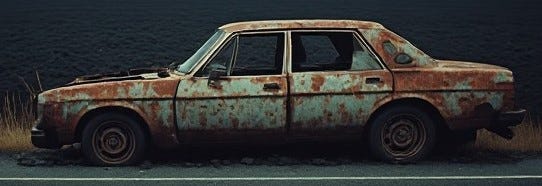
There were maybe a dozen or fifteen gathered at that spot as the speaker went on, stood against the crackle of purple discharge in the excitable clouds of afternoon. He was stood on an abandoned car, a family sedan, rusted and scuffed. Its paintwork scabbed away in flakes, and all the windows were shattered and toothed with jagged remainings.
“Utopia, then, is the act of building on the beginnings that the designs of providence or the random sketchings of our fate have left us as our building blocks. We make better; we cease our labors; we retire in satisfaction, pleased at the beginnings we’ve made. Others come and build on that and then others still.”
The clouds began to clear, and the speaker gazd quickly at the sky and seemed satisfied. The sun came through, the old reliable sun, only a little changed, the light now altered as if it were always later than it was. Noonday light was like evening, afternoon was like the gloamlight of sundown.
“If we toil together, that, friends, that is our utopia. We carry utopia in our straining muscles as we stoop to tender the legumes, we hammer utopia into the timbers along with the nail which was before so bent but which we’ve straightened for this task.”
In the breaks of sunlight the speaker’s face was revealed. Unlike those who were gathered, there were no blotches or blisters on it. He was a middle-aged man, headhair and face stubble the same grizzled length like the fur of a silvery hound. One long thin scar ran from the crown of his head, down across the forehead, and alongside the nose to terminate at the lip. The hair around it was shocked whiter than the gunmetal gray of the rest, the nick in his moustache hair like a tiny moustache-within-a-moustache.
Like everyone, his dress was patched rags, but patched neater than the rough repairs made to the old ripped blankets and windcheaters of the blistered congregation. He was a cut above, or so it seemed to them as they clustered near but not too near on the rifts and rents in the blacktop at the crossroad where stood the dead sentinel of the old Conoco station.
A disturbance: an old woman, bulked up by swathes of rags, pushed through the listeners and shoved her way to the front. She stood beneath the preacher and spoke her complaint.
“Those are fine words, preachin’ man, but you ain’t told us anythin’ ‘bout feedin’ our bellies.”
“Perhaps your bellies are better empty, your sight all the clearer for your hunger.”
“The fuck you know ‘bout hunger, reverend? Standin’ up there with your fancy talk, utopia and happenstance and whatever the fuck. Poor starvin’ folks got no thoughts of all that spiritual horseshit, mister. Only a bowl o’ stew could suffice.”
The scarred man who’d been speaking eyed the sky anxiously. He seemed unperturbed by the woman’s carping, but something about the day or the time gave him an unease. He shifted, and bent down to address her now.
“What are you saying, sister?”
“Sayin’ shit or get off the pot. Sayin’ cease your vain predicatin’. Sayin’ feed us now, big guy.”
The scarred man glanced up again at the sky and seemed relieved.
“What if I offered you a miracle instead? What if I asked of the Lord, or the Cosmos, or Time itself and Fate, to blacken our sky this very moment?”
The woman seemed unimpressed. “And what iffen you did, ya bigmouth motherfucker? What then?”
He raised himself to his full height on top of the wrecked vehicle, lifted up his arms and addressed the others at the crossroads: “Behold!”
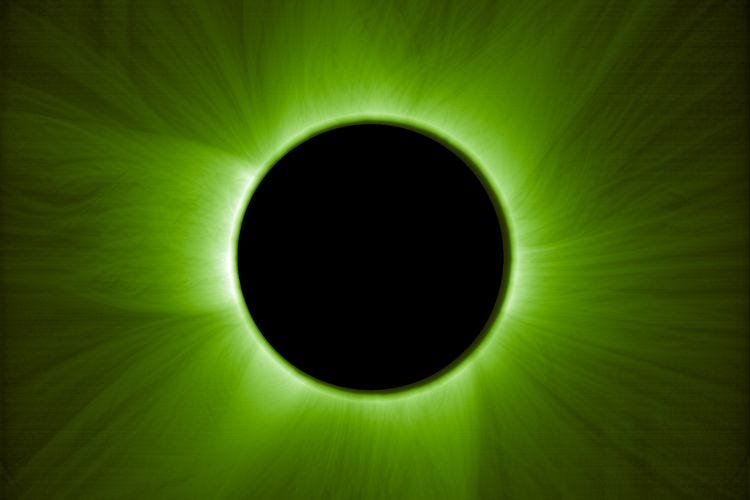
The sun’s light was so much dimmer than before The Kollapse, and it hardly strained the eyes to stare into the milky disk of it as it neared the western horizon above the fields, above the plains with all their splits and rifts. You could see the sun not much brighter than a full moon used to be, and you could see a bite being taken out of it. Time passed and the bite grew to swallow a third of the sun.
Krak-crows and the jitterings of prairie dograts ceased and the life around became a silence. There was a soft chiming in the air as the darkness gathered all the sound to itself and turned it back to the listeners as a remnant, a sonic wraith.
The man on top of his wrecked car spoke on…
There’s quite a lot of time between when you first notice that small bite taken out of the dimmed sun up there in the sky and when the disk becomes fully darkened, the bubbling glister and the ring of white fire. How much time? How many minutes? Nobody counts time by minutes any more in this world; time is counted by pulses of blood in the veins, the gasping and hawking of scarce breath.
During that unmeasured time here at the crossroads, Slate the Speaker goes on speaking to the assembled wanderers from the outland. It’s glib and easy for him by now to talk so passionately, though he’s never before had such an opportunity to gather in so many. Usually it will be one or two, and paradoxically it’s a greater verbal effort to convince one than to convince many.
As he spools out the alluring spiel of the Tomorrow Brotherhood without hardly any thought, prophecy piled upon foretelling, Slate’s mind turns to the woman standing at the front, the one who’d badgered him with all the complaints about empty bellies. She seems hearty for all her talk of starvation. In all the swathed rags it’s difficult to tell her weight, but her face and neck seem meaty enough.
He imagines her - in his mind he calls her Brigitte - rootling around through the sacks in the encampment larder and finding nothing. Maybe a warty turnip or two. She’s going to be the first. All the others will have followed him to the Tomorrow Brotherhood encampment, the old airfield, but she will be the first.
As he goes on in his confident babble, he envisions the future, for despite all his trickery with almanacs and predetermined celestial events, he is something of a prophet. He sees the future with the clarity of a single ray of light escaping the sun’s corona.
She’ll look up from the near-empty sacks and demand to know where the food is kept. He’ll inform her then that the harvest is due. That the first ones to gather the harvest traditionally get the lion’s share, the first pick. He’ll ask Brigitte if she’d like to be a First Harvester.
She’ll say Yes. The hungriest ones always say Yes.
And then the walk to the perimeter fence, to the Harvesting Field. He’ll hang back just enough, while the other Tomorrow Brethren emerge to follow them at a distance. Except for the ones still in the Terminal Building, welcoming the blistered arrivals to their new home.
Now she’ll be at The Mouths and he’ll make that little summoning whistle which they understand. Two soft whoops.
Out they’ll swarm, the crawling ones and the bright flying ones. Brigitte’ll be able to outrun the crawling ones - she looks plenty healthy and more than fast enough - but the flying ones will be on her in but a gasping breath or two. They’ll be all over her head and she’ll flail and stumble and go down. Slate’s seen it enough to know how it’ll play out.
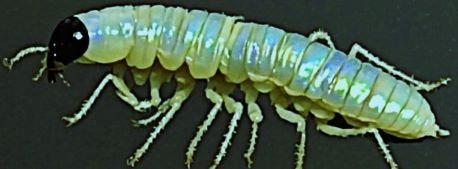
Flying ants, or are they termites? Not black like ants are - iridescent wings and eyes and pale milky bodies. The Tomorrow Folk call them BanderAnts. “Because they bander together”. They fly not like insects fly, random and darting, but like hawks, direct to their target and straight as an arrow. It’s a weird thing to see, this flight: so unnatural, so purposeful.
The crawling ones that scurry out after the fliers are longer, fat as a man’s arm, with scorpion-like tails, and have those purplish iridescences striped lengthwise along the segmented cream-colored thorax. They have a strange sweetish smell like babies supping on sweetened milk if you get close enough to them. Only Slate and one or two others dare to get so close.
There’s an understanding between the swarm at The Mouths and the people clustered in the airfield terminal, the bedraggled community who call themselves the Tomorrow Brotherhood. When the struggle is done, when Brigitte ceases to grunt and to writhe, the Exchange will begin.
Brigitte lies there, being gnawed by a thousand mouths into a million pieces, and the crawling BanderAnts return back to The Mouths with tiny rich chunks of her.
The Tomorrow Folk have gathered a few paces behind Slate. And the Exchange begins.
Out now come the Carriers, more of the crawling creatures, in a procession stately and pompous as those old-timey European royal funerals used to be. In single file they process, each carrying a Grub. These are the quid pro quo for the small gobbets of Brigitte that are streaming back down inside the earth through The Mouths.
The Exchange, a mystery and a gift.
These Grubs are slightly bigger than footballs - than footballs used to be - and each one undulates with slight momentary pressures, bulbs and fists of inner soft white tissue pressing up against the yellowish translucence of their wet membrane skin. They too are segmented, except not strongly, but almost undefined as if their segmentation was an afterthough to their true form, bulbous pulsating blobs that sniff at the air with tufted muzzles. They are rich and generous organisms, like fat sacks of clotted cream in a restless animal motion.
When the file approaches where Slate stands, he bends down, but not too fast, for he remembers how he got his scar. He bends down, takes a fat Grub from each of the crawling BanderAnts, sniffing the sweetened air around them, and then turns back to hand the writhing thing to one of the Tomorrow Brethren. The Exchange is generous to them: a Grub for each of them in return for a single Harvest Sacrifice.
It is a beautiful thing. It is a gift of fate, or of some wry and humorous god, or just of some pure contingent random happenstance. The thing is not to question your gift but to receive it with grace.
And as Slate continued his speech on the top of the car wreck underneath the eclipse and the midnight noon sky, approaching his peroration now as the rings gleamed white fire at the borders of the sun, he saw all of future stretch around the world like a jacket woven for them all. As if preordained, written in some almanac which nobody would ever know how to rightly read.
And he looked down on the ragged woman at his feet and paused in his speech. He saw she was no longer scowling, but smiling wide with gap-toothed joy. And he smiled back at her, at his Brigitte, and conferred on her all the grace and beauty he could muster.
And the ring loosened at the edge of the sun and the light broke out again.
And all seemed much brighter and more hopeful than it had ever been before.
=== // GIFTS / END // ===
No posts
Comments
Nothing yet. Say the first thing.
Sign in to join the conversation.