
Samay Raina’s return isn’t a comeback story. It is the clearest signal yet that the audience — not the platform — is now the scarce asset in Indian entertainment.
In February 2025, an Indian comedian pulled his own show off YouTube. The show was called India’s Got Latent. It had made him one of the country’s most-watched creators. It had also, through an off-hand line from one of his guests, become the trigger for a national moral panic, a Maharashtra police complaint, death threats, and a shutdown that reached every creator who had ever sat behind the desk.
Then he disappeared. For almost a year.
He came back with a stand-up special called Still Alive. Seventy minutes. One camera. One person. It crossed thirty-two million views in three days and fifty million within a fortnight; according to Outlook India, it became the most-watched full-length stand-up special on YouTube. The last minute of the special was a public announcement: India’s Got Latent Season 2 was in production.
Two months later, Netflix and YouTube ran that season as a simulcast — the same episode, dropped on the same clock, on two rival platforms. Episode one, featuring Alia Bhatt and Sharvari, cleared forty-five million views on YouTube in four days and slotted into Netflix’s Global Top 10 Non-English Shows chart in the same window.
Two of the world’s largest video platforms released the same episode at the same moment — under a structure that preserved Raina’s relationship with his audience while extending his reach into Netflix’s global library.
Netflix didn’t buy the show. It rented the reach. The audience remained Samay Raina’s.
Cinema has not yet understood this. Four things it needs to steal from the model.
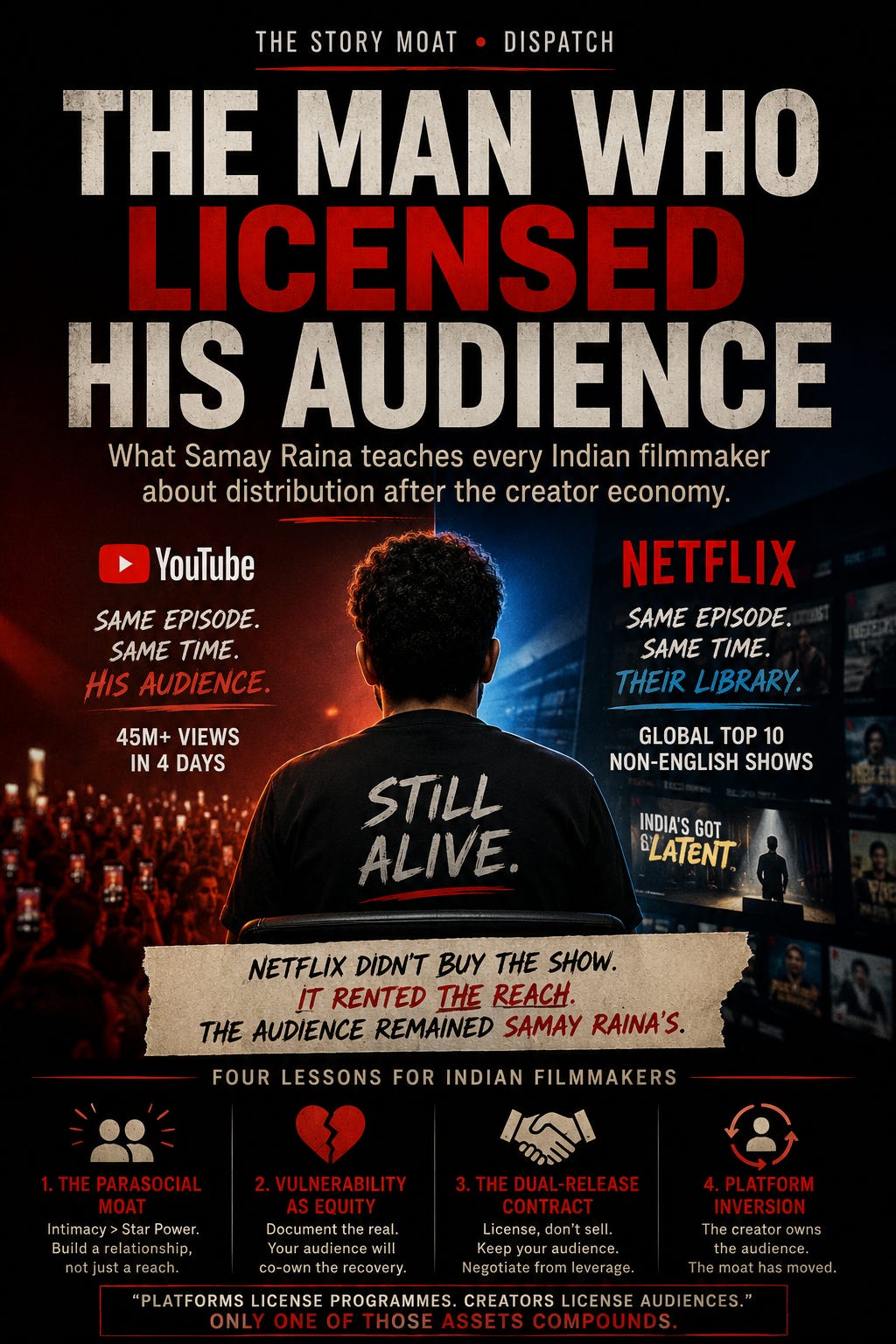
Samay Raina’s brand is deliberately not aspirational. The set-up is often a hostel dorm. The lighting is functional. The slang — bawaseer, haggar OP, launda energy — is written by the audience, not for it. The stated register is “virtual common room.”
The economics of that register are more interesting than the aesthetics. A film sells you a ticket for two-and-a-half hours of distance from the star. Raina sells his audience proximity to a peer.
Scarcity used to be the moat. In an attention economy, intimacy is.
The closest a Hindi film comes is the promotional cycle — an actor on Koffee With Karan, a Reddit AMA, an Instagram Live. Performances of intimacy inside a machine that still runs on distance. The star arrives, does the beat, exits. The audience knows the difference.
The most instructive part of the Raina story is the cancellation itself.
The 2025 controversy was not a marketing problem the comedian solved with a well-worded apology. It was a real event with real consequences — police complaints, death threats, a career shutdown, a mental-health cost. When he came back, Still Alive did not paper over any of it. It documented it. He talked about the anxiety. He talked about the legal fights. He named the interview that had triggered the collapse. He made the seventy minutes about the cost.
Traditional celebrity culture treats vulnerability as a liability. Raina turned it into equity. His audience did not just forgive him. They co-owned the recovery. That is the deepest form of parasocial bond a modern brand can build, and it is unavailable to any Hindi star currently spending crores to conceal a private life.
The India’s Got Latent Season 2 deal is a case study every entertainment lawyer in India should be studying this month.
Raina did not sell India’s Got Latent to Netflix. He licensed it — non-exclusively — to Netflix, while releasing every episode on his own YouTube channel on the same clock. The arrangement gave Netflix a premium title while allowing Raina to retain simultaneous access to his own audience. Netflix gained a Global Top 10 slot and international dubbing. Raina kept the audience, the IP, the ad revenue, the merchandise pipeline, and the ability to walk into the next deal with more leverage than the last one.
This is the inverted deal. Historically, a creator gave up rights to reach a bigger audience. Raina reached the bigger audience without giving up rights. The math held because his own channel was already comparable in scale to what Netflix could add to it in raw reach.
Very few Bollywood stars possess this level of direct audience leverage. No production house has it on the strength of its own logo. A creator who owns their audience owns everything downstream of it. That is the actual moat, and Raina is one of the first Indians to price it correctly.
The deepest lesson here isn’t about Netflix, and isn’t about Raina.
It’s about who owns the audience.
For most of Indian entertainment history, three answers have held the field, in sequence.
The studio owned the audience. Yash Raj signed a star. The star signed a distributor. The distributor signed a screen. The audience arrived because the studio had assembled the chain. Distribution was the moat.
Then the platform owned the audience. Netflix, Prime Video, Disney+ Hotstar built the aggregation layer. The star lost some of the pull. The studio lost some of the leverage. The audience arrived because the platform had signed up their subscription. Aggregation became the moat.
Now the creator owns the audience. The direct-to-viewer relationship — YouTube, Instagram, podcasting, short-form — has produced a generation of Indian creators whose reach is independent of any studio or platform. Samay Raina. Bhuvan Bam. Zakir Khan. Kusha Kapila. CarryMinati. Each of them can address an audience directly, in a language that audience already speaks, on a schedule the creator sets. Relationship becomes the moat.
The intermediary has changed. The audience has not. Twenty years ago, Shah Rukh Khan needed satellite television to reach India. Today, Samay Raina can reach India before television, before streaming, and before cinema.
Platforms used to aggregate audiences. Increasingly, they aggregate creators who already aggregate audiences. That is the inversion. A creator with tens of millions of recurring viewers is no longer a supplier looking for a Netflix deal. Netflix is a distributor looking for a Samay Raina deal.
Hollywood spent decades believing that whoever owned distribution owned the customer. The creator economy reverses that equation. Distribution has become abundant. Trust has become scarce. And the scarce asset is what gets priced. That is why an independent comedian, working from a hostel dorm with a functional light and a rotating panel of friends, now walks into contract negotiations that a decade of Bollywood stars cannot replicate. The star has fans. The creator has followers. Fans buy the ticket. Followers show up whether or not the ticket is on sale.
This is what the dual release proves. It is not a case study in marketing, or licensing, or brand strategy. It is a case study in whose asset was the scarce one. Netflix has a library. Raina has a room. On the current maths, the room is worth more.
— · —
Four instructions for the Indian producer, studio head, writer, and star.
Build the audience before you build the film. Every project in development should have a documented audience the producer can address the day the film greenlights. If you cannot name that audience by cohort, channel and city, you do not yet have a film to finance — you have a screenplay.
Stop treating YouTube as promotion. It is the discovery engine, the community builder, and the ongoing audience relationship. If your only YouTube activity is a trailer drop, your film is renting an audience someone else has built.
Write the vulnerability in. The next generation of Indian stars will not be built on the perfectly engineered persona. They will be built on the documentation of the messy version, and the audience’s investment in it. The performer willing to be seen incomplete will out-earn the performer who never lets the mask slip.
Structure the deal for non-exclusivity. Cinema, festival, streaming, YouTube, short-form — these are separate windows that can co-exist on separate contracts. The producer who bundles them at pre-production has priced the film for the past. The producer who structures them as independent revenue streams is pricing for the market that arrived last quarter.
— · —
The next great Indian studio may never call itself a studio.
It may call itself a YouTube channel.
Netflix licensed a show. Samay Raina licensed an audience. Only one of those assets compounds.
— · —
Comments
Nothing yet. Say the first thing.
Sign in to join the conversation.