
THE 2-MINUTE READ
Indian exhibition had its strongest year on record by industry estimates. But the box-office record tells only part of the story.
PVR INOX reduced net debt from more than ₹1,400 crore at the time of its 2023 merger to roughly ₹162 crore by March 2026. It delivered record revenue and EBITDA, returned its continuing operations to profit, and shifted most planned screen growth toward capital-light structures.
Footfalls did recover — admissions rose nearly 10% across the year. But revenue grew faster, because each visit became more valuable through higher ticket prices, greater food-and-beverage spend and premium formats. At the same time, a broader range of films began contributing meaningful box office, reducing dependence on a few annual miracles.
Indian exhibition did not stop counting audiences. It stopped believing audience count was the whole business.
— · —
THE LONG READ
For most of the last decade, the story of Indian exhibition was told in one number: footfalls. How many bodies through how many doors. It was the metric the industry grew up on, the one analysts modelled, and the one that made the pandemic look like an extinction event.
FY26 broke that frame — not by making footfalls irrelevant, but by proving they were never the whole equation.
By PVR INOX and Ormax estimates, Indian box office collections reached a record ₹13,519 crore in FY26, up 11% year on year. But the more revealing figures sit inside the exhibitors’ own accounts.
PVR INOX, which captures roughly a third of India’s box office, reported FY26 revenue of about ₹6,743 crore and EBITDA near ₹968 crore. Profit after tax from continuing operations reached approximately ₹231 crore; reported PAT was ₹387 crore after including gains related to the disposal of a subsidiary. Both numbers reverse a substantial loss the previous year.
The balance-sheet movement is the more durable signal. Net debt fell from ₹1,430 crore in March 2023 — at the time of the merger — to roughly ₹162 crore by March 2026.
PVR INOX is not the entire exhibition market. But as the country’s largest national chain and a participant in roughly a third of domestic box office, its accounts offer the clearest available view of how the operating model itself is changing.
Indian exhibition did not simply recover its old business. It rebuilt the economics underneath it.
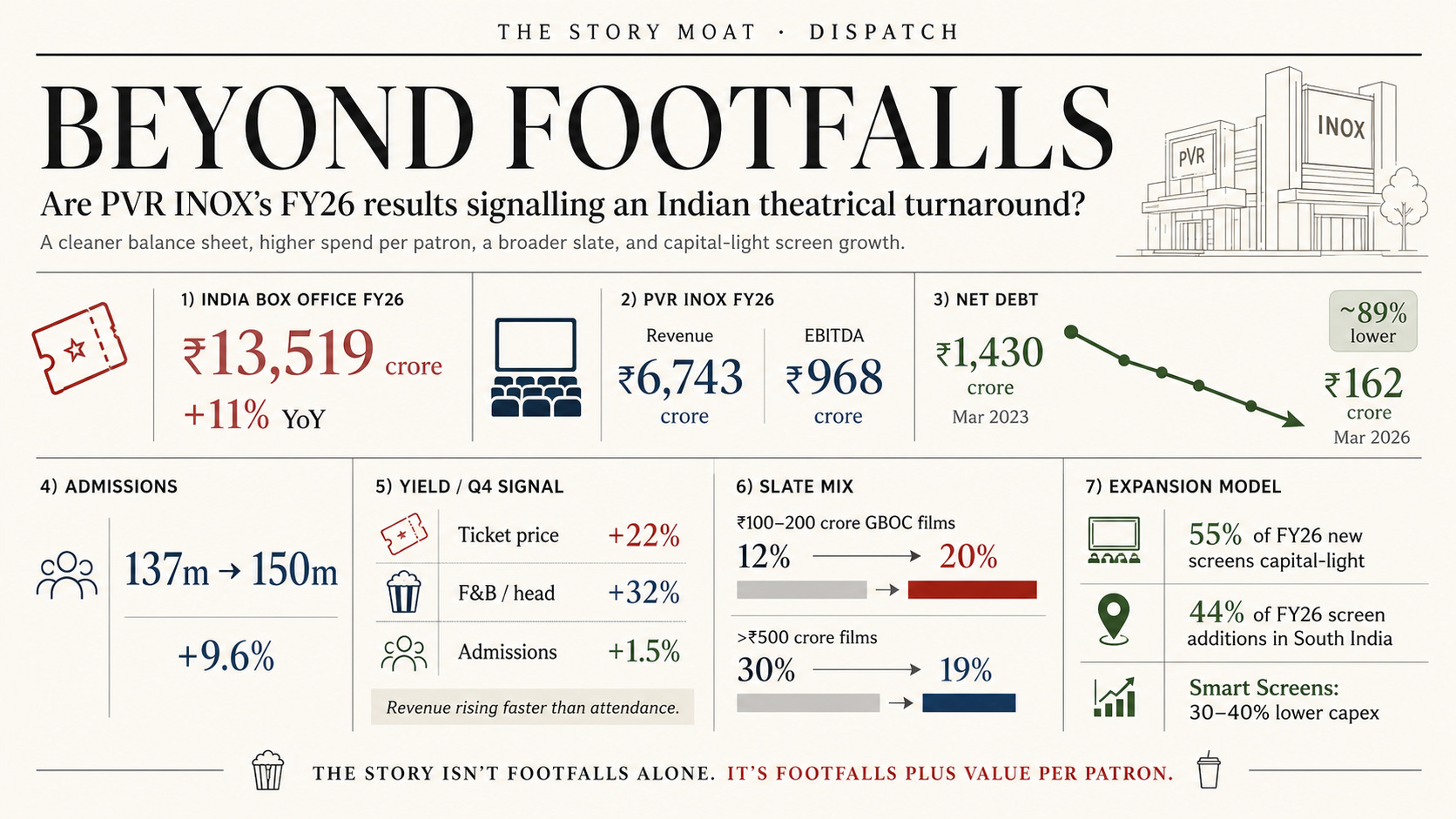
Four structural changes are visible — some across the market, others most clearly inside PVR INOX’s operating model.
The most under-reported part of this story is financial, not creative.
Post-merger, PVR INOX carried a debt load that made every soft quarter a liquidity question. By FY26, net debt had fallen roughly 89% from the merger-era peak, and management has been public about targeting a zero-net-debt position.
Why this matters more than the box-office headline: an exhibitor with negligible net debt can fund more of its expansion through operating cash, reduce refinancing exposure, and tolerate a weak content quarter without turning it into a liquidity event. That changes the cost of every new screen, the negotiating position with landlords and distributors, and — most importantly — the time horizon on which the business can plan.
One qualification worth stating plainly: part of FY26’s deleveraging benefited from subsidiary-disposal proceeds, not operating cash alone. That is more than a cyclical rebound. It is evidence of a different capital structure. But a single strong year cannot yet prove that cyclicality has disappeared from a business that remains fundamentally content-dependent.
Still — the balance sheet is the moat under the moat. A cinema chain that can survive a bad six months without refinancing can programme for the long term. One that cannot will chase whatever fills seats this Friday.
This is the actual structural shift, and the detail matters.
FY26 combined a real footfall recovery with higher patron value. Admissions rose nearly 10% across the year — from roughly 137 million to 150 million — while average ticket price and food-and-beverage spend per head both reached record levels. Total income grew about 16%, outpacing admissions growth.
The structural shift became clearest in the March quarter. Admissions rose only 1.5%. Ticket prices rose 22%. F&B spend per head rose 32%. Total income rose 25%. That quarter is the clean picture of the new model: near-flat attendance, sharply higher revenue.
At PVR INOX, premium large formats — IMAX, 4DX, ICE and newer domestic premium tiers — have grown faster than the general screen portfolio, including during periods when overall collections softened.
The economics are straightforward. A patron in a premium-format seat with a full F&B basket can be worth materially more than a patron in a standard seat who makes no purchase. Exhibitors spent five years discovering that they were also in the premium-experience business, not only the seat-filling business.
The old model asked how many people came. The new model asks what the visit was worth.
The counter-risk is obvious and worth stating: pricing power has a ceiling. Push the average ticket too far and the occasional cinemagoer becomes a non-cinemagoer. Which is why exhibitors can operate premium formats at several times the standard ticket price while simultaneously using ₹99 weekday promotions to protect frequency. The business now segments its own audience rather than pricing to a single average.
Footfalls remain the demand metric. Yield per patron has become the value metric. The rebuilt business requires both.
For a decade, Indian exhibition ran on a brutal distribution of outcomes: three or four films carried the year, and everything else was noise. That made the business a lottery on a handful of release dates.
FY26 looked different. Films in the ₹100–200 crore gross-box-office band contributed roughly 20% of industry collections in FY26, up from about 12%, while films above ₹500 crore contributed 19%, down from approximately 30%.
Read that carefully, because it is easy to misread. This is a gross box-office distribution, not a production-budget one. The important change is not that mid-budget films became more viable. It is that more films are carrying meaningful portions of the calendar, instead of the year depending on a few extraordinary blockbusters.
That may be the healthiest statistic in Indian exhibition. A calendar with more load-bearing weeks is a calendar an exhibitor can staff, programme and finance against.
Above that band, the ceiling also moved. Dhurandhar became one of the largest Hindi theatrical successes in Indian history, demonstrating that the market’s blockbuster ceiling remained exceptionally high. The mega-hit resets the benchmark. The broader middle pays the rent.
And critically, the release logic has moved decisively back toward theatrical-first for films seeking meaningful commercial scale, while direct-to-OTT has become a more selective route rather than the default alternative it appeared to be during the pandemic years. Theatrical performance has again become an important pricing and signalling mechanism for downstream digital and satellite value.
The final change is the one that determines whether any of this compounds.
Historically, adding a screen in India meant a full capital commitment — fit-out, projection, seating, sound — recovered over years of uncertain occupancy. That model produced beautiful cinemas and poor returns on capital.
The pivot is toward developer- or franchisee-owned, company-operated structures, where a partner funds most or all of the build and the exhibitor runs the operation. PVR INOX reports that capital-light structures represented 55% of FY26 new-screen additions, with per-screen capex intensity down about 24%. The structures vary: FOCO arrangements are fully partner-funded, while broader asset-light deals typically see 40–80% of capex funded externally.
For FY27, the company has guided to roughly 120 new screens against capex of about ₹350–400 crore, with 55–60% planned through capital-light structures.
Alongside it sits the more interesting bet: Smart Screens for tier-2 and tier-3 markets — automated, self-service, with management citing per-screen capex 30–40% below a conventional build, priced for ₹150–200 tickets rather than metro pricing.
With many metro markets already heavily served at premium price points, PVR INOX sees the next screen-growth opportunity in lower-cost formats across smaller cities. That is the “Bharat” thesis, and the logic holds: you cannot serve a ₹150 ticket market with an operating model designed around ₹500 metro tickets.
The company is also directing a large share of growth toward South India, which accounted for 44% of its FY26 screen additions.
— · —
For six years, the Indian industry argued about whether streaming would kill cinema. The market has reached a working truce, and neither side won it outright.
What happened instead was a sorting.
Streaming became the natural home for much mid-budget, dialogue-led storytelling that did not materially benefit from a cinema screen. Theatrical increasingly concentrated around films whose value rose through scale, collectivity, urgency or star-driven opening demand. Neither category is absolute — dialogue-led dramas still succeed theatrically, spectacle still underperforms — but the centre of gravity moved.
The 2020–22 window collapse, when some major films began appearing on streaming as little as four weeks after release, trained audiences to wait. The industry has spent three years untraining them. An eight-week window remains the norm for Hindi films released through the major national chains, while regional-market rules remain less uniform and continue to be negotiated — South Indian exhibitors have pushed for a standard eight-week rule, but producer resistance and existing contracts mean implementation is uneven.
That window is not nostalgia. It is one of the most important pricing decisions the sector has made since reopening, because a film that can be waited for is a film that will be waited for.
Streaming maximises availability. Theatre manufactures salience. The Indian industry finally stopped pretending those were the same business.
— · —
Budget for survivability, not for the headline gross. A broader ₹100–200 crore grossing band is healthy for exhibition, but producers should not mistake gross collections for available production budgets. Build the film so its economics work before the theatrical outcome has to become miraculous.
Design for theatrical differentiation from the script stage. If the film’s proposition depends on scale, sound, spectacle or collective tension, that value must be present in the screenplay and production design — not added as a format label in post. At PVR INOX, premium-format revenue is growing faster than the general screen portfolio, and films that genuinely justify the format are better positioned to participate in that demand.
Treat the window as part of the rights architecture. A meaningful theatrical window can preserve urgency and protect exhibitor support, but its value depends on the film, the pre-sale and the downstream contract. Do not shorten it reflexively; price explicitly what you receive in exchange for surrendering it.
Build a proposition that survives outside the ₹500 metro ticket. The next screen-growth opportunity includes tier-2 and tier-3 markets where exhibitors are targeting ₹150–200 pricing. A film that works at both premium and value price points has a materially larger theatrical market than one designed only for multiplex economics.
— · —
The Indian theatrical business spent 2020 to 2022 being told it was obsolete, and 2023 to 2025 proving it wasn’t. FY26 is the first year it stopped arguing and simply operated — profitably, with a substantially repaired balance sheet, a broader slate and a growth model materially less dependent on debt-intensive expansion.
None of this makes the business easy. Occupancy remains the constraint it has always been. Pricing power has limits. Part of this year’s balance-sheet improvement came from asset sales rather than operations. And the entire structure still rests on the assumption that Indian filmmakers keep making films worth leaving the house for.
But the shape has changed. And the shape is what determines whether a good year is a rebound or a foundation.
For five years the question was whether Indian audiences would come back to cinemas. FY26 answered a better one: whether the business would be worth running when they did.
— · —

Comments
Nothing yet. Say the first thing.
Sign in to join the conversation.