
The premise should collapse the moment you describe it.
A cursed New England island. A cowardly mayor trying to sell it as a tourist destination. A town hall that has to process sea hags, killer clowns and a subterranean demonic pact as bureaucratic inconveniences.
That show, Widow’s Bay, premiered on Apple TV+ on 29 April 2026. Ten weeks later, it received nineteen Emmy nominations — a breakout awards showing for a first-season comedy — including Outstanding Comedy Series, Lead Actor (Matthew Rhys), Writing (Katie Dippold), Directing (Hiro Murai), Cinematography and Production Design. It holds a 97% Rotten Tomatoes score at the time of writing. Guillermo del Toro called it “one of the most mesmerizing acts of narrative prestidigitation in horror.”
Prestige horror-comedy usually retreats toward one side: broad parody, or serious horror with occasional jokes. Widow’s Bay did neither.
Watching the season, one governing principle becomes visible: the characters are allowed to be comic. The supernatural threat is not.
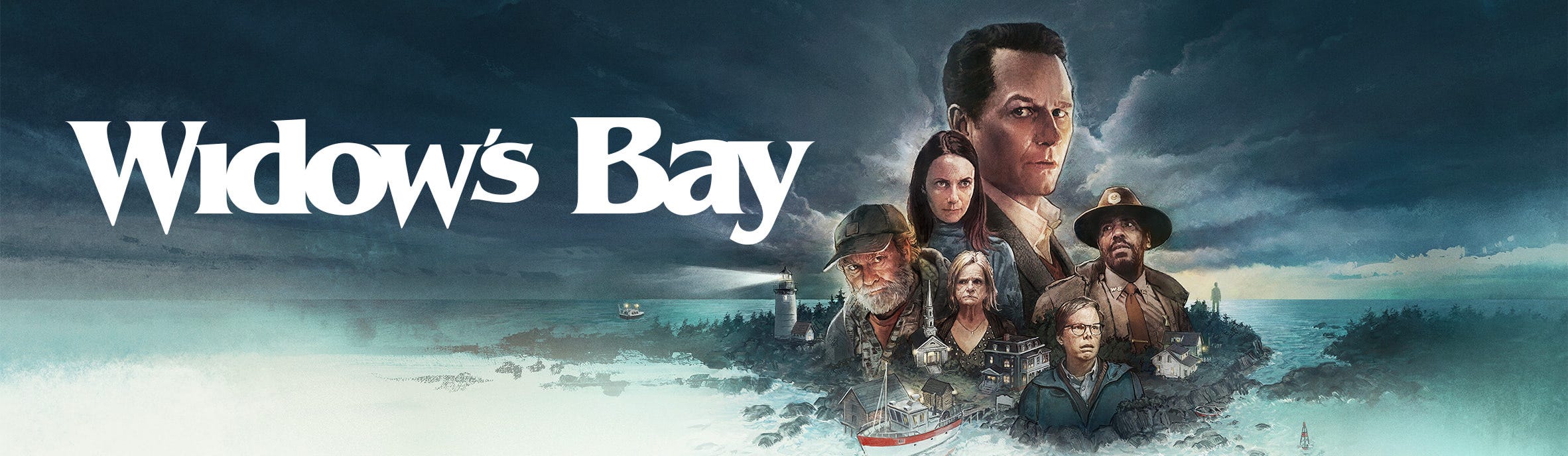
Four things every filmmaker should steal.
The discipline is simple to state and difficult to hold: comedy lives in the characters; horror lives in the threats. When a demon appears, no one punctures the moment with a knowing line or a wink toward the audience.
The arrangement works in both directions. Treating the threat seriously protects the horror. Letting the characters remain funny protects the surprise. Comedy lowers the audience’s guard; horror enters through the opening. Neither could function without the other holding the line.
This is the “magic trick” every horror-comedy critic has noticed and struggled to name. Widow’s Bay does not blend fear and comedy into one safe tone. It lets each remain fully itself.
The common instinct in Indian hybrid storytelling is the opposite — to signal every tonal change. Once the scene turns comic, the frame relaxes; once it turns frightening, the frame tightens. The audience learns the rhythm and stops being surprised. Widow’s Bay refuses that comfort.
Christian Sprenger, the show’s ASC cinematographer, treats lighting as the second half of the tonal rule.
The town hall is often photographed in a bright, utilitarian register — but Sprenger and Hiro Murai resist assigning separate visual systems to comedy and horror. The larger discipline: do not tell the audience which genre has entered the room. The reference points are not other horror shows. They are the first act of Spielberg’s Jaws and the first act of Kubrick’s The Shining — both films that build dread inside well-lit, mundane spaces. Sprenger’s own line: “Dark doesn’t mean scary.”
The consequence: when the supernatural intrudes, it lands startlingly immediate. The audience is not protected by the conventional visual warning that horror is coming.
For Episode 6 — a 1702 colonial-history flashback — the production changes cameras, lenses and aspect ratio: an ARRI Alexa 265, a 1.43:1 frame, and restored 1950s ASC Todd-AO spherical lenses. Interiors are lit almost entirely with practical firelight and candles.
The lesson is not “use candles.” It is that a single episode was allowed to be aesthetically foreign to the rest of the season, and the show trusted its audience to follow the shift. Prestige, in 2026, is the ability to move register without losing coherence.
The show’s production philosophy is best expressed in a Sprenger interview: the crew took “clearly silly” premises and applied to them the level of craft normally reserved for the most serious work.
Substantial practical sets were built. The show’s driving curse book was custom-designed and disguised inside the dust jacket of a fictional self-help book. Board games, tourist brochures, municipal signage, historical documents — every layer of the island’s ephemera was designed as if it were a functioning piece of the town.
The audience does not consciously register every object. It senses the density. What it feels is that the makers cared about a premise that could have been played for cheap laughs. That commitment is worth more than any single visual effect.
This is the inversion at the heart of the model. An absurd premise treated with serious craft reads as literate. A serious premise treated without conviction reads as pretentious. Widow’s Bay is one and never the other.
The show’s quietest feat is that it is deeply literate about the genres it draws from without becoming an imitation of any of them.
Stephen King — the New England town, the ancestral curse, the fog. Spielberg’s Jaws — the mayor downplaying an existential threat to protect tourist revenue. John Carpenter’s The Fog and Halloween — the rolling sea mist, the masked boogeyman, the static compositions that let danger lurk in the background of a shot. Parks and Recreation — the bureaucratic absurdity, the incompetent civil servant ensemble. Atlanta and Barry — Murai’s own tonal signature, transposed to a coastal town.
The show never sits inside any one of these long enough to be reduced to it. It braids.
Originality can come from the relationship between references, not the absence of references.
An Indian version might look something like Panchayat × Tumbbad × Jaws. Bureaucracy and a local ensemble. Indigenous supernatural mythology. A civic leader suppressing danger for economic reasons. The originality would not sit inside any one reference. It would sit in the collision. Few Indian series have attempted that exact braid.
— · —
Four suggestions for the Indian producer, showrunner, writer, and director.
Pick one non-negotiable tonal rule and refuse to break it. The rule doesn’t have to be Widow’s Bay’s rule. It has to be legible, communicable to every department, and enforceable across ten episodes.
Light for the tone you want, not the genre you’re in. Horror doesn’t equal shadow. Comedy doesn’t equal soft key. Choose lighting for what the scene needs the audience to feel, not for what the genre has trained the audience to expect.
Over-commit the craft to the silly premise. If your show can be described as absurd in one sentence, the physical world should reward the audience for taking it seriously. Custom-print the grimoire. Build the practical set. The audience registers respect without needing to name it.
Braid, don’t borrow. Pick three or four antecedents from different corners of the genre map. Take one specific device from each. Let the combination — not any single reference — be what the show becomes.
— · —
Widow’s Bay was in development for close to two decades before Apple ordered the series in 2024. Katie Dippold originally wrote a version of the premise as a spec script while trying to get staffed on Parks and Recreation.
What arrived on screen in 2026 was a premise sharpened across nearly eighteen years — made with prestige-grade craft and disciplined by a single tonal rule.
Widow’s Bay did not solve horror-comedy by finding a perfect midpoint between fear and laughter. It gave each one a separate job.
The joke belongs to the character. The threat belongs to the world. Let the joke neutralise the threat, and neither survives.
Comments
Nothing yet. Say the first thing.
Sign in to join the conversation.