
THE 2-MINUTE READ
Ask how big the global horror film market is and you will find confident answers — $12 billion, $26 billion, $128 billion. Treat them all with suspicion. Nobody measures horror box office consistently across countries, and the big round numbers come from market-research reports that fold in games, haunted attractions and merchandise without showing their work.
What can be verified tells a sharper story. By mid-2025, horror accounted for 17% of North American ticket sales — up from 11% in 2024 and just 4% a decade earlier, according to Comscore data reported by Reuters. In Indonesia, local films captured 65% of admissions in 2024, with horror remaining one of the dominant engines of that domestic success. Korea’s Exhuma grossed nearly $94M worldwide, setting records in Indonesia and Vietnam without a Hollywood remake in sight.
And the genre crosses language barriers unusually well — because much of its value is carried by image, sound and rhythm rather than dialogue.
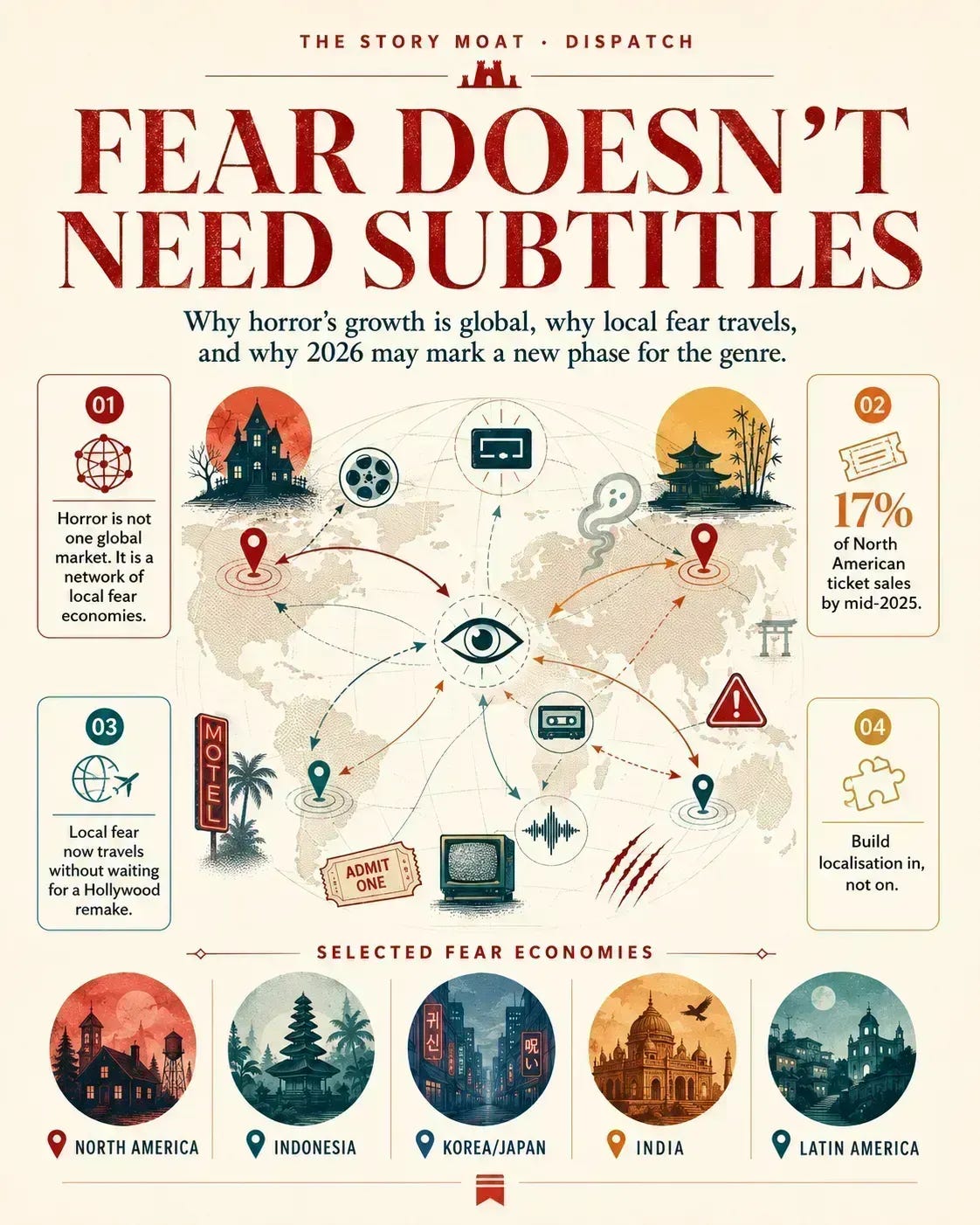
Horror is not one global market. It is a network of local fear economies and several of them are expanding or internationalising at the same time.
— · —
THE LONG READ
Start with the honest answer to the headline question: nobody knows exactly how big the global horror film market is, and anyone who gives you a prec
ise figure is selling a report.
The reasons are structural. Most countries do not publish genre-level box office splits. “Horror” is classified inconsistently — is Sinners horror or a period drama with vampires? Is Stree horror or comedy? And the eye-watering totals in circulation — $12.8 billion, $128 billion — only work by folding in games, haunted attractions, merchandise and streaming, categories with no shared methodology.
So this essay does something different. It builds the picture from what can actually be verified — and the verified picture is more interesting than the invented one.
The cleanest long-run data comes from North America, where genre shares are tracked. And the arc is remarkable
By mid-2025, horror accounted for 17% of North American ticket sales — up from 11% in 2024 and just 4% a decade earlier, according to Comscore data reported by Reuters. That is a theatrical share that has more than quadrupled from its level ten years ago.
A midyear figure is influenced by the release slate — 2025 front-loaded Sinners, Final Destination: Bloodlines and 28 Years Later — so treat the 17% as a high-water mark rather than a settled annual number. But a genre.
share that climbs across ten years, through a pandemic, a streaming revolution and two industry strikes, looks increasingly like more than a one-year cycle. It looks like a sustained re-rating of the genre’s theatrical value.
And the re-rating happened without requiring blockbuster-scale cost structures. The Conjuring: Last Rites passed roughly $499M worldwide. Sinners took roughly $370M worldwide as an original. Weapons took roughly $270M on a $38M budget. In 2026, Backrooms opened to $118M worldwide — A24’s biggest opening ever — while Obsession crossed $400M worldwide on a reported $750,000 production budget.
By mid-2025, horror’s North American theatrical share had reached more than four times its decade-earlier level — without generally r
equiring the cost base of action, fantasy or franchise spectacle. That gap is the commercial argument for the genre.
The world’s largest theatrical markets in 2025 were, in order: the United States, China, Japan, India, the UK and Ireland, France, Germany, Mexico, South Korea and Australia. But — and this is the point most “global horror market” write-ups miss — those are rankings of total box office, not horror box office. Horror’s penetration across them is wildly uneven, and the unevenness is the map worth studying.
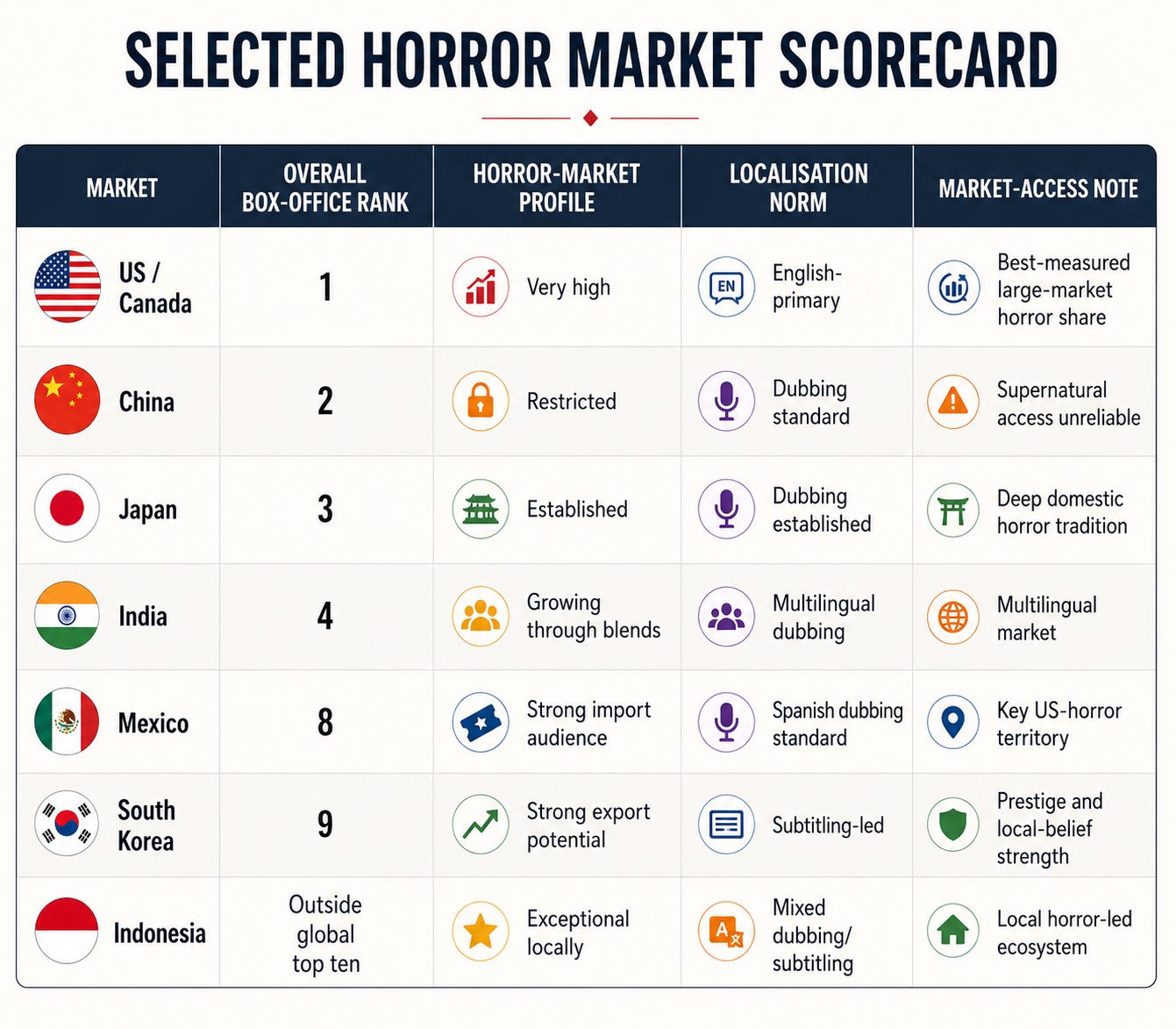
The assessments of horror-market profile and localisation norms are directional rather than quantitative; comparable genre-level data is not available across all territories.
Two entries on that grid deserve their own paragraphs — the biggest market horror can’t rely on, and the smaller one it should be studying.
The China constraint. China’s censorship regime makes supernatural horror especially difficult and unpredictable: ghosts and possession often require rationalised explanations, alterations or outright exclusion. Consequently, producers cannot reliably model meaningful Chinese revenue for most supernatural horror films. Large action, fantasy and creature franchises can still treat China as potential upside; most supernatural horror cannot. That is a ceiling — and also a resilience. Horror’s decade of growth was built without depending on the market whose access is most politically fragile.
Indonesia, the clearest local-horror economy. In 2024, Indonesian films captured 65% of national admissions — roughly 80 million tickets, an all-time record — and horror was one of the strongest contributors to that local-film boom. Half of the top ten Indonesian films by admissions since 2011 are horror titles, and local production has grown from fewer than five horror films a year in the 1990s to dozens annually. Few sizeable theatrical markets appear as horror-weighted as Indonesia’s domestic slate. If you want to see what happens when local fear competes with imported spectacle and wins, look at Jakarta alongside Los Angeles
Korea and Japan, the export laboratories. Japan proved twenty-five years ago — through the Ring and Ju-On remake era — that horror premises travel even when the films initially didn’t. Korea has now closed the loop: Exhuma grossed nearly $94M worldwide, with roughly $80M from Korea itself and record-setting runs in Indonesia and Vietnam — no remake required, just subtitles and dubs.
India, the blend market. Indian horror runs through the horror-comedy lane — the Maddock universe — and through folk horror’s export proof, Tumbbad. And India already has a mature cross-language distribution culture: South Indian films routinely expand through Hindi dubbing, while Hindi, Tamil and Telugu versions help Hollywood franchises penetrate beyond English-speaking metros. Horror can benefit from that infrastructure, particularly when its appeal rests on sound, imagery and recognisable franchise grammar.
Mexico and Latin America, the franchise base. Mexico and Spanish-speaking Latin America are important dubbed markets for major US horror franchises. During the global opening of The Conjuring: Last Rites, Mexico was its largest individual international territory, while Brazil was also among its strongest. Established theatrical infrastructure and Spanish- and Portuguese-language localisation make the region a core release market rather than a secondary adaptation exercise.
Southeast Asia, the regional multiplier. Indonesia provides the audience scale, while Thailand (Pee Mak, Shutter) and Vietnam add established horror traditions and growing theatrical demand. Southeast Asia offers some of the clearest examples of local-language horror competing directly with — and occasionally outdrawing — Hollywood imports. The region also pro
ved unusually receptive to Exhuma, showing how a culturally specific Asian horror film can travel across neighbouring markets without first being remade.
Horror is unusually language-portable, and the reasons are practical before they are mystical.
In many commercial horror formats, the decisive scenes carry a relatively low dialogue load. A drama’s meaning lives in its lines; a comedy’s timing lives in its language. Much of horror’s meaning lives in image, sound and rhythm — the creak, the shadow, the sub-bass, the silence before the cut. Less of the film’s value passes through the translation layer, so less is lost in it. (The exception proves the rule: dialogue-heavy psychological horror travels more like drama.)
The grammar is shared. The over-the-shoulder shot, the mirror reveal, the door that should not be open — horror’s visual codes are as close to a universal cinematic language as the medium has produced. An audience in Jakarta, Seoul, Mexico City and Mumbai reads the same shot the same way.
Dubbing can cost the genre less. In dubbing-standard territories — including Germany, France, Italy, Spain, much of Latin America and parts of India — the dubbed version is often the primary commercial product. Many forms of horror can lose less through dubbing than comedy or dialogue-led drama, because their central set pieces depend less on linguistic precision. This is part of why horror franchises localise so profitably: the Conjuring films play dubbed across Latin America and India as full-value theatrical events, not as compromised imports.
The result is a genre where the direction of travel has reversed. Twenty years ago, horror globalisation meant Hollywood remaking Asian films for Western audiences. Today it means Exhuma setting records in Southeast Asia, Indonesian horror drawing tens of millions of local admissions, and a Korean, Thai or Indonesian hit reaching the world in its original language with a dub track.
The remake era asked: how do we remake this? The current era asks: why remake it at all?
Compare the horror economy of 2016 with 2026 and four changes stand out.
The share re-rating. Horror’s North American ticket share rose from roughly 4% a decade earlier to 17% by mid-2025 — a high-water mark representing more than four times its earlier footprint in the genre’s best-measured market.
The streaming sort. As mid-budget drama and comedy migrated to streaming, horror consolidated its position as one of the genres audiences most reliably leave the house for — because its core theatrical product — collective fear in a dark room — is difficult for the living room to reproduce at the same intensity or scale.
The local-language maturation. For much of the earlier globalisation cycle, successful Asian horror premises reached Western mass audiences primarily through Hollywood remakes. By 2026, local horror industries across Indonesia, South Korea, Thailand and India were increasingly capable of sending the original films outward directly — creating films and franchises designed first for domestic audiences.
The creator pipeline. The newest change, and the sharpest. Backrooms and Obsession — both from filmmakers who built audiences on YouTube before touching a theatrical camera — delivered two of 2026’s defining hits. The proof-of-concept for a horror film can now happen in public, on a platform, before a studio spends a dollar.
So: is this an inflection point?
On the evidence, yes — but be precise about which one. This is not the moment horror became big; it has been compounding for a decade. It is the moment three previously separate trends converged: a high-water mark for theatrical share in North America, maturing local-language horror economies across Asia, and a creator-led pipeline that materially lowers the cost of discovering and validating talent. Each reinforces the others. The local industries supply the specificity that travels; the share re-rating supplies the exhibitor incentive to book it; the creator pipeline allows studios to discover the next generation after audiences have already supplied an early proof of demand.
The honest caveats: the data gap means the “global market” will keep resisting precise measurement. China’s constraint shows little sign of lifting for supernatural horror. And a genre whose share quadruples eventually invites oversupply — the legibility trap operates at market scale too.
But the direction is not ambiguous.
— · —
Stop asking how big the market is. Ask which fear economies your film can enter. The global figure is unknowable and irrelevant to any single film. What matters is the stack of specific markets a project can realistically play — home theatrical, dub territories, festival circuit, streaming windows — and what each is worth.
Build localisation in, not on. If the film has international ambition, budget dubbing and subtitling during development. Protect clean dialogue stems, sound-effects and music separation, lip-sync flexibility and culturally specific language. Horror often travels well through dubbing — but only when localisation preserves the sound design and performance rather than sitting on top of them.
Watch Indonesia the way the last generation watched Korea. Indonesia is one of the most credible markets to watch for the next major Asian horror export — not because one is guaranteed, but because local audience scale, genre volume and culturally specific material are already present. A market where local films command 65% of admissions, with horror among the strongest domestic genres, has the base to produce breakouts. Indian producers should be exploring co-production and remake rights now, before Hollywood does.
Price the China constraint honestly. If the base case assumes meaningful Chinese revenue for most supernatural horror films, the model is wrong. Treat any access as upside, not underwriting. Horror’s worldwide numbers are built largely without China — which means the genre’s international upside concentrates in Latin America, Southeast Asia, India, Japan and Europe. Structure territory pre-sales accordingly.
— · —
The global horror market resists a single number because it was never a single market. It is a network of local fear economies and receptive territories — American, Indonesian, Korean, Indian, Mexican, Japanese — each shaped by different beliefs, languages, audience habits and distribution systems, and increasingly connected without requiring Hollywood to remake every successful idea.
Horror’s global advantage is not that one worldwide market exists. It is that culturally specific fear can now reach multiple markets without first being remade by Hollywood.
Every other genre needs translation. Horror only needs the lights off.
— · —

Comments
Nothing yet. Say the first thing.
Sign in to join the conversation.