
If I had to describe myself in one word it might be average, and I say that proudly.
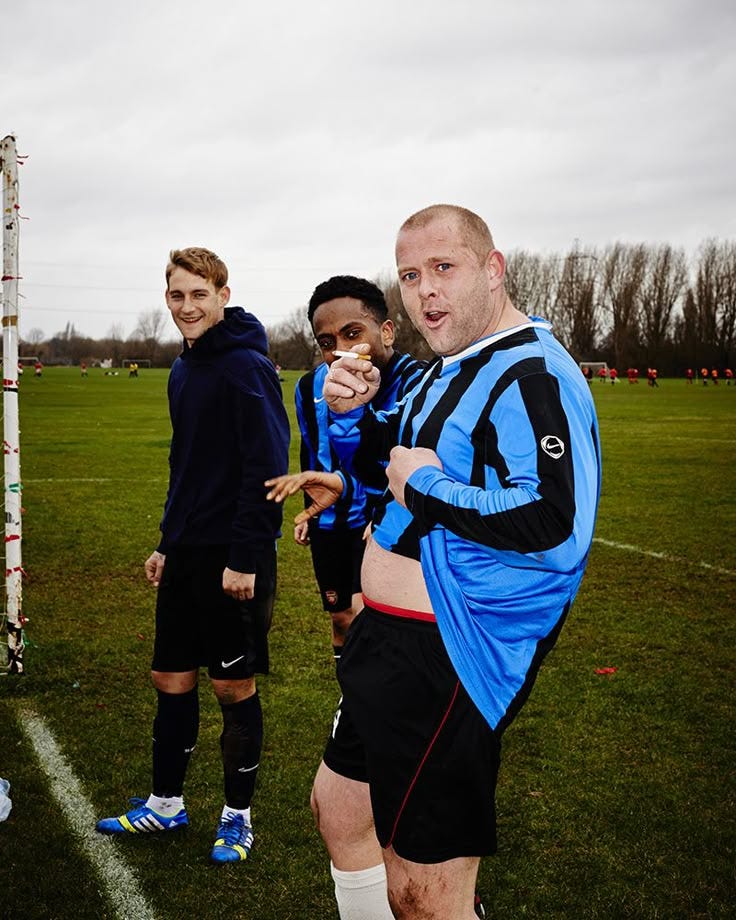
Football took me just about as far as academy level and no further. I train muay thai and jiu jitsu, where people with more experience beat me up on a weekly basis, and I get round a golf course off a handicap of eighteen. I play guitar, piano and bass at varying levels, and not one of them well enough to call myself a serious musician, and my Spanish is enough to claim I speak another language while being nowhere near enough to be mistaken for a native speaker. I cook most days and can feed a table of people who ask for seconds, though I overcook things constantly and I can’t seem to get rice right for some reason…
For a long time this bothered me. I read it as evidence that I lacked the discipline to see anything through, that I was one of those people who starts things and gets bored. I have come round to a slightly gentler interpretation since, which is that I am curious, I like learning, and being good enough at a lot of things has made for a full life.
The same pattern ran through my working life, where it caused rather more trouble. I liked maths and science, so my teachers pushed me towards engineering, and I lasted a few months in an internship before working out it wasn’t for me. Music production came next, chosen mostly because it was the furthest thing I could think of from engineering, and about halfway through the degree I realised I didn’t want to be a musician either. Then a junior marketing job, then an agency of my own that folded, then a creative director role.. In each case I was competent enough to carry on but never good enough for anyone, including me, to think I might become truly exceptional at it.
What took me a while to work out is that the discomfort wasn’t about not being “the best”. It was something different that came from somewhere outside me.

There are two ideas about the value of an ordinary life which sit alongside each other in most people’s minds, and I think they create a tension that most of us never examine.
The first is that every life carries equal weight. It runs through the democratic idea that every voice deserves to be heard, and through the religious inheritance underneath Western culture, which insists on the dignity of each person regardless of whatever they managed to achieve. We teach this to children and write it into constitutions. One person, one vote, and equal treatment before the law.
The second is that we all live inside steep hierarchies where the top of a field takes almost everything and the rest divide up what is left. The richest 0.001% of the world hold three times more wealth than the poorest half of humanity combined. When Rolling Stone crunched the streaming data, the top 1% of artists were taking around 90% of the streams. Fifty-one clubs have played in the Premier League since 1992 and seven have ever won it, three of them taking 26 of the 34 titles between them.
So the rules that are supposed to govern how we treat each other, and the rules that decide how we actually live, are two different sets of rules. People hold both sincerely, yet only the second one changes how they behave. Tell somebody at a party that you are aiming for a life much like everybody else’s and watch how it registers on their face.

The first thing anybody asks you at most social events is what you do. We work for money and we also work in order to have something to say when that question arrives, i.e it says something about us, or more specifically, how we want to be perceived. Whether we like it or not the answer to this question is how the success of most adults gets measured.
So being exceptional becomes the prerequisite for being taken seriously.
The message underneath all of this is that in order to count for anything you have to be exceptional at something. This is simply not possible for everyone. Exceptional means the exception. Most people could probably become exceptional at one thing given enough years and the luck of picking the right thing, hardly anybody manages it at more than one, and plenty of people never find out which thing they might have been exceptional at. So we hold up a standard that most people are structurally required to miss, and then treat missing it as a personal failing.
Here is the part that people tend to miss. Even if you can clear that bar, it’s not always the right move.
When an industry disappears, the people who feel the shift most are often those who were most exceptional. They put in the most time, they built a skillset specific to that industry, and they built a network of people who all operate in the same domain. Deep expertise works like a key cut very precisely for one lock. The precision is what makes it valuable, and it is also what makes it worth nothing the moment somebody changes the lock.
Kellingley Colliery in North Yorkshire closed on 18 December 2015 and took British deep coal mining with it. Around 450 men worked the final shift on twelve weeks’ severance, at a pit that had employed more than two thousand at its height. The ones with thirty years underground held a skill that virtually no other employer in the country was interested in, because there was no longer anywhere in the country to use it. Print journalism, travel agents and film photography have all seen similar disruption.

Economists have a name for what those men lost. They call it industry-specific human capital, and Derek Neal published a paper in 1995 measuring what happens to it when a job goes. Workers who found something new inside the same industry recovered most of their old wage. Workers who had to move to a different industry did not, and the longer they had spent in the old one, the bigger the shortfall.
Excellence requires focus, and focus is the opposite of hedging. Nobody becomes exceptional at something by keeping their options open. You close them, you make sacrifices, deliberately and for years, and depth is what you get in return. That is a spectacular bet when the thing you bet on holds, but a devastating loss when it doesn’t.
Twenty years inside one domain buys extraordinary depth and a very narrow set of things to test yourself against. It also buys status. For whoever was best at the job, the job was the reason people listened when they spoke, and when the industry goes, both go with it.
Now this isn’t to say that breadth is automatically safe. The current wave of automation is best at the “competent middle” of knowledge work: a serviceable email, a decent deck, a reasonable first pass at an analysis, adequate copy. That is a description that could apply to a broadly capable generalist, and anybody in that position who feels safe hasn’t looked closely enough.
If specialists are exposed because their skill has nowhere else to go, and generalists are exposed because their output is the first thing a model does adequately, then neither position is as safe as it sounds.
So I am not going to tell you that being broad protects you. What it does is lower the cost of changing your mind, and in a decade where so many people are going to be forced to change theirs, that counts for a lot.
If you recognise yourself in any of this and want to do something about it, upgrading gets you the practical pieces and the comment threads where other readers are working through the same thing, all for the price of a cup of coffee.
The most immediate thing is that you get to be bad at things in public.
I get beaten up in jiu jitsu every week by people who have been doing it longer than me. Nothing is at stake in that. I am not the person who is supposed to be good at jiu jitsu, so getting tapped out by a teenager costs me a bruised rib and nothing else, and I come away having learned something. There is a weekly dose of humility in it that I now look forward to. If I had built any part of who I am on being a martial artist, that same session would be humiliating, and I would find reasons to stop going.

In an article a few weeks ago I wrote about a test for whether a conversation went well. It mustn’t feel like you won. If you come out of it feeling like you won, it was probably a disaster. That test only works if you don’t need the room to validate something about you. The people who have to be the most impressive person present are exhausting company, and they learn very little, because managing that impression uses up all the attention they might have spent listening. Being average takes that pressure off. You can ask the basic question. You can say that you don’t know, and most importantly, it means you learn much faster than the person who cannot afford to.
The second thing is that you have fewer identities to shed.
Once you are excellent at something it stops being a thing you do and becomes a thing you are, and after that you cannot do it badly without feeling like it is hurting your pride.
Football is where I saw this most dramatically. The best player at a school gets picked up by an academy, walks in, and is suddenly ordinary in a room full of boys who were also the best at their school. Some of them adjust. But most of them don’t, because being the best was never something they did, it was who they had been since they were nine. I have seen boys quit football entirely at sixteen who were still very good players, because being merely good had become unimaginable.
Again, this translates to people’s working lives, which is why leaving a job you are brilliant at is so much harder than it looks from the outside. If your work is who you are, walking away can leave you feeling lost and frightened out of all proportion to the decision itself. Someone competent and unhappy tends to leave much quicker. Years can go by while someone brilliant and unhappy assembles reasons why this is not the moment to jump. People who never fused with what they did move earlier and more easily, because there is less to dismantle on the way out.
The third thing is that I believe a broad life is just more fun. Maybe I’m biased.
The world is big and beautiful, and being able to engage with it in a multitude of ways brings me immense joy. I couldn’t teach Spanish, but I can go to Spain and have a decent conversation with a local. I couldn’t cook in a Michelin starred restaurant, but I can invite a group of friends round for dinner and put a smile on their faces with good food. I will never perform an original song in front of thousands, but I play my guitar every day between meetings because it helps me reset.
For years I measured myself against one question. Could I be exceptional in any of these things? The answer was no, probably not, and it took me far too long to figure out that that was totally okay.
None of this is a suggestion to aim lower. I have never met anybody who built something worth building without working extremely hard.
The question “how do I become exceptional” has almost no purchase on an ordinary life. The one that helped me was different, and it was about what five things I am pretty good at leave behind in me, none of which is a career on its own.
I want to be careful here, because I am not suggesting there is a job out there made of football and music and cooking. There isn’t. What those things left me with is a separate matter from the things themselves. Football taught me how to communicate in high stress situations. From music production I got the ability to keep working at something unfinished for months. The agency folding taught me more about how a business really works than three years of a degree did. None of that is legible on a CV, but I use most of it every day.
It is also a question no institution ever puts to anybody. You get a careers adviser at sixteen who looks at your best two subjects and names a profession, and after that you are on your own with it.
If you are interested in lots of things and have no idea how to build a real job from them, we built Rumbo for that. It helps you work out what the combination of them adds up to, then builds a plan around it with personalised guidance and live job listings. Check it out here.
To read next
No posts
Comments
Nothing yet. Say the first thing.
Sign in to join the conversation.