
Found throughout oral and written storytelling traditions, the Trickster speaks to the power of our human appetites, and has been represented in the animal form of the coyote, raven, fox, spider and hare, and has also been depicted as a forest imp, household spirit, nymph, goblin, fairy, or shapeshifter, as well as a mythic figure or fictional character such as Prometheus, Loki, Krishna, Puck, Bugs Bunny, Inspector Clouseau of the Pink Panther films, the Monkey King, and so on…
The Trickster’s capacity to inhabit so much of the human imagination (and to take on such a diversity of forms) speaks to the dynamism of this archetype. With its capacity to represent both creation and destruction, the Trickster embodies our potential both to create and order the world, and to topple it over.
Tricksters provide for disorder and change; they enable us to see the seamy underside of life and remind us that culture is artificial and thus, there is no necessary reason why things must be the way they are. If there is sufficient motivation to change things, Trickster provides for the possibility of such change, most often by showing that the rules of culture are not fixed, or arbitrary.
The Navajo Creation Myths (there are numerous recorded versions) are essentially Emergence myths, positing the upward movement of various beings through different worlds from deep within a world of mist. First Man and First Woman are the first beings mentioned who provide light and beginning to this process, but Coyote also seems to have existed from the beginning. All three figures are believed to have originated from the primordial medicine bundle, from which all creation originates.
How intriguing that Coyote makes the world as much as first man and first woman do.
Coyote is both hero and anti-hero. Coyote is a creator – shaping the land and rivers, and putting the mountains in their places. Coyote is a culture-maker, bringing fire and teaching people how to enact rituals and establish traditions. Coyote is a savior who battles destructive monsters and transforms them into safer visions and versions - generally, making the world more livable. It is Coyote who puts stars in the sky to light the heavens and establish a guidance system for humans. And yet, Coyote is also a destroyer, an undoer, a ruiner, a reverser, a thief, a chronic bumbler, and mischief-maker whose cunning and creativity – and foolishness - bring mayhem and disorder.
I love the paradoxical nature of the trickster who points its finger directly back at us, fickle humans. Trickster reminds us of our human capacities as both world-builders and dismantlers, as cunning creators and idiot buffoons. And, the trickster adeptly erases any clean distinction between these or any other neat categories.
On the first day of my class on Play, we begin with the Trickster. I offer students this excerpted and edited convo between scholars, Bayo Akomolafé and john a. powell, to begin building a richer, more complex definition of play, and to explore the actor and artist as a kind of trickster/culture worker.
Question
How can we teach one another to play the role of the trickster, identity smasher and new world creator?
Response
We may have to think about and invite play back into our lives, both individually and collectively.
The trickster is the invitation to move from side to side, to break the posture that we are used to, to play like children…
That’s a gift, that’s the decolonial.
I do not think of humans as tricksters.
I think of the trickster as this energetic flow, this liminal quality that shapes new possibilities, which enlists humans, as well as nonhumans, and is always invitational.
The trickster’s deepest work is to break open binaries, is to disturb binaries…
Whether it is between God and man, man and woman, or heaven and hell, or language and reality, or reason and emotion.
The ideas that these are binaries and to find a way, one might call it a third way, between the cracks and the binaries.
Grieving together is trickster work, playing together is trickster work, sitting in the dark and waiting for something to happen is trickster work.
Wherever you find openings in the explanation we give to things, that is the invitation to the trickster – that is the invitation to play.
From The Edges in the Middle
Moving through our day-to-day social realities – especially here and now in the US under advancing fascism, or the fascism that is and has always been - our muscles for conformity, for obedience, are well-flexed. They have been socially reinforced, even coerced. Daily, we perform social acts that keep certain power structures – what Jacques Lacan called, performing for the big other - intact. And so, it follows that we must practice flexing alternative characteristics of our nature, those of the trickster – the unruly one who questions and disobeys, exposes hypocrisy, slips in between categories and the cracks in things, and turns power on its head.
I see the presence of this trickster energy in recent protests against ICE in American cities. In Portland and Minneapolis, even in the face of violence, folks are channeling the energy and the tactics of the trickster.
These folks understood the assignment:
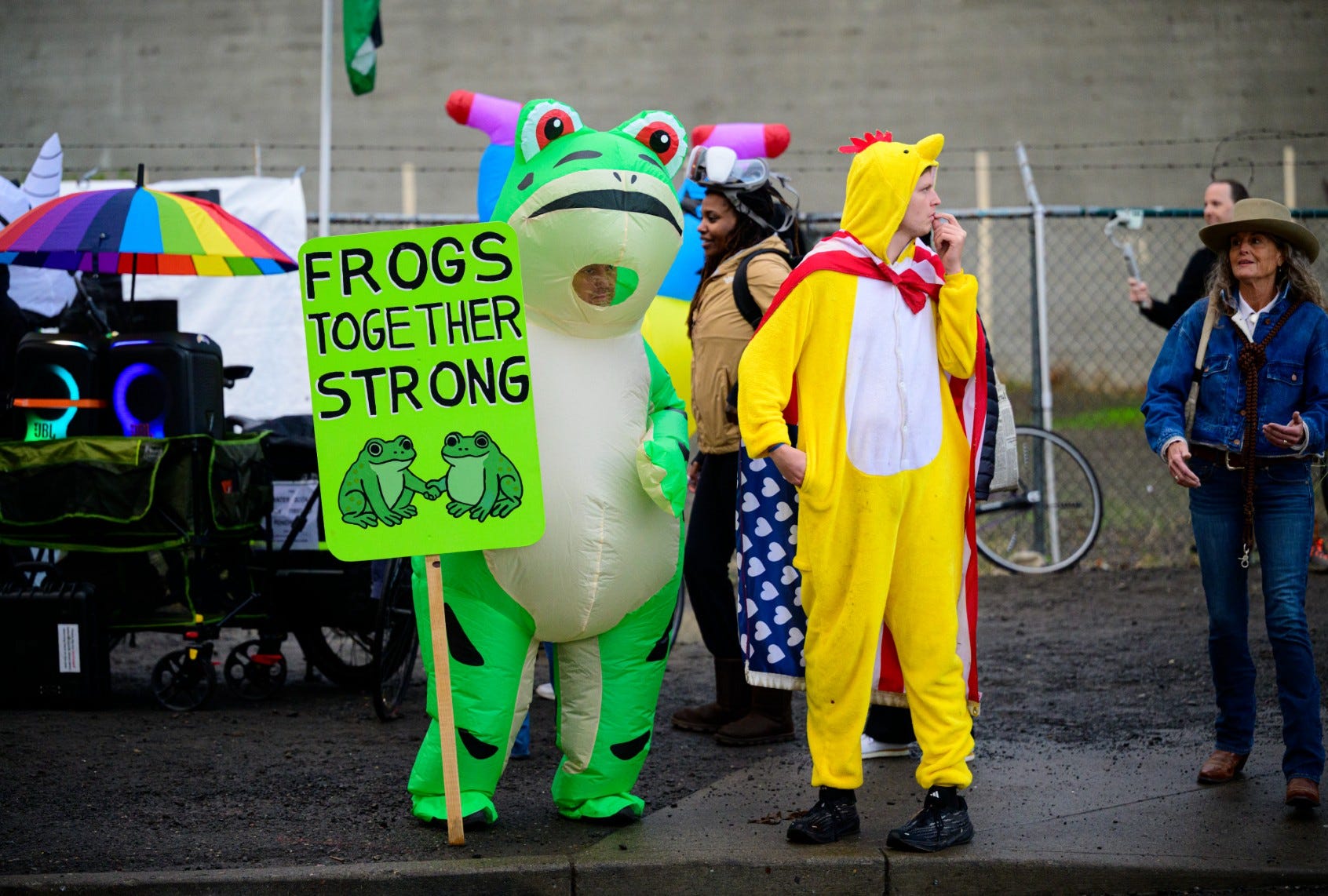
And, this guy…
Or, these clowns…
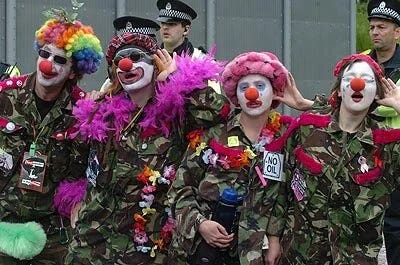
This image (above) is not from today but from the early 2000’s. This is CIRCA, the clandestine insurgent rebel clown army – an anti-authoritarian left-wing activist group primarily active from 2003 to 2005 that used clowning, play and games, and non-violent tactics to act against corporate globalisation, war, capitalism, and heavy policing of protests, among other issues. In particular, they were instrumental to protests against the G8 summit and the war in Iraq.
During this period, groups of insurgent clowns, called gaggles, formed around the world – particularly in the Pacific Northwest in the US and throughout the UK. Group members – ordinary people - trained as activist clowns and engaged in tactical frivolity, a form of public protest involving humor that often included peaceful non-compliance with authorities, and adopted carnivalesque and whimsical antics.
Instead of uniforms, rebel clowns wore multi-forms; the war on terror was rebranded as the war on error. Instead of merely puncturing the routine flow of political practices and making visible what otherwise remains unnoticed, CIRCA used humor and playfulness to reconfigure – to scramble - the workings of politics and structures of power, and to establish and assert spaces for joyfulness and community celebration inside and as protest.
Comments
Nothing yet. Say the first thing.
Sign in to join the conversation.