
Hi everyone,
I took last week off with the family in the Normandy countryside to eat my own body weight in cheese, so apologies for the service interruption.
This week I’m tackling another issue that came up in my subscriber survey: B2B brands and the nuances around their use of sponsorship. I wanted to flag in advance that much of my thinking on B2B marketing has been influenced by LinkedIn’s B2B Institute and, in particular, the introduction to Feldwick on Fame, by Paul Feldwick.
In fact, Paul is something of an effectiveness hero of mine, and I often cite his excellent Why Does The Pedlar Sing? as the one book about marketing and advertising that I’d recommend to everyone. So big ups to Paul.
If you have any questions or thoughts on this week’s topic, I’d love to hear them - please leave a comment or start a thread in the chat.
Rory
There’s a classic B2B ad from 1958 for McGraw-Hill Magazines called The Man In The Chair. It shows a ‘typical’ B2B buyer, telling a sales representative that he has no idea who their company is or what it stands for, and then asks, passive-aggressively: “Now-what was it you wanted to sell me?” It elegantly makes the point that, in the world of B2B sales, brand awareness, fame and perception are crucial.
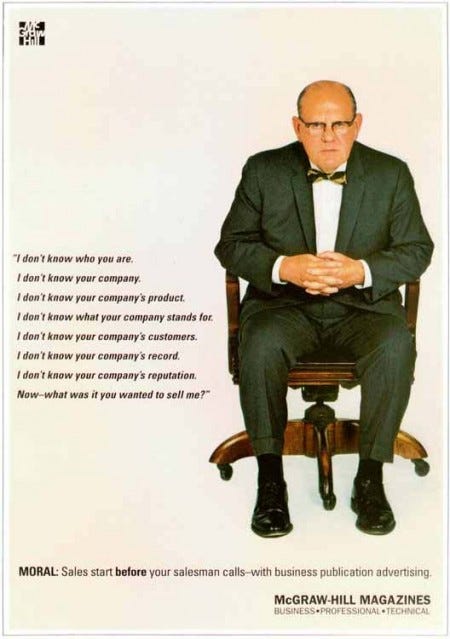
Another famous B2B maxim is ‘nobody ever got fired for hiring IBM’. Again, it goes to show just how much the emotional reassurance brand fame provides can overcome deficiencies in technical features and even pricing.
Those of us who have been involved in agency pitches (another B2B sales environment) will know this to be true, too. VCCP, McCann, Uncommon and Mother don’t just win pitches because they have excellent strategic and creative work; their reputation precedes them, and, all things being equal, the more famous agency tends to win more often.
The question for much of the marketing community is, therefore: if we can all agree on the value of brand fame in B2B marketing, why does a majority of B2B marketers behave as though it’s only the sales pipeline that matters?
For some reason, the received wisdom is that B2B buyers are completely different from B2C buyers; that B2B buyers are rational, risk-averse, many-headed, slow, and therefore need a fundamentally different playbook from consumers. We see the consequences of this everywhere, from job specs that require B2B experience to the creation of ‘demand-gen’ teams and CFOs who fund demand-gen because it appears to measure cleanly.
When it comes to sponsorship, there’s a sense that a partnership used to promote a B2B brand is inherently different from one for a B2C brand and may not fit within the broader discussion of effectiveness, primarily because much of the B2B work is done through hospitality and one-to-one relationship-building, not broad-reach comms.
That’s nonsense. I’ve judged Effie entries in which the target audience was one person.
But there are some genuine differences, so let’s have a look at them…
A shampoo brand is talking to tens of millions of people it will never meet. A business selling enterprise software might have a total addressable market of a few thousand companies, and inside those companies, a few dozen people who actually sign the contract. You can often name them. You can find them on LinkedIn, see where they have worked before, and find out which conferences they attend. The audience is not a faceless mass. It is a list.
That is true, and it changes what is possible. Account-based marketing exists because in B2B, you genuinely can market to a named account, sometimes to a named person. So the instinct to treat the audience as a tightly targetable set of individuals is not stupid. It is a fair reading of the situation before you.
Consumers buy many categories fast and often. A lot of businesses do not. Around 75% of companies buy a new computer system once every five years, and roughly 80% change their principal bank once every ten (figures from the LinkedIn B2B Institute and Ehrenberg-Bass). A shampoo decision is made in seconds in front of a shelf. A core banking decision is made once a decade by a committee.
So the buying cycle really is longer, and the moment of purchase really is rarer. Again, no argument from me.
The consumer is, more or less, one person. The B2B buyer is usually several. The boss, the board, the finance director, the end users, and at some point procurement, who exist mainly to ask all the difficult questions you were hoping wouldn’t come up. Paul Feldwick makes this point well in his introduction to the B2B Institute’s Feldwick on Fame: B2B decisions, far more than B2C ones, involve many stakeholders and decision influencers. Consensus has to be built. One person’s enthusiasm is not enough.
The price is higher. The personal risk is higher. Choosing the wrong shampoo costs you a few quid. Choosing the wrong supplier can cost you your job. So there is due diligence, there are RFPs, there are specs to be matched, references to be checked. The process is more rigorous because the consequences are more serious.
So there it is. Four genuine differences, all real, all defensible. If you stopped reading here, you would conclude that B2B buyers are a different animal and need a different playbook. But that would be a mistake.
Nobody is saying that buying a fleet of trucks is the same as buying a chocolate bar. But in both cases, the people doing the buying are human beings, meaning they have the same kind of mind, and their responses to marketing follow the same patterns. Let’s have a look at some of the key principles.
Start with the single most important number in B2B marketing. At any given moment, only about 5% of business buyers are in the market for what you sell. The other 95% are out of market, not looking, not listening for a sales call (the 95-5 rule, from John Dawes, again for the B2B Institute and Ehrenberg-Bass).
If your entire effort is aimed at capturing demand that already exists, you are fishing in 5% of the pond and ignoring the rest. The demand-gen model is not wrong so much as small, because it caters to the 5%. It does nothing for the 95% who will be in market next year, or the year after, and who are more likely, when that day comes, to put the brand that is salient on the shortlist, and buy the company that is more famous. You cannot generate demand from people who are not looking. You can only be remembered by them when the time comes.
Then the growth laws themselves. When Les Binet and Peter Field analysed the IPA Databank for B2B specifically, in The 5 Principles of Growth in B2B Marketing, they found that B2B brands respond to share of voice in almost exactly the same way as B2C brands. Set your share of voice above your share of the market, and you tend to grow.
Long-term campaigns that build mental availability and make the company more famous typically deliver the best business results. On their own cut of the B2B data, brand-building produced more very large business effects than activation did. The same laws were found in B2B, using the same evidence base that built the B2C playbook.
The media budget conclusion follows. For consumer brands, the well-known optimum is roughly 60% brand to 40% activation. For B2B, Binet and Field land near a 50:50 split, slightly more weight on activation than in B2C, which makes sense given the long cycles and the value of the eventual sale. At least half the budget should be spent on the 95% who are not buying yet.
Now comes the part that tends to surprise people. The received wisdom says consumers buy on emotion and businesses buy on logic. The evidence pretty much says the opposite.
Research by CEB and Google, From Promotion to Emotion, found that B2B buyers were more emotionally connected to their suppliers than consumers were to their brands, and that personal value, career advancement, reduced personal risk, the confidence of having chosen well, drove purchase far harder than business value did. The same work found that only 14% of business decision makers would pay a premium for a brand’s business-value differentiation. The spec sheet, the thing B2B marketing pours itself into, moves almost nobody.
I would not lean on the precise percentages there, because that study is now over a decade old and the numbers warrant some nuance. But the direction has held up. The B2B Institute, Binet and Field, and System1 have all pointed the same way since. The business buyer is not a rational machine in a suit. The brain does not change on the way into the office.
Which brings us to what most B2B advertising actually looks like. Because the industry believes its buyer is rational, it must therefore make rational decisions. Features, benefits, pricing, proof points, and a strong call to action. In Orlando Wood’s terms, it is relentlessly left-brained, and in System1’s terms, working with Peter Field and Adam Morgan on The Extraordinary Cost of Dull, it is simply dull. It sparks no feeling, and work that sparks no feeling builds no memory, and memory is the only thing that survives the years between this moment and the moment the customer is finally ready to buy.
The exceptions prove the rule. Volvo Trucks put Jean-Claude Van Damme in the splits between two reversing lorries and made a piece of B2B advertising that millions of people who will never buy a truck still remember.
That is fame, built the same way fame is always built, on character, incident and craft, not on payload specifications.
Side note: Jane Deehan outlines many of the creative principles brilliantly in her LinkedIn article B2B Marketing in a Right-Brained World.
The B2B audience is smaller and more identifiable. But a small audience that buys once a decade is the audience you most need to reach years before they buy, not the one you can safely ignore until they raise their hand. Long cycles do not argue for activation. They argue for the longest-memory tool you have, which is brand.
The buying group is many-headed, yes. And fame is the only thing that travels easily across a committee. Feldwick’s second reason a famous brand wins: fame is social, so it is far easier to get agreement, acceptance, even enthusiasm, for a name everyone in the room already knows. The finance director, the end user and the sceptic on the board do not need to be individually persuaded if the brand has already done the persuading. Nobody has to defend the obvious choice.
The stakes are higher and the scrutiny is greater. Which is precisely why emotion does more work, not less. When the downside is your own job, you want to feel safe, and the famous brand is the one that feels safe. And it is Feldwick’s third reason: however hard we try to decide rationally, there are always unknowns no spec sheet can close. Who will actually deliver? Whose technology will actually perform here? When the suppliers all promise much the same thing, the famous one wins, because it gets onto more shortlists, reaches consensus more easily, and is the one everyone feels comfortable signing off. As Feldwick puts it, the most important search engine is still the one in somebody’s head.
Every genuine difference, examined honestly, points the same way. Not to a different playbook than B2C marketing, but to the same one, applied harder.
As I’ve argued repeatedly, sponsorship is one of the few remaining marketing tools that enables brand-building at scale. If the laws are the same, it should work in B2B for the same reasons it works anywhere: build fame, build mental availability, attach emotion, reach the 95% before they are looking.
Which is why B2B companies have long used sponsorship to do the brand job, and continue to do so today. Intel sponsored the 2018 Winter Olympics to drag its perception from chipmaker to technology leader, and shifted “Intel is essential to transforming business” by sixteen points. Smartsheet, a project-management tool nobody outside the category had heard of, bought its way into the conversation through McLaren’s Formula 1 team. Xero, selling accounting software to small businesses, and used the Women’s World Cup to double the number of UK grassroots clubs using its product. iShares used NBA rookies to make long-term investing feel exciting rather than boring. All of them B2B or near enough, all of them using consumer sport to build mental availability among buyers who were overwhelmingly out of market.
But B2B has always asked sponsorship to do a second job as well, one that consumer sponsorship rarely carries on its own, and with no real B2C equivalent: hospitality.
The box. The paddock. The golf day. The hospitality suite where you take the client who is worth a seven-figure contract and let the event do the warming-up for you. This is older than it looks, but its modern, industrial form has a birthplace. At the Los Angeles Games in 1984, Peter Ueberroth’s organising committee pulled television rights, licensing, team partnerships and hospitality into a single commercial architecture, and hospitality centres appeared for the first time - curated environments built to host executives, reward staff and deepen corporate participation. That is the institutional birth of structured corporate hospitality at scale, and B2B has leaned on it ever since.
Which is usually where someone folds their arms. Whenever the conversation turns to effectiveness, you can rely on the question coming up: “but what about B2B and hospitality?” It is the great get-out. Because the relationship work happens in private, over years, between people, it gets treated as unknowable, and so the whole of B2B sponsorship gets quietly excused from the effectiveness conversation.
That seems counterintuitive. Hospitality is not the hardest part of sponsorship to measure. It is the easiest.
Go back to the first thing we said about the B2B buyer: the audience is a list. You know who you invited to the box. You know their name, their company, the size of the account and where they sit in the buying group. That is not a measurement problem, it is a measurement gift.
Track the named guests into the CRM. Did the relationship deepen? Did the opportunity progress? Did the account renew, expand, sign? This is the closest thing marketing has to a closed loop, from invited guest to meeting to opportunity to contract, to profit and ROI.
That is also why the “you can’t measure it” complaint confuses two jobs that need two scorecards. The brand work answers brand questions: are we more salient, more famous, year on year? The hospitality answers a commercial one: did these named relationships convert? Trying to judge one with the other’s yardstick is what makes the whole thing look like a black box.
The honest caveat is that a long B2B sales cycle has many touches, and no single day in the paddock closes a seven-figure deal on its own. So the discipline is to measure influence and account progression rather than claim sole attribution, exactly as you would for any activation channel in a considered purchase.
The reason hospitality has escaped measurement is not really about effort, but due to two factors: its success is often assessed by sales rather than marketing, and the long sales cycle makes the link genuinely fiddly. Both are fixable. Effectiveness follows intent, so when brand and sales agree up front what the hospitality is for and who it is aimed at, the loop can be closed like any other.
So, to answer the question I started with. Does B2B sponsorship need a fundamentally different approach? No. The same laws apply, the same priority on fame and reach, the same long-term logic.
Where I’d suggest there’s an opportunity for improvement, is in the prioritisation of the two jobs sponsorship can do for B2B brands. It is often treated as a relationship tool first, with brand fame as a pleasant side effect, when the evidence says it should be the other way round. The hospitality is real and it has value. But it works on the 5%, the people already in market, already in the room, already worth entertaining. The fame works on the 95%. Sponsorship is the rare tool that does both at once: builds the memory among the many who are not buying yet, and provides the infrastructure to entertain the few who are.
What it needs is the priority the right way up. Build the fame first, among the 95% who will remember you when their decade-long cycle finally turns, and treat the hospitality as what it is, the thing that closes people who already know who you are. The suite cannot manufacture the knowing. It can only trade on it.
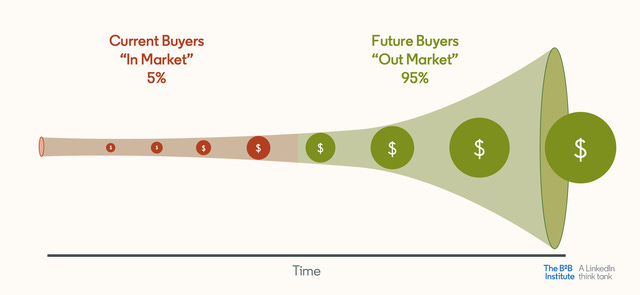
The man in the chair told the salesman that his name meant nothing because his company’s name meant nothing. B2B has spent more than sixty years quoting him approvingly and then spending its money as though the salesman were the whole story.
He was telling you the fame had to come first. I think he still is.
No posts
Comments
Nothing yet. Say the first thing.
Sign in to join the conversation.