
On October 31st 1851, a bricklayer from Solihull named Richard Manx cried like a child and asked the man standing over him whether he was trying to kill him.
Manx had been walking for six weeks, after setting himself the hardest task the mad Victorian sport of pedestrianism had ever devised: a thousand miles inside five hundred hours.
He walked through the day and through the night, snatching sleep in the gaps and being hauled upright when the next mile came due. He was kept going on game and poultry, roast beef and mutton, strong beef tea and old ale, and tea laced with brandy in the small hours. On one bad morning he woke from five minutes’ rest and punched the person sent to wake him.
But on that final day, after weeping and asking to be left alone, he did the miraculous: he got up. He finished.
And when the course was measured properly afterwards, it turned out he had walked 12 miles more than he needed to.
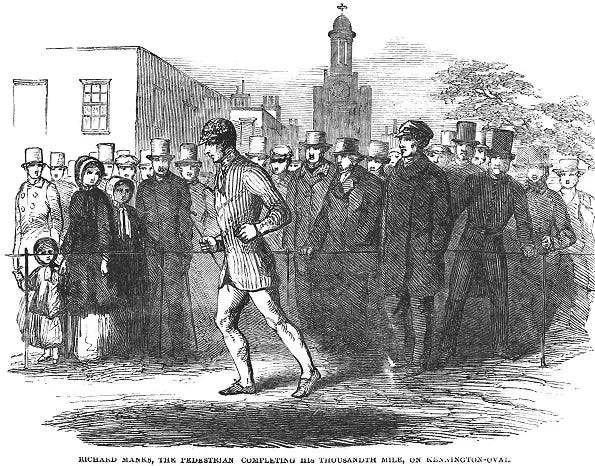
Manx’s story will be familiar to any of you who listen to The Rest Is History, and caught their episode last summer about mad Victorian sport. In it, Tom Holland argues that the creation of The Kennington Oval marks the transition from pre-modern entertainment to modern sport.
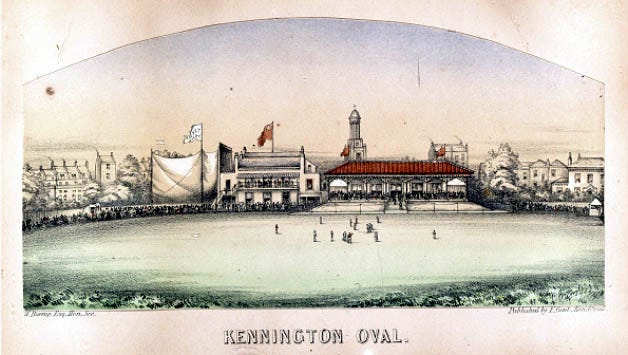
It was just six years old when it was used as the venue for Manx’s feat. By the time he finished, it was full to its three thousand seat capacity, and the surrounding streets were lined with people who couldn’t get in. It was a boon to the consortium that established it, and they made decent money. But the Oval’s finances were precarious during its early days and it had to be saved from developers twice.
What made it the progenitor of the sporting landscape we would recognise today was a single commercial insight, and the man who had it most clearly was Charles Alcock, secretary of both the Football Association and Surrey County Cricket Club. In 1872 he invented the FA Cup and staged the first final at the Oval, which went on to host nineteen FA Cup finals in total, the first football and rugby internationals, and in 1880 the first cricket Test played in England.
But underneath the romance was a business model. A one-off fixture pays you once, but a league or a cup pays you every week, because it manufactures a reason for the next match, and the one after that. The Football League was founded in 1888, and its great innovation was the fixture list. For the first time, grounds up and down the country knew which teams would be playing when, months in advance. It changed the economics of the whole enterprise.
The Oval was the first great ground to run itself as a business rather than a gentlemen’s leisure amenity. Soon enough, entrepreneurial football patrons across the country were expanding their own ground to accommodate, and monetise, the demand for weekly football.
I was thinking about this when the FIFA furore kicked off last month. In case you’ve been living under a rock, Gianni Infantino announced a plan to fold FIFA’s tournaments into a new company valued at roughly twenty billion dollars and to sell about a fifth of it to private investors, among them a firm run by Joshua Kushner. He then had to swiftly cancel the plan after UEFA voted to boycott the World Cup and said the plan put football’s soul up for sale.
On the terraces, fans have a shorter version of the same complaint: “the game’s gone”. Both objections rest on the idea that underneath all the money, there is something purer, older and truer than the commerce, which the commerce now threatens to defile.
I’m no fan of Infantino’s scheme, the way he went about it, or the proposed buyer. But what I’d question is the idea of ‘pure’ sport that money will inevitably spoil.
It’s wider than football. Take the origins of cricket: it grew from a loose village game into the codified sport we know today on the back of gambling; the connection was so open that in 1664 Parliament felt the need to pass an act limiting a single wager to a hundred pounds. Through the eighteenth century the game was run by wealthy patrons who hired the best players they could find to help them win their bets, and in doing so created the first professional cricketers, who were paid not to honour the game but to protect an investment. The first proper rulebook, drawn up at the Star and Garter in Pall Mall in 1744, was written primarily to make the gambling fair and the disputes settleable.
Football is different, in that its codification was largely motivated by a need to resolve conflict between those who wanted to play the Cambridge game or the Rugby game, with matches frequently breaking down into screaming arguments because neither side could agree on the legality of handling or hacking.
The Football Association was founded to create a single set of rules for the game, and its first members were mostly upper-middle-class men who viewed sport as a tool for character building, discipline, and healthy exercise. They aggressively resisted commercialism and professionalism for decades, with an attitude to sport that would later come to be known as The Corinthian Ideal.
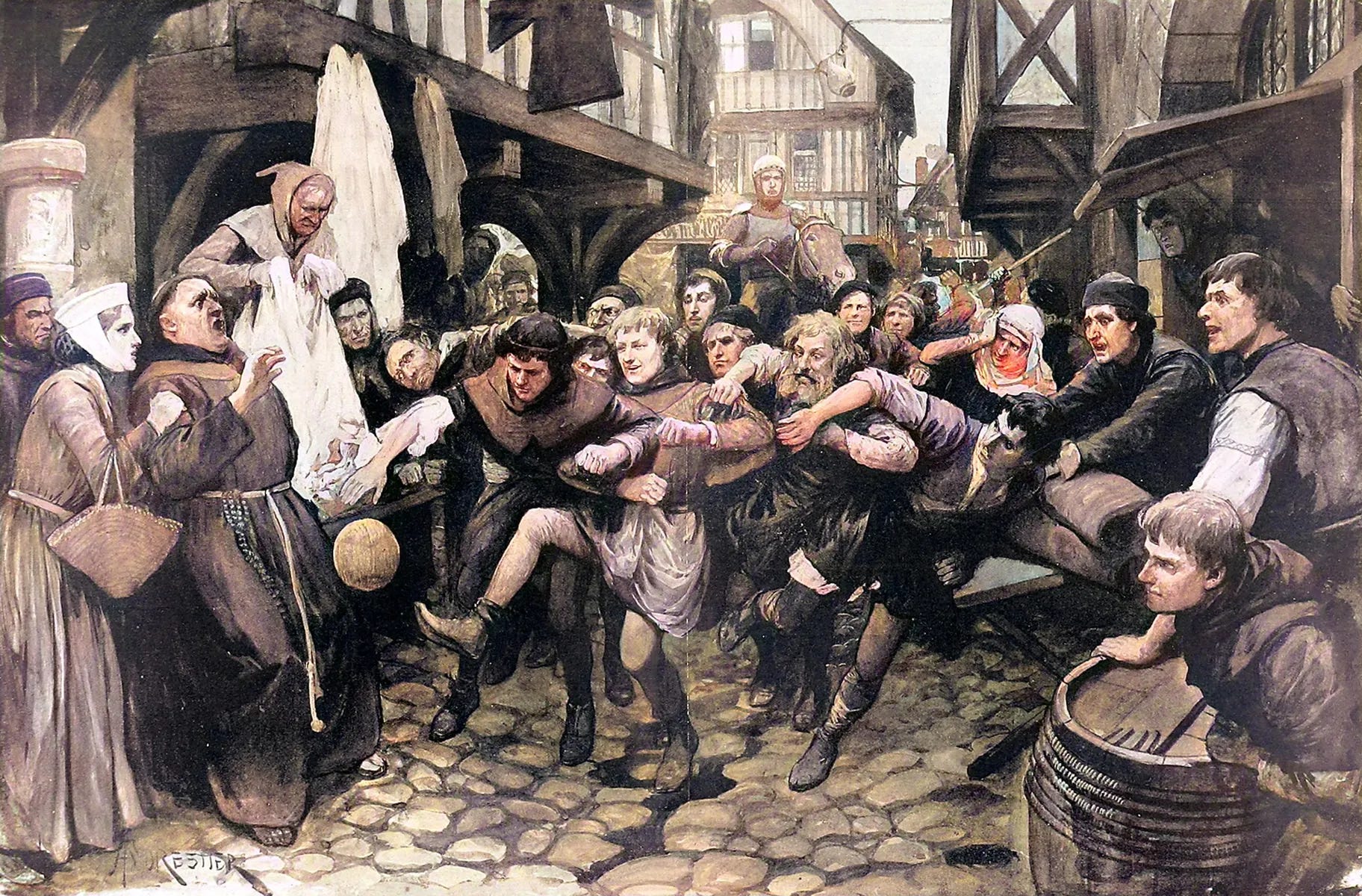
Its tempting to view this as evidence of a pure, anti-commercial, founding principle of football. But note who those people were; they were not ‘the people’ UEFA is currently arguing football belongs too. They were well-to-do professional men and ex-public-schoolboys, playing a very different game to what constituted football at a street level, which was more like the Shrovetide football still played in Ashbourne, Derbyshire to this day.
The upper-class belief in the Corinthian ideal was itself a direct product of the public school system, and George Cotton is the man usually credited with introducing organised games to English public schools. He taught under the influential Thomas Arnold at Rugby school before arriving at Marlborough College in 1852. It was the year after the “Marlborough Rebellion” of 1851, in which pupils protested against harsh discipline and chronic hunger with four days of anarchy and a coordinated explosion of fireworks. It sounds quite the scene.
“On the signal the school appeared to blow up. The court became ablaze with fireworks, and fireworks shot from every building. Mr Wilkinson, rushing out in a state of extreme agitation, had a bottle full of gunpowder exploded behind his back and rushed back. The other masters were equally powerless. Chaos reigned all night. The long corridors of B House echoed to ceaseless detonations. For two days the college reeked of gunpowder and smoke drifted through the smashed windows and broken doors. The authorities were paralysed.”
Gathan-Hardy, The Public School Phenomenon, Harmondsworth, 1979
Wilkinson resigned soon after, and Cotton took over. The first thing he did was clamp down on drinking. After that, he realised sport channelled the boys’ energies and introduced organised, staff-led games, and he was the first person to appoint masters specifically to supervise sport. Harrow and Uppingham quickly followed suit, and their influence transformed the public schools adoption of sport. From there it hardened into the ideology called athleticism, consolidating from the 1850s through the 1880s, leading to the codification of many sports at the end of the 19th century.
The public school approach to sport became a central pillar of the British Empire's geopolitical and imperial strategy. The historian J.A. Mangan argues that it acted as a highly effective human resources tool, manufacturing the ideal workforce for the fundamentally commercial enterprise of global imperialism.
The prefect system used on sports pitches taught boys how to govern peers and manage large groups. The physical conditioning and psychological indoctrination of the playing fields was viewed as directly translating to military success; it was famously claimed that Wellington said the Battle of Waterloo was “won on the playing fields of Eton” (although those words were likely put in his mouth).
Nevertheless, the concept of “fair play” and “doing the decent thing”, again honed on the sports pitches, became a valuable corporate brand that lubricated international commerce. And, by exporting codified sports like football and cricket to the colonies, Britain broke down local cultural barriers and integrated conquered societies into the British economic orbit, extracting trillions of dollars of wealth in today’s money in the process.
Maybe not such a pure origin story after all.
When football clubs began forming out of ordinary life in the 1870s, they came overwhelmingly from the workplace and the church. West Bromwich Albion started at a spring works, Manchester United among railwaymen at Newton Heath, Arsenal among munitions workers in Woolwich.
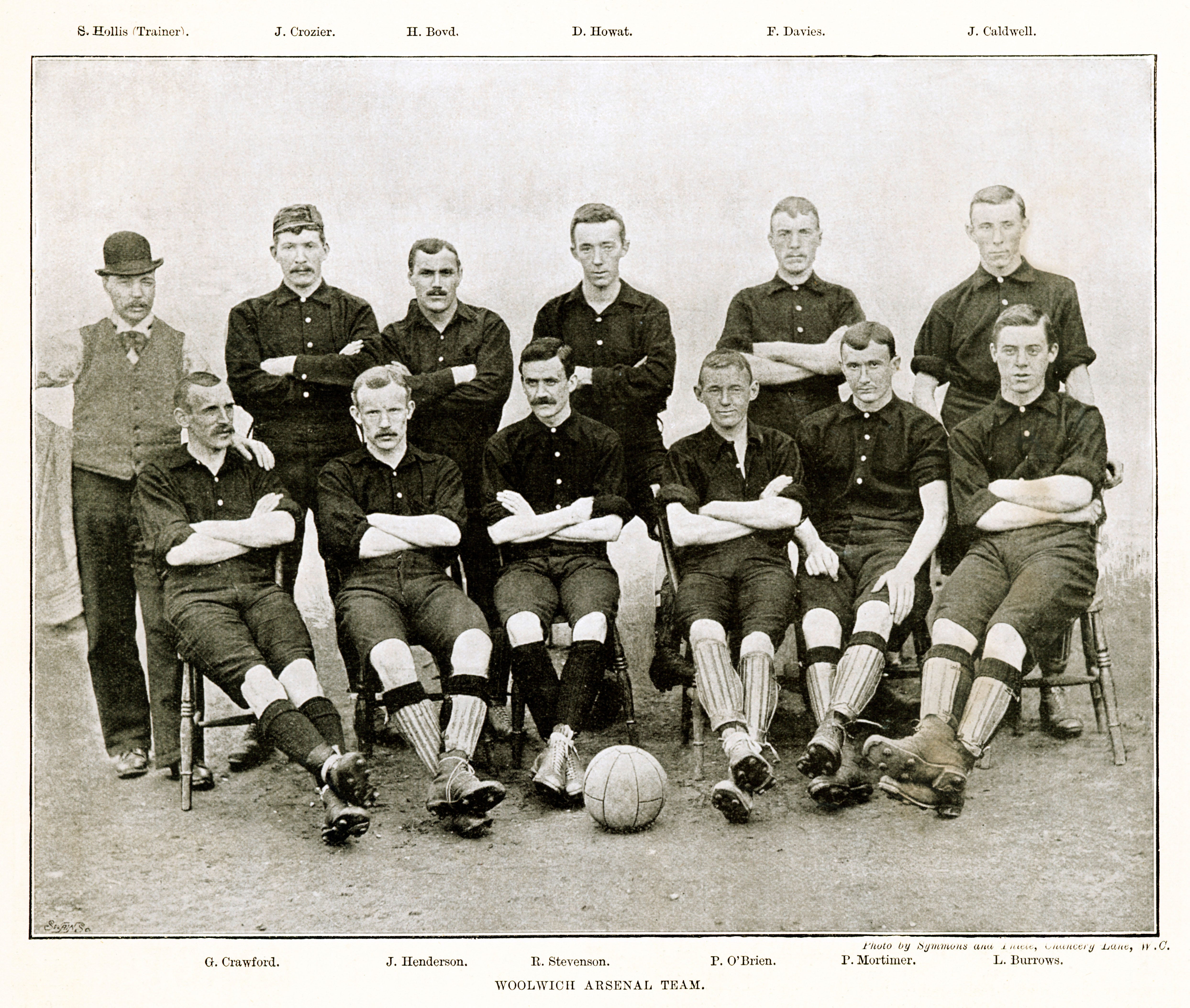
This meant the first owners of the football clubs the workers supported also owned the factory they worked in. An employer who backed a team got his workforce entertained, kept off the drink and away from the union meeting, and got the reputational benefit of being perceived as a benefactor in a town where he was also the man banking the profit from the labour.
The churches, from which Aston Villa, Everton and Manchester City all sprang, wanted young men occupied, sober and morally improved, and worked hand in hand with the factory owners who wanted the same. All of it depended on the working man having a free Saturday afternoon, which was itself recent and hard-won. Free time was created, then filled, then sold back.
None of this was new even then. As far back as Roman times, games and circuses were paid for by magistrates and emperors who wanted the crowd’s affection and a return on the outlay. Tom Holland makes the point that sport has become a way for entire states, not merely rich individuals, to project power and prestige. There is nothing modern in it - the visible funder of sport has always been buying something other than the sport.
So the pure thing everyone reaches for, the soul being sold or the game that has supposedly gone, is the one thing there isn’t any real evidence for at all. Which means commercialism is one of the foundational pillars that sport, as we know it, was built on.
The hardest part to accept is that even the idea of sport for the simple joy of it is as much a product of the same forces. The Victorian reformers were frightened of working-class free time, and their answer was organised recreation, pushed by schools, churches and employers who wanted a calmer, fitter, more governable population that used their time “wisely”.
And while there are undoubtedly naturally occurring competitive urges in human beings to see who can jump the highest or throw the furthest, the taste for organised sport was not an innate constant waiting to be freed. It was promoted, by emperors, companies, churches and governments who found it useful, and it spread because powerful people wanted it to. By some amazingly lucky coincidence it turned out to be one of the top five things human beings have ever invented (the other four are punk, acid house, poppadoms, and Back To The Future, if you’re wondering).
But let’s not pretend their motivations were pure.
Talking of Back to the Future, there is a scene Part III where Doc, stranded in 1885, gets drunk and tries to explain the coming century to a saloon full of cowboys. In the future, he says, we still run, but we do it for recreation, for fun. A grizzled old timer stares at him and asks, “Run for fun? What the hell kind of fun is that?”
The joke is meant to be on the old man, but it’s an interesting question. Running for fun is a strange, recent, manufactured idea, and somebody would need to sell it and the shoes to do it, in just the same way somebody sold a Victorian walking race, a weekly league, a works team and a World Cup.
The game may have always been beautiful, but it was never pure and then lost.

I had great fun chatting with my former Iris mucker Rob Voase for his Everybody Hates Your Brand podcast, and it's dropped today.
We cover sponsorship's effectiveness gap, how sponsorship can be directed towards solving almost any marketing challenge, and how the best use logo exposure as the foundational layer of multi-channel, fame-driving campaigns. You can
No posts
Comments
Nothing yet. Say the first thing.
Sign in to join the conversation.