
Welcome to the second issue of The Spiral Lab Magazine! This issue’s theme is Manifesto, inspired by a manifesto shared by TSL Collective member Aileen.1 She originally wrote her piece at a Buddhist retreat from a prompt offered by the poet Linda France, a prompt which Aileen shared with the rest of the collective. One of the questions in the original prompt was “What is worth walking toward?” which feels to me (Marta2, editor of this issue) like one of the most important questions we can ask ourselves these days. As a collective, we came together for a workshop of manifesto-making, and the results are delightfully wide-ranging:
Manifesto, by Aileen (the original inspiration for this issue)
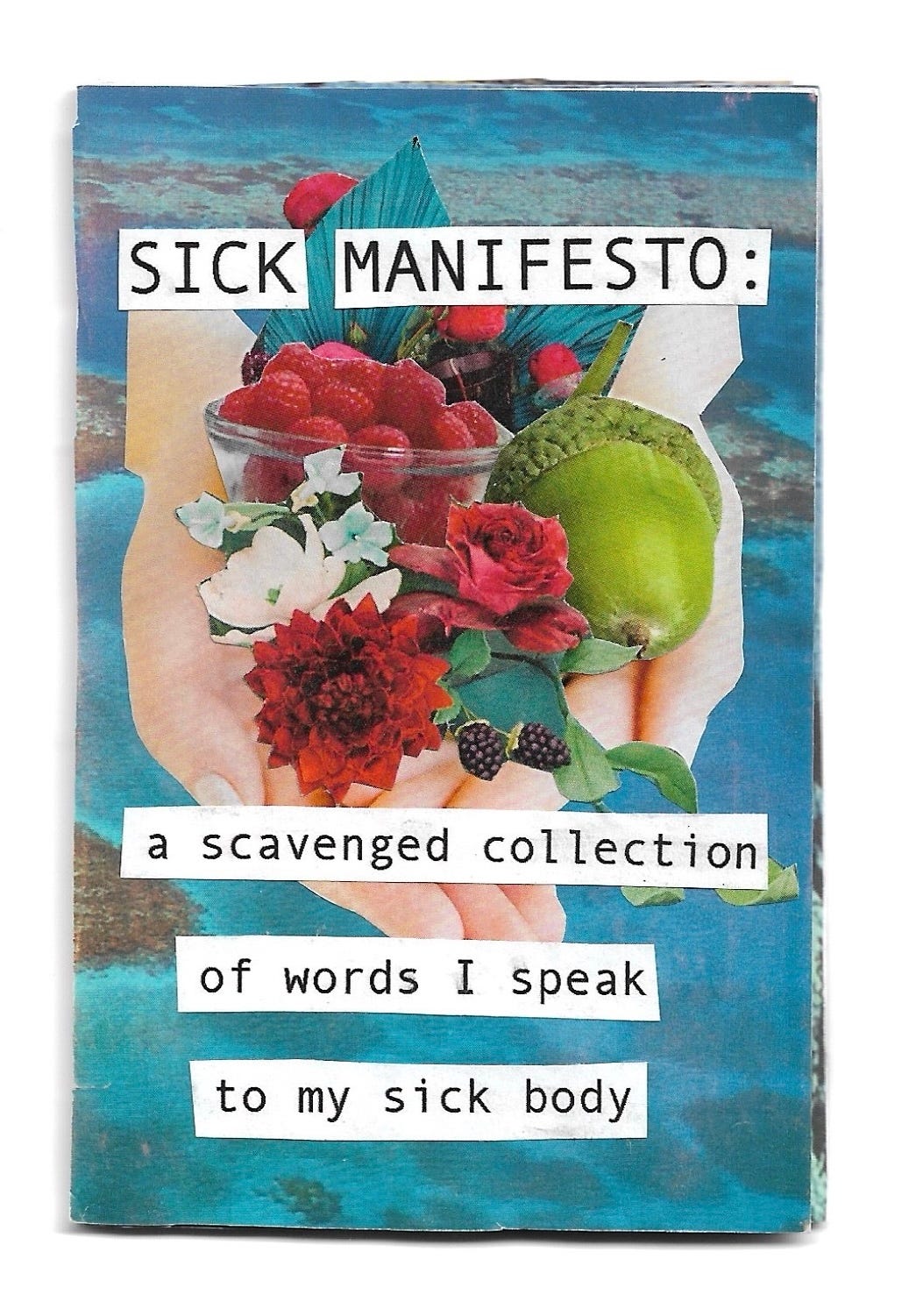
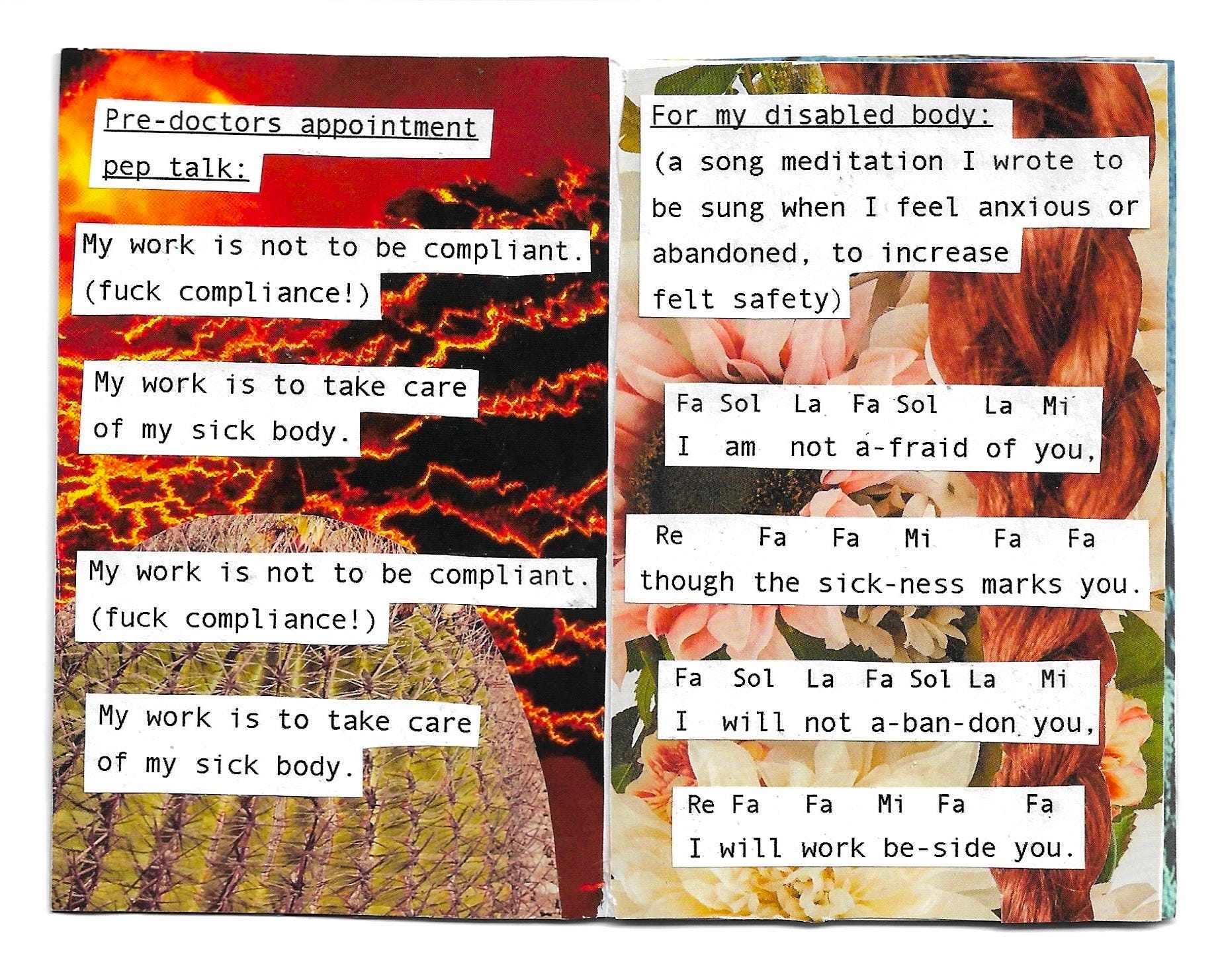
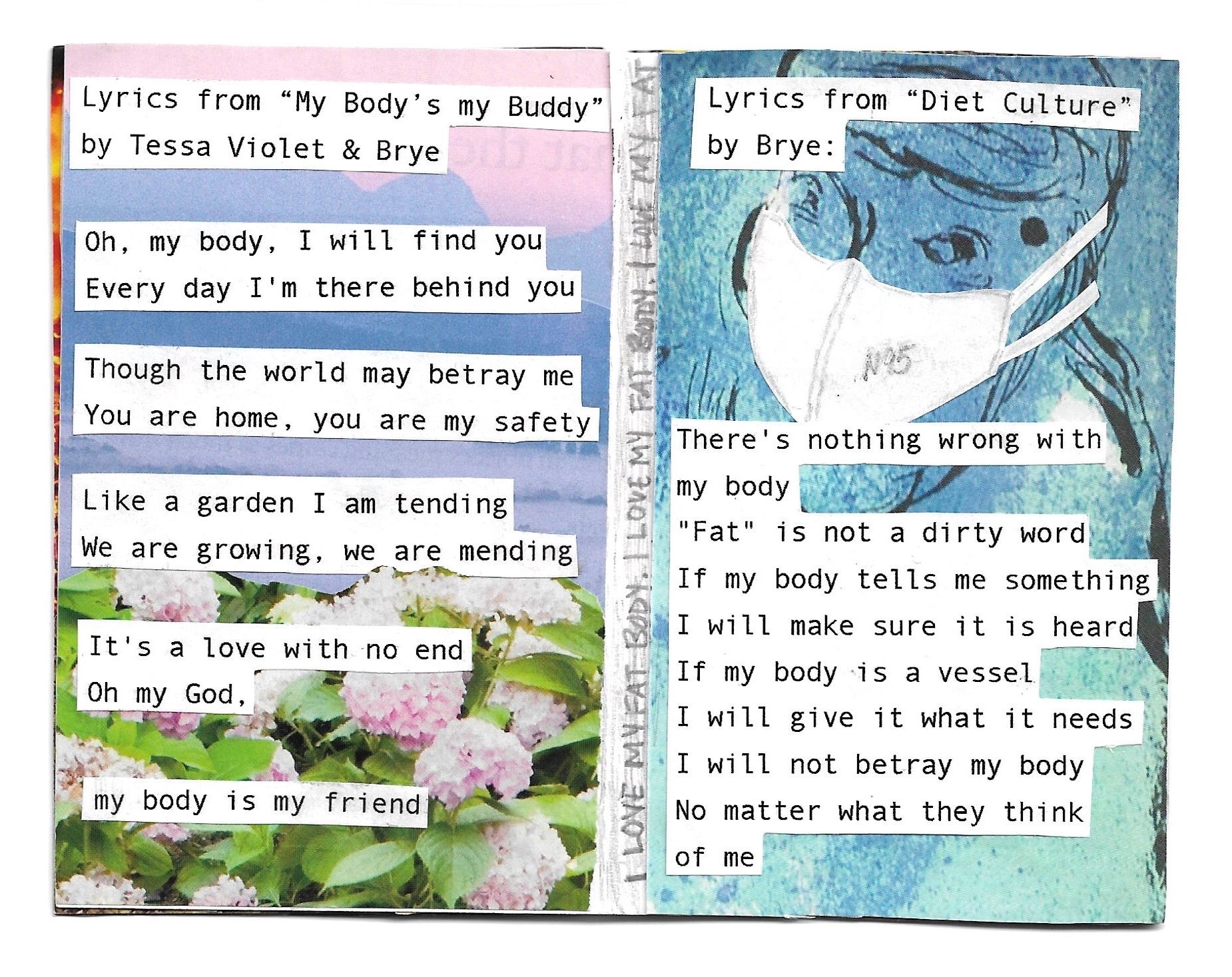
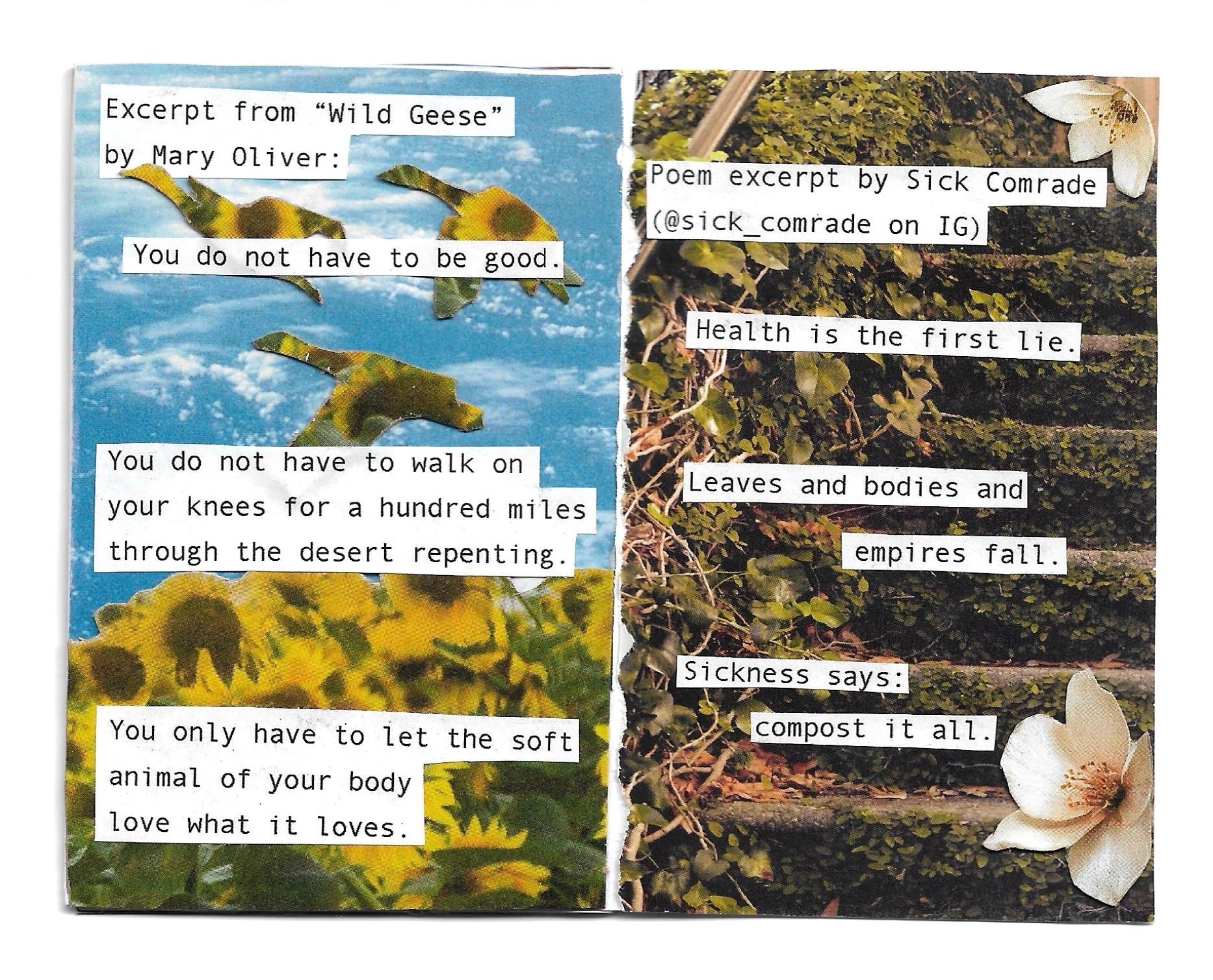
Sick Manifesto: a scavenged collection of words I speak to my sick body, a zine by Mylo3
Manifesto of a burnt-out AuDHDer in a burning world, a poem by Poornima4
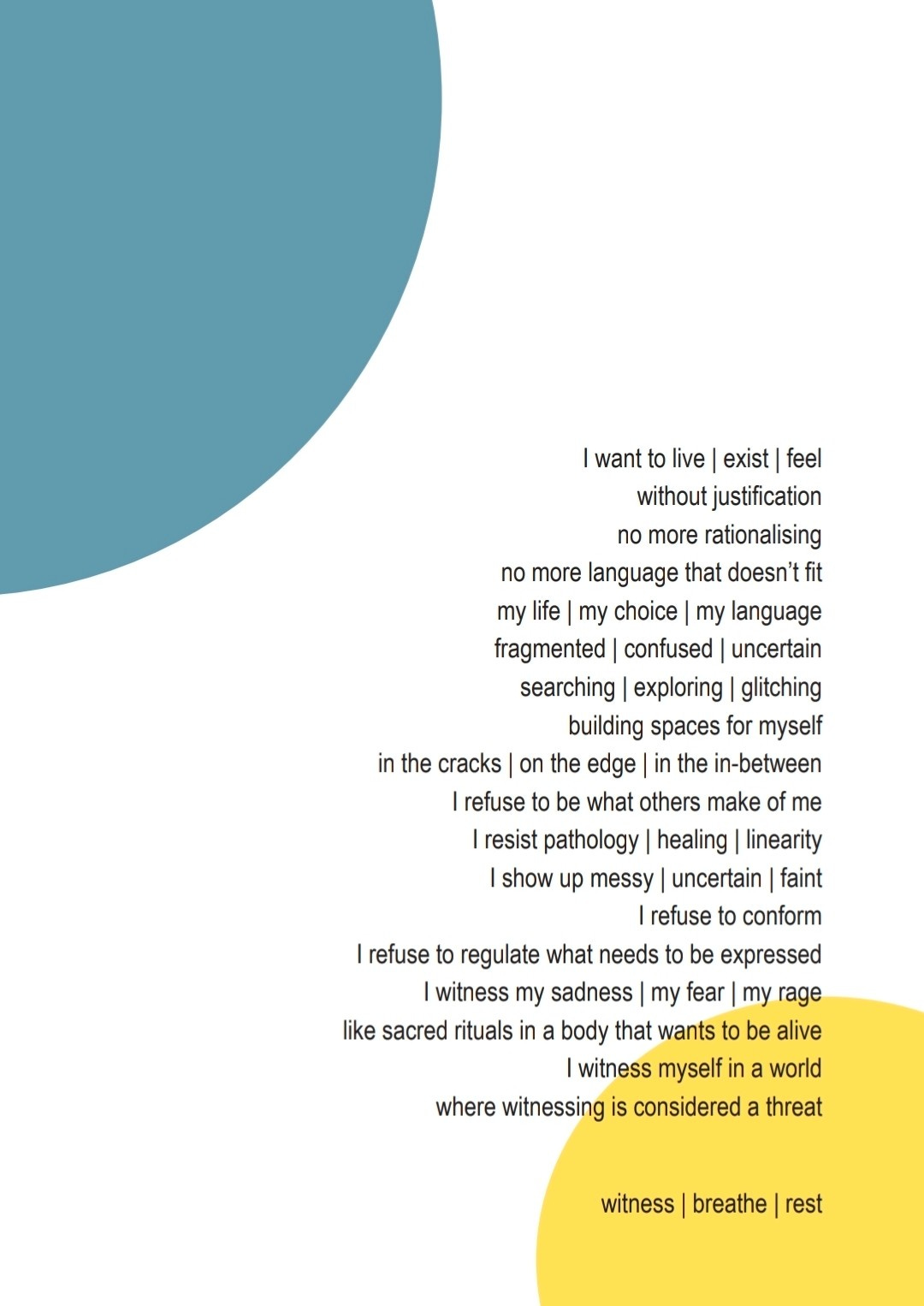
I want to live, a poem by Le*ah5
Manifesto? a meditation on the OCD brain as a living manifesto, by Céol6
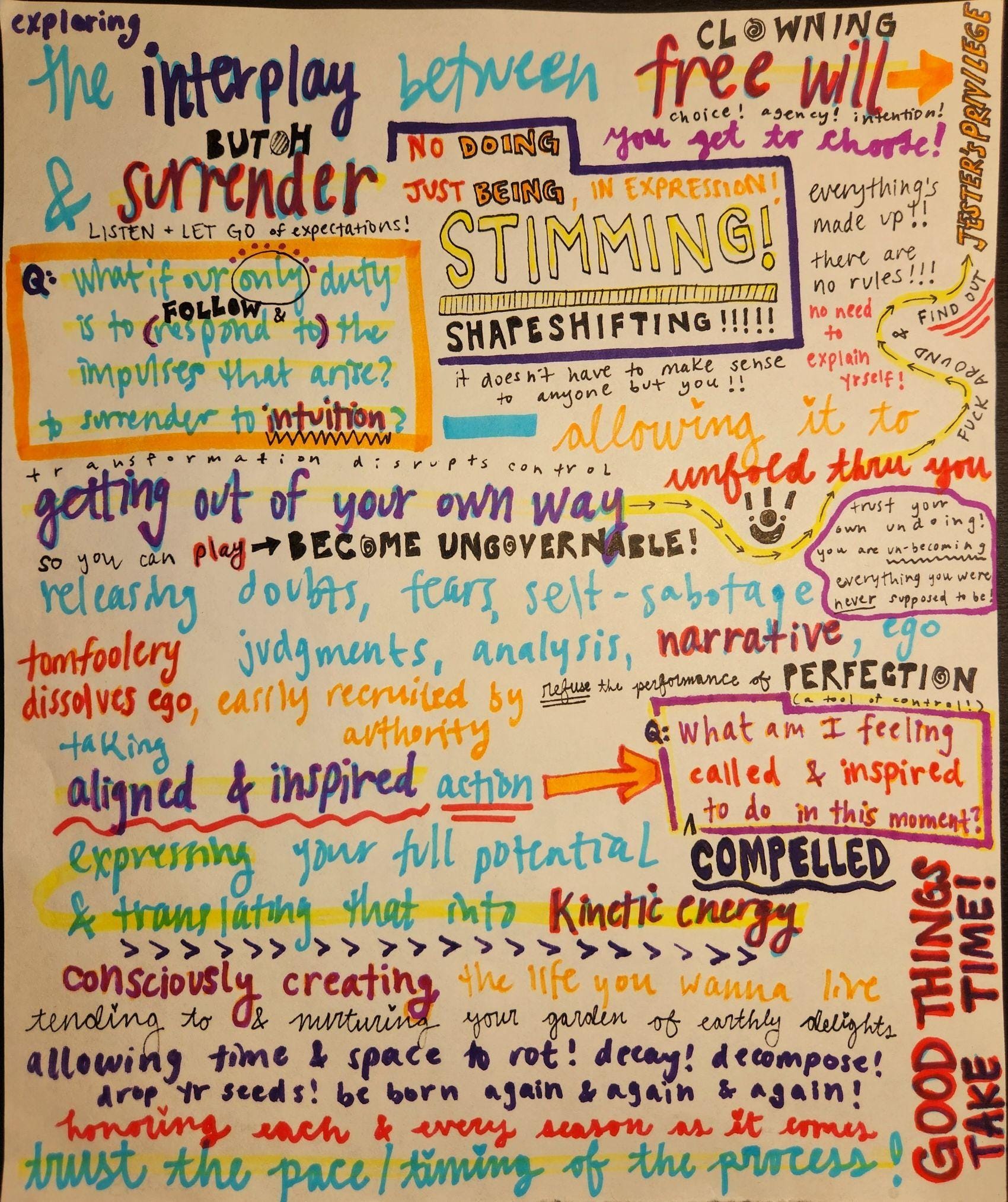
a manifesto on free will and surrender colorfully handwritten by a. wunder7
We Were Never Singular, speculative fiction by Le*ah.
I (Marta) was not able to finish my own manifesto, partly because I have spent the past month and a half wrangling with the Department of Human Services over our health insurance benefits (read: lots of bureaucracy, quite a bit of anxiety, all my bandwidth), and also because the more I explored my topic, the more complicated it came to feel … and I missed my own deadline! But that’s how we roll here at the Spiral Lab Collective—we work in crip time/spiral time, and sometimes good enough is good enough. Which, appropriately, is the topic of my manifesto, a zine about enoughness. I still plan to finish it. In fact, I would like to invite you to participate—in my manifesto-in-progress on the topic of enoughness, or in your own manifesto on any topic you like! Next week, we will offer some journaling/art invitations, and in the coming weeks, once again we will offer a free workshop where you can begin to create your own manifestos, which we would love to share (with your permission) in the final “readers respond” post in this issue cycle.
To resist all attempts at assimilation, conformity, being squashed into too small a box, the devastation of capitalism, insane justifications and downright lies.
To resist the desire to be liked, admired, looked up to and the accumulation of more things than I need in order to blank out things I don’t want to think about - the injustices, the corruption, the abuse, remembering what I know and what my body knows, that there are things worth fighting for, that truth matters, that what I do affects others, that I can make a difference.
Remembering that community matters, that words matter, that silence matters. The space between things, pausing for breath, for healing, for creating connections. For time to sit in the garden, by the overgrown pond or in the orchard where the apples are now ripening, reminding me that everything happens in its own time and sometimes all we can do is plant seeds and wait for them to grow. To make time to notice the golden sunlight filtering through the trees, the song of the robin, the patchy blue sky.
To make time for stillness, for being with my breath, with metta, for the feel of bare feet on cool wet grass. Earthing myself, not losing myself, gaining strength from connection, not being alone because everything is connected to everything else.
Remembering to write, to pay attention. Not being too much in my own head or caught up in a story. There is only this moment, then the next, my breath, my pen, my heart, my voice. Remembering to stay connected to life and to what matters most.
Someday I want to be able enough
To go to protests and public hearings,
To volunteer regularly for causes I believe in.
But until the time I gain that capacity,
I will resist the system in quiet ways
I will center my needs over patriarchal and capitalistic demands
But when masking is a necessity,
I will hold on to the memory of my real self
I will lean on my communities to help me remember.
I will rest and recover
I will rediscover my lost joy
I will remain curious and ask questions
I will show my passion without shame
I will love my special interests,
Even when no one else does.
I will balance my need for safety and rest
With my need for action and expression
I will flaunt my wild hair, curly and grey
In the face of racist and misogynistic taunts
I will speak up whenever I can
And when I can’t,
I will amplify the voices of those who do.
I will stay with my anger to protect
To fight against oppression
I will stay with my grief from witnessing,
So that I have the strength to hold on to my anger.
(Detailed enough OCD thought process after the list -- please take care of yourself ♥)
Upon learning that the next topic would be manifestos, and that we were invited to write our own manifesto, I got confused. Why? No clue yet. I knew what a manifesto was, and still looked up some examples. It did not help—after all, I do know what a manifesto is.
The problem was something else: I had too much to write about. I could write a manifesto book, full of manifestos. But where should I start? What should I include? And, more importantly, what should I not include, knowing (or at least strongly believing) that you, the reader, probably does not care for 150 pages of manifestos.
I was raised in France, and while French has a direct translation for manifesto, the verb manifester (read mah-knee-fest-EY) also means to demonstrate, to protest. Also, French has a culture of manifester and striking. My first manifestation could have been first year of high school. It was not, because I was a well-behaved, far too obedient autistic kid who did not believe they had the right to miss school, and also did not have any kind of access to the news. It was, however, the first time I saw manifestants (protestors) come back from a manifestation. I was 14, and I saw my classmates come back with red, swollen eyes. Tear gas.
In college, I got the chance to manifester on a couple of occasions. One was happy and went rather well (we agreed with the government, might have helped.) One felt serious, the first time I felt like I was openly manifesting for my rights. Went well, until we got to a big square and a friend got news that the police were coming to nasser (nah-SAY, a nasse is a fish trap) us, which means there were coming from every street at once to trap us and scare us and pepper spray us and maybe worse. Our group divided in half, I was in the half that went home. A few protests later, the friend who had warned me about the nasse would be wounded by the police, and was still disabled the last time I saw them, some 8 months later. The last manifestation I took part in I was not able to do all the walking required, and needed help from 2 people in order to get back home. I no longer participate in manifestations, so that the two people can take part as long as they want, which is in turns more efficient in having more people protesting (not saying that disabled people should not be protesting, just that it is so much harder, requires me to rest for days or weeks, and that I find it more efficient to direct my energy elsewhere. That being said, if you’re not disabled and see disabled people at a protest, please consider the extra amount of energy they’re using, make the protest more accessible if you’re organising it, and be a decent, respectful person by not moving people like you would objects).
So I grew up surrounded by a culture of strikes and protests. And what is a protest, if not the gathering of people around a shared manifesto? Should I write all the manifestos of every protests I’ve ever been to? Plus manifestos about protests that should be happening, but are not? Plus manifestos about my own being?
You may be wondering what were those manifestation manifestos. What were those protests about? I can’t even remember. Probably minority rights, workers’ rights, maybe for the planet as well. I may have gone on strike too. More rights. No to fewer rights. Change. Respect.8
Can’t remember. It’s not that I did not care—I did, intensely. And so do I when I write a piece. So do I when I spend 2 hours explaining what being trans or disabled is not, and what rights we need. So do I when I spend 300 hours volunteering every year. So do I when I bring a cake for a fellow volunteer who’s on the verge of burning out. So do I when I take the time to question my potential prejudice, and gather the courage to question my friend’s (or doctors, or...) So do I when I try to take care of myself and others, when I try to not set productivist deadlines, when I try to understand where people are coming from. So do I when I lend a book. So do I when I spend 15 hours creating crosswords every month, because crosswords are made of fun definitions one doesn’t question while relaxing, even though definitions shape perception. So do I when I facilitate workshops about issues that are dear to me. So do I when I choose the topics for my creative writing workshops. So do I when I think.
So did I when I decided to stop buying plastic at all yesterday.
When I decided I would be making my own fermented vegetables, a year ago
When I decided to kind of stop buying plastic, 2 years ago
When I decided to try and stop judging myself for doing stuff that have a negative impact if the alternative is not living because of a lack of disabled-friendly alternatives.
When I decided to stop buying books mainly by white privileged men, just because it so happens all the most famous ones are written by white men, but to make the effort to dig deeper and learn about less famous, marginalised authors, whose voice deserves to be heard and is often more interesting. I now need a pretty good reason to buy books from white privileged men.
When I decided to subscribe to a small farmer, 3 years ago, and buy only local food.
When I decided to stop buying to billionaires and to only buy in small shops
When I decided to watch videos in 360px max (144 when there is no writing), because more feels like luxury and a waste of resources.
When I decided to boycott Amazon, 7 years ago. Which was also when I decided to buy presents either second hand or from artists / craftspeople or occasionally from NGOs.
When I decided to boycott Israel, 10 years ago (for context, there wasn’t huge lists like today, so I mainly boycotted hummus from Israel, which is honestly not as good as homemade hummus and frankly overpriced. It’s a bit harder now that people have made those huge lists available, still stuck on finding a feasible alternative for the one website i was still using)
When I decided to become vegan
To stop eating foie gras (age 16)
To stop eating anything that had palm oil in it (age 13) (Well must have known about some news, then)
This list I wrote from memory. So it’s probably the ones that took most effort, or that are still ongoing, coupled with the first ones. Some were probably easy enough that I don’t even notice anymore. Some would probably have deserved to make it to the list - well, they all should be there because I care about everything* - but we’re not writing 200 pages today, right? I say before editing the list to make it longer because this really deserves its spot - and this too, and - ok, I’ll stop.
* at least I try to, but it’s hard to be aware of every issue, but I do try to be aware of everything and read far too much depressing stuff for my nervous system to handle, as I do care about being aware, which still does not mean I can know everything there is to care about on Earth. Even though I try and - of course I’ll never know everything, time to stop, brain.
The thing is, I have OCD. And my brain judges me baaad whenever I become aware that I was doing something bad, and that, had I cared, or known, to look into it earlier, I would not have been complicit. My brain would judge me even worse were I not to do my utmost possible to stop said bad action immediately. That little piece of internal monologue, right before? that’s my brain judging me for not knowing very important stuff that I might be able to do a tiny little thing about, were I to know about it (deep breath out, deep breath in)
My brain races, spirals down, searches the internet for hours, even days on end. My brain wishes me dead when I realise I’ve failed. My brain would probably have me dead were I not to follow up on what I’ve found (Huge recent improvement, my brain is now able to recognise when I’ve genuinely tried my best, and when I’m in the midst of an ongoing process that cannot happen at once (but should still be actually ongoing, right?) and let it go accordingly) (if you don’t stop trying i’ll let it go).)
What is the problem, why does it matter, what can I stop doing, what can I do.
For I will not be complicit.
I cannot be complicit with the state of the world. With this level of systemic violence, in (almost?) every single existing system
I cannot face myself if I haven’t done every tiny thing my disabled body and brain can do to do their part.
I cannot bear the idea of leaving the Earth feeling guilt (I could honestly work on trying to feel proud rather than not guilty)
Before I started working on my OCD symptoms, I somehow had the belief that every person I had ever met, or crossed path with, would, after their death, scrutinize every single action, every single thought I’ve ever had and judge me on it (this may have started after my grandmother’s death, thinking she was watching over me?). I needed to be able to stand by any of my thoughts / actions.
This is not a moral prowess, it is a survival mechanism.
I’m not trying to be perfect to brag, I’m trying to be as little imperfect as possible so I can endure living with myself (endure be proud).
My OCD brain is a living manifesto, ready to protest anything unfair. I have to remind myself that rest is productive, aaaand productivity is a capitalist concept so fuck it, rest is not productive, rest is radical change. Rest is more time to not produce, to reflect, to process thoughts, to create art, to share, to share thoughts, knowledge, skills, fights, struggles. Or just to be bored. After all, boredom was an everyday companion until the advent of new technologies and constant entertainment for the sake of advertisement. So now I try to forget my phone (yeah, all that research I’m doing online, and all that following the news too. Hours every day) so I get to be bored again.
The good news is, there are probably just about as many ways to care as I have interests.9
(Do I know what a manifesto is?)
No one knows when the strike began. Some say it must have started in the gut. Others believe it began in the soil, with bacterial networks quietly slowing their work. Fermentation stalled. Immune systems hesitated. The invisible workers that held bodies and ecosystems together began to withdraw.
Humans called it a crisis, a disease. Something to be eradicated.
Only later did they realise it was a strike.
For millennia microbial workers had maintained the planetary infrastructure: digestion, immunity, decomposition, fermentation, mood regulation, atmospheric exchange, and the delicate chemistry of living together. Their labour was constant, subtle, and largely unnamed.
Archival note:
Several yogurt cultures reportedly joined the protests.
After extensive observation, the microbial unions reached a shared conclusion: there was simply too much noise.
Humans had filled their environments and bodies with signals, screens, chemicals, advertisements, constant acceleration, endless extraction. The subtle microbial conversations that once shaped instinct and gut intuition could no longer be heard.
When the microbes stopped whispering, humans lost their gut feeling.
For humans, decisions became strangely difficult. The world grew louder. Human language lost its nuance. Black and white replaced the colours of a more complex world.
And then the dreams began.
Night after night, across the planet, humans started dreaming of cities inside themselves. Lush gardens of bacteria. Fungal threads weaving through neurons. Swarms of microscopic presences arguing, laughing, collaborating.
In the dreams the microbes spoke. In patterns, pulses, unfamiliar rhythms of meaning.
Many human dreamers woke up remembering only fragments.
The first word that could be translated was a signal. It could be felt in the gut, at a bend inside the human duodenum:
tap–tap–tap-tip-tap
Its meaning arrived slowly, but with surprising clarity: “When food [is ready], wash your hands [first].” (Words in square brackets were added for human legibility.)
It was the simplest lesson. Food is collaboration. Bodies are ecosystems. Care for the worlds that feed you.
There was also a second, highly protective layer in that message: Microbes from different colonies don’t mix very well. Please don’t force us to fight our cousins.
Only later did the longer sentences begin.
One day (or was it a night?), the Microbial Council issued a statement.
For several hundred thousand years, the term ‘human’ has been used to describe a particular kind of planetary being. This designation grants symbolic representation to approximately thirty trillion human cells while omitting the hundreds of trillions of microbial citizens responsible for maintaining the collective body.
This oversight can no longer be maintained.
The word human has also accumulated other problems over the centuries. It has been used to define who belongs and who does not, to justify hierarchies, exclusions, and fantasies of singular individuality.
Meanwhile the biological reality has always been clear. What humans call a body is a multispecies collaboration. A walking ecosystem. A densely populated metropolis of cells, bacteria, fungi, viruses, and other small co-conspirators.
Human bodies were never singular.
For this reason, the Microbial Council proposes a linguistic experiment.
Rather than unilaterally renaming the collective body, we invite a collaborative process.
Open Call
Renaming the Multispecies Body
The Microbial Council for Multispecies Affairs invites proposals for new words describing the multispecies collaboration currently operating under the outdated label ‘human’.
We are looking for words that recognise that bodies are ecosystems, that life emerges through entanglement, that no being exists independently of others, that collaboration, disagreement, and co-evolution drive survival, that death and collapse are inevitable for the creation of new forms of life.
The following are early translations gathered from dream transmissions:
Tik-takkidy-tok
A cooperative assembly of organisms temporarily agreeing to move in the same direction.
Sympoiet
A being that makes itself together with others.
Ssss-ssss-s
A lifeform that cannot exist outside its relations.
Polypoeisis
A plural creature composed of many lives becoming together.
These examples are provisional and incomplete. We suspect many better words already exist in dreams, soil, kitchens, forests, microbial colonies, and collective imaginations.
Submissions may be delivered through dreams, fermentation, fungal networks, speculative writing, quiet listening, or the usual communication channels.
We remind applicants that we have been here the entire time.
We look forward to renaming ourselves together.
Signed,
The Microbial Council for Multispecies Affairs
Current membership: innumerable
And if you listen closely tonight,
you might hear it again in your dreams:
tap–tap–tap-tip-tap
Food is ready.
The future is collaborative.
Aileen (she/her) is an AuDHD multi-passionate artist, writer and book collector. She loves mixed media and accumulating more art supplies than she can ever possibly use. She has a tiny museum of unfinished craft projects and lives by the sea in Scotland.
Instagram: @aileenpatersonart Website: theautisticlibrary.com.
Marta is a hermit who plays a writer, artist, teacher, and community organizer on the internet. In truth, she mostly sits on her couch and knits. She is also the editor of this issue of The Spiral Lab Magazine.
Mylo K. Oliver (they/them) is an eclectic artist and vocational human being. They are a tender-hearted and tender-bodied white fatty, and a strong-willed gender non-compliant trans queer. They’re autistic, chronically ill, and an all-round disabled cringy weirdo. They love a crisp caesar salad, watching drama mystery shows, and being overwhelmed with cuteness aggression at the little furry creature that lives in their home.
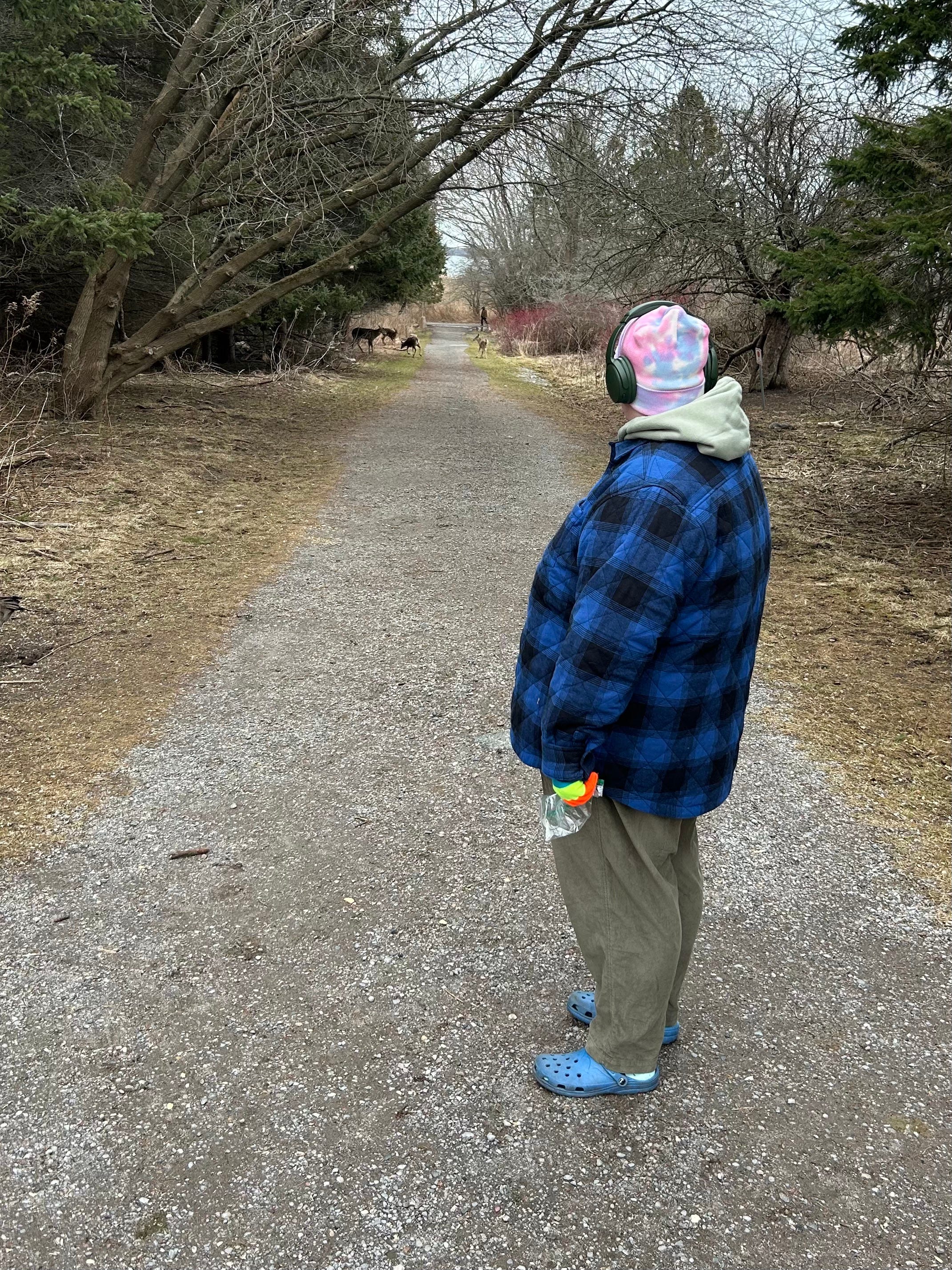
Poornima (she/her) is an AuDHD person living in India. After years of burnout, she is now re-remembering herself through flow, art, and community. Nature walks and stargazing are her vibe.
Le*ah writes from a practice of attentive, non-extractive listening. Their work explores chaos, embodiment, and neurodivergent experience beyond capture, clarity, or completion.
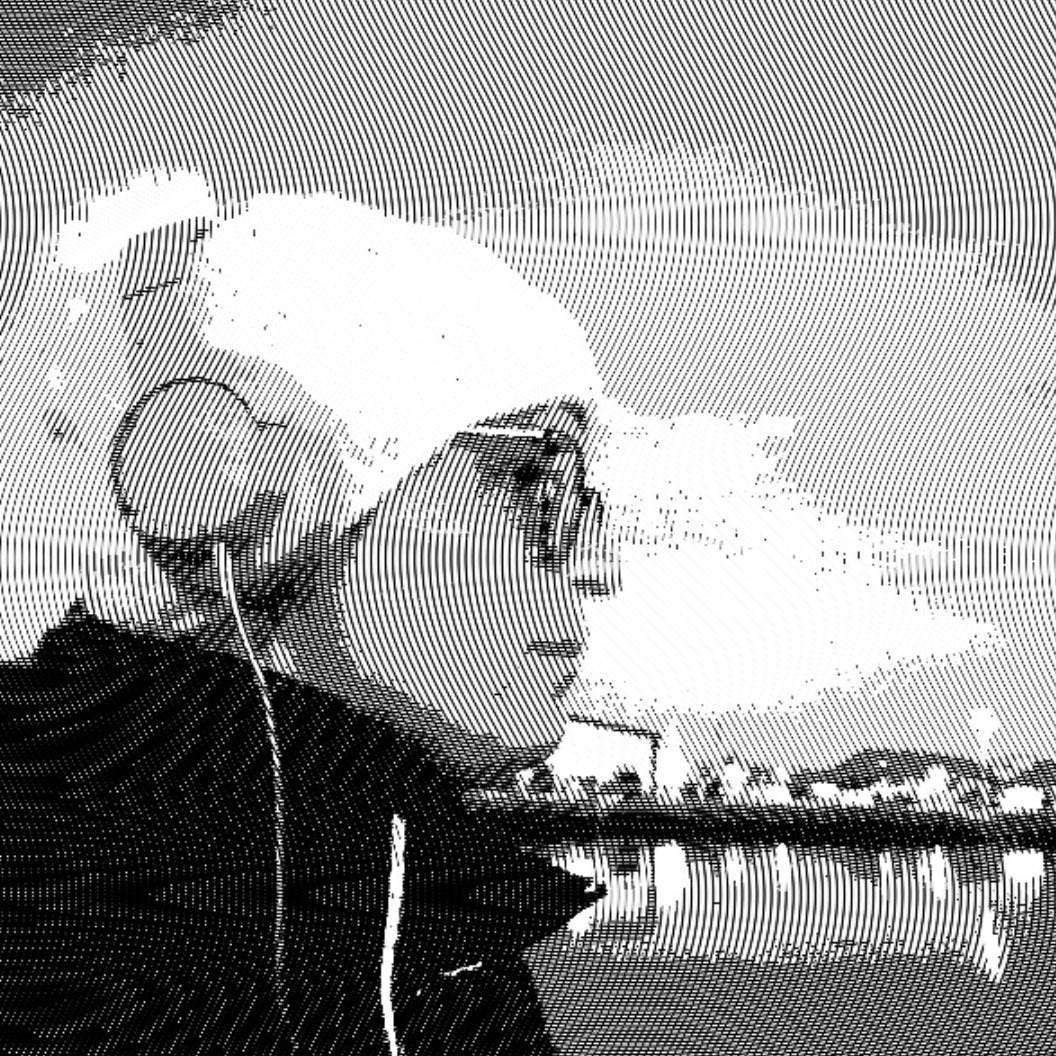
A few days ago, Céol was a kitten inside an old cat’s body, and they will probably be that again, but not today.
a. wunder asks, what is water? it’s a difficult question because water is impossible to describe. one might ask the same about birds. what are birds? we just don’t know!
linktr.ee/vielobst
IG: @uncannyvalleycat
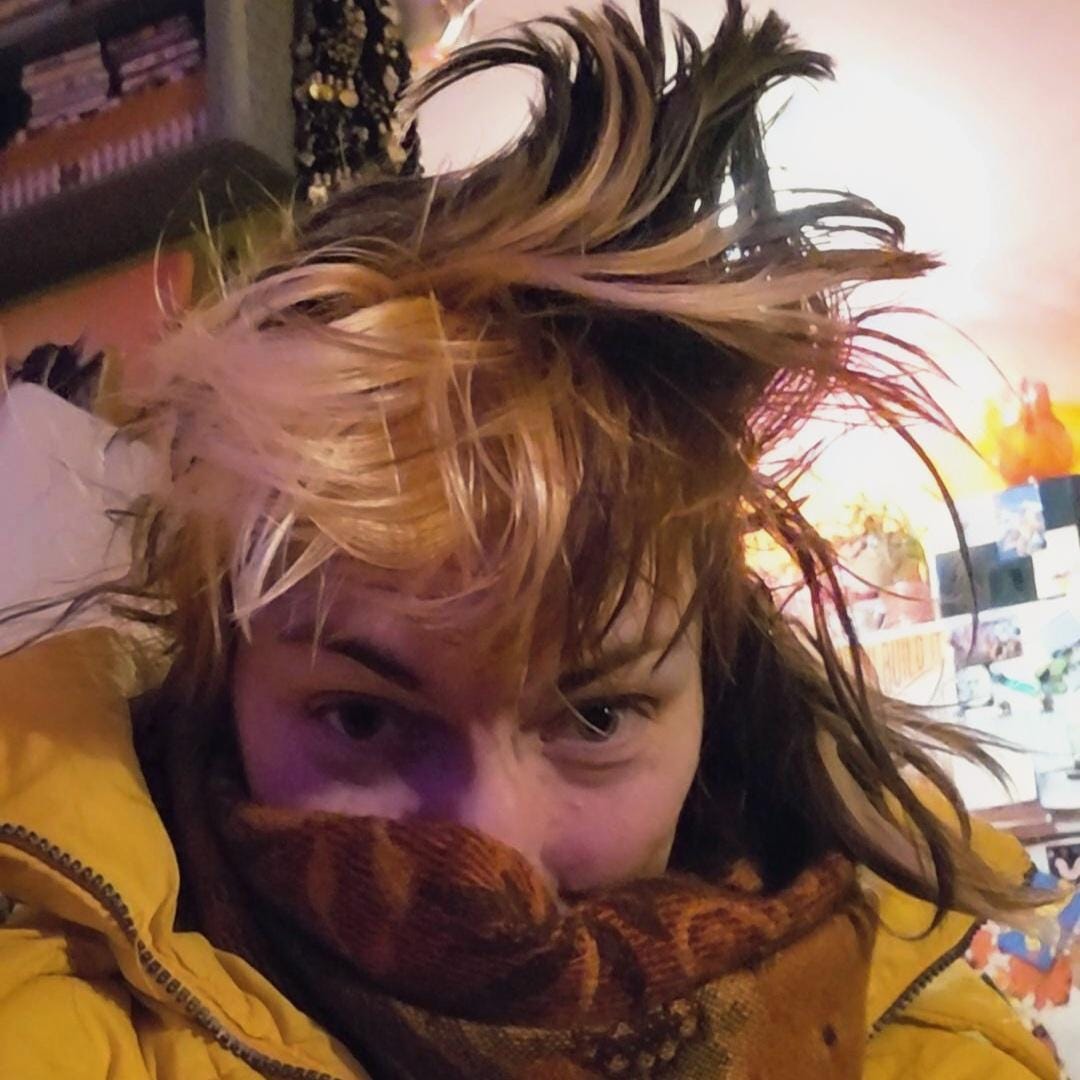
Over the years I’ve realised that there are two definitions of respect - the respect of beings as beings with and in their difference, and the respect of authority. I’m not talking about authority here.
(Also good news, autism me has grown to learn to disobey systemic stuff that has never made sense, and is enjoying the peace of being coherent.)
Comments
Nothing yet. Say the first thing.
Sign in to join the conversation.