

No doubt that I am behind MANY in fully understanding the level that Patrick Byrne is involved in blockchain and cryptocurrency circles. I was working on a separate project about his work in the elections arena and stumbled upon the fact that Patrick Byrne, in addition to all of his election work, is highly knowledgeable about blockchain technology, Bitcoin and crypto. Needless to say, as a BITCOIN maxi & in the election integrity fight, I am completely intrigued.
I have had many conversations with friends in the election integrity arena about my thoughts on blockchain voting. While at this time I am not necessarily advocating for it, I do believe that we need educate ourselves, understand it and be ready, engaged and involved because I DO think that we WILL see this in the future…BUT it is going to be a very hard sell to the American People.
It’s a tough sell…rightly so. Many voters (especially those skeptical of 2020) see “technology” as the vector for manipulation. And who can blame them? Proprietary, closed-source voting machines from a handful of vendors, opaque tabulation software, and centralized databases that no ordinary citizen can independently verify. What’s not to love?
It’s going to be messy…and uncomfortable for many…probably all of us.
So, let’s get to it…
Not gonna lie…he is quite “interesting.” Keep reading, but watch this short video if you have 18 minutes…it is worth your time!

The video traces the dramatic and unconventional career of Patrick Byrne, former CEO of Overstock. It presents him as a brilliant but controversial figure—an entrepreneur with a PhD in philosophy, a black belt, and a history of battling cancer—who became deeply involved in political intrigue, Wall Street fights, and early blockchain innovation.
It covers his rise at Overstock, his early advocacy for Bitcoin and blockchain, his long-running feud with Wall Street over market manipulation, and his creation of blockchain ventures like Medici and tZERO. The video then shifts to the explosive events that led to his resignation: Byrne’s claim that he became entangled in FBI political espionage involving Russian agent Maria Butina and U.S. political campaigns.
The final section explores Byrne’s belief that the global financial system is nearing collapse and that blockchain-based systems will replace traditional institutions. The creator frames Byrne as a visionary whose predictions—however extreme—have often proven accurate.
Patrick M. Byrne, former CEO of Overstock.com, has emerged as a significant figure in election integrity advocacy since 2019, focusing on allegations of fraud in the 2020 U.S. presidential election. His efforts center on exposing claimed systemic vulnerabilities, funding investigations, and promoting reforms to enhance transparency in voting processes.
Byrne’s involvement intensified after resigning from Overstock, where he began promoting theories of a “Deep State” (it exists!) conspiracy influencing elections. He spoke at multiple “Stop the Steal” rallies in states like Florida, Texas, and Georgia highlighting irregularities in vote tabulation and machine security. On December 18, 2020, Byrne participated in an unscheduled Oval Office meeting with President Trump, Sidney Powell, and Michael Flynn, presenting what he described as evidence of election fraud, including cyber intrusions and foreign interference. He also addressed the crowd at Trump’s January 6, 2021, rally in Washington, D.C., urging action against perceived theft, which later led to his testimony before the House January 6 Committee in 2022 and a suspension from Twitter (now X).
A major contribution was founding The America Project in February 2021, a nonprofit aimed at protecting constitutional rights through election oversight. Through this organization, Byrne raised and donated approximately $1.7 million to support the Arizona Senate’s audit of Maricopa County ballots, conducted by Cyber Ninjas. Byrne leveraged its findings to expose potential issues like chain-of-custody lapses, voter roll discrepancies, and machine vulnerabilities, fueling calls for similar forensic audits nationwide. He continues to advocate for The America Project’s initiatives, including voter roll cleanups, poll watcher training, and grassroots efforts to monitor elections, emphasizing transparency to prevent future irregularities.
Byrne authored and self-published The Deep Rig: How Election Fraud Cost Donald J. Trump the White House, detailing his personal investigations into cyber attacks on voting systems, ballot harvesting, and manipulations in swing states. The book draws on whistleblower accounts and data analyses to argue for widespread fraud.
Briefly serving as CEO of Defending the Republic, Byrne supported Sidney Powell’s legal defenses against defamation suits related to her “Kraken” lawsuits, which challenged 2020 results over machine and software issues. His advocacy has faced legal pushback: in 2021, Dominion Voting Systems sued him (along with networks like OAN and Newsmax) for $1.73 billion in defamation for falsely claiming their machines flipped votes. Despite this, Byrne has persisted, joining the ReAwaken America tour in 2021 with Flynn and Mike Lindell to discuss election security and promote audits.
Byrne’s work extends to proposing technological solutions, such as blockchain-based voting systems to ensure verifiable and tamper-proof elections, drawing from his Overstock experience with cryptocurrency when he became the first major retailer to accept Bitcoin in 2013, and heavily invested in blockchain technology through subsidiaries like tZERO, a digital stock exchange platform that attracted investment from Intercontinental Exchange in 2022.
As of 2026, he remains active in disseminating information via his blog and media appearances, focusing on Venezuelan election parallels and U.S. vulnerabilities, while claiming involvement in international affairs that tie back to global election integrity concerns.
His connections in the space are robust: he funded Powell’s efforts, collaborated with Flynn on events and Oval Office strategies, and supported audits linked to Arizona figures like Mark Finchem and national advocates like Lindell. Byrne’s perspective critiques centralized election systems, pushing for decentralized, auditable methods to restore public trust.
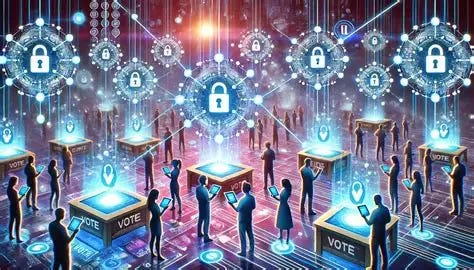
Eroded trust is real and persistent and perception drives legitimacy more than any report. Pitching more complex tech like blockchain to people who just concluded “tech stole it” risks sounding like “the solution to bad tech is different tech.”
I try to be realistic and evidence based when I consider this technology as an option…it isn’t going to be an easy road, but I think it may be inevitable…
So how do we start?
We’ve all heard the stories: proprietary voting machines, closed-source software, centralized tabulation, and a deep distrust that “the system” can be manipulated behind closed doors. For millions of Americans, especially after 2020, the word “technology” in elections triggers alarm bells. Those in the sphere KNOW the truth but “official reports from CISA, courts, and audits found no widespread fraud altering outcomes,” (yeah, sure!) but perception is reality. Trust is broken, and legitimacy depends on fixing that perception.
So how does our government introduce something as advanced as blockchain voting to people who are convinced technology enabled the steal? It’s a tough sell, but maybe not impossible if they approach it with honesty, humility, and facts.
They MUST start every conversation here: “You’re right to question black-box systems. Dominion, ES&S, Hart as these are proprietary machines run by private companies with limited public audits. If experts still debate vulnerabilities in touch-screen Direct Recording Electronic voting machine or internet-exposed components, why should everyday voters just ‘trust us’?”
This shared ground disarms defensiveness. Frame blockchain not as “more tech magic,” but as the antidote to centralized secrecy: decentralized, open, mathematically provable. Today’s systems often boil down to trusting vendors and officials. Blockchain flips that to “don’t trust…verify” for the vote tally itself.
Skip the whitepapers.
The public ledger analogy: Imagine every vote as a permanent line in a giant, shared Google Sheet that anyone on Earth can download and check. Once your vote is added, no one…not election officials, not hackers…can secretly change it without the whole network rejecting the edit. The total is locked by unbreakable math (cryptography), not a company’s word.
The Bitcoin comparison: Bitcoin’s blockchain has protected hundreds of billions in value for over 15 years with zero successful ledger hacks, despite constant global attacks. We’re applying the same principle to vote counts, not the risky fantasy of full internet voting from your phone.
Key benefits that matter to skeptics:
Immutability — Votes can’t be altered after recording.
Transparency — Anyone (journalists, political parties, candidates, you with a laptop) can independently sum the totals from a public explorer and match official results.
End-to-end verifiability (in solid designs) — Voters get a private cryptographic receipt to confirm their vote was counted correctly, without revealing who they voted for.
Contrast it clearly: “The 2020 machines? Closed code, no real-time public audit trail. Blockchain makes the count publicly provable forever.”
Be direct: “The alleged problems came from centralized, secret systems that are easy to target or doubt. Blockchain is decentralized…the opposite! Altering millions of votes undetectably would require hacking thousands of independent nodes worldwide at once. That’s exponentially harder than breaching one vendor’s server.”
Important reality check: The strongest versions aren’t “vote on your phone via blockchain.” They’re paper ballots scanned optically, with vote hashes or commitments posted to a public blockchain for an immutable audit trail. The blockchain doesn’t replace paper, it makes the results forever verifiable by citizens.
Pilots show promise in limited scopes (e.g., West Virginia’s overseas military voting via Voatz) with no tampering reported and higher convenience. But national-scale remote blockchain voting has serious expert warnings (device malware, coercion risks, scalability issues). Be transparent: “It works well in small, controlled uses and here’s the public audit data.”
Blockchain alone won’t rebuild trust. Bundle it with proven safeguards:
Mandatory hand-marked paper ballots plus risk-limiting audits (RLAs).
Strict voter ID, chain-of-custody rules, same-day in-person priority.
Open-source code where feasible plus live public dashboards.
Start small: Pilot in one county under maximum scrutiny. “Watch the code, the nodes, the verification yourself. If it fails, we scrap it.”
Focus on outcomes: Verifiable higher turnout, faster certified results, fewer “stolen election” claims because anyone can re-count the public ledger.
Short, visual demos — 60-second videos of a test election where a skeptic audits the blockchain on their phone.
Adversarial validation — Invite red-team hackers, opposing parties, and independent auditors to attack it publicly.
No savior rhetoric — Say “This adds mathematical proof where trust has broken,” not “This fixes everything forever.”
Target allies — Crypto-savvy conservatives and libertarians already value decentralization and distrust centralized power. Lean into that.
Acknowledge limits — “Blockchain secures the count, not registration fraud or home coercion. We still need ID, audits, and observers.”
Cybersecurity experts agree that Blockchain isn’t a silver bullet. It doesn’t solve voter authentication at scale, endpoint security (your device), or coercion risks. It’s strongest for specific uses like immutable tallies of absentee ballots, verifiable voter rolls, or audit trails in low-to-medium stakes elections.
For maximum trust across the nation, prioritize transparent, auditable paper-based systems with public RLAs first since they’re low-tech, proven, and let non-coders watch the count. Blockchain can supplement where it adds real, provable value.
The path forward? Show the code. Run pilots under brutal scrutiny. Let results, not rhetoric, convince people.
If we want elections citizens can truly trust, we start by meeting people where they are: skeptical, watchful, and demanding proof. That’s the gold standard we’re fighting for…a system people trust.

Can they secure our elections should The People demand it?
The U.S. Space Force (USSF) was created in 2019 specifically to protect American interests in the space domain: satellites, communications, positioning/timing, and the cyber threats that target them. Elections are a civilian, state-and-local function under the Department of Homeland Security (DHS) and CISA as critical infrastructure. The military’s role (including Space Force) is strictly supportive, primarily defending against foreign interference via Cyber Command and NSA partnerships. Direct military control of voting would raise serious legal and constitutional issues (Posse Comitatus, state sovereignty).
That said, here’s a realistic, limited, supportive role Space Force could play in a hybrid paper plus blockchain audit-trail system for elections. This builds on what Space Force already does (secure SATCOM, Positioning, Navigating & Timing (PNT), space-based crypto) and existing military blockchain experiments, without turning Guardians into vote-counters.
Polling places and county tabulation centers could optically scan paper ballots, generate cryptographic hashes (proofs) of the results, and transmit those hashes via Space Force-protected satellite communications (SATCOM) instead of vulnerable terrestrial internet.
Why it helps: SATCOM is jam-resistant, encrypted end-to-end, and designed for contested environments. Once hashes hit a public or permissioned blockchain, anyone can verify totals independently.
Precedent: Space Force already contracts for space-grade encryption (Viasat’s 2025 contract for satellite-to-ground crypto) and has used blockchain firms like Xage Security (2020) for protecting sensitive data across distributed systems.
Real-world parallel: Screven County, Georgia (2024) anchored its election results to the Bitcoin blockchain for immutable public proof. Imagine doing that over military-grade satellite links instead of commercial internet.
Every blockchain transaction needs a trusted timestamp. Space Force owns and operates the GPS constellation (now GPS III with enhanced anti-spoofing).
Votes or audit hashes could be timestamped with atomic-clock-level precision from Space Force PNT signals, making it mathematically provable when a result was recorded.
This prevents “back-dating” attacks that skeptics worry about in centralized systems.
Bonus: GPS-authenticated timing is already used in financial systems and critical infrastructure for exactly this reason.
Run a small number of lightweight blockchain validator nodes on hardened Space Force ground stations or (in future proliferated architectures) even hosted payloads on resilient satellite constellations.
Altering the ledger would require compromising both terrestrial nodes and space assets simultaneously—orders of magnitude harder than hacking a single county server.
Space Force already explores blockchain for space-domain data (SIMBA Chain project on space debris tokenization; broader DoD interest in distributed ledgers).
This creates a “constellation-backed” public ledger that remains live even if ground networks are under cyber attack.
Space Force is actively developing next-gen cryptography for satellites (Viasat, etc.). These could secure the private keys or zero-knowledge proofs that let voters verify their own ballot was included (without revealing the vote).
Perfect for military/overseas absentee voting pilots (building on West Virginia’s 2018 Voatz blockchain trial).
Quantum-resistant algorithms could future-proof against nation-state threats.

Hand-marked paper ballots scanned optically at precincts (citizen observers present).
Hashes of precinct totals posted to blockchain via Space Force SATCOM.
Full paper risk-limiting audits (RLAs) remain the legal record.
Public blockchain explorer lets anybody re-sum the hashes on their laptop and match certified results.
Space Force provides the secure pipe and clock, not the vote tabulation, eligibility, or certification (those stay with state/county officials).
Real Limits and Why This Isn’t Science Fiction
No direct Space Force operation of elections: They’d supply comms/timing/crypto support under DHS request, same way they support other critical infrastructure.
Scalability: Best for transmitting audit data or military ballots, not replacing in-person paper.
Cost and testing: Start with a single-county pilot (as Georgia did with Bitcoin blockchain). Invite red-team hackers, both parties, and citizens to audit.
Existing military blockchain work (Xage, SIMBA, Air Force Research Lab contracts) shows the tech is already in the pipeline for data integrity.
Bottom Line: Space Force can’t “run” our elections, and shouldn’t. But it can provide the world’s most hardened space infrastructure to make the audit trail publicly verifiable and mathematically bulletproof.
Imagine: Every county scanner feeds hashes over Space Force SATCOM to a transparent blockchain anchored by GPS timing. Paper stays king. Citizens verify the math themselves. Foreign hackers hit a wall of orbital redundancy.
This is exactly the kind of “don’t trust, verify” layer that rebuilds trust where it’s been lost. No hype about “unhackable” voting machines. Just proven military-grade comms and timing wrapped around citizen-controlled paper ballots and public ledgers.
Open code, open observers, open results. Because the best election security uses every American advantage we have, including the Guardians watching the high ground. Secure infrastructure. Honest results. No excuses.
No posts
Comments
Nothing yet. Say the first thing.
Sign in to join the conversation.