
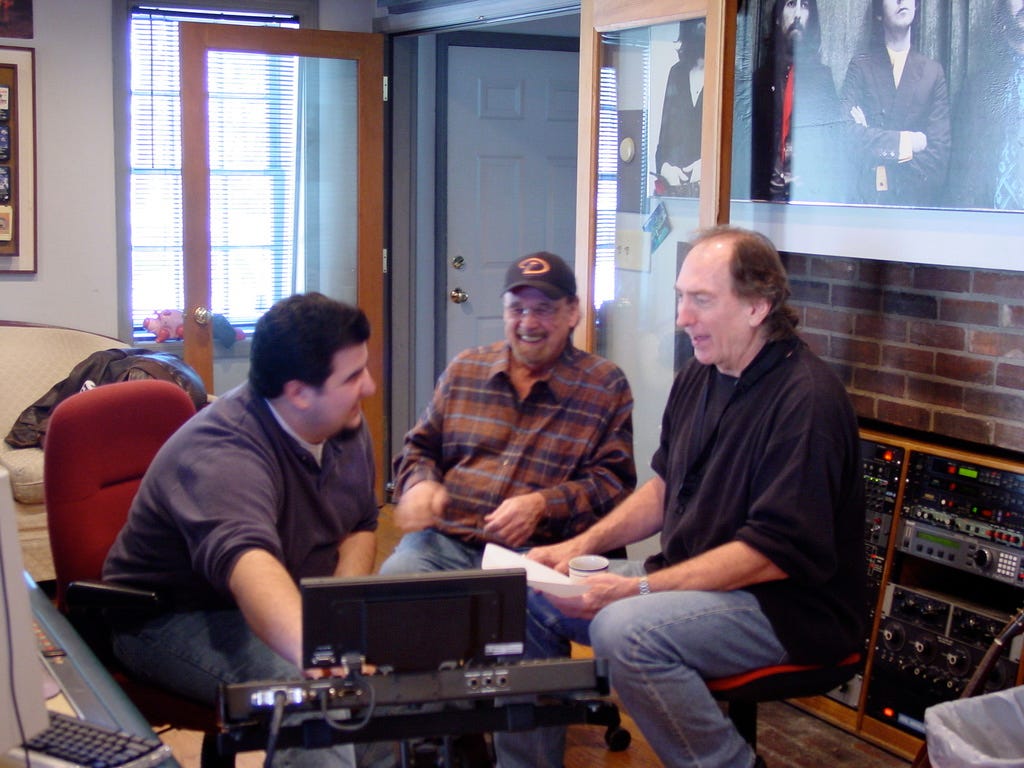
He didn’t want his guitar to touch the computer. When we first talked on the phone about the recordings we were about to make, I told him that we would record on Radar (as close to a digital tape machine as existed in our studio) and then I would transfer it to a computer program, Pro Tools, for overdubs and mixing.
Nope.
“I don’t want my guitar to touch the computer. I don’t like the way it sounds.” At the time, recording in a computer was still a relatively new thing, so this thinking was not uncommon. But I was a kid. The above photo was dated 2003, so I’m likely 22. I grew up working in the computer. Yes, I used a console every single day, but I was most comfortable mixing “in the box”. Even so, Duane Friggin’ Eddy just said no… and I was certainly not in a position to argue with Duanne Friggin’ Eddy.
The console in the upstairs studio of The HUM Depot (still the best and worst name for a studio ever) was an aging Neve 8232 with VCA automation. It was functional to mix on, but you had to work for it and there were only a few engineers I knew (fine, one) that could do it comfortably. Automation is important in mixing. Anytime you want to turn a track—say the guitar—up you move the fader up, and the automation “records” that and does that move every time you play back. Without automation, you had to physically move the faders every single time, and it had to be done perfectly or you’re probably starting over from scratch. Automation negates the need for the mixing engineer to have a ‘perfect performance’.
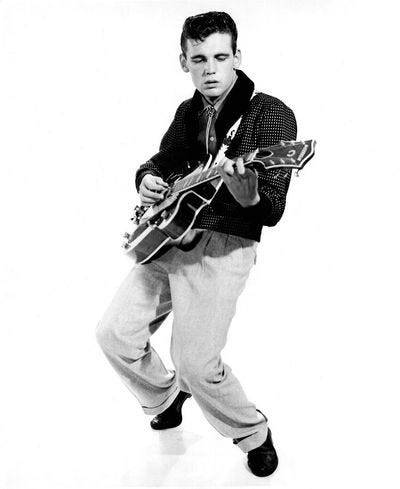
Was this a record or was it a demo? I don’t remember, but I do remember that Duane treated every moment in the studio like it was a record that could be released and become a hit. We were probably working at demo rates, but everyone was hopeful that they’d be a part of helping Duane crack the code to his next career swell. Most of my recording friends wrote or recorded with Duane as everyone was happy to get in line and take a swing with one of the end-all-be-all legends.
I’m pretty sure we recorded 3 songs in the morning, and then likely added overdub tracks that afternoon and evening. The next day we mixed. We might have spent two days on the mixes.
It quickly became clear that I was struggling with the console automation. I had assisted another engineer using it all the time, but never having relied on it myself I couldn’t get in a flow. At one point Duane and I decided to forgo the automation and "perform” the mix. Moving the faders as we went, stopping and starting over when we made a mistake.
We likely had 24 tracks of instruments. In one section the piano would need to be louder and in the next the tambourine (or whatever). There were more tracks—and in turn faders—than I had fingers to push so Duane jumped in and we performed the mix together. I’m pretty sure on one song Duane’s wonderful wife Deed (always present to support and quietly reading on the couch when she needed to fade into the background) jumped in to help.
As Duane and I practiced the moves of a mix we looked at each other and smiled. I beamed and shouted over the loud music, “This is fun, I’ve never mixed without automation before!” Duane looked at me and yelled back “This was the only way we could do it back in the day!” laughing the whole time. He laughed at the kid, but he respected the kid. He couldn’t believe that it had gotten to the point that a (decent) engineer he was working with was young enough to have never done it the old-school way. But unlike many, he didn’t think less of me for it. It just amused him.
In an industry ripe with classism, Duane Eddy treated everyone in the room like they were important, had ideas worth hearing, and worth his damn time.
I wish I could say the same about everyone. Hell, I wish I could say the same about myself.
No posts
Comments
Nothing yet. Say the first thing.
Sign in to join the conversation.