
Bad Bunny recently made Super Bowl history with what became the most popular halftime show of all time, amassing 128 million views in a single day.
I am not one for pop culture rabbit holes, but the week after the Super Bowl, I rewatched reels of the halftime show like I had an addiction. While the music, costumes, and choreography were vibrant and creative, what surprised me most was the wholesomeness: the unexpected wedding, the spotlight on children and the elderly, the intergenerational dancing, but most of all, the palpable sense of joy and earnest love of Puerto Rico.
To say nothing of the eye contact.
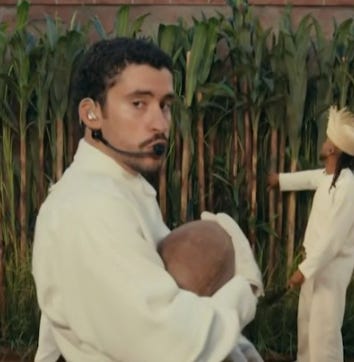
But of course, Bad Bunny smoldering into the camera was not real eye contact — the intimacy was illusory, a peak moment of our parasocial age. And according to our guest in today’s episode, Rosalynde Welch, the vivid snapshots of intergenerational community life of Puerto Rico were also, somewhat, a romanticized projection. Puerto Rico’s total fertility rate is currently one of the lowest in the world — 0.9 births per woman — far below replacement level. This, combined with out-migration, means there may not be a bustling Puerto Rican society in future decades as depicted in the halftime show.
In this conversation, we consider whether the medium by which Bad Bunny dazzled us contradicts his message. The halftime show celebrated Puerto Rico as a beloved home, yet most of us watched it on screens and smartphones — all part of the technological environment eroding attachment to local places and communities and contributing to global changes in fertility. Sociologist Alice Evans, whose Substack tracks the fertility crisis with region-specific reports, argues that smartphones are key culprits in the decline of coupling: they provide endless private entertainment while enabling “cultural leapfrogging,” whereby people sidestep local norms and preferences for those they encounter online. This weakens the social conditions in which people once paired off and built families.
All this, Rosalynde explains, makes the wedding at the center of Bad Bunny’s halftime show so striking. His most recent album, DeBÍ TiRAR MáS FOToS (”I should have taken more photos”), mourns the loss of Puerto Rican culture to gentrification, overtourism, and outmigration. Was his halftime show a hint that he is concerned for Puerto Rico’s fertility rates, as well? Beyond economic and political reform, is marriage and, well, birthing more Puerto Ricans a part of the solution?
The inevitable question: how do you get people to have more kids? The fact that our technological environment complicates family formation is not a new idea for listeners of The Soloists, but grasping this on a theoretical level is not sufficient to undo its influence. This is one reason we rarely engage the fertility crisis discourse, where apocalyptic graphs and moralizing scolds can invoke panic, guilt, and anxiety for those whom the discourse supposedly wants to persuade to have kids. Ironically, there can be a conflict between the medium and message of the most well-meaning pronatalists: for youngsters prone to overthinking love and fearful that the end of the world may actually be nigh, its catastrophic tone can undermine the self-trust and sense of ease necessary to entering longterm relationships.
Rosalynde offers a hopeful question: if you know you can’t go back, can you cultivate “a local world within yourself?”
Yet pronatalists could take a leaf out of Bad Bunny’s playbook, too. His joyful portrayal of intergenerational community life, with a wedding at the center, had a spiritual coherence to it, despite its contradictions. He didn’t tell us to reform ourselves; he made us love and want what we were seeing. We move towards what brings light.
______________________
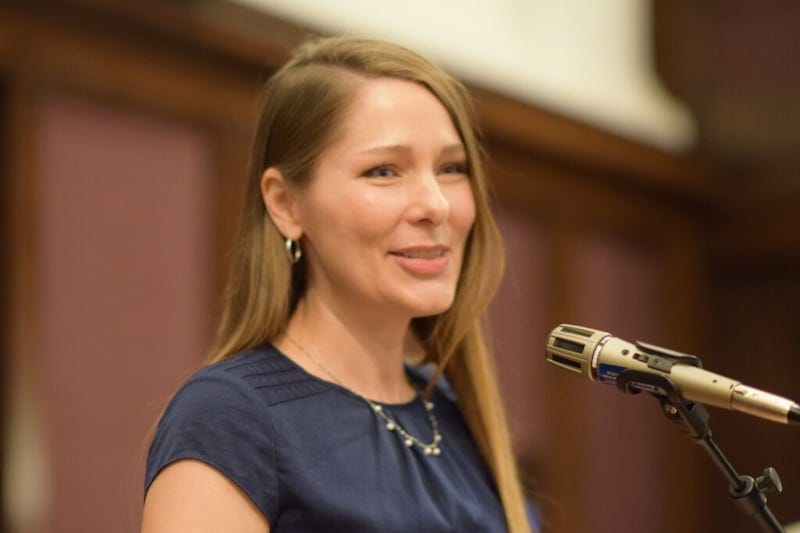
Rosalynde Frandsen Welch is Associate Director and a Research Fellow at the Neal A. Maxwell Institute for Religious Scholarship. Her research focuses on Latter-day Saint scripture, theology, and literature. She holds a PhD in early modern English literature from the University of California, San Diego, and a BA in English from Brigham Young University.
Comments
Nothing yet. Say the first thing.
Sign in to join the conversation.