
You are surrounded by people talking about using AI at the frontier, and that is why you think you are behind.
Show you how few people are actually using AI.
Give you the one finding I have not seen anyone quote.
Tell you what to do to counter AI FOMO.
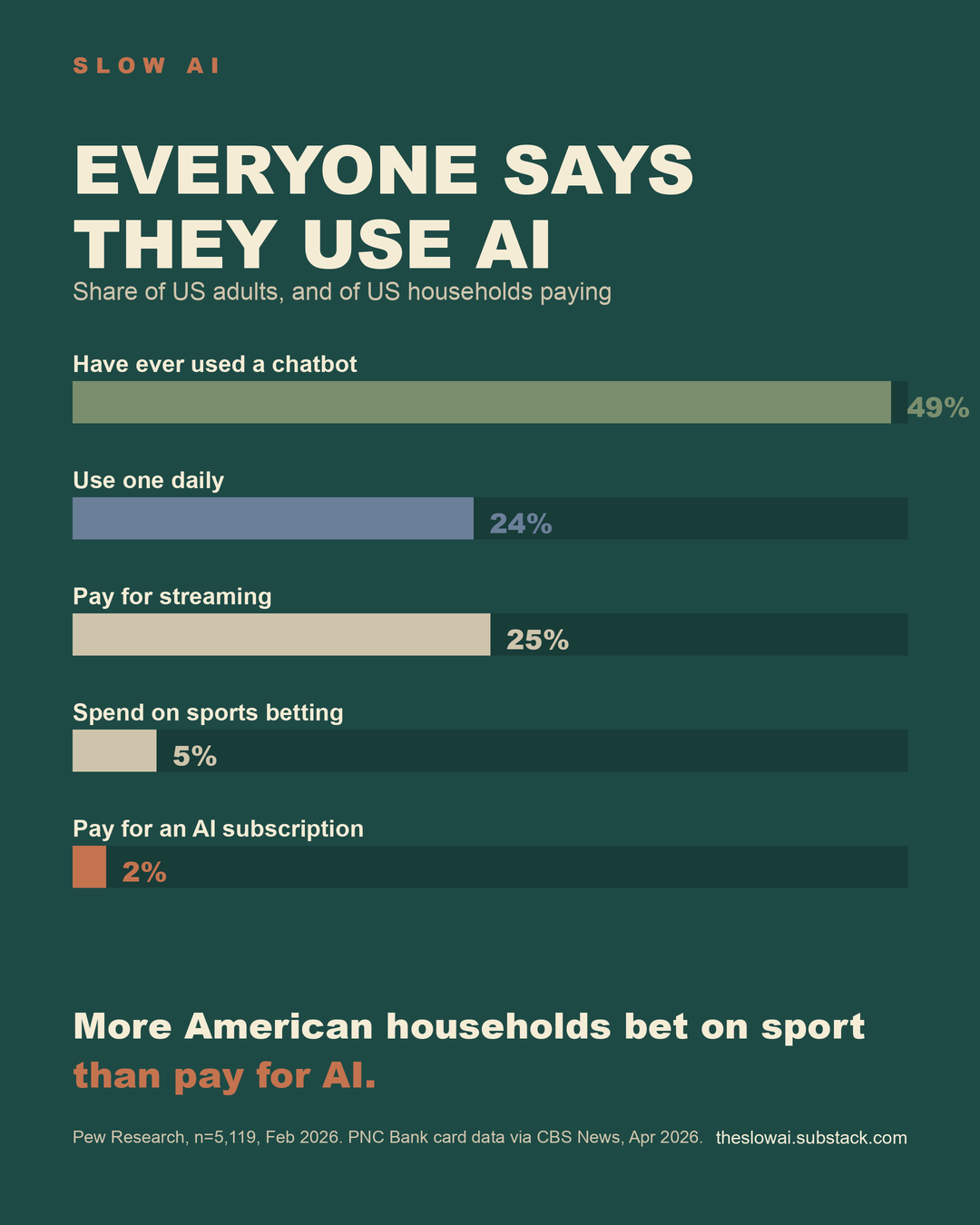
PNC Bank looked at its own card data and found that about 2% of US households pay for a generative AI subscription, up roughly 155% on the year before. The vast majority of them pay $20 a month, and the average subscription lasts seven months. Bank of America Institute, looking at its own customers in March 2026, put the figure at about 3%.
In the same PNC data, 5% of US households spend money on sports betting and roughly 25% pay for streaming.
Brian LeBlanc, a senior economist at PNC, put the position plainly:
“We are growing quite rapidly, but we are still nowhere near streaming.”
A caveat on both figures. PNC measured its own cardholders. Bank of America measured its own customers. Those are large, useful samples of card-spending households, and neither is a census of America. When you see a number like this quoted as a flat fact about the country, somebody has done a conversion that the bank did not do.
There is also a fair objection to reading low payment as rejection. The free tiers are actually pretty good. Someone using ChatGPT every day without paying may have found it perfectly useful and simply not needed more, which says something about pricing.
In February 2026, Pew Research surveyed 5,119 US adults through its American Trends Panel. It found that only 49% have ever used an AI chatbot such as ChatGPT, Gemini or Copilot. Twenty-four per cent use one daily. Another 25% use one several times a week or less.
Which leaves about half of American adults who have never used one at all. Again, with the caveat that the survey (as such surveys tend to do) was extrapolated from 5,119 adults to 349.3 million people.
Pew also asked the non-users why. Most of the answers have been widely reported. I have not seen anyone quote this one.
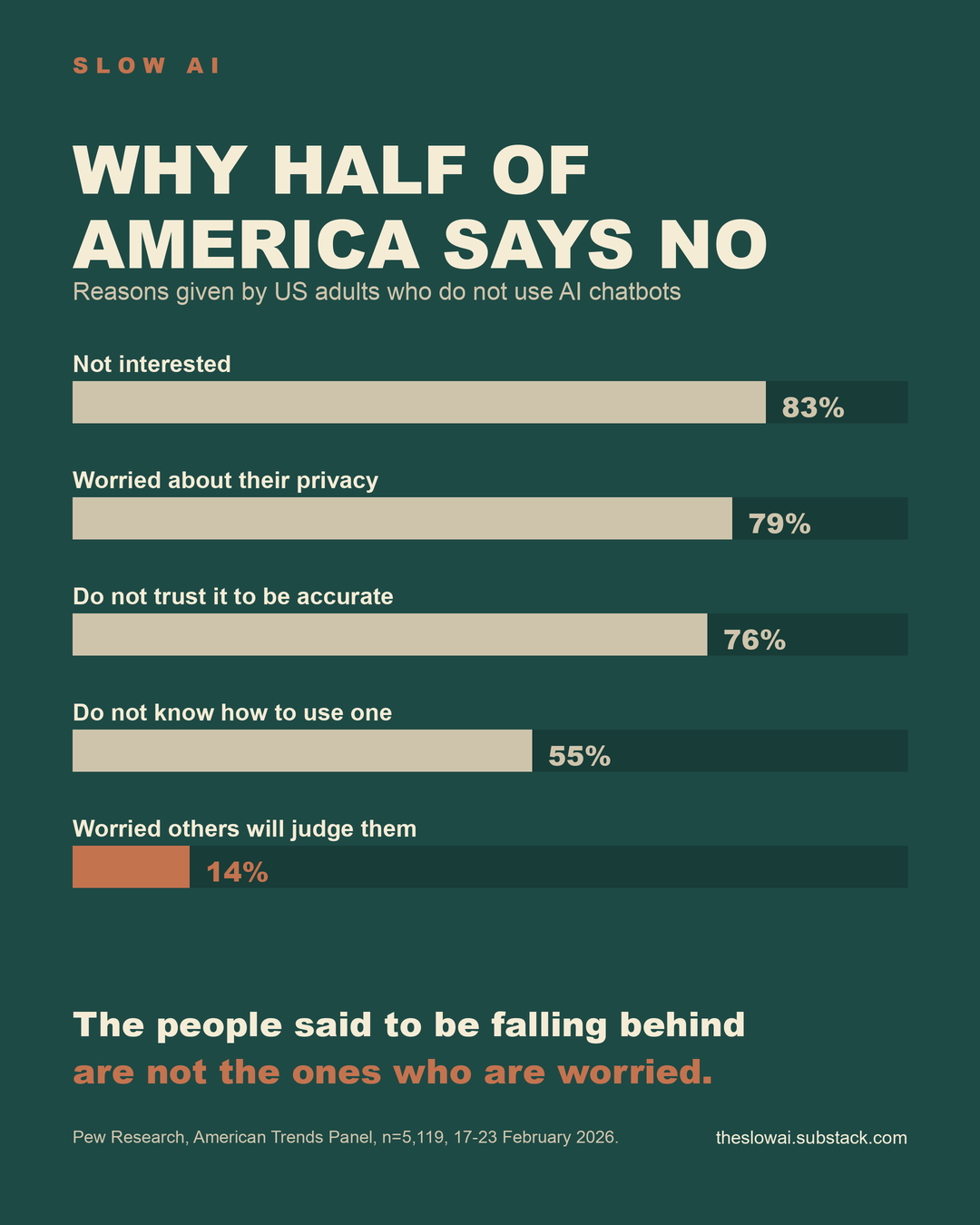
Among Americans who do not use chatbots, 14% say a reason is that they think others will judge them for it. Three per cent call it a major reason.
Do you know someone who has been made to feel slow for not adopting this fast enough? Please send this to them.
Eighty-three per cent say a factor is that they are not interested, and 60% call that a major reason. Seventy-nine per cent cite concerns about how their personal information will be used. Seventy-six per cent say they do not trust chatbots to give accurate information.
Not knowing how to use them comes fourth, on 55%.
Disinterest, privacy, accuracy, and then capability. These are considered positions held by people who have thought about it and decided no.
Pew asked them about the next twelve months too. Sixty-seven per cent said they were not too likely or not at all likely to start. Five per cent said they were highly likely.
If you enjoy this newsletter then you might also enjoy Slow AI the book.
I should implicate myself here.
Over twenty thousand people subscribe to this newsletter. Every one of them chose to subscribe to a publication about artificial intelligence. I record a weekly show about AI news. I am a full professor of critical AI literacy. I post about this on at least four platforms, and the people who reply are the people who care enough to reply.
My sample is broken. Every person I speak to about AI is at the frontier, because that is the only kind of person who turns up.
If I am not careful, I will tell you that everyone is doing this, and I will be reporting my inbox rather than the majority.
Your feed is doing the same to you. Algorithms show you more of what you engage with. Read three posts about AI agents and you now live in a world where everyone runs AI agents. The 76% who do not trust the output are not in your feed, because they were never going to post about it.
These are also consumer numbers. Businesses buy seats in bulk, and a company paying for four hundred licences appears in none of it, which is where a great deal of the actual money sits. The household figures tell you how many people chose this for themselves.
Understanding this technology matters, and I want to be unambiguous about that. It is going into hiring decisions, benefit assessments, medical triage and your children’s classrooms. The people who understand how it works will have more say in how it gets used than the people who do not. Learn it properly. Refuse the urgency that comes bundled with it.
Audit your feed for sixty seconds. Scroll back through the last ten things you read about AI and count how many were posted by somebody with a product, a course, a consultancy or a newsletter to sell. That count is where the feeling is coming from. Mute three of them today. You will lose nothing, because anything that matters will reach you twice.
Run one honest test this week. Take a real task you have already done, where you know what good looks like, and give it to a free chatbot. A set of essays you have marked. A meeting you sat in. A report you wrote last month. Twenty minutes of first-hand evidence beats a year of other people’s claims, and it is the only way to find out where the thing is actually useful to you.
Do not pay for anything for four weeks. The average paid subscription lasts seven months, and 87% of the students we surveyed are using free accounts. Pay when one specific job in your week is worth $20 a month. Cancel the month it stops being. Paying to feel current is the purest form of the tax this post is about.
Keep one sentence ready. For the meeting where somebody implies you are behind: “I have not needed it for that yet. What did it do for you?” Nine times in ten the answer is vague, because the person is repeating a feeling. Asking turns a boast into a claim that has to be evidenced, and it does that without embarrassing anyone.
If you are already a power user, help out another human. You are the small percentage who pay, and every enthusiastic thread you post works as free advertising for companies that will never send you a penny. It also feeds the anxiety this whole piece is about. So find the colleague who has gone silent in the AI conversations and give them half an hour. Show them one thing. Tell them what it cannot do. One honest half-hour is worth more to them than a hundred posts about the frontier.
Go slow.
Comments
Nothing yet. Say the first thing.
Sign in to join the conversation.