
Previously, on the skeptical cardiologist, I presented the case of a 71-year-old woman with atrial flutter (hereafter abbreviated as aflutter or flutter)
She had been started on flecainide for suppression of the Aflutter and had been doing well, but when she consulted with a prominent electrophysiologist, he recommended an ablation procedure.
I asked for reader comments on management and received some excellent input from physicians and from patients with aflutter.
As is the norm in medicine, we will encounter a wide spectrum of recommendations and outcomes, an evidence base that isn’t robust enough to mandate one definitive approach for all individuals, and a need to engage in shared decision-making informed by both clinician and patient experience and education.
@David Saenger, a cardiologist and ultramarathoner wrote
I think of a flutter like WPW. The ablation is safe, quick, has a lot of data and is very effective. I’d much prefer ablation to long term anti arrhythmia medication.
John Martin-Beaulieu an APRN specializing in cardiac electrophysiology wrote
There is a non zero risk of sudden death from 1:1 conduction of atrial flutter that she may not be able to treat in time with PRN beta blocker. She likely won’t tolerate routine beta blocker without significant symptoms in the absence of pacemaker. In order to avoid all of this, and including being able to stop at least flecainide I would favor ablation limited to the cavo tricuspid isthmus for typical flutter, assuming there is no documented atrial fibrillation. I would not do an empirical PVI. Particularly since she has a relationship with a renowned electrophysiologist, this should be a very low risk procedure.
There are a few case reports of very rapid flutter in the setting of flecainide usage but I haven’t come across any of sudden death (see good discussion here)
The reader brings up the likelihood that success rates of ablation are operator-dependent. Ideally, your ablation is performed by an EP who has performed many such procedures with a low complication rate.
A 2009 meta-analysis found the success rate of typical afutter ablation was 91.7% after one procedure and 97.0% after multiple procedures
Steve Remole an electrophysiologist wrote
Ablate! Hands down. Creating a line of block from the tricuspid valve annulus to the inferior vena cava is a very effective treatment for typical atrial flutter; it is technically easy, the lesion is highly durable and no left sided access is needed.
Whether to cross and do PVI is the only controversial topic. I would do so if left atrial enlargement were present, or if atrial fibrillation was easily inducible after the CTI line terminated the flutter.
Dr. Remole describes the ablation procedure for typical atrial flutter which is often abbreviated as CTI.
In contrast to the chaos in the atria of afib patients, typical a flutter is due to a single organized macro-reentrant circuit in the right atrium, rotating around the tricuspid annulus and dependent on conduction through the cavotricuspid isthmus (CTI).
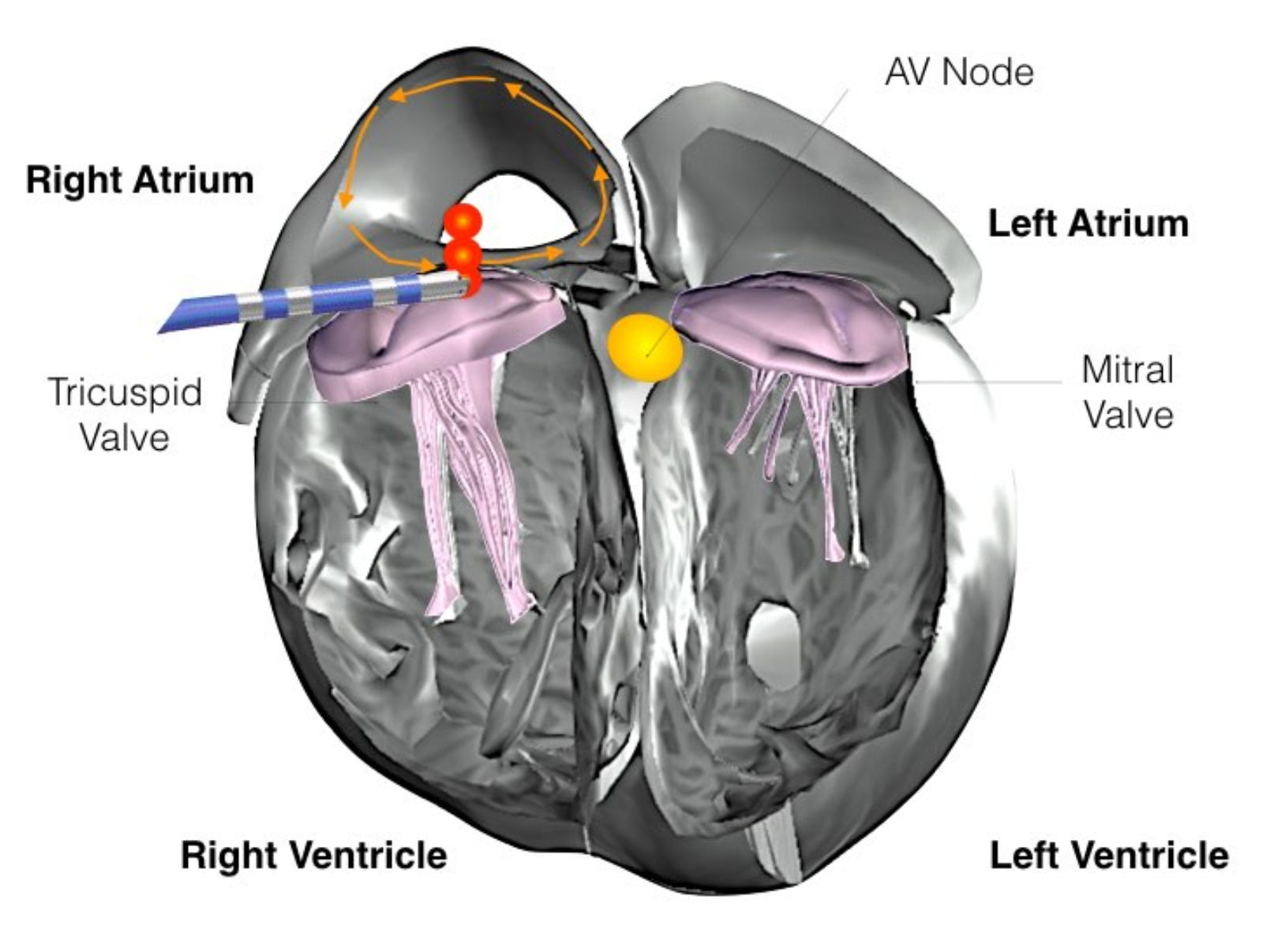
CT ablation appears superior to antiarrhythmic drugs for keeping symptomatic typical flutter from recurring, with fewer side effects and better quality of life, which is why it’s considered first-line by many— but the trials1 are small and dated, use surrogate endpoints, and leave the rate-control comparison and any hard-outcome questions untested.
Pete Watson is both a physician and an aflutter patient who wrote positively of his experience which is relevant to masters athletes
As a nationally-ranked masters level cyclist (and academic-clinician), I developed Atrial Flutter at the age of 63. I woke mid-sleep with a HR of 86 (resting was normally 48). I contacted a former employee who worked in my research lab who was Director of Cardiology at a local medical center. A 12-lead revealed AFlutter. After consultation with an EP and Holter Monitoring, it was determined that we would proceed with an ablation. This was primarily due to my wish to continue athletic endeavors. The procedure was successful and I resumed training. I have had no further arrhythmic episodes despite my increased risk for AFib.
My thoughts as a physician (who is NOT a cardiologist) is the choice for medical management vs. ablation is likely best made in the context of the patients lifestyle expectations. I cannot say that medical management would have negatively impacted my athletic performance, but consistent efforts elevating my HR to 150+ bpm (along with the presence of a RBBB and prolonged QRS segment) may have put me at greater risk for a arrhythmic event
Another cyclist shared a similar experience
I started having atrial flutter in my mid 40’s. I was on flecainide and 325 mg aspirin for nearly 10 years. I tried a beta blocker initially, but it was debilitating because I enjoyed running and cycling (my HR stayed below 100 bpm and I felt very sluggish and lethargic). I had an ablation in 2016 because I wanted to be off the meds and I was an excellent candidate for the ablation. I have not had any issues since then. I am now 64, retired, and back into cycling. Having an ablation is a personal choice dependent upon lifestyle. If the drugs are working and not affecting long term health or current lifestyle, then stay the course. Ablation is not a guaranteed fix.
Several other readers shared similar flutter ablation success stories
On the other hand one reader John Fischer described multiple ablations for both flutter and fib over a 10 year period which have been unsuccessful
Some physician readers advocate for a more conservative approach before referring for ablation. Something that, in the world of atrial fib, Dr. Mandrola has termed “Give Peace a Chance.”
I have appropriated the term “active surveillance” from the prostate cancer world to describe this process of working on risk factors and monitoring for recurrence.
Andrew D. Beamer, a cardiologist who graduated from medical school 2 years after me presents a more conservative approach which I consider very reasonable:
Comments
Nothing yet. Say the first thing.
Sign in to join the conversation.