

Fancy TWO DAYS in a writers’ room with me and a bunch of other writers? We’ll be coming up with ideas, pitching stories, breaking them, turning them into plots and figuring out the pilot? And you can ask me anything. You can do all that on 11th-12th September in North London. This really is a great opportunity to get some handy experience and increase your sitcom skills.
Places are STRICTLY LIMITED, so I recommend booking early:
Writing a pilot sitcom script is a slog. You may be happy with your characters. You’ve got a decent situation. You’ve even got ideas for plots, stories and jokes. Isn’t it just a question of putting them all together? Job done?
No. Not even close. It’s way harder. Why?
Because you’re not entirely sure what the finished product is supposed to look like. When you’re developing a sitcom, you’re not just trying to write a funny script. You’re devising a template for all future episodes.
You’re not just baking a batch of delicious cookies to present to a roomful of TV executives. You’re not pitching a cookie or even a plate of cookies. You’re pitching a recipe which produces delicious cookies every single time. It is reliable. It’s certain.
That’s the appeal of situation comedy. It’s a cookie. It’s your favourite cookie. And it’s your favourite because you know what it tastes like. Every episode is the same. You put on an episode of Brooklyn Nine-Nine because you’re expecting to see Jake goofing around trying to be John McClane (Bruce Willis) from Die Hard, whilst yearning for a father figure. Amy will try to be top of the class. Rosa will refuse to emotionally engage. Boyle will be creepily friendly. And so on. You can fill in the rest if you’ve seen the show. And you will probably smile when you read this word: Wunch.
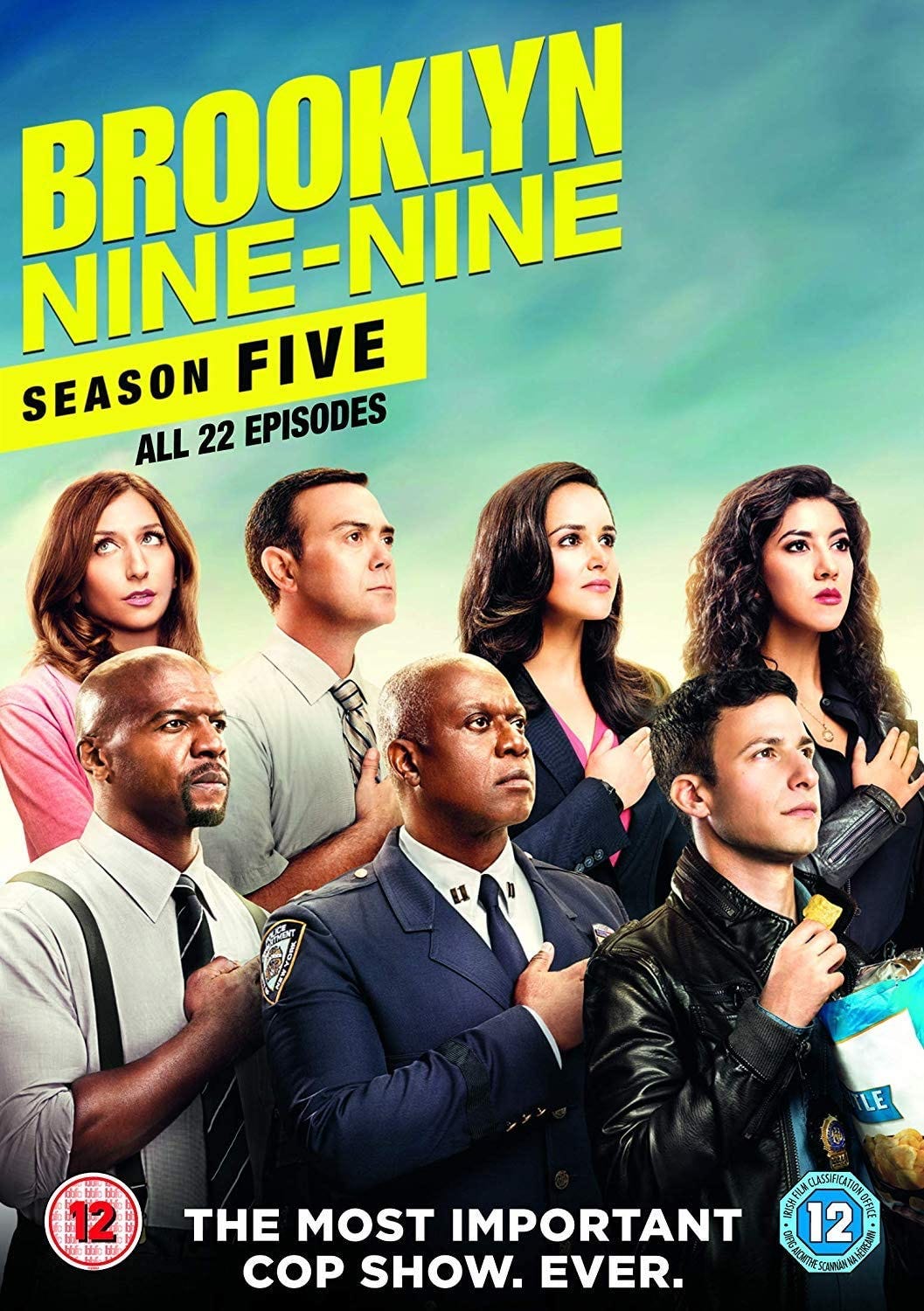
Writing a Brooklyn Nine-Nine script is comparatively easy. So many episodes have been made, and all of the variables have been decided. You know the characters. You know the kinds of stories the show does. You know what an episode of Brooklyn Nine-Nine is meant to look like. If we’re honest, AI could probably have a decent go. With some decent prompts and a gag pass, it might even be passable (although not broadcastable).
This used to be the way into the industry in the USA. Take your favourite long-running TV show like Cheers or M*A*S*H or Frasier. You would write your own episode of one of those shows. You would send it to a showrunner of a new sitcom, along with your own sitcom pilot to show your ‘voice’. But your main task was to demonstrate you can write in the voice of existing characters on an existing show. They might hire you to work on their show, writing for their characters, starting at the very bottom.
If I hadn’t loved England so much, I would have moved to Los Angeles in around 2001 and hawked around some spec scripts in an attempt to get work. That was the way in. Pilot season in the US would mean literally dozens of shows would be going into production and needing a writing staff. People like me.
As it was, things were going okay for me here in the UK. I was getting plenty of work on BBC Radio 4, and making inroads in television. Soon I was writing episodes of existing shows, like My Hero. I wrote six of those. I also wrote an episode of My Family which happened to air the same night as the last ever episode of Friends. That was 28th May 2004. Perhaps that was the high watermark of those sitcoms. Frasier also ended in 2004. Seinfeld had finished in 1998. Two and a Half Men in 2003. There were shows like The Big Bang Theory still to come but did any hit the heights of Friends, Seinfeld and Frasier?
Something had changed. Maybe it was 9/11. Everyone was talking about exciting gritty new shows like The Wire, The West Wing, 24 and The Sopranos. Everything became much more serious. Comedy continued, but it was more muted. The studio sitcom, the mainstay of comedy for decades, was out. ‘Single-camera’ shows, ie. shows without a studio audience, became the norm: The Office which gave birth to Parks and Recreation. There was also Modern Family, Scrubs, Curb Your Enthusiasm, Arrested Development, My Name is Earl and so on. In the UK, there was The Inbetweeners, Peep Show, Outnumbered, Green Wing, The Thick of It.
Miranda, a mainstream studio sitcom during this period, was an outlier, which perhaps explains why it was so wildly popular.
Then streaming changed it all over again. Everything fragmented. Finance got complicated. And we all had cameras in our phones and suddenly you could make your own stuff and put it up on YouTube. And where does that leave the wannabe sitcom writer? What are the ways in?
What this means is that the days when you could make your start in the comedy industry with a spec script of someone else’s show are well and truly over. You had to write an original pilot script in which you are doing many things: setting up the show, demonstrating your comedy voice, showing that you can handle plot and characters, while writing funny.
This is incredibly hard. And you have to do it right out of the gate. Let me illustrate this with a sitcom I’ve just made up on the spot called The Have-Yachts. I’ve just grabbed this title at random from a book sitting on my desk. It’s by Evan Osnos. What a great name. And it’s about the super-rich. It’s called The Have and Have-Yachts. What a great title.
Your sitcom is set on a luxury yacht owned by a billionaire. There’s a tech bro billionaire with a trophy wife. There’s an idiot son and a daughter from hell. There’s the captain of the ship, a jaded, retired Royal Naval officer. There’s also a chef, a maid and a steward.
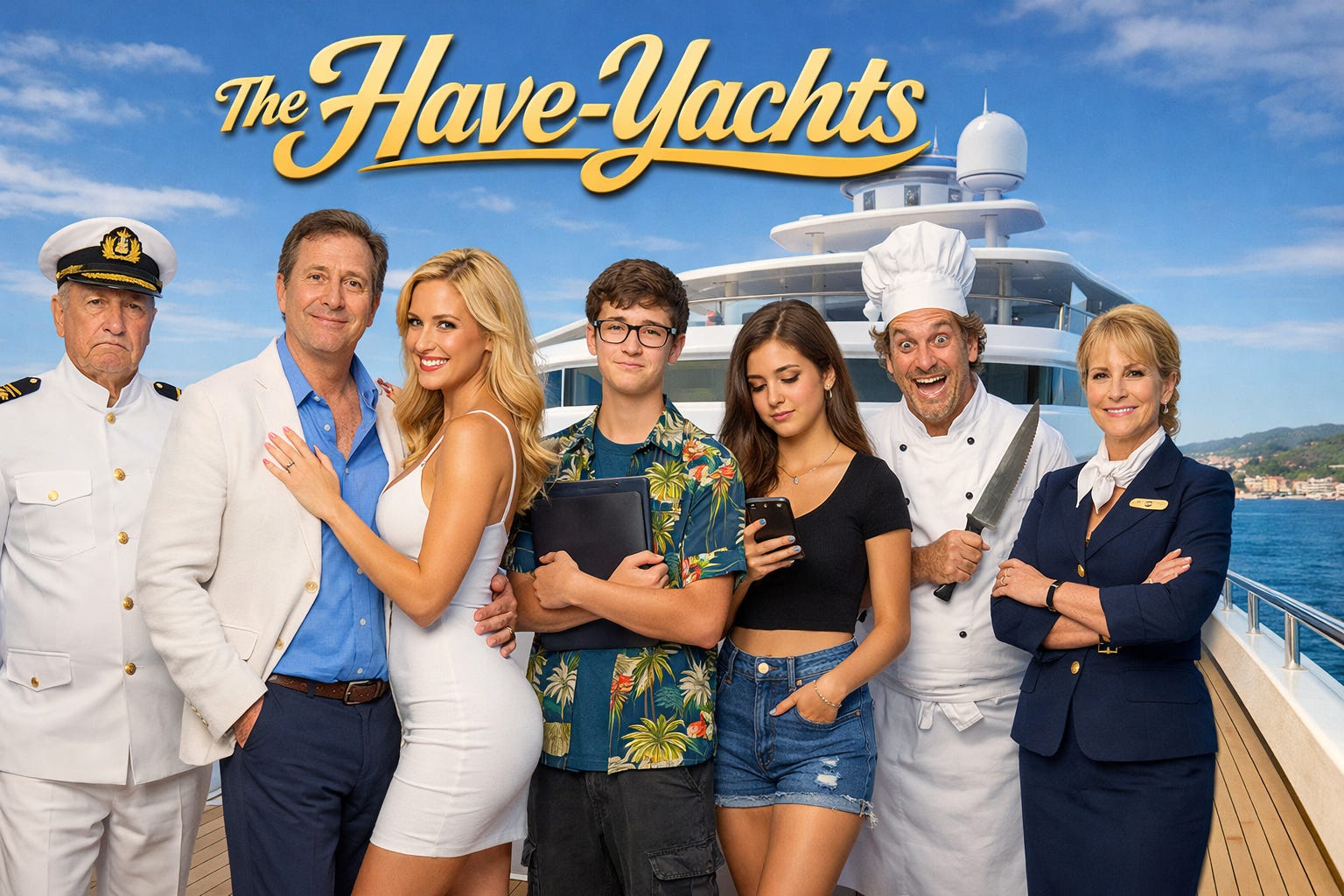
So is this show about all eight of them? Or the billionaire? Or the long-suffering ex-Naval officer? Or the ambitious son? Or his little sister? Is it upstairs/downstairs? Or just upstairs? Or downstairs?
And are we on the ship the whole time? Is it always out on the open sea? Or are they in a different port every week, with hilarious consequences? Or is it moored up somewhere in Florida the whole time?
Is the first series one trip with a series of destinations? Is the billionaire wanted by the FBI? Or is he not the bad guy? He’s just a nice guy who has no idea what to do with all the money? Is this The White Lotus without the murder? Is this Arrested Development?
Your pilot script needs to answer all these questions. All. Of. Them. I said it was hard. This is why. You need to ponder all of these imponderables, bake a batch of cookies – present the cookies and the recipe. This involves test-baking again and again. You’re going to be making a lot of cookies.
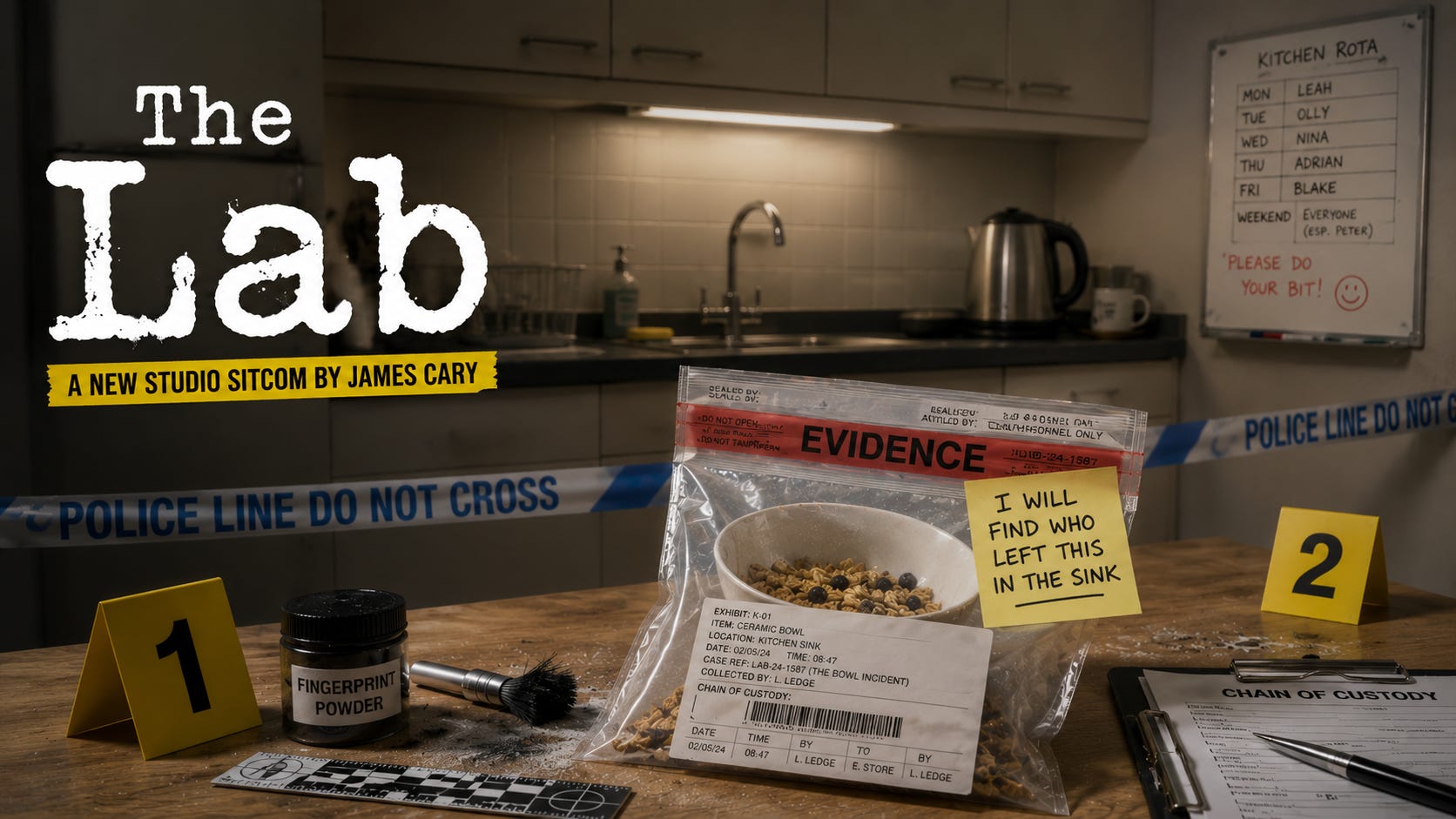
That is what I have to do with The Lab. I have to figure out a show which really sells the idea. It needs to have the right tone, the right shape and the right balance of characters. And it needs to have a reason to exist now. Oh, and it has to be really, really funny.
Does that sound hard? It should. It is. I’ve been doing this for over twenty years and I still find it hard. My only advantage over other writers is that I know how hard it is. I know that I need to dig deep and think of lots of stories for my characters so I can choose plots that are suitable and emblematic of the show.
Newer writers make the mistake of latching onto the first plot they have, make it really funny, failing to realise that they have written a pilot episode for the wrong show. Or they’ve written an episode that is entirely set-up.
Let’s go back to the show set on a billionaire’s yacht. We might have this idea based on a man becoming a billionaire. We start on the day his company floats on the stock exchange. There’s a scramble for shares. Suddenly he’s worth billions. He buys an expensive car. Drives to the marina. Or at least tries to. His car is really hard to drive. Maybe he crashes it. Thumbs a ride to the marina. Buys a yacht and sets sail. End of episode.
In that episode we’re going to see his office, his colleagues, his car and old life – and never see them again. The next ten episodes are on the yacht. So why have the opening episode bear no relation to future episodes? We may have established our lead character, but that’s not enough. We have to establish all the characters. And the situation.
I said it was hard. I need to get on with it. But because I know it’s hard, I also know I will be easily distracted, checking email and then looking at the internet. I could have a very busy morning doing that. So I’ve printed out my pilot plot ideas. And I’m going into the living room with my notes and a pen and have a long hard think about it. Besides, my office is cold. I think I’m going to light a fire. Hopefully my imagination will follow suit.
Field Notes from a Sitcom Writer by James Cary will soon be available for pre-order. To stay posted, make sure you have subscribed:
No posts
Comments
Nothing yet. Say the first thing.
Sign in to join the conversation.