
Wealth Building
1️⃣ Income and Wealth Are Not the Same Thing
When we think about someone doing well financially, income is often one of the first things we notice.
How much do they earn?
Did they get a pay rise?
How successful is their business?
These can all tell us something useful.
But they do not tell us everything.
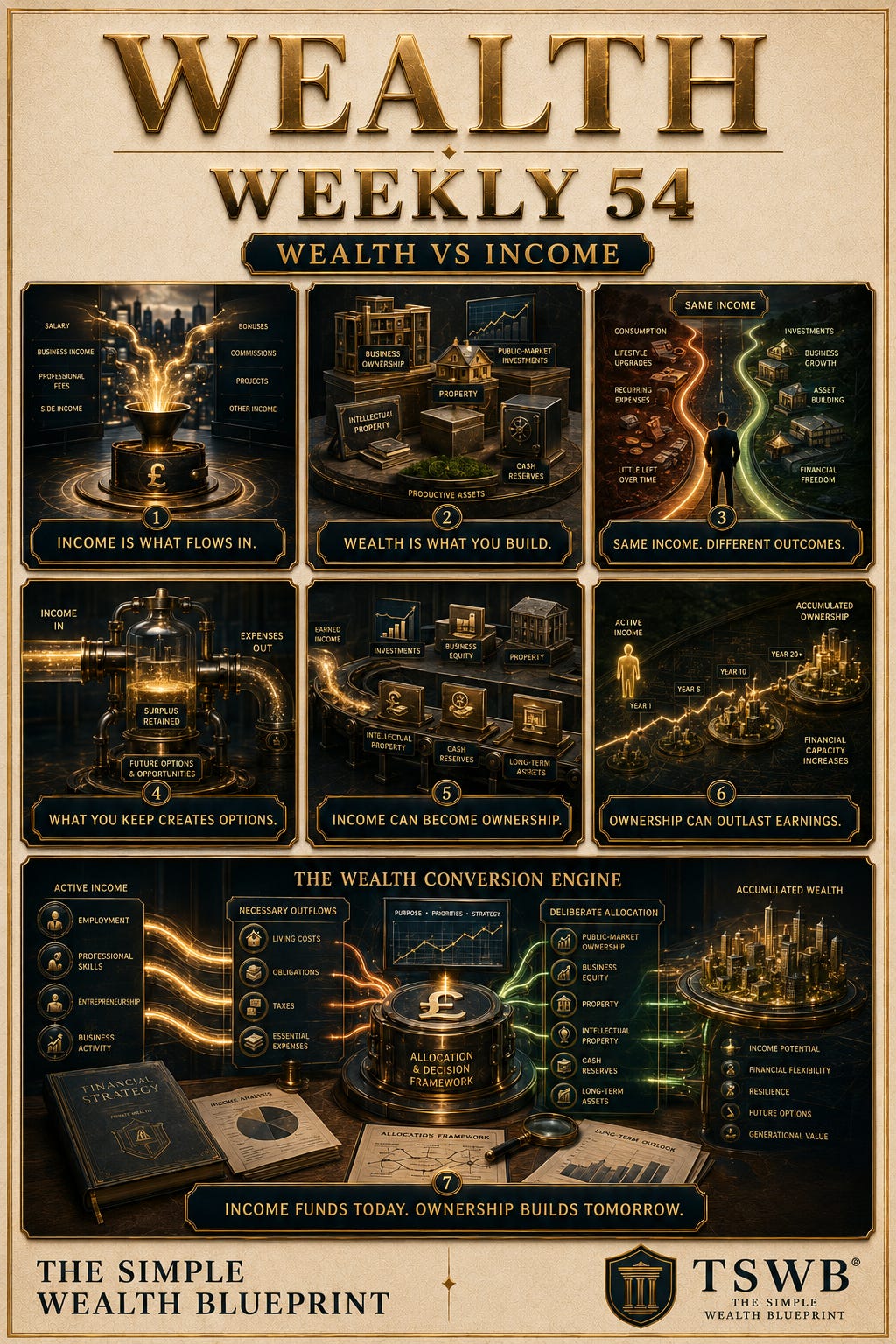
Income is money coming in. It might come from employment, a business, investments, property, or another source.
Wealth is the financial position we build over time.
Imagine someone earns £2,000 this month.
That tells us something about their income, but very little about their wealth.
We still don’t know what they spend, what they save, what they own, or what they owe.
Income tells us what is being earned.
To understand wealth, we need to look at what is being built.
2️⃣ Why High Income Can Be Misleading
Imagine two people.
One earns £60,000 a year but has high expenses, a lot of debt, and relatively little saved or invested.
The other earns £30,000 and has gradually built savings, investments, a pension, and equity in their home.
Which person is wealthier?
The answer is that we still don’t know.
We would need to know more about their finances before we could decide.
And that is exactly why income can sometimes be misleading.
Looking only at salary gives us one part of the picture.
A higher income can be extremely valuable. It can create more choices and opportunities.
But earning more and building more are not automatically the same thing.
3️⃣ What Happens After the Money Arrives?
This is where income and wealth begin to connect.
Income arrives.
Some supports everyday life.
Some may be enjoyed.
Some may be kept.
And part of what remains can be saved, invested, used to pay down debt, or turned into something we own.
Over time, the journey can look something like this:
Earn → Keep → Allocate → Own → Grow
Imagine someone uses part of their salary to buy investments.
Those investments may later grow or produce income of their own.
The original earnings have now done more than support today’s lifestyle.
Part of that income has become something they own.
And what they own may continue helping their finances long after the original income was earned.
4️⃣ Wealth Is Often Harder to See
There is another reason income and wealth are easy to confuse.
Spending is visible.
We can see cars.
Homes.
Holidays.
Clothes.
Restaurants.
But much of someone’s wealth remains hidden.
Imagine two neighbours who appear to live very different lifestyles.
From the outside, we cannot see their mortgage balances, investments, savings, business ownership, pensions, or debts.
The person with the more expensive lifestyle may be wealthier.
The person with the quieter lifestyle may be wealthier.
We simply cannot know from appearances alone.
What we can see tells us something about how someone lives.
It does not necessarily tell us what they own.
5️⃣ Ownership Changes the Picture
Once we look beyond income, ownership becomes much more important.
And ownership can take many forms.
A nurse may steadily build a pension and investments.
A tradesperson may build ownership in a business.
An author may own work that continues producing royalties.
A homeowner may gradually own more of their home as the mortgage is repaid.
These people may earn very different amounts and build wealth in very different ways.
There is no single way wealth has to look.
Income reflects what is being earned now.
What we own can allow earlier earnings and decisions to keep working for us in the future.
6️⃣ Income Still Matters
None of this makes income less important.
In fact, earning more can give us much more room to build wealth.
Imagine someone’s income rises from £30,000 to £40,000 while their other costs remain broadly similar.
They now have more room to save, invest, pay down debt, buy assets, or simply create more financial breathing room.
That is meaningful progress.
But there is another side to it.
If the extra income is matched by higher spending and new costs, their income may rise much faster than their wealth.
Higher income gives us more options.
What we do with those options still matters.
7️⃣ A Better Way to Think About Progress
This gives us a broader way to think about our own finances.
Instead of asking only:
“How much do I earn?”
we can begin asking a few other questions.
How much am I keeping?
What do I own?
What do I owe?
Am I gradually owning more?
Are my assets growing or producing income?
Is my overall financial position getting stronger?
This matters because progress is not always visible on a payslip.
Someone’s salary might stay the same while their investments grow, debt falls, savings increase, or their ownership in a business grows.
Their income may look exactly the same.
Their wealth may be quietly growing.
8️⃣ Thinking Beyond the Payslip
Perhaps the biggest shift is simply learning to see income differently.
Income helps us live today.
It can pay our bills, support our families, create experiences, and give us choices.
But part of it can also help build tomorrow.
Some may provide security.
Some may reduce what we owe.
Some may become what we own.
There is no single correct balance for everyone.
The useful habit is to look beyond the amount arriving each month and ask:
“What is my income helping me build?”
That simple question gives us a clearer way to think about financial progress.
Wealth Weekly Pro
Income is only one way to measure financial progress.
In Wealth Weekly Pro, we’ll explore how to look at income alongside what we keep, own and owe, then build a practical wealth scorecard for measuring progress beyond salary alone.
Word of the Week
Wealth
The financial position we build over time through what we own and the resources we have, considered alongside what we owe.
Wealth Weekly Prediction
As investing, business ownership, digital assets, and other ways of building ownership become easier to access, income alone may become an increasingly incomplete way to measure financial progress.
Bold Prediction
The next generation will become less interested in asking:
“How much do you earn?”
and more interested in asking:
“What do you own?”
Final Message
Income tells us what we earn.
Wealth tells us what those earnings are helping us build.

Available for iOS and Android
No posts
Comments
Nothing yet. Say the first thing.
Sign in to join the conversation.