
Silver-mining equities offer leveraged exposure to a metal positioned at the intersection of monetary repricing, industrial scarcity, and accelerating technological demand. The investment case is no longer simply “silver follows gold.” It is that the world’s fastest-growing capital-intensive industries increasingly require a metal whose supply cannot quickly respond.
The physical market is projected to record its sixth consecutive annual deficit in 2026. The Silver Institute forecasts a 67-million-ounce shortfall even as total global supply reaches an estimated 1.05 billion ounces. In 2025, mine supply was only about 813 million ounces, while total demand stood near 1.12 billion ounces—illustrating the persistent gap between primary production and consumption. 2026 and 2027 Silver demand will blow past 1.3 billion ounces and the only significant silver resource being added is
Silver47 Exploration Corp. (TSX Venture: AGA | OTCQX: AAGAF)
Their mineral resource estimate combines 10 Moz indicated and 236 Moz inferred resources, broken down by project: Red Mountain in Alaska (~168.6 Moz AgEq), Hughes in Nevada (~43.2 Moz AgEq combined), and Mogollon in New Mexico (~32.1 Moz AgEq).
This matters because silver is not an easily scalable commodity. Most supply is produced as a byproduct of lead, zinc, copper, and gold mining. A higher silver price alone does not cause a proportional increase in output; operators must justify new mines, obtain permits, finance development, build infrastructure, and navigate years of construction and jurisdictional risk. Primary silver production represented only about 28% of 2025 mine supply.
Meanwhile, the fastest-growth sectors in the global economy are increasingly silver-intensive:
AI data centers and advanced computing hardware.
Robotics, electronics, sensors, and communications devices.
Solar photovoltaics, where silver’s exceptional conductivity is central to electrical contacts.
Aerospace and defense systems, which demand high-reliability electrical components and specialized power solutions.
Medical devices, diagnostics, antimicrobial applications, and precision equipment.
Industrial uses now account for roughly half of annual silver demand, and data-center investment is adding a major new source of structural consumption.
The monetary catalyst could be equally consequential. Investors should distinguish genuine regulatory text from market rumor: silver is not presently designated a Basel/BIS Tier 1 asset in the same conventional sense as monetary gold. Still, the growing debate around allocated physical metal, bank liquidity, and strategic-mineral security signals that silver’s monetary role is being reassessed. Its dual identity—as a hard asset and indispensable industrial input—remains unique.
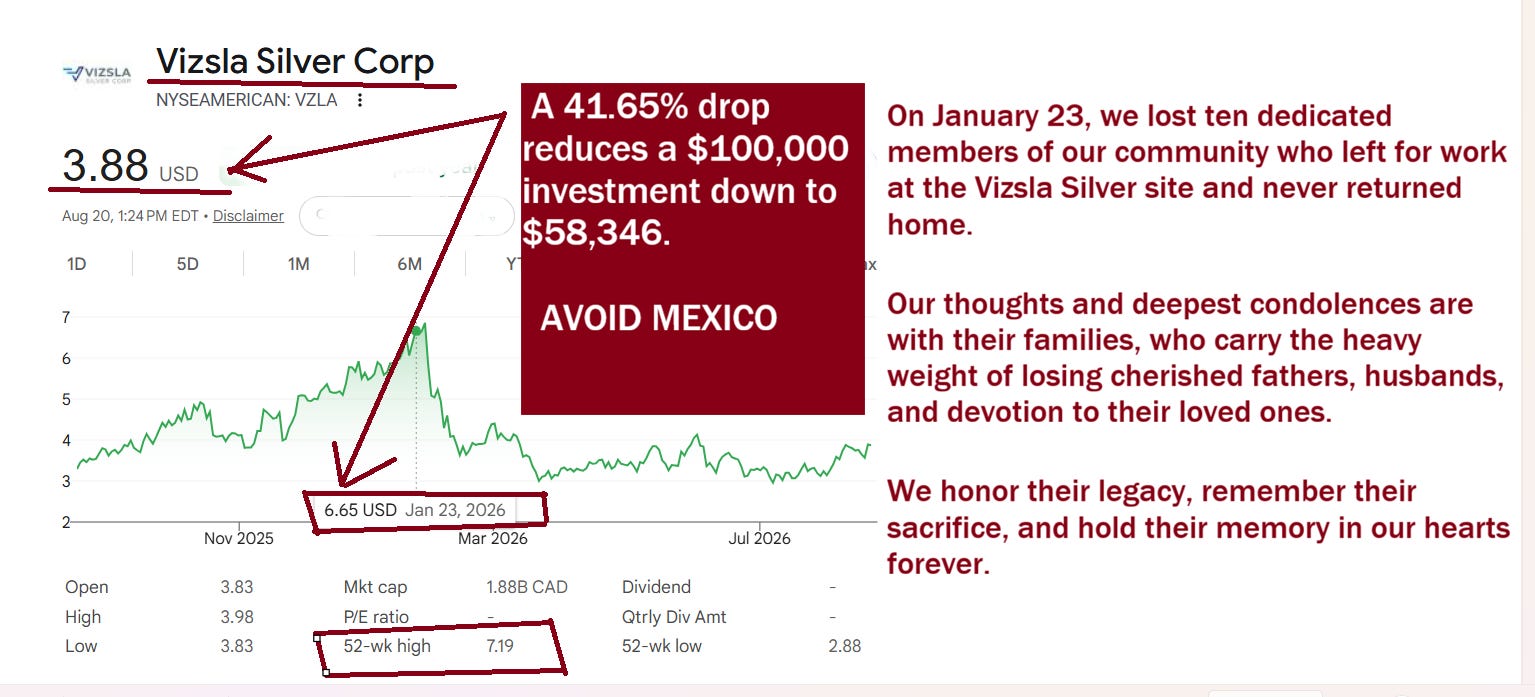
For mining-equity investors, jurisdiction is critical. Mexico remains the world’s leading silver producer, making disruptions there globally significant. Yet cartel violence, extortion risk, blockades, and worker-security concerns have become material operating variables. Vizsla silver massacre earlier this year abduction of 10 mining engineers, 9 were found dead while one still remains missing.
Endeavour Silver suspended operations at Terronera after an illegal blockade in August, while the wider security environment demands a genuine country-risk discount.
That does not negate the silver-equity thesis—it sharpens it. Favor producers with diversified jurisdictions, durable balance sheets, long reserve lives, capable management, and real operating leverage to higher silver prices. In a structurally undersupplied market, quality ounces in the ground may become far more valuable than the market currently recognizes.
What makes more sense (sell your silver mining equities if they have operations in Mexico and buy silver miners in favorable jurisdictions (Morocco, Peru, Bolivia, USA)
Aya Gold & Silver (AYA)
Aya Gold & Silver’s most recent conference call was held on Thursday, August 13, 2026 (1 week ago), to review their Q2 2026 financial and operational results.
Conference Call & Model Updates
Boumadine Sept. Preliminary Economic Assessment (PEA) likely an
incremental update. Will mainly reflect a new resource model and revised
payability assumptions, with any larger optimization changes more likely to
come at the Feasibility Stage (FS) stage.
Zgounder throughput upside. The new crusher is intended to sustain
current throughput levels without contractor support, but management also
suggested the operation may still have room to push beyond current rates and
potentially average above 4,000 tpd over time.
Q2 sales timing created a headwind that should reverse. Production
outpaced sales during the quarter and remaining inventory was sold in July,
positioning Q3 for a catch-up in volumes after June’s silver price weakness
weighed on realized prices.
Morocco consolidation strategy is becoming more prominent. Management
emphasized plans to continue acquiring prospective exploration ground,
reinforcing its view that Morocco remains underexplored and that Aya’s first-
mover position can drive future discoveries beyond Boumadine.
Management appeared increasingly confident in both Zgounder’s operating
momentum and Boumadine’s development path, while signalling that
the real step-change catalyst remains the feasibility study rather than the
upcoming PEA update.
Maintaining Outperform, and C$43.00 target (was C$41.00), revised higher
to reflect ongoing exploration success at Boumadine. A target is based on
1.50x NAVPS (unchanged). Trading at P/NAV of 1.28x (PAAS 0.74x, HL 1.83x,
EDR 1.06x).
end of segment
_______________________________________________________________________
our opinions are not our sponsors opinions
the editorial department is separate from the promotions department
not financial advice
Comments
Nothing yet. Say the first thing.
Sign in to join the conversation.