
Hey friends 👋 Happy Sunday.
Here’s your weekly dose of AI and insight.
It’s been a big week with Google teaching Gemini to clone your face, Meta agreeing to power its direct rival to the tune of $10 billion, and China taking #1 from Claude for the first time. A clear pattern continues to emerge that the AI race is no longer just about who builds the best model anymore. Winning centres on ownership of the compute layer underneath it all and on who’s willing to give intelligence away to win the long game.
If you’re enjoying this kind of analysis and want to support my work, become a paid subscriber today. You'll get access to the full archive of The Signal and 6 months free of Wispr Flow, my most-used AI tool, so you can dictate instead of type. If you’re a paid subscriber, reply to this email for access.
Today’s Signal is brought to you by HubSpot.

When a buyer asks ChatGPT for the best option in your category, it comes back with a handful of brands. HubSpot AEO shows you whether you’re one of them.
→ Brand visibility score and competitor share of voice
→ Prompt tracking and citation analysis in one place
→ See how often you appear, in what context, and what to fix
Free for 28 days, with 25 prompts tracked across ChatGPT, Gemini and Perplexity.
My top-3 picks of AI news this week.

Google dropped a wave of Gemini updates this week, pushing its AI assistant deeper into every corner of its ecosystem, from avatars to appearing in Chrome.
Personal avatars: You can now record your face and voice to create an avatar, then reference yourself in prompts to generate images and videos starring you. Available to adults on Google AI plans, though not yet in the UK or EU.
Spark expands: Google’s 24/7 background agent Spark is rolling out to AI Ultra subscribers in more countries and languages. It handles multi-step tasks across Gmail, Calendar and Docs under your direction—running on schedules or triggered by conditions you set.
NotebookLM renamed: NotebookLM is now Gemini Notebook—same product, new name, with now over 30 million users. It syncs across the Gemini app and Search, and gains code execution for deeper data analysis grounded in your sources.
Alex’s take: Gemini users now have to pay a premium to access Spark. It’s only currently available to AI Ultra subscribers, a plan that’s 5x more expensive ($99.99) than its junior AI Pro counterpart ($19.99). However, with that premium, you get the ability to orchestrate your entire workspace in one place, making it far more useful than using Gemini in standalone apps. Now, with Spark, you can do things like setting up scheduled tasks that comb through online job opportunities and send you a direct summary report. Or even track when you receive an email inquiring about your photography services, automatically extract the client’s name, requested date, and log the lead in a “Client Tracker” Sheet. This feels like Google’s response to Claude Cowork and ChatGPT Work. And long term, I think it’ll be the most potent, as you have a direct line into all of your workspace apps—Meets, Docs, Drive, Sheets, Tasks, Gmail, Calendar, the list goes on—and the efficiency of having everything together vs connecting externally will remove any friction a user has for orchestrating their work tools within Claude or ChatGPT today. Google is catching up.
Meta
Meta is in early talks to lease AI computing power to Anthropic in a deal worth up to $10 billion over two years, which would turn the social media giant into an infrastructure supplier for its direct rival.
Deal structure: Anthropic proposed the deal in June and would pay Meta in monthly instalments—roughly $417 million a month—with early-exit options on both sides.
Cloud ambitions: Zuckerberg said in May that entering cloud computing was “definitely on the table,” and Meta has hired 18-year AWS veteran Dave Brown to lead the effort. Its $145 billion infrastructure spend this year is more than double last year’s.
Familiar playbook: This mirrors Anthropic’s May agreement with SpaceX, which rents the Claude maker access to its Colossus supercomputers in Memphis for around $1.25 billion a month.
Alex’s take: “He who controls the spice controls the universe.” It’s a legenday quote from Baron Harkonnen in the film adaptation of Dune. In the novel, the foundational truth is that the empire relies entirely on the spice supply from the desert planet Arrakis to function. I think it perfectly summarises this next phases of the AI saga, where the owners of compute (SpaceX, Google, Amazon, and now Meta) increasingly set the direction of where the frontier models are heading. Compute is useful for two things. First it’s for training these AI models. Second, it’s for inference, the proces of getting answers back from your prompts. Both are necessary to control if you are to build and run the leading intelligence on the planet. In Dune, spice drives all interstellar travel and political power. In the AI race, compute drives model progress, product speed, and ultimately who wins—and the landlords collect rent whichever model comes out on top, even better if its their own.
Thinking Machines
Thinking Machines Lab, the startup founded by former OpenAI CTO Mira Murati, has released Inkling, its first open-weights model, with the full weights free for anyone to download, customise, and run.
Frontier scale, fully open: Inkling is a 975-billion-parameter model (41 billion active per task) that reasons across text, images, and audio, released under a permissive Apache 2.0 licence—one of the largest open models ever from a US lab.
Built to be customised: The company openly says Inkling isn’t the strongest model available. The design goal was a well-rounded base that businesses fine-tune into specialists on Tinker, its customisation platform, which is where the revenue comes from.
Adjustable thinking: A controllable “reasoning effort” dial lets users trade answer quality against speed and cost, from quick responses to deep analysis.
Alex’s take: I think it’s a smart play to give away their model for free on the surface. From the outset it might seems mad at first, but when you look at the economics, it makes total sense. Frontier labs today charge for access—per use or via a consumer subscription. Thinking Machines charges for customisation. They earn when companies fine-tune on Tinker. I’m a big believer that fine-tuning open models will win in the long run. Bridgewater has already done so on its own financial data and beat proprietary models at ~1/14th of the cost. Business want models they control, trained on their data, running on their infrastrucutre, not paying the silent tax that Alex Karp articulated earlier this month in the form of handing over their data—for free—to these frontier firms to build competing products against. I think within two years most serious companies will run a customised open model alongside their AI-of-choice subscription—and the labs selling generic intelligence by the token should be nervous.

Alex’s take: Demis Hassabis published an essay this week arguing that AGI is probably a few years away and its impact could be 10x the Industrial Revolution at 10x the speed. What I found most interesting was his concrete proposal for a self-regulatory organisation (SRO) for frontier AI modelled on FINRA, the body Wall Street set up to police itself under government oversight. Labs would submit frontier models for review 30 days before release, voluntarily at first, against benchmarks covering cyber, biological and other catastrophic risks. To see why every major lab leader endorsed it within days, compare the alternative Dario Amodei keeps asking for: an FAA for AI. The FAA takes five to nine years to certify a new aircraft design. The labs are backing the lightest oversight on offer, which makes sense, but the catch is that an SRO only pays off if it replaces other regulation. If states and federal agencies keep writing their own AI rules on top of it, the labs have conceded oversight and gained nothing in return.
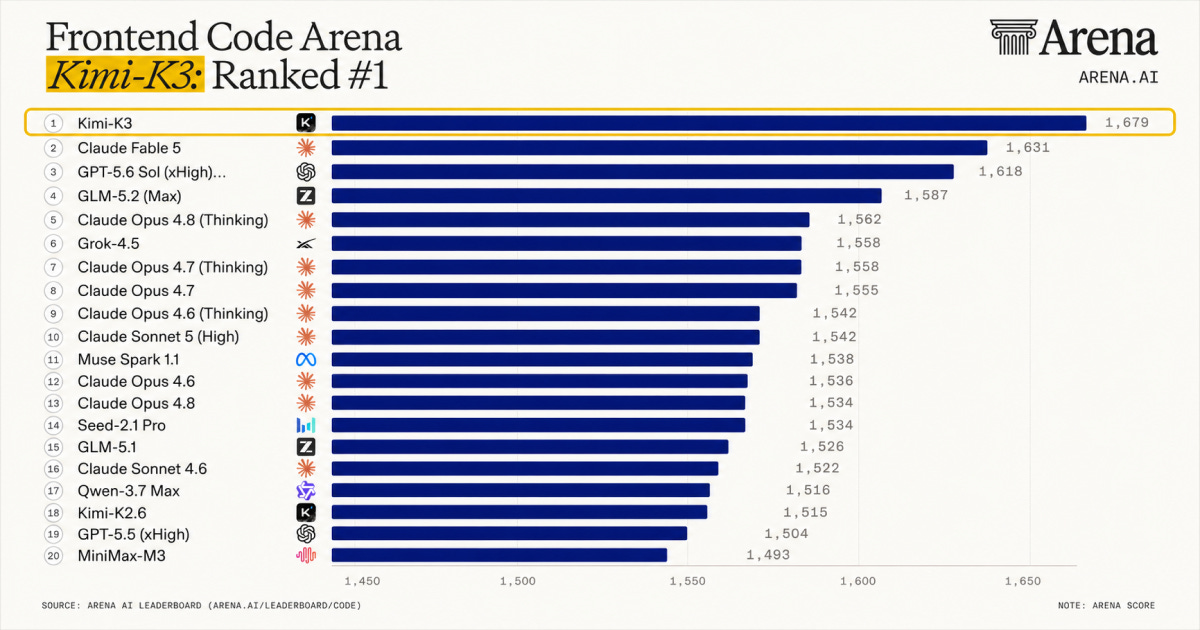
Alex’s take: For the first time, a Chinese model sits at #1 on LMArena's Frontend Code Arena. Kimi K3, built by Moonshot AI, topped the leaderboard with 1,679 points—beating Claude Fable 5, ranking first in six of seven categories, and jumping 17 places from its predecessor’s #18. David Sacks called it "concerning" and blamed regulation; funnily enough his replies kept asking which regulation stopped OpenAI or Anthropic from staying ahead. K3 costs $3 per million input tokens and $15 for output, against Claude Fable 5's $10 and $50—and on July 27, Moonshot releases the full weights, 2.8 trillion parameters, the largest open model ever for anyone to use. The same week, Xi Jinping used the World AI Conference to launch a 29-country AI cooperation body and pitch open, cheap Chinese AI to the developing world. Whilst American intelligence is rented, Chinese intelligence is yours to keep, no matter the circumstance. DeepSeek was dismissed as a one off. Kimi K3 makes it a pattern that can’t be ignored.
a16z’s Justine Moore on Anthropic’s aura problem:

Justine Moore@venturetwins
Fastest aura loss I’ve seen in a long time…

Claude @claudeai
Beginning July 20, Claude Fable 5 will be included in all Max and Team Premium plans, at 50% of limits. Pro and Team Standard users will continue to have access to Fable via usage credits, and will receive a one-time $100 credit. Demand for Fable has been challenging to
3:18 AM · Jul 18, 2026 · 1.13M Views
204 Replies · 429 Reposts · 11.8K Likes
Alex’s take: Anthropic has spent six weeks changing its mind and shuffling timelines about for who gets Fable 5 and for how long. The model launched on 9 June, went dark for 19 days under US export controls, relaunched on 1 July, then had its cutoff date pushed back twice before this weekend's announcement finally settled things. Half of usage limits on top-tier plans, pay-as-you-go for everyone else. Anthropic says demand has been "challenging to predict", and sure, I believe it, but repeated deadline shuffling turns a capacity problem into a credibility one. However, we must remember that the memory of people in tech is akin to that of a goldfish. People forget what happend last week once enamoured with the latest product, model, or partnership release, let alone what happened last month. Given that the quality of intelligence is quickly converging, goodwill, it turns out, is an overwhelmingly large portion of your subscription too.
"Do data centres actually increase the cost of residential bills?”
Alex’s take: Two-thirds of Americans believe a new data centre nearby would push up their electricity bill. But the evidence is actually pointing the other direction. A new working paper from the Electric Power Research Institute found data centres pushed US residential rates modestly down between 2015 and 2024, even after accounting for developers favouring states where power was already cheap. Utilities recover vast fixed costs across every kilowatt-hour sold, so a large, steady customer pulls the average down for everyone. The sharpest rises have come in states with aggressive climate policies, not the most data centres. Virginia, with more data centres than anywhere in America, sits near the national average. But there’s an important caveat which the authors touch on that I think is important to highlight. The past decade’s growth has absorbed slack in the grid, and that slack is essentially now running out. Policy has also answered this month via the POWER Act with Oregon’s approval of PGE’s 29.7% rate rise for data centres whilst cutting residential rates by 1.3%. Let’s see if the other 49 states are paying attention.
Already a subscriber? Get your whole team on board. Signal Pro group subscriptions give everyone access to weekly AI workflows and tutorials. Share this with your manager today.
💡 If you enjoyed this issue, share it with a friend.
See you next week,
Alex BanksP.S. One robot kicks another robot's head off.
Comments
Nothing yet. Say the first thing.
Sign in to join the conversation.