

Welcome to Showcase!
We’re back with our August edition!
A note from Bethany Leger, our new editor:
Dear Readers,
You did it, again! A big thank you to everyone for your great submissions. This month’s selections had me hooked from start to finish. What may be a distant memory, perhaps a story that has laid dormant, needn’t fall flat in its retelling. These pieces were alive, a testament to the authors’ ability to shake the dust off and generate suspense in a way that feels unmanufactured, authentic.
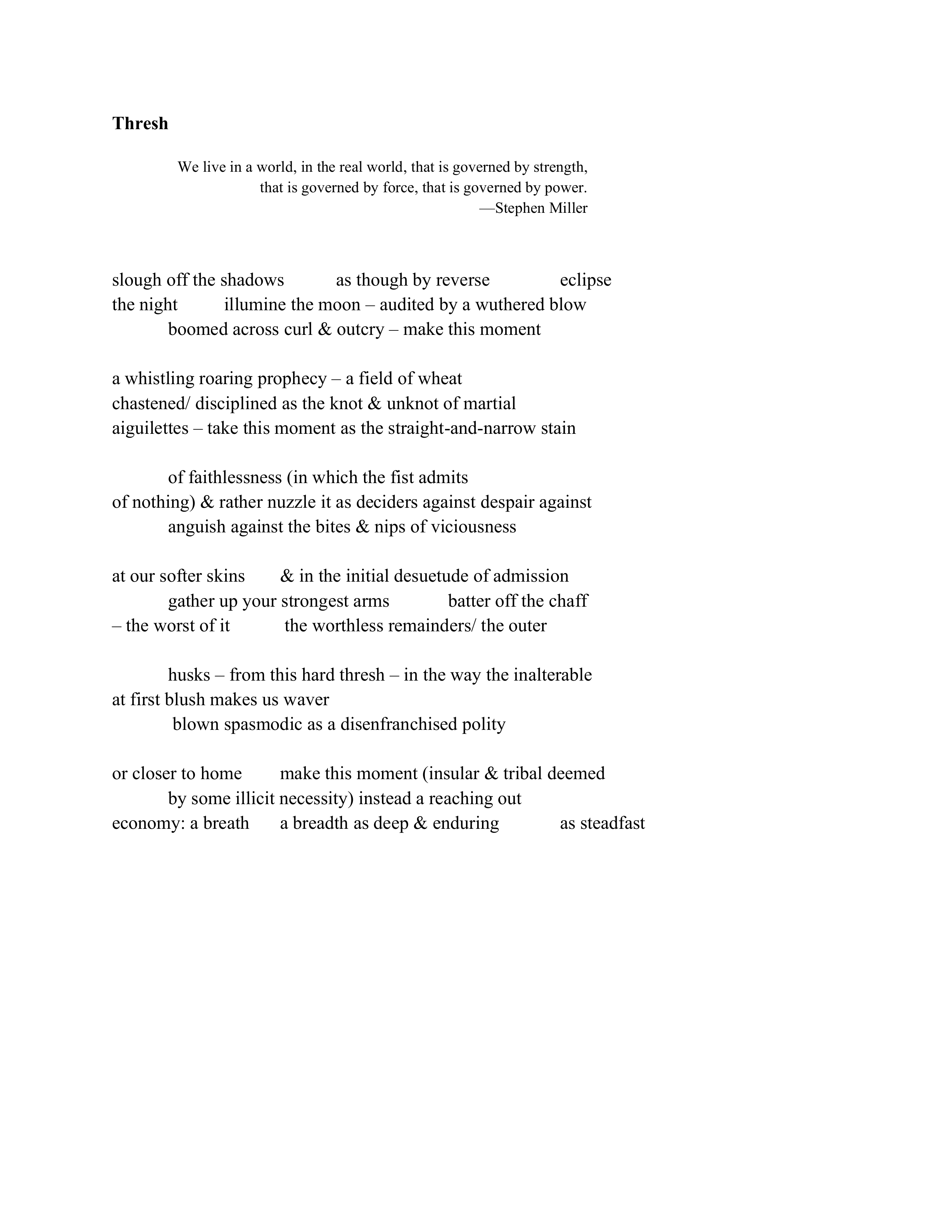
Thresh swept me back to the threshing floor of my youth, tasked with dividing society into the Blessed and the Damned. The hubris of my elders felt like “the bites & nips of viciousness at our softer skins” (h/t to M.A.S.), an impossible ask for a child who is inclined to notice the better angels of human nature. I didn’t so much read, as barreled, from one stanza to the next, impatient to see where this “whistling, roaring prophecy” would go.
Aria Temple’s Unbecoming is a cautionary tale of a young woman who will not be underestimated, only her bite transcends the need to bark. Temple subtly captures the unease of knowing your life will never be your own unless you take it back, especially when “his presence is the gun on the table.” In this case, when those closest to us use the Divine to dominate and subjugate, the pressure to conform can be overwhelming. She builds a tension that will either culminate in panic, or, possibly, just below the surface, lies a force to be reckoned with.
Thank you to these writers. We now present their work. As we continue with the relaunch of Showcase, I look forward to discovering even more page-turners, risk-takers, and all who put one foot in front of the other, each day, as the greatest act of bravery they know. Sincerely,
Bethany
Without further ado, this week’s selections are...
Mara Adamitz Scrupe for Poetry
Aria Temple for Prose (Short Fiction)
Some Housekeeping:
We will be in touch with everyone regarding their work very shortly. If you were not selected this month, we may yet ask to keep your piece, so please read any messages sent via submittable. Thanks to all who have submitted. If you submitted, and your work was not selected, please wait at least several cycles before resubmitting that same work. We thank you for the opportunity to have read or to read again.
As a reminder, we feature writers of all origins and all levels.
Let’s build a positive and positively enticing writing community such that readers, casual and devoted, continue to find us and make a type of home in our midst.
Jane Doe, new book, Lovely Title Here (with link)
Become a Patron of Showcase to appear at the front of every issue.
Short Fiction by Aria Temple
—Originally published by Showcase: Object & Idea.
Text within this block will maintain its original spacing when published
I dread the twelfth of June. It will be the day he comes for me.
He is one of those men in white that stand outside the chapel door before the start of every service. A minister as old as the first edition of A Prayer for Owen Meany. His presence is the gun on the table—wherever I stand shall condemn me to a life under heaven’s disfavor.
If only I had not worn that ivory dress, I would not be here. I have been pulled into a corner by everyone I know. The walls are closing in, and I am turning eighteen. It is a blessing to be chosen, they say. A blessing. My body has learned to flinch at the very word. How can an incessant ‘wish’ be a tightening noose?
Quietly, I sit on one of the pews. The eyes of the other members burrow into me as they walk past. I am marked. I hear whispers of potential expulsion. Once it has come to this, it will not be long until they cast me out, and I am no longer one of the brethren.
I was taught to seek forgiveness, to recant upon my knees. But the thought brings a sudden reprieve. A sliver of light steals through the half-open door. Then I hear the voice beneath, let them cast stones. Let them turn your name into a sermon.
And for the first time—my life is my own.
I used the twelfth of June, the day she comes of age, as a marker of time in which these invisible walls will finally fall away and all that fear and dread to manifest itself into existence. This is further underlined by stark visions of impending judgment and loss of agency, like the ivory dress, which was a kind of warning that she wouldn’t remain unscathed for long, and which carried her to the other side of faith, one framed as a higher calling that should not go unanswered.
I began this piece with the intent to allow readers to walk gently into experiences outside their own, as though dipping their feet into the same waters as the protagonist herself had. Some of us know that it is a reflection of what some women still experience today, though not necessarily tied to one culture or community. At its center, this piece leaves room for light at the end of the tunnel.
Showcase: We’d love to hear how you conceived of the piece. Can you tell us about the inspiration behind it? How did you come to write your 2 favorite lines/sentences? What do you like most about this piece?
This piece grew out of observing real people that I’ve known whose potential was lost to the unforgiving expectations around them. As I was writing, I tried to put myself into their shoes, sitting silently in my room, attention undivided--to truly feel what it was like to live under that weight. And that is just how my first two lines (my favorite) came to me. What I like most about this piece is how the protagonist turns her own fear on its head.
What motivates you on a thematic level? At what point do you consider the nuts and bolts of technique, style, word choice, and other craft items?
To be honest, I wasn’t that much conscious about the technical part. I wrote down the words I felt could best capture that intense feeling and let it flow from there without giving away too much. Though the piece might be longer, sometimes it is enough.
Where do you feel this work fits in on a historical or social level? How about aesthetic or stylewise and can you particularize your answer?
I see this work as fitting into a long history of stories about women preserving a sense of self, even if it’s entirely internal. And as an introvert, I’m naturally drawn to moments of courage, however quiet, and so the only choice that made sense to me was to make it intimate and atmospheric, with much of the aesthetic coming from the 90s films I was raised on.
As someone who was raised in a devout household, I’m intimately familiar with the portrait you’ve painted. If “the road to hell is paved with good intentions”, what message or advice would you want to communicate to these parents and faith communities?
I don’t feel qualified enough to give advice, but what I kept coming back to while writing was the need for greater listening within families. It’s not always easy to question things, especially if it’s something one was born into and has been taught to be true. While good intentions often come from a place of love, they could still create a lot of unspoken pain.
Are there any pieces, books, or authors to whom you’d compare your work, or that inspire you? Which of the above have influenced you and this piece in particular?
To be honest, there wasn’t any specific book or author in mind when I was working on this piece, but I’ve always been inspired by Hilary Mantel. Mantel taught me not to fear the visceral and to try to find the balance between rhythmic and incisive. These pieces of wisdom have stayed with me.
A Poem by Mara Adamitz Scrupe
—Originally published by Showcase: Object & Idea.
Regarding where my writing fits in relation to other writers, I learned long ago not to compare my creative work to any other, but instead to read widely and voraciously in efforts to know and understand as much as possible about what other artists are engaged in exploring, and to familiarize myself with the best work on offer today. My creative practice constitutes an amalgam of documentary film, painting and drawing, books arts, sculpture and place-based installation, alongside literary works of poetry and prose. For all of my projects, I conduct deep historical research, resourcing official documents, antique and vintage photographs, personal letters, texts, and mementos. My visual work influences my writing and vice versa. Visuality drives my poetry, essays, and reviews. I’m deeply curious about and stimulated by the world beyond myself; my practice addresses the personal as its moves toward the global. Exploring a compound topography of memoir, social history, ethnography, and the communal and environmental contours and implications of place, my poems emerge from observation and research in the natural sciences, social histories, theology, geology, biology, horticulture, and human ecology, alongside my fascination with fugitive artifacts and remnants of material culture. While specificity in language is crucial to my writing, I also explore fluidity, pacing and rhythmic potential in word spacing and the placement of lines on the page. I believe these strategies offer me opportunities for visualization in the rendering of compelling emotional intensity. I work to bring urgency to language that is musical and cadenced in rhythms that swerve and pulse, stutter and race toward a realization of the richness of our relationships with one another, and with the places we inhabit and think of as home.
Showcase: We’d love to hear how you conceived of the piece. Can you tell us about the inspiration behind it? How did you come to write your 2 favorite lines/sentences? What do you like most about this piece?
The epigraph to the poem “Thresh” is the best way to understand the inspiration for the poem. Having read that quote in a longer essay, I couldn’t get it out of my head. Of course, anyone who studies human nature will think hard about the notion that the real world is governed (presumably overwhelmingly, as Mr. Miller’s words seem to suggest) by force and power. And while I have lived long enough and seen enough of human struggles to acknowledge that power certainly plays a role in our affairs – both individually and as a part of a larger body politic – my writing often pushes back “against despair against/ anguish against the bites & nips of viciousness” in an effort to assert my hope that our better natures will prevail, replacing dependence on force and power with greater efforts toward justice and compassion.
What motivates you on a thematic level? At what point do you consider the nuts and bolts of technique, style, word choice, and other craft items?
When I encounter an idea, theory or notion that makes me feel something intensely, I tend to write in response to it. I’ve been writing since I was a child, and I’ve been making art of one kind or another for more than half a century. I am not a formally trained writer, but I am an inveterate reader and have been all my life. Thus, I suppose any technique I employ in my poems has been honed over a long period of time through reading work that moves me. I am not primarily interested in providing comfort to my readers, or necessarily to make common cause. I mean for my poetry to challenge readers both technically and intellectually, and in that effort, as I work out a new piece, issues such as word choice, line breaks and pauses and so forth, are considered and integrated as I write, to enhance the effectiveness of the piece in delivering musicality, emotion, pacing, and so on. Of course, I will return after a first draft is completed to do a certain amount of editing. But for the most part, I write in a rant style that echoes what’s going on in my head, and what I hear that interior voice saying, in the immediacy of thinking through a theme or subject.
Where do you feel this work fits in on a historical or social level? How about aesthetic or stylewise and can you particularize your answer?
I honestly have no idea how to answer this question. In the end, I suppose all artists must leave this kind of analysis (as I do, for better or worse) to literary theorists and their pedagogy. I’m far too busy simply trying to get the work done to spend much time analyzing where my creative practice lands in a social or historical context. Likewise, I believe I have developed a very singular voice, or style if you will, that I simply allowed to evolve and expand over many years across the many disciplines that characterize it, from environmental installation to documentary film, to poetry writing, among others.
There are several instances where you use what could be considered religious-coded language; terms like “a whistling roaring prophecy”, and “the stain of faithlessness”. Can you elaborate on the meaning of the poem?
As a cradle Catholic, albeit one who deeply questions all religious belief systems, I was steeped in the mysticism of “the Church” from a very early age, which may account for the esotericism and visuality of my writing. The metaphysical possibility of our humanity moves me deeply, whether or not I believe in the narratives of organized religion. The profound implications of the struggle between tribal power for its own sake, and the hopeful embrace of the universality of all the living world, is what grounds my writing in “Thresh”, as well as in many of my poems.
Are there any pieces, books, or authors to whom you’d compare your work, or that inspire you? Which of the above have influenced you and this piece in particular?
Since bits and pieces of what I read influence my visual and literary work, and I rarely respond in whole to a given book or author, I always find it difficult, or perhaps a bit unnerving, to reference specific authors or books as direct sources. That noted, it has been mentioned that my poems seem to address materiality and material culture as a kind of grounding for exploring social, political and spiritual subjects and experiences. So from that perspective, I will say that nonfiction is my primary source, including social and political history, art history, anthropology, archaeology, philosophy, environmentalism, and spiritual and religious theory, among other disciplines.
or
or
Chad Sokolovsky, Author of Prophecy Mechanic (Poems)
Cathy Rose, Writer.
Jane Ciabattari, Author of Stealing the Fire: Stories
Scott Archer Jones, Author of And Throw Away The Skins
Lucy Ferriss, Author of The Misconceiver
Cara Diaconoff, Author of novel, I'll Be a Stranger to You
Scott Ward, Author of Rebel: The American Iliad.
We recognize that many great pieces sit in obscurity having been published once and provided brief light, only to then languish. But let the creative waters churn. Let what was once sediment rise again as nutrients. Showcase enthusiastically calls for previously published work alongside unpublished work.
We also pay writers. As we grow and if we hit certain benchmarks which we’ll share along the way, we’ll be able to raise the payout to writers.
Payment Calculator (payments made to writers so far):$1450Please subscribe to our new format, share with friends, colleagues, and classmates, and consider submitting work. Submitting is free at a limited rate, which you can read about just below.
We will read very actively and pledge an eight-week turn around for all submitted work. We will generally publish monthly on the third Tuesday as well, providing as many opportunities as we can for writers. We hope you will read this issue and continue following our journey!
Showcase is a publication of C&R Press and Steel Toe Books. You will periodically see info for C&R and STB, from book releases to submission deadlines and author promotions.
No posts
Comments
Nothing yet. Say the first thing.
Sign in to join the conversation.