
Happy Friday, writing friends!
Yesterday’s author interview actually consisted of THREE incredible interviews with Linwood Barclay, Hank Phillippi Ryan, and Laura Moriarty. We promise that you don’t want to miss out on any of them! 👀
Then, we’re excited to share an excerpt from The Modern Guide to Querying Literary Agents by Alyssa Matesic and Patrick McDonald. Check it out below!
Today’s Q&A is by Shelly Jay Shore, author of Love Me Like a Rock Song:
“The first thing I do when I’m going to start a round of revisions is to make a master page for each round. That’ll include the top one to three goals of the revision (like “clean up the pacing” or “deepen so-and-so’s emotional arc”), and then the most pressing tasks or biggest issues related to a list of other areas: plot, pacing, backstory, craft, character, and story. Then I set up a to-do list for new content that needs to be written, and then finally I create a chapter-by-chapter table that includes the chapter title, the summary and key events, the characters included, what category/categories of work I need to do, and how much effort I think it’ll be to get the work done (green for light, yellow for medium, red for “yikes, get comfy”). When I have all the sections mapped out, THEN I go through and read/annotate the first draft — building out the page beforehand helps me refresh my memory and remind me what I’m looking for. Once the draft is done, I transfer all my notes into the master page in their respective sections, then start a new draft document!”
Keep reading for the rest of Shelly’s great insights!
CeCe is teaching her popular Writing Tension course in the fall featuring an all-new interactive component: The Acquisitions Pipeline. Scroll for all the deets! ⬇️
Finally, don’t forget that the Beta Reader Match Up is open to registrations for an 8 September match up!
That’s all for now. Thanks for reading! ❤️
The Shit No One Tells You About Writing Team
P.S. Still not sure about upgrading to paid? Check out our Tuesday Teaser below to see what you’re missing!
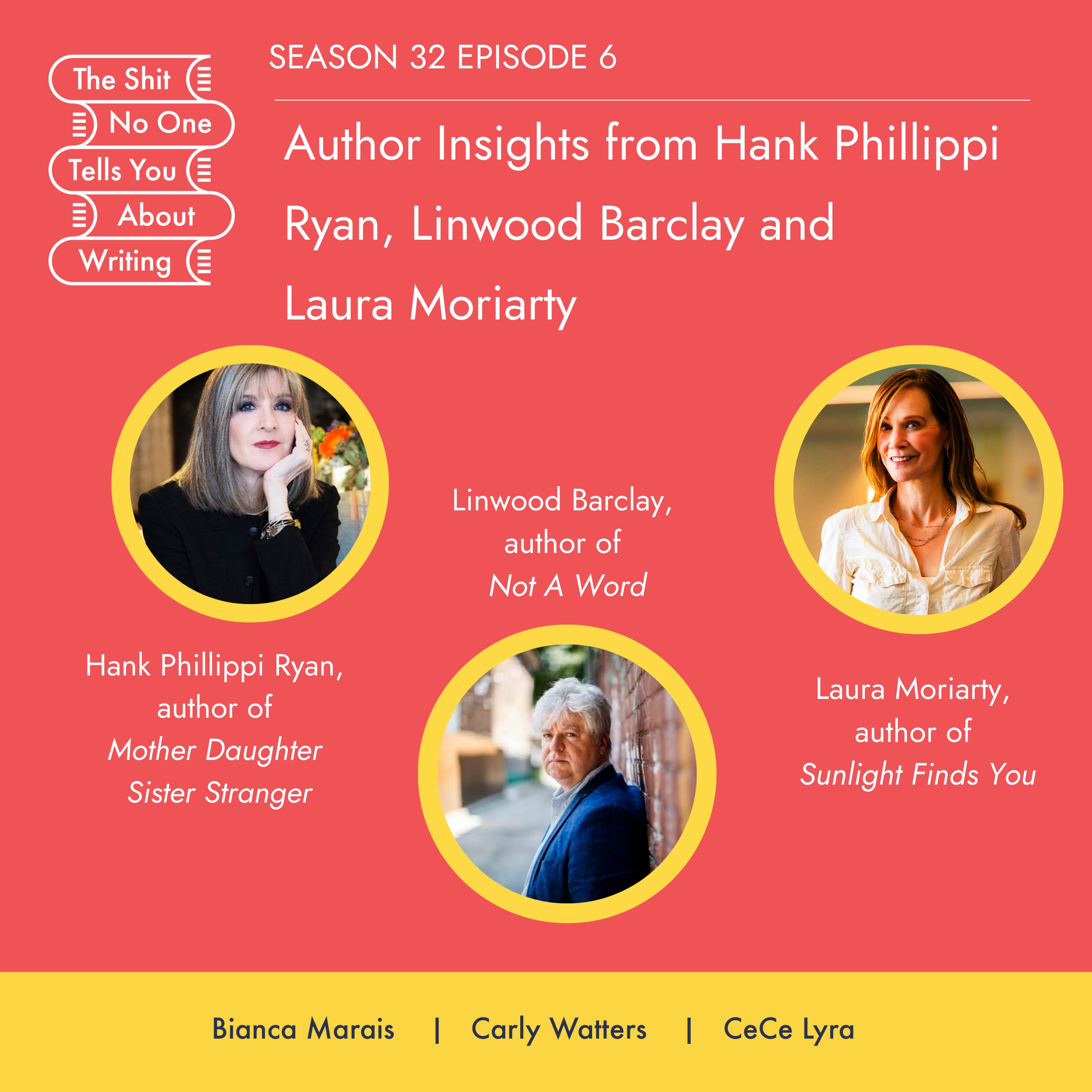
In part one of this week’s packed episode, Bianca Marais chats with thriller powerhouse Hank Phillippi Ryan, as they unpack the craft behind Mother Daughter Sister Stranger. From writing an unforgettable prologue, to building relentless suspense through curiosity, ticking clocks, and emotional stakes, Hank shares why panic is an essential part of her writing process. She also discusses how reading ambitious novels pushes her to take bigger creative risks, and why grounding readers in a character’s emotional journey is the key to making every twist land.
“I thought very deeply about this prologue and whether to do it at all. It was absolutely the first thing that I wrote. It is what came out of my brain before I typed chapter one. So I took that as a sign that it was meant to be.”
-Hank Phillippi Ryan
Next up is Laura Moriarty who discusses the craft behind Sunlight Finds You, exploring how voice can carry an opening without a traditional hook, why switching from third person to first person transformed the novel, and how a retrospective narrator creates powerful opportunities for foreshadowing. Laura also dives into historical research, layering exposition naturally, and using hindsight to add emotional weight to a coming-of-age story that lingers long after the final page.
“And it was like snipping a string on a helium balloon and just letting the story rise up…all of a sudden, that’s what made the story.”
-Laura Moriarty
Last but not least in part three of this packed episode is New York Times bestselling author Linwood Barclay joins Bianca Marais to talk thrillers, twists, and keeping readers hooked. Linwood breaks down his “somewhere in the middle” approach to plotting, why his stories often begin with a killer “what if?”, and how TV taught him to treat chapter endings like commercial breaks. Plus, they dig into breaking writing rules, avoiding backstory overload, creating curiosity from page one, and why what characters do and say matters more than what they look like.
“I wouldn’t start building a house without some blueprints. I wouldn’t build the house until I had a really solid foundation. But I don’t have to know what furniture I’m going to put in there. I don’t need to know the color of the drapes. I don’t need to know what the fixtures will be like. I don’t need to know that yet. I just need to know the basic structure.”
-Linwood Barclay
Listen to it here or watch it on YouTube!
The confusion and guessing games of the querying process end here. From two industry experts who built and work with the tools literary agents use daily, a step-by-step, proven guide for turning queries into representation, backed by real data and exclusive insights from over four million queries.
We’re excited to share this excerpt with you!
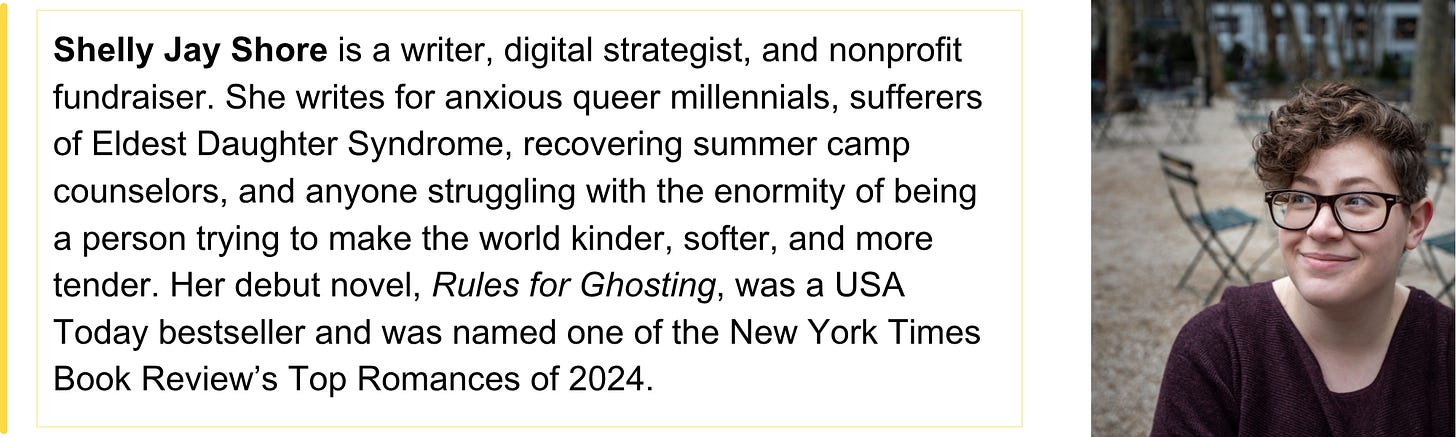
Alyssa Matesic is an independent developmental book editor and publishing consultant who has held editorial roles at Henry Holt & Company, The Book Group literary agency, and Ballantine Books. She built one of the leading YouTube channels for aspiring traditionally published authors (@AlyssaMatesic) and shares writing and publishing insights to help authors at all stages of their careers through her popular newsletter, Chapter Break.
Patrick McDonald is the creator of QueryTracker and QueryManager, the industry-leading online querying tools. He has been bringing agents and authors together for 17 years.
TSNOTYAW: What is your writing routine? Do you light a scented candle, turn on background music, write in silence, prefer a coffee shop or your writing desk at home? What about your practice works for you and why?
Shelly Jay Shore: I have ADHD, so my brain gets cranky if I try to do the same thing too many times. I’ve never had much luck with a specific writing schedule or routine — there are some days when I can write 15,000 words and others where I just need to stare at the ceiling. The rituals and practices that have worked for me are less about a specific environment or ambiance and more about checking in with myself at the beginning of the day. What are my energy levels like? Does today feel like a day to take things in (research, music, just walking around in the woods near my house) or a day to produce something new? Once I have that figured out, I can get started on the where or the how or the vibe, which definitely varies by day.
How do you feed your creativity? Particularly in the face of rejection or difficult feedback?
The biggest way I feed my creativity is by interacting with other forms or sources of creativity! I have really eclectic reading habits (the last three books I read were a queer romance, a Mary Oliver anthology, and a collection of Jewish myths in translation), but I also spend a lot of time in creative communities with folks who are doing things that are totally different from me, like painting and woodcarving and metalworking. I really believe in creativity for the sake of creativity, rather than for the sake of a particular outcome, and I think that’s part of why I don’t necessarily have a hard time with rejection or feedback. For me, it always comes down to: Did I enjoy doing the work? Would I have written this even if there was no chance of it selling? As long as the answer is “yes,” everything else gets manageable.
What’s your editing strategy? Do you edit drafts in phases, paying attention to specific elements of craft and storytelling with each round of revision, or do you tackle everything at once? Do you still use beta readers during the editing process?
I’m a gigantic Notion fan, so the first thing I do when I’m going to start a round of revisions is to make a master page for each round. That’ll include the top one to three goals of the revision (like “clean up the pacing” or “deepen so-and-so’s emotional arc”), and then the most pressing tasks or biggest issues related to a list of other areas: plot, pacing, backstory, craft, character, and story. Then I set up a to-do list for new content that needs to be written, and then finally I create a chapter-by-chapter table that includes the chapter title, the summary and key events, the characters included, what category/categories of work I need to do, and how much effort I think it’ll be to get the work done (green for light, yellow for medium, red for “yikes, get comfy”). When I have all the sections mapped out, THEN I go through and read/annotate the first draft — building out the page beforehand helps me refresh my memory and remind me what I’m looking for. Once the draft is done, I transfer all my notes into the master page in their respective sections, then start a new draft document!
It is a bonkers process, but it works for me! I don’t usually subject beta readers to the mayhem of the actual work I’m doing, but I often have one or two readers reading concurrently with the other edits I’m doing. 80% of the time, by the time they’ve gotten me their feedback, I’ve already addressed 90% of it, and the remaining 10% is usually light!
How do you dive into each new world you create? With characters first, world first, plot first? What’s your process when you’re beginning a new project?
Story first! Not plot — that comes later — but the question that sets up the emotional core of the book. With Rules for Ghosting, it was “What is scarier: real ghosts, metaphorical ghosts, or not realizing how many ways you’ve started almost haunting your own life?” For Love Me Like A Rock Song, it was “What would it take to make an impulsive, mentally ill creative on a massive deadline be willing to hurt someone else to finish their work on time, and what would it take to make them change their mind?” Then I sort of jot down the first few answers that come to mind and a tiny logline for a potential plot for each answer. If I like any of those potential plots, they might become a slightly longer summary. If I’m already slogging by that point, I go back to the initial question. If I’m still having fun, I start turning it into an organized project!
How do you feel about switching genres? And how did you find the genre that works best for you?
I’m at a potential switching point right now, so I think I can safely say I’m a fan!
This is probably terrible advice for writers who are looking at actually selling their work, but I usually start sketching out story and plot before I’ve totally settled on a genre. Usually by the third beat I can get a sense of what direction it’s going (obviously you’re going to hit a different kind of rising action with a fantasy novel versus literary fiction) but I’ve definitely done two to three versions of a particular story before landing on a favorite. Rules for Ghosting wasn’t written as a romance, but it ended up hitting readers that way. My original plan was to go more upmarket with Love Me Like A Rock Song, but this time a more traditional rom-com made way more sense. In general: experimentation! (This goes back to the whole “did I have fun doing it? then it’s worth it” philosophy of creativity.)
When you are working on many subsequent drafts of a book, how do you know that the work you are doing is actually serving your book? More broadly, what are some tips for writers who have made it past the first and second draft and have no clue where to go from there?
This is hard, because it’s so variable by project!
If it’s an “I know this draft isn’t right and I can’t for the life of me figure out what is wrong with it” situation, that’s usually when I call in a second or third opinion from a beta, ideally someone who’s read at least one of the previous drafts. If it’s more of “I’m 99% sure this is ready, but I feel like I SHOULD do more,” that is the devil talking. Put the document down, send it to a trusted reader, and don’t touch anything until you’ve received feedback, because most of the time if your gut says it’s ready, it’s as ready as you can make it. This is true whether it’s at the project level, because you know your storytelling abilities as well as anyone else, or at the line level, because it’s really a matter of familiarity with what your writing looks like at its best, and holding the current status to that standard.
Personally, I go really in-depth with my revisions, and I’m a fairly clean drafter to begin with, so I’ve definitely pronounced a book done enough to go to the next person up the chain (my agent or editor) on the second draft before. But generally, on the big-picture level, I write down a goal every time I start a new project — not a publishing goal, but an experience goal. It might be “Make sure the book answers the question I started with” or “tell XYZ story in a way that feels complete and meaningful.” Usually, the first draft or two doesn’t hit the goal.
Do you buy into the “write what you know” adage? Why or why not?
Yes and no, though it has more to do with consideration than with craft.
Generally, I do think there are some kinds of point-of-view characters and stories that shouldn’t be written by someone with no relationship to those identities or stories — partly because it’s really easy to be harmful and fall into stereotypes, but also because there is probably someone who is in that community or close to that experience who could write it just as well as you could, and probably better. It’s for sure a grey area, not a hard line, but it’s something I think about.
On the flip side, I think that when it comes to plot and setting and worldbuilding, you should absolutely write what you DON’T know — that’s half the fun of it. Do you want historical fiction to disappear because we’re all out of people who lived in the 1800s? Of course not! J. R. R. Tolkien was an academic translator before he started writing fiction. It’s good to learn new things. Any excuse to do that, whether it’s to create a believable fantasy world or just to play around with something new, is a good one.
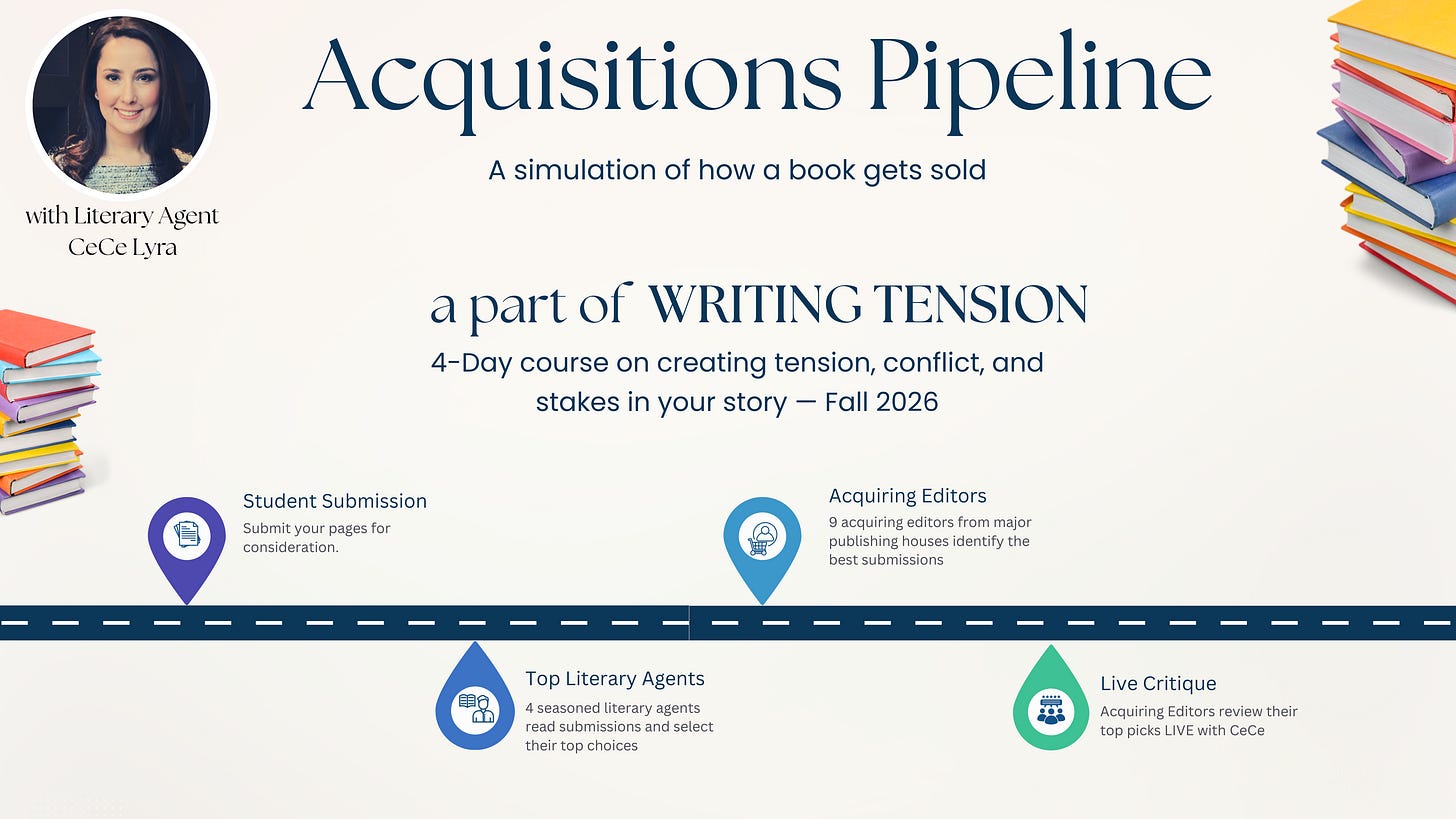
CeCe is teaching her popular Writing Tension course in the fall featuring an all-new interactive component: The Acquisitions Pipeline. The Acquisitions Pipeline is a simulation of how a book gets sold. Students of the course will be invited to submit their pages to be reviewed by a panel of 4 seasoned literary agents. Their mission: to select the works with the most potential. All students of the course will get to see which submissions made this shortlist. Then, those submissions will be sent to a panel of 9 top acquiring editors from major publishing houses. Their job: to select the top two per genre (that’s a total of 18 selections!) and critique them at a live event moderated by CeCe, highlighting what’s working, what’s not, and how the writer can make their work more competitive.
Does that sound super fun and also a little terrifying? It does to us, too!
Maybe your work will be selected. Maybe it won’t. The true value lies in witnessing how experienced acquiring editors (whose day job is to acquire books!) read real pages across different genres.
Please note that the Acquisitions Pipeline is an educational opportunity—submitting to the pipeline does not constitute a submission to a literary agent for representation and/or a submission to an acquiring editor for acquisition.
Due to the interactive nature of the course, spots are limited.
To find out more about this special edition of Writing Tension featuring the all-new Acquisitions Pipeline email learnwithceceassistant@gmail.com, or click below!

Are you looking for beta readers, some of whom might potentially become writing group members down the line? Are you wanting to be matched up with those writing in a similar genre and/or time zone, so they can critique your work as you critique theirs at the same time?
Your manuscript doesn’t have to be complete to sign up!
On the 8th of September, Bianca will match you up with between 2-6 other writers in similar genres and/or time zones depending on how many writers sign up. After that, it’s up to you to set up a date when you’ll either all meet up virtually to discuss your work or just send each other your written critiques. Whatever works best for you!
Important Instructions:
Submit 3000 words in a Word document before midnight ET on 7 September. If they aren’t opening chapters, you need to provide a summary so your beta readers have context for the submission. You may ask 2-5 specific questions within the same document for your beta readers to address.
The summary and questions don’t form part of the 3000 words.
Cost: US $25
Please note: NO AI whatsoever may be used to critique each other’s work!
More about the match up here!
In next week’s newsletter exclusively for our paid members, we’ve got ….
A video by C.N. Vair, author of The Devil Knows Her Name, which looks at how writing long sentences can save your writing! Intrigued? We were too! 👀
Tuesday’s Meet Your Dream Agent profile is of Maggie Sadler from Howland Literary Agency:
“The [mistake] I’m encountering the most lately (so it’s at the forefront of my mind) is not telling me what the book is about! I’ve read nearly ten queries in a row wherein the first two paragraphs were just repeating my MSWL back at me, without any real insight into the project being queried. While I appreciate that the author is trying to ensure that the project they’re querying isn’t off-base, I want to cut to the quick of what the author is presenting to me at this moment. (insert the gif of Tom Hiddleston as Loki crying, “Tell me!” here!)
I’m also just becoming quite skeptical that this particular format—the regurgitated MSWL without really divulging what the queried project is about—suggests AI-generated or assisted query letters, but perhaps that’s a conversation for another time. Please don’t send me a query that was assisted or generated by AI! It’s antithetical to what we’re all trying to do here!”
You will want to keep reading to see if you and Maggie would make a good match! And to see her detailed breakdown of why she rejects fulls!
We also have a video from Megan Frampton, author of Demons and Diplomacy, where she discusses the art of embracing your so-called ‘flaws’ in order to find your own distinctive writing voice.
Then, Jessica Hamilton, author of The Woods, pens an excellent essay on The Power of Place:
“It only recently dawned on me, after having written several novels, that it’s setting that most inspires my writing, more so even than a specific idea, character or concept. I’ve started many novels based on concept or character alone but almost always run out of steam and leave them unfinished. The novels that come to me the easiest are the ones in which setting is an active participant in the story.
As a reader I find this as well, if a setting is only loosely described, is too generic or banal, I tend to lose interest in the book. When a setting is described with enough detail to create a clear mental image and plays an important role in the story, I’m hooked. I believe that a writer can’t go wrong when they work to create emotional connection not just through their characters but through their setting as well.”
Not yet a member? For just $10 USD a month or $120 USD a year you get:
an exclusive newsletter on Tuesdays featuring bonus author Q&As and other exclusive content from industry experts
access to Carly Watters and CeCe Lyra’s written notes on queries from the podcast’s Books With Hooks feature
monthly bonus podcast episodes, AND
regular Ask Me Anythings / Q&As with Carly, CeCe, and Bianca Marais.
If that doesn’t kickstart your writing journey, we don’t know what will!
That’s all for this week’s news! If you enjoyed it, why not share the love? 🥰
Share The Shit No One Tells You About Writing
Tune in again next week for more invaluable wisdom from our wonderful hosts! Until then, happy writing! 😍
❤️ The Shit No One Tells You About Writing Team
Our work takes place on land now known as Toronto and Ottawa and we acknowledge that these are the traditional territories of the Mississaugas of the Credit, the Anishnabeg, the Chippewa, the Haudenosaunee, and the Wendat Peoples as well as the unceded, unsurrendered territory of the Anishinaabe Algonquin Nation. Toronto is covered under Treaty 13 and the Williams Treaties. We respect and affirm the inherent and Treaty Rights of all Indigenous Peoples across this land and acknowledge the historical oppression of lands, cultures, languages, and the original Peoples in what we now know as Canada. We invite you to learn more about the land you inhabit, the history of that land, and how to actively be part of a better future going forward together at Native Land or Whose Land.
Cece Lyra is a literary agent at Wendy Sherman Associates. If you’d like to query CeCe, please refer to the submission guidelines at www.wsherman.com. Carly Watters is a literary agent at P.S. Literary Agency, but her work on this podcast is not affiliated with the agency, and the views expressed by Carly on this podcast are solely that of her as a podcast co-host and do not necessarily reflect the views, opinions, policies, or position of P.S. Literary Agency.
Comments
Nothing yet. Say the first thing.
Sign in to join the conversation.