
Before the bell, Lifco, the leading Swedish serial acquirer, released its Q2 report, showing an acceleration in both organic revenue as well as EBITA growth. Let’s review the quarter and our valuation model in more detail. As we speak, shares are marked up 3%.
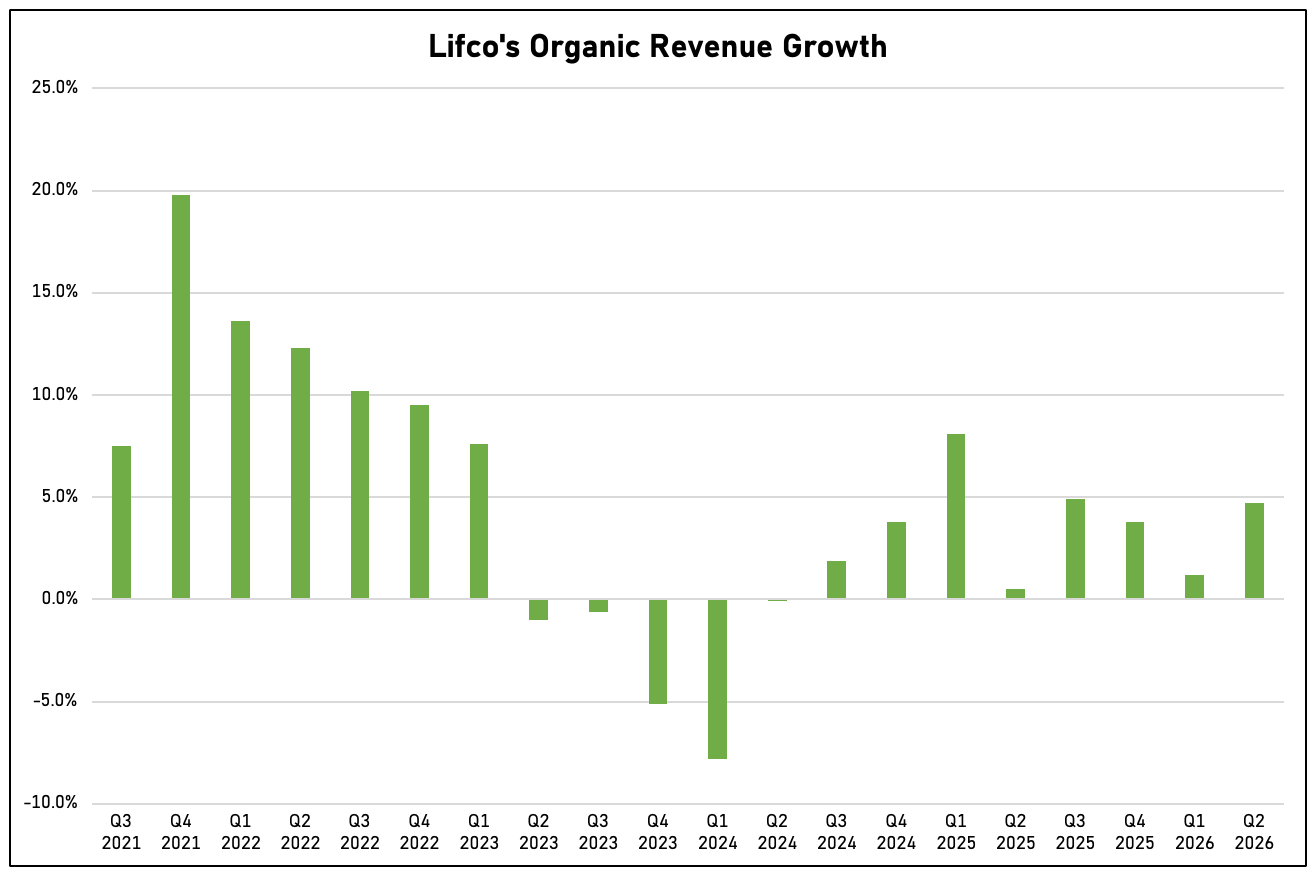
Organic revenue growth came in at +4.7%, marking a decent acceleration vs. Q1 and vs. the same period last year. For Lifco, it’s worth keeping in mind that individual quarters and sequential acceleration or deceleration should be taken with a grain of salt.
There can be a shift in deliveries because of holidays (timing of Easter), large orders, product mix, and the recently strong outperformance for Contract Manufacturing impacting both the top-line as well as relative profitability. Furthermore, within each segment and just like for any other serial acquirer, you’ve got a range of EBITA profitability.
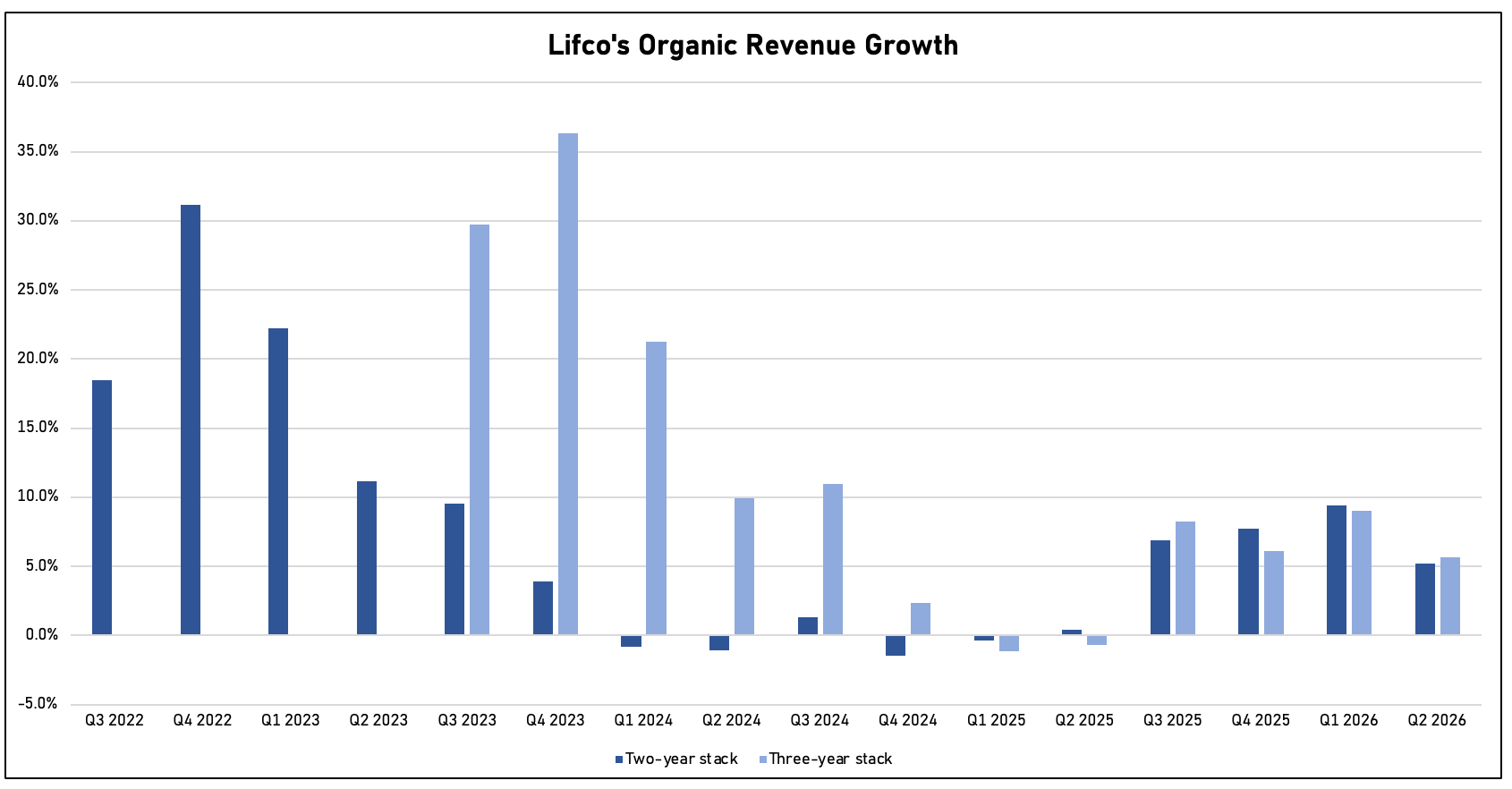
Looking at Lifco’s past two years’ performance, there have been quite a few puts and takes to which investors overreacted - be it positive or negative. FY2025 was a special year but Lifco’s now in stabler waters when it comes to organic growth. That’s when zooming out to a two- and three-year stack makes us get rid of quarterly volatility.
It has to be said that more meaningful organic growth would be helpful; 5% organic growth on a three-year stack is below Lifco’s high-quality standards.
At the end of the day, incremental organic EBITA, the IRRs on acquisitions, and total capital deployment are the only things one should care about (coupled with prudent financial management/leverage). We’ve been very spot on with our assumptions on Lifco’s fundamental development as we don’t pay a lot of attention to quarterly or even intra-quarter trends. The CEO himself has had a hard time figuring out why month X developed favorably or unfavorably given the macroeconomic and geopolitical noise.
But I think it also has to do with the holiday shifts in Central Europe and so forth. But for example, this quarter, April was okay, May was very weak, and June was good. And we saw a similar effect actually in the first quarter, which is strange because you would argue that March in theory would have been a weak quarter given what happened in the beginning or late February, beginning of March. It’s hard to make very good conclusions around this. But I can only mention that this is how it’s been around.
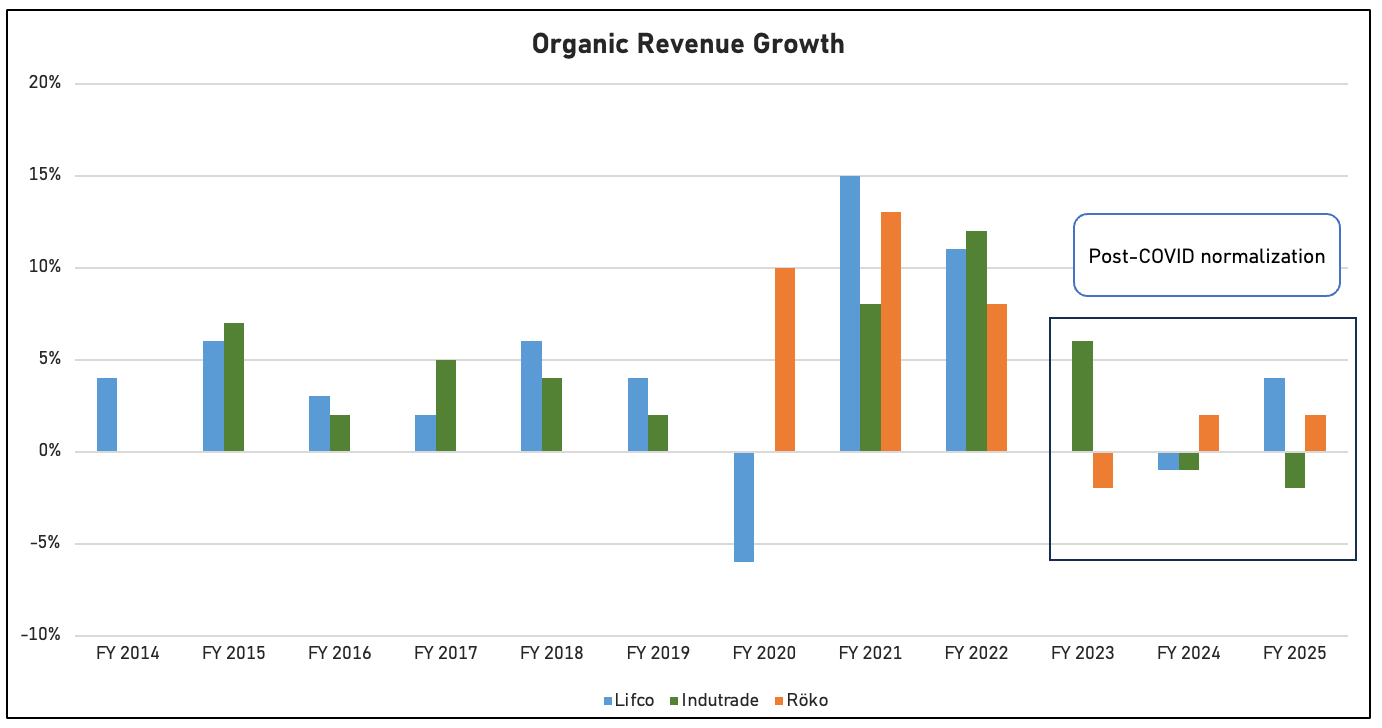
The below graph shows that, on a top-line level, Swedish serial acquirers had a great pandemic but have since seen sales growth slow.
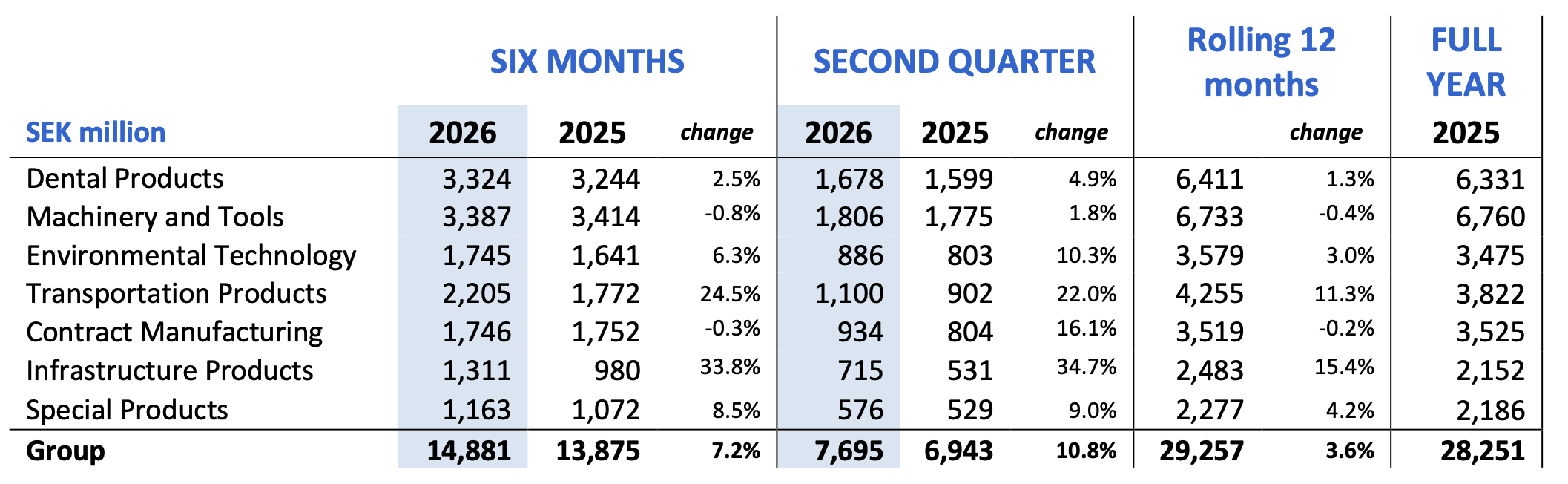
What remains pretty much unchanged is the lack of meaningful growth in Lifco’s more cyclical segments, particularly in Demolition & Tools.
The question around Demolition & Tools, I think I can only repeat what we said in the last Q2. It’s been overall, you know, the Demolition & Tools area peaked around 23 level and then had a very difficult 24. We saw some comeback in 25 and then we had maybe a bit surprisingly to many observers a bit weaker start in Q1 2026. In this quarter, I would say overall stable. You know, given the uncertainty in the global economy and especially, you know, the area where we have more CAPEX related products, there’s still a lot of uncertainty around those areas. It’s still very difficult to predict what would happen there going forward. - CEO Waldemarson
Lifco does not break down the organic EBITA growth per quarter - only a rounded percentage is being given at the end of the fiscal year. Nonetheless, one can make some guesstimates based on the consolidated EBITA margin, organic revenue growth, and how the acquisition mix plays out (even though pro-forma figures can differ). Based on this, our estimate for organic EBITA growth is around 8.5% - 9.5% in Q2 2026. This is a notable acceleration from Q1’s +2.5%, and clearly much better than the -6% from Q2 last year, presenting an easy comparison.
It also means that on a two-year stack, Lifco’s organic EBITA growth remains quite soft at about 2.5% or no real growth after adjusting for inflation and price increases, driven by industrial and construction related end market exposure. We’ve experienced this post-COVID sluggishness for some time now.
Going forward, we sort of repeat the previously shared info from last Summer:
As you keep adding margin accretive companies to your funnel, you’re bound to see some significant margin expansion (as per our calculations, it’s a cumulative 145-170 bps since FY24). The fact that margins have dropped from 23.2% to 22.4% indicates that the incremental profit development has reversed from the exceptional post-COVID levels. Not something to worry about at all - it was to be expected but maybe it wasn’t priced in. At this point, organic sales growth of about 2-3% is likely too low to stabilize incremental organic profitability (there’s wage inflation, commodity prices). It’s not limited to just Lifco, it’s becoming evident from other industrials’ earnings reports as well.
The simple math on margin expansion also got confirmed by Lifco’s CEO, when he talked about what’s driving strong performance in Environmental Technology:
I think many of these companies, we have high margin companies with high margin of product sales and also some of them have margin sales. But when you get organic decline, it’s very difficult to protect margins and vice versa. When you get some positive organic development, it’s quite easy to have an operational leverage normally. So I think that’s a simple explanation that we have organisations with product developers and sales force, so we have better leverage on those organisations. We tend to get better margins
Unlike the past several quarters (have to go back quite some time), newly acquired and effectively consolidated businesses during 1H 2026 were not margin accretive. Their realized EBITA margin was 21.2%. On a pro-forma basis in 1H, they would have been 23.8% - slightly accretive. Of course, net net, the year-over-year contribution from acquisitions acquired in 2025 was still helping EBITA margin.
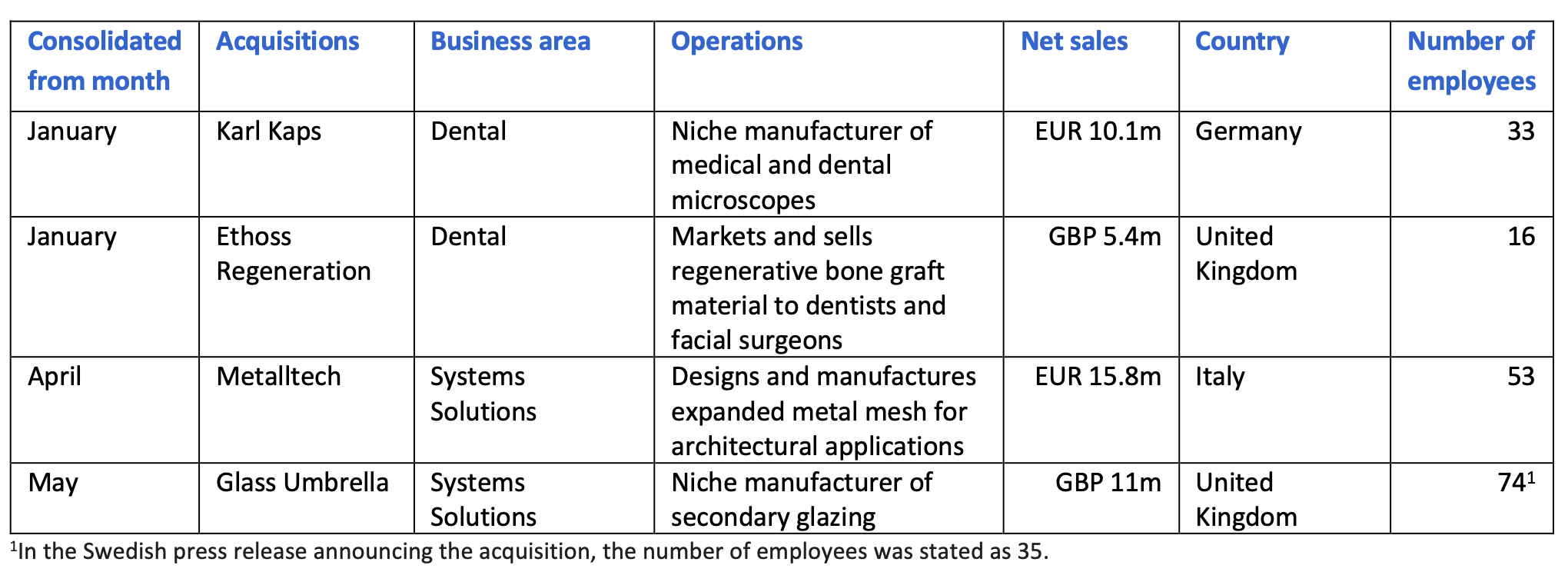
Thus far, Lifco’s consolidated four new entities in 2026, while add-on acquisitions were not publicly disclosed. The total EV acquired stood at 928 million SEK with pro-forma annualized EBITA in the region of 110 million SEK, thus implying a multiple of 9.1x. This is at the upper end of Lifco’s historical range but we don’t have the full details on any seasonality between 1H and 2H for the newly acquired businesses.
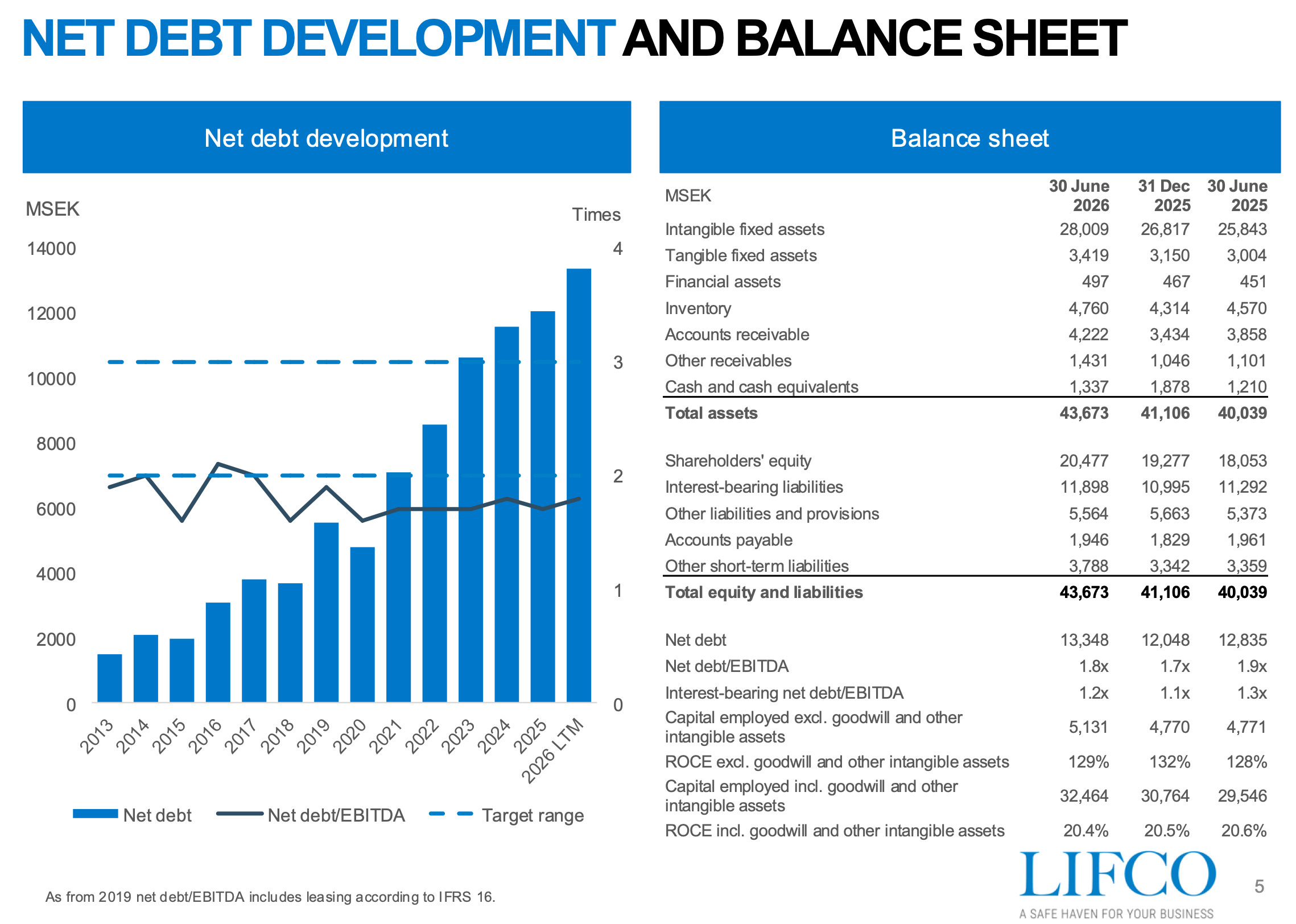
As capital deployment is now running below last year’s level, financial leverage’s ticked down to 1.2x EBITDA when excluding lease debt and put/call liabilities. Interestingly, Lifco’s acquisitions for which a mandatory put/call contract is currently in place, have continued to perform well - the existing debt got revalued by 229 million SEK since the beginning of the year, or an increase of 193 million SEK in a single quarter. The put/call liabilities are being revalued on EBITA performance, and an average multiple of 4 - 8.25x.
Following Lifco’s Q2 report, we’ve slightly adjusted our assumptions for FY26, reflecting:
better organic EBITA growth of ca. 3% (versus 1.5-2% previously), also reflecting Lifco’s subsidiaries’ price adjustments including the lagged effect for some of its business areas. At the same time, the recent developments in the Middle East and cost inflation (transportation costs) may dampen the rebound in volume activity observed during Q2;
about 2.5 billion SEK in total M&A (implying transactions worth 1.5 billion SEK for 2H) but given ongoing discussions, we might as well get a stronger 2H - M&A is inherently lumpy and Lifco’s got a tendency of acquiring more businesses just after the summer months/during the fall;
an increase in the average multiple paid to 8x EV/EBITA, reflecting the 1H outcome and pro-forma information (extrapolated over a full year);
lower financial costs (30 million SEK reduction)
Note that our acquisition spend assumptions reflect 100% of the Enterprise Value as if Lifco is not adding any incremental put/call debt. Subsequently, we don’t make explicit assumptions on how revaluations for today’s redeemable minority debt will evolve from here. As we’re already accounting for the put/call debt, we don’t have to incorporate dividend payments and acquisition of minorities either. As we’ve discussed in our write-up (July 2024), futurechanges in already accounted for put/call debt as well as dividends paid to ordinary non-controlling interests don’t drive major changes in the expected CAGR.
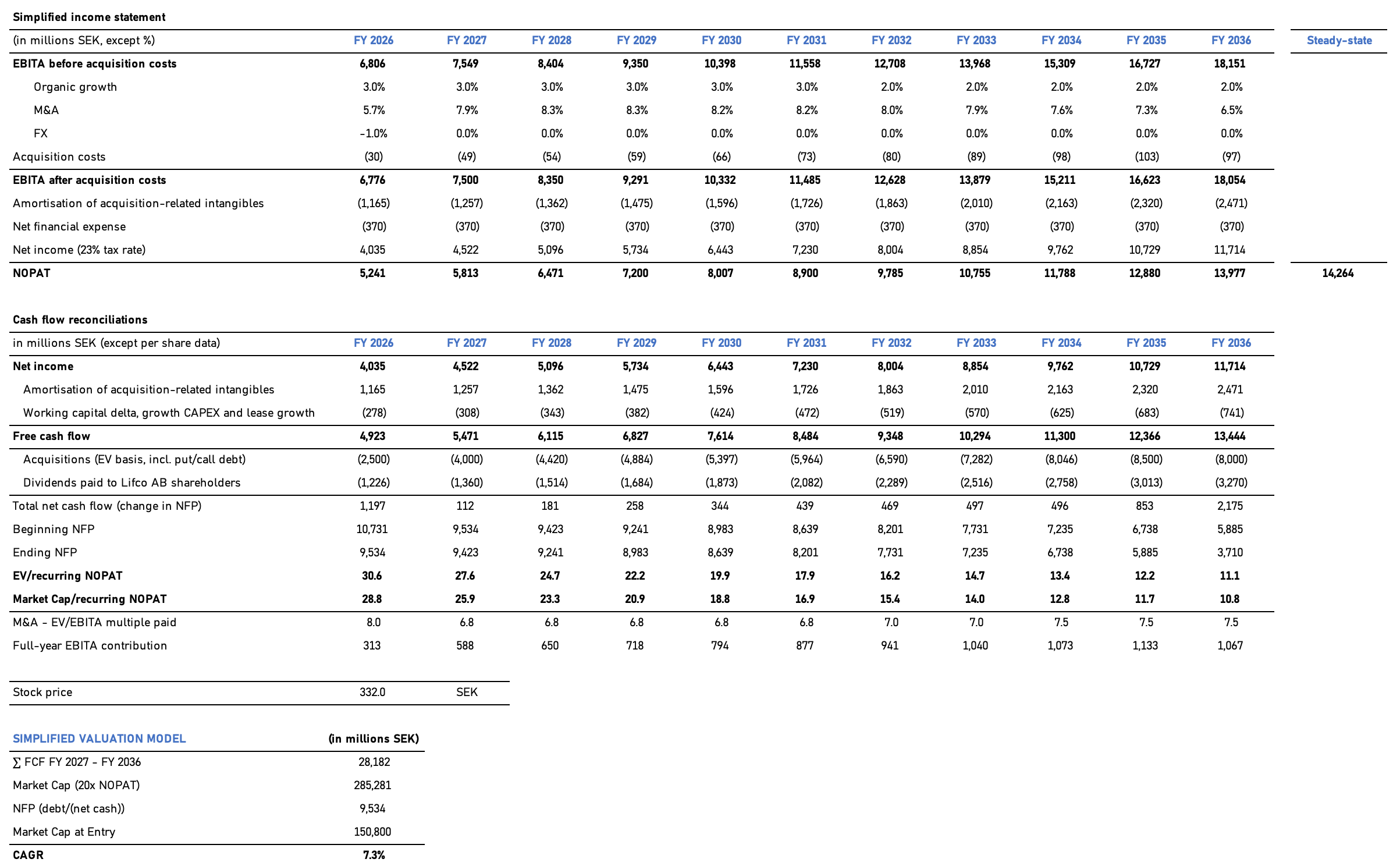
As is usually the case, these tweaks don’t move the valuation model much, and after having rolled the model forward, the projected CAGR comes in at about 7.3% - excluding dividend withholding taxes, dividend reinvestments, and any accretion from Lifco reinvesting more of its excess FCF into M&A and/or organic growth (inventory).
What does change is the share price, and we reiterate our views on Lifco being far less attractively priced compared to our other industrial serial acquirers (Diploma, HEICO, and our recently added but non-disclosed Nordic serial acquirer). They’ve seen their valuation multiples come down on the back of accelerating organic and acquisitive growth. Something does not add up here, in our opinion.
At 28x EV/NOPAT in FY27, we judge that investor expectations on Lifco’s organic growth and continuously growing 4 billion SEK in annual M&A beyond FY26 are high - in the sense that upside surprises are considered to be small.
Overall, we expect Lifco’s typical organic performance ex. extraordinary circumstances (such as inflation) to continue at a 3-ish percent level, especially as we’ve cycled through a strong organic margin expansion cycle during and just after COVID. The recent two years’ organic EBITA performance was relatively weak but against our expectations, it did not hurt the valuation multiple.
As for valuation, we continue to back our view of a 20x exit multiple. The impact of raising the current rate by 2x increments is a tailwind of 90-100 bps to the CAGR. So, at 24x NOPAT by FY36, the expected CAGR comes in at +9.3% - still below our hurdle rate. It’s a general observation around the valuation premium for Swedish serial acquirers.
Lifco’s ever-growing scale will inevitably introduce more pronounced M&A timing risks but each serial acquirer is going to deal differently with that kind of capital deployment hurdles. Pre-COVID, with a much smaller scale and easier base to grow margins organically, Lifco shares consistently traded at about 18-21x NOPAT, allowing for very stably robust shareholder returns. When valuation fell back in October 2023, it presented a substantial buying opportunity we took advantage of.
Today, we can’t really see an exciting risk/reward for long-term investors.
No posts
Comments
Nothing yet. Say the first thing.
Sign in to join the conversation.