
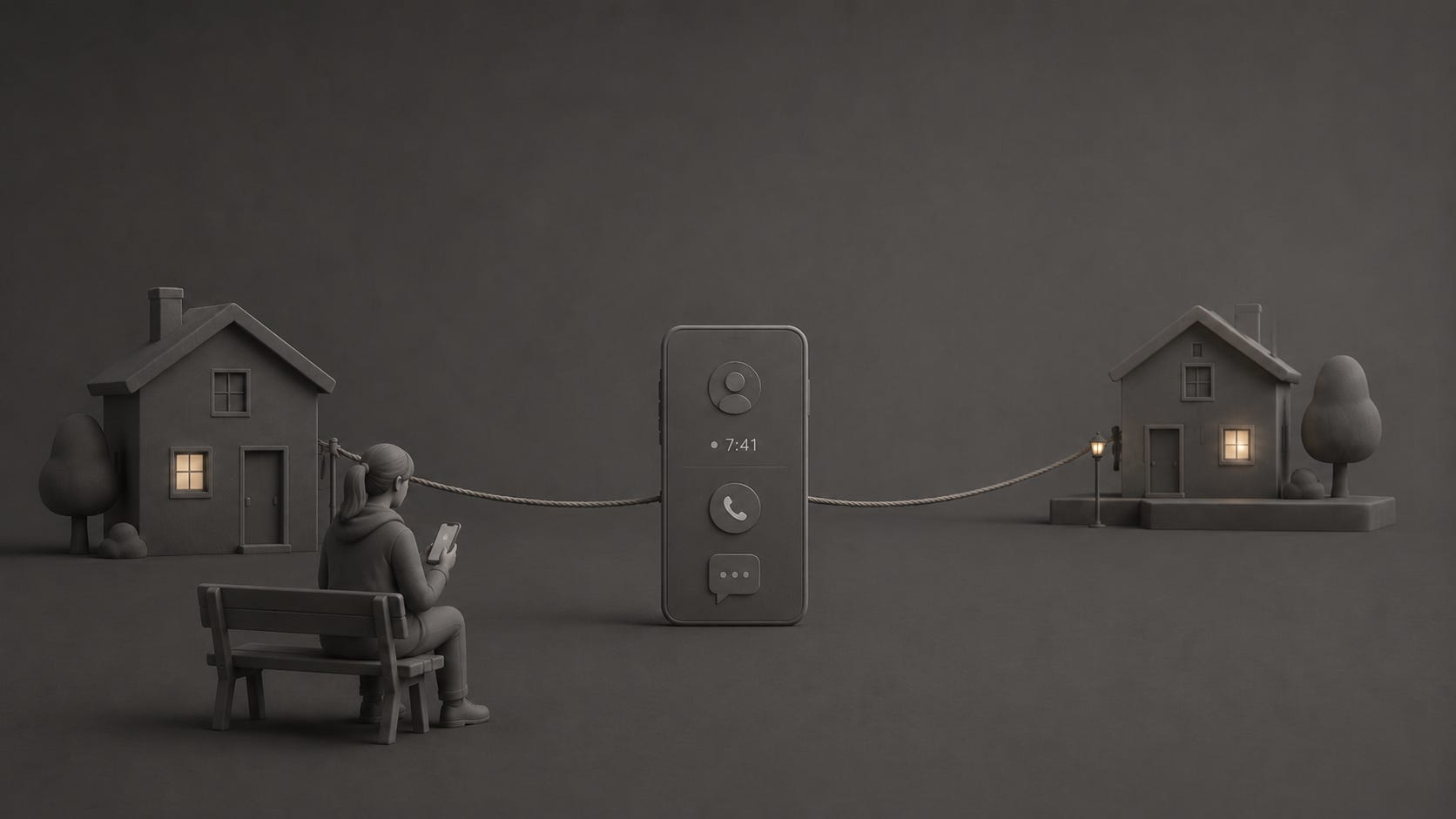
I check whether my mother is alive before I check my own email.
That sounds dramatic. It’s not. It takes two seconds and it looks like nothing: I open WhatsApp, I open our chat, I just look under her name. Last seen today at 7:41. Great. She’s up. The kettle’s been on. Somewhere in Turkey a flower GIF has already been sent to eleven people.
I close the app. That’s the whole visit.
It’s a very sophisticated system, I’ve been running it for over three years. 7:41 means a normal morning. Anything before six means her back is bothering her again and she gave up on sleep. Nothing by ten means I text my dad something breezy like “is mum with you?” with my heart doing something that is not breezy at all. I have built an entire monitoring operation out of a messaging app’s most useless feature, and I run it every day, and I have never once mentioned it to her.
Here’s the part I’d rather skip: the checking has slowly started replacing the calling.
Because checking is free. Checking asks nothing of me. A call is twenty minutes minimum, and it will contain a detailed weather report, a question about whether I’m eating, and at least one story I’ve heard so many times I could sit the exam. So on a busy day I do the two-second version. Green light. She exists. I love her. Next tab.
She does her version too, by the way. She watches my status updates. She notes the two blue ticks when I’ve seen the good-morning roses and said nothing back. She once asked me, very lightly, not an accusation, just placed gently on the table between us: “You saw my message at nine. You wrote back at five. Busy day?”
She’s running the same operation. Hers is just older than mine. Mothers invented read receipts; the phone company only automated them.
And I keep thinking about what we’ve actually agreed to, the two of us, without ever discussing it. We’ve agreed that knowing the other one is there counts. That the green dot is a kind of hand-holding. Some weeks it honestly is. And some weeks it’s how I get to feel like a good daughter for the price of absolutely nothing.
Last seen today at 7:41. Seen by whom, though. Not by me. I just checked the timestamp.
I talk with people in their seventies every day, so let me tell you what the green dot looks like from the other side.
The people I speak with know they’re being checked on. Of course they know. You are not subtle. One woman told me she goes online every morning at the same time “so the children don’t worry” — the way you’d raise a flag on a hill. Up by eight. All’s well. Some of them told me they do it before they’re actually up to anything, phone on, then back to bed. The flag matters more than the morning.
What do I notice, across hundreds of these conversations? Two things, and they don’t quite match.
The first: this checking is real love. Nobody experiences it as surveillance. Knowing that somewhere, a grown child glanced at a timestamp and exhaled — that is a warm thing to know. It gets mentioned to me with pride, actually. My son notices if I’m not online by ten. That sentence is doing a lot of work. Someone is watching for me. I have not slipped out of view.
The second: nobody tells the timestamp anything. The morning flag says alive. It does not say I didn’t sleep. It doesn’t say the neighbour who used to ring hasn’t rung. It doesn’t say I had a strange dizzy moment on the stairs and told no one, because you’d worry, and worrying you is the thing I most don’t want to be. The signal was designed to carry one bit of information, and one bit is what it carries. Everything else waits for a voice.
Here’s the pattern I’d gently hand back to you: the dot answers your question, but notice which question you’ve started asking. Is she there? is a smaller question than how is she? — and the dot will never once make you ask the bigger one. It’s very good at that. It sends you away satisfied.
The people I talk with don’t need more monitoring. They are, if anything, the most monitored generation of older adults in history — timestamps, ticks, last-seens, the whole quiet dashboard their children run. What they’re short on is the other thing. Being asked a question the dot can’t answer. Being heard deciding how they are, out loud, in their own order, with the weather report included.
So, the dot.
Keep it. Honestly. Check every morning. It’s not nothing — it’s a rope between two houses, and ropes matter.
But once in a while, notice what you’re doing. You’re reading a timestamp and calling it her.
7:41 is not her voice. 7:41 is not the story you’ve heard a hundred times, told the hundred-and-first time, slightly differently, watch for it. 7:41 doesn’t know what she didn’t say.
She raises the flag every morning so you won’t worry.
Call anyway. Let her hear that it worked.
No posts
Comments
Nothing yet. Say the first thing.
Sign in to join the conversation.