
This work runs on reader support. Become a Paid Subscriber or Early Founding Member today to keep it growing.
If you can’t support today, share this article with two people who care about the Constitution—that helps just as much. Thank you.
Donate to The Second Bill of Rights
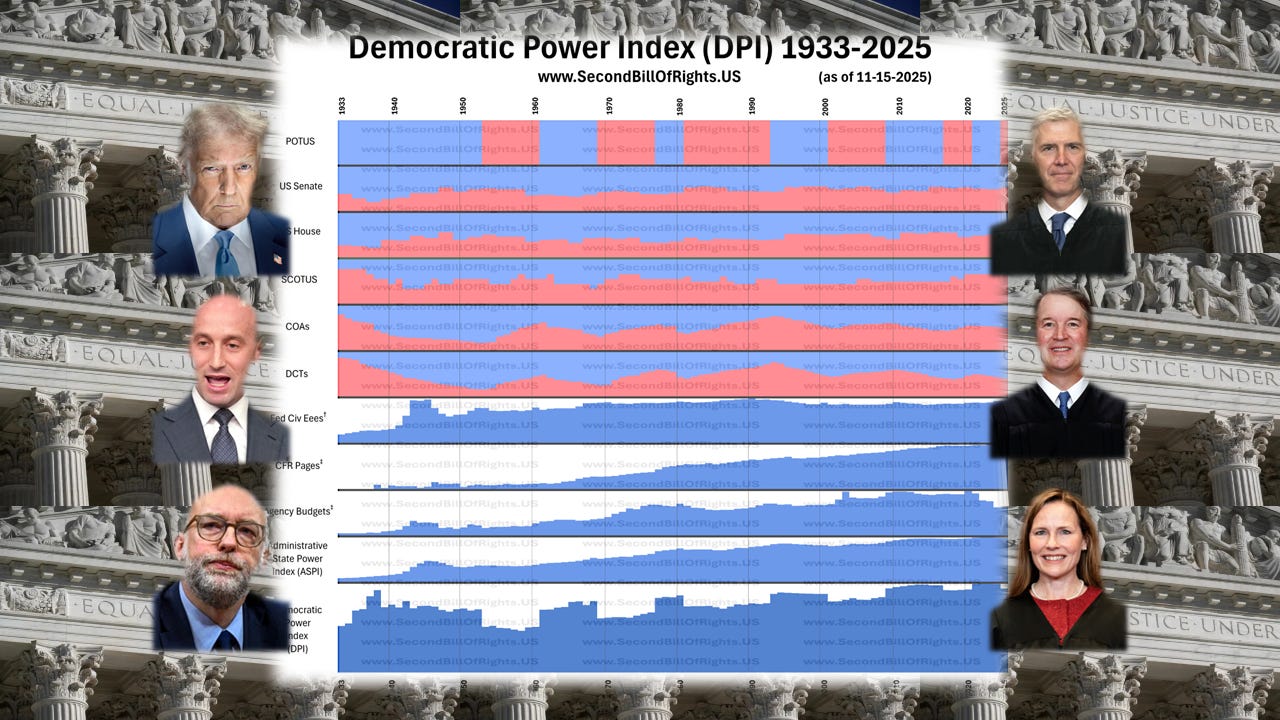
From 2017 to today, a new inflection has marked the long arc of American governance: the Supreme Court’s 6–3 realignment, the end of Chevron deference, and the unspooling of major-questions doctrine shattered a generation-long standoff. What began as incremental rollback—Dobbs, Bruen, West Virginia v. EPA—grew into the first measurable retreat of the administrative state since World War II. For the first time in nearly a century, DPI and ASPI have both ever so slightly turned down in response to shrinking regulatory outlays, GDP-driven discipline, and courts determined to reverse nearly 100 years of bureaucratic expansion. Lower courts are shifting, district courts see their high variance muted as appointments rebalance the judiciary back to a GOP=appointed majority, and the apparatus now finds its mass receding faster than anyone believed possible just a few years ago. Result: the “Plateau” in the DPI bands gives way; the “Apparatus” (ASPI) at last begins to shrink.
“Mean reversion comes for the thickest rulebooks.”
We have a brand-new DPI graphic! The components for 2024 agencies as a % of GDP were finalized AND President Trump signing into law the One Big Beautiful Bill and then the continuing resolution on November 12, 2025 updated the 2025 inputs for that figure as well.
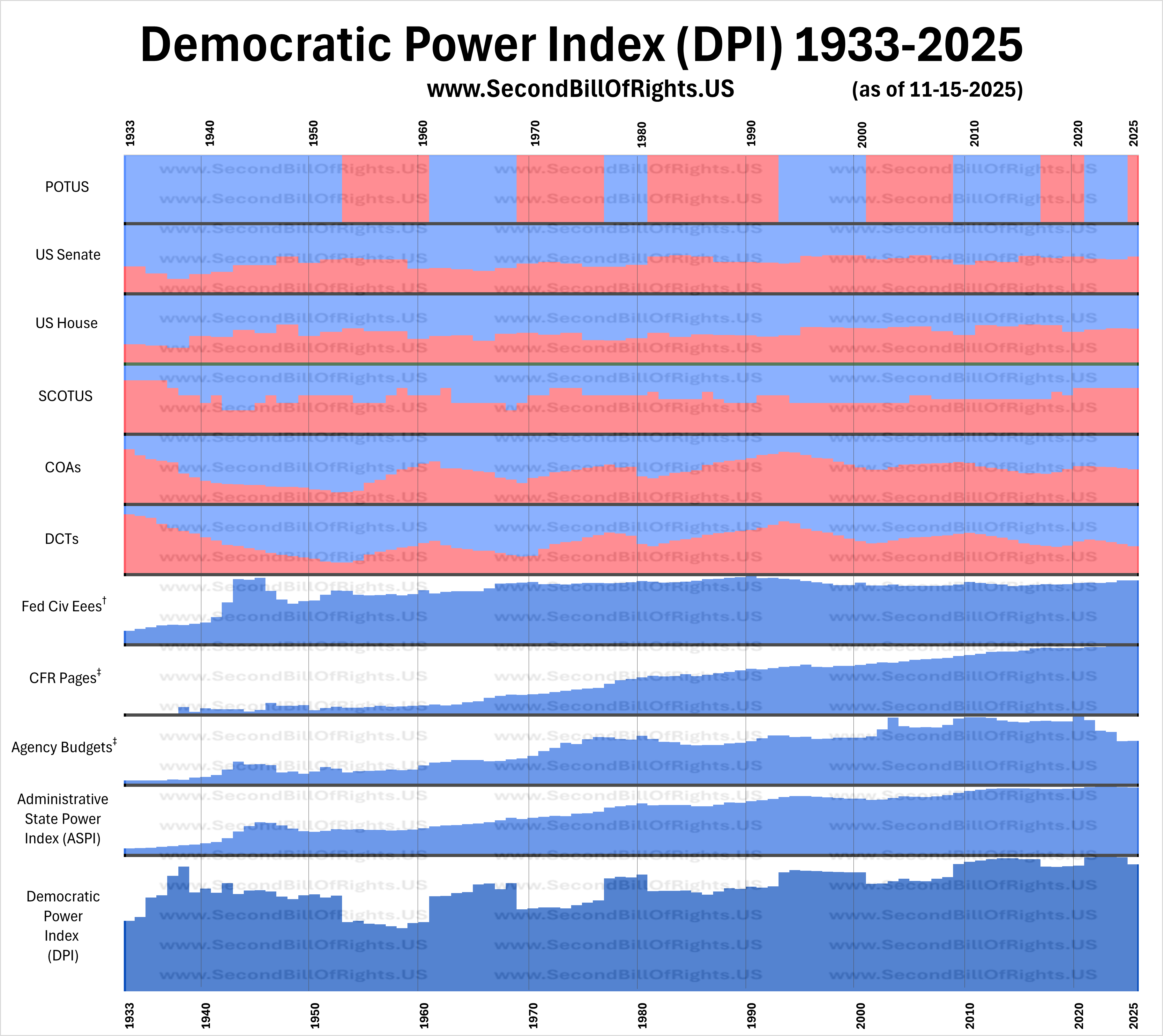
Please feel free to download, copy, share, repurpose, zoom-in-on, whatever you want with the image. That’s the whole point of all this. Spread it far and wide.
Don’t let anyone perpetuate the lie of “Republican control” ever again—no such thing has happened since the 1920s under Coolidge and Hoover—you remember all of them . . . they made the ‘20s ROAR!

Please remember that the four ASPI-related rows for 2024 are based on one remaining 2023 figures (CFR pages), and for 2025 are based on one 2023 figure, one 2024 figure, and an as of 11/15/2025 updated projection. Expect those final published numbers once published to pull down each of those rows from what you see here. That, in turn, will pull down ASPT and DPI for 2024 and 2025. See why the tiny urban blue bubbles are on fire and full of rioters like never before? Burn, baby, burn!
And lastly before we begin this fourth article in the series, if you haven’t yet read the first three articles, here are the buttons to read them now:
The DPT: Shields Begin to Plateau
Now, let’s get to it, finally!
For nearly a century, the Democratic Power Index (DPI) has told a story of relentless expansion: New Deal supermajorities, FDR’s administrative behemoth, postwar agency proliferation, and a long “Triple Shield” era where the legislative, judicial, and executive branches (plus the Fourth Branch bureaucracy) locked in a one-way ratchet. Even after 1994 shattered decades of Democratic dominance in Congress, DPI and its administrative cousin, ASPI, merely plateaued at historic highs, rather than reversing course—until now.
With the release of the latest DPI graphic incorporating finalized federal outlays and GDP data for 2024 ($6.75T out of $29.18T, down to 23.13%) and projections for 2025 ($7.1T out of $30.4T, down to 23.36%), we are finally seeing the long-theorized inflection—a sharp drop in federal regulatory outlays as a share of GDP, not just a statistical blip, but a signpost of real institutional contraction. The resulting ASPI and DPI lines both take a very small turn downward for the first sustained period since Roosevelt’s ramp-up. This fourth article dissects this sea change, tracing its roots to political and legal transformation after 2016, and exploring what may come next for both the Fourth Branch and its partisan architects.
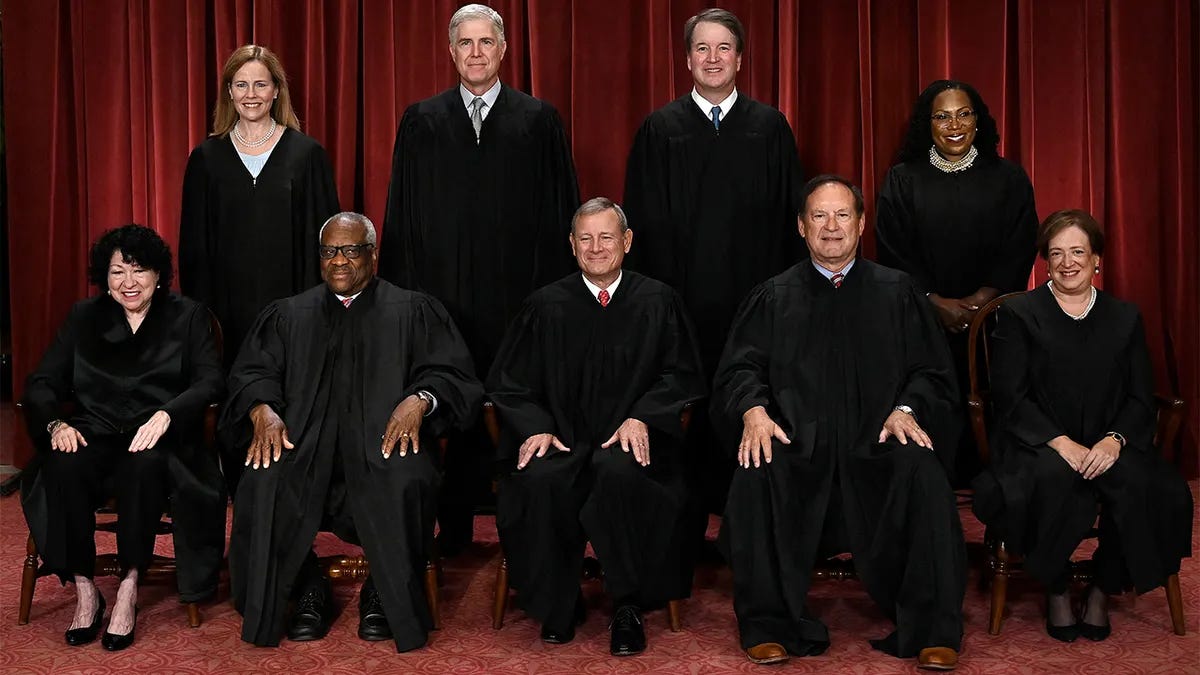
The modern rollback began in earnest with Trump45, but the real fulcrum for federal power came as the Supreme Court shifted decisively to a 6–3 GOP-appointed majority with Associate Justices Gorsuch, Kavanaugh, and Barrett. Dobbs reversed a half-century of national abortion precedent; Bruen upended restrictive gun regimes; West Virginia v. EPA sharply constrained major regulatory initiatives; and Loper Bright set the Chevron doctrine ablaze, transferring final interpretive authority away from the administrative state and back to the judiciary and (at long last) to the text of congressional statutes.
Courts of Appeals (COAs): Ideological Filtration and Policy Chokepoints. In the last decade, Courts of Appeals have adopted the role of sophisticated, ideological filtration systems—functioning as true policy chokepoints when Supreme Court review remains selective. Especially with a less-frequent grant of certiorari by SCOTUS, COAs have become the final word on nationally pivotal statutes, regulatory enforcement, and emerging constitutional interpretations. Judicial panels, often split ideologically and increasingly strategic, now determine the fate of executive actions: regulatory freezes, executive orders, and new agency doctrines all find their crucible at this level. The panel draw has come to matter as much as the merits of a case, and advocates nationwide game strategy around the possibility of finding a sympathetic COA before risking the randomizing effect of Supreme Court selection. This environment breeds sophisticated doctrinal filtering: opinions tailored to fit the narrow bandwidth of likely Supreme Court attention, while allowing muscular precedent-setting on everything else.
District Courts (DCTs): The Land of High Variance and “Screwball” Law. District Courts, meanwhile, remain the wild frontier of federal law—variance land—where ambitious litigators aggressively forum-shop for sympathetic benches, and single judges can, in theory, wield outsized national influence through temporary restraining orders or preliminary injunctions. The Supreme Court’s June 27, 2025 Trump v. CASA, Inc. decision sought to rein this in, establishing a demanding new test: nationwide injunctive relief must now be explicitly justified as necessary to provide complete relief to the plaintiffs before the court, rather than applied as a matter of judicial discretion. However, practical realities have diverged quickly. In the wake of this ruling, some district judges have moved fast to adapt—massaging pleadings, accelerating class certification, or strategically casting “complete relief” in broader terms to skirt the new boundaries and achieve what are, in effect, de facto national injunctions in urgent cases. As a result, while appellate harmonization occurs over time, these inventive remedies and creative theories often linger, fueling public confusion and accelerating the underlying “whiplash” policy cycle. Scholars increasingly point to this cat-and-mouse dynamic as a root cause of our “shadow docket” phenomenon: a court system repeatedly buffeted by abrupt, sometimes contradictory interventions from strategically chosen trial judges—a dynamic the Supreme Court’s new rule has so far only partially constrained.
\After the Biden administration’s intensive appointments, both Courts of Appeals (COA) and District Courts (DCT) have been brought roughly back to an even 50/50 partisan split. That, however, is a fleeting equilibrium: given retirements, vacancies, and the composition of the current Senate, projections strongly suggest these courts will shift to a 60/40 or stronger GOP alignment by the end of 2028—a tectonic shift for administrative law, emergency orders, and injunction practice.
The rise of the Supreme Court’s shadow docket—emergency orders, expedited stays, and terse, late-night decisions—has only intensified this resistance pattern. Conservative justices have repeatedly admonished lower courts for disregarding or narrowly construing opaque signals from above, while liberal dissenters deride the system as “Calvinball,” with rules invented anew for each emergent crisis.

The real fight is no longer solely about substantive merits in traditional published opinions, but about who can send, decipher, and react to signals with the greatest speed and precision. This shift has produced a true jurisprudential arms race, marked by rising polarization between those demanding clear, enforceable rules and those defending the inherent ambiguity—and the strategic utility—of the new emergency process. The shadow docket, once a rarely used backstop, now shapes the pace, content, and legitimacy of national legal policy in ways unimaginable just a decade ago.
A new and crucial cleavage has emerged in the Democratic response to recent Republican presidents. While Trump45 generated deep irritation and resistance—much of it stylistic and rhetorical—Trump47 is received with outright existential dread by Democratic leaders, activists, and the permanent bureaucracy—Trump47 and his team are going to slay the swamp hydra with intent if not malice aforethought. The stakes are higher now because the lessons of the first Trump term have been learned: Project 2025 and aligned efforts promise to go much further, much faster, and with vastly more technical preparation than in the past. The “deep state” and Democratic apparatus are not merely annoyed; they are terrified of the explicit intent and the sophistication behind Trump47’s strategic plans to undo decades of surreptitious administrative entrenchment.

Key to this acceleration are at least these seven administration planners and effectuators who have shaped and are executing this rollback strategy:

Stephen Miller — Deputy Chief of Staff for Policy, “Prime Minister of Dismantling.” Miller is not just an architect of immigration restriction but acts as the strategic coordinator behind nearly all major administrative rollbacks, translating President Trump’s instincts into aggressive executive actions. His mastery of bureaucratic maneuvering, willingness to push constitutional boundaries, and deep networks within both DOJ and DHS make him the ideal tactician for targeting vulnerable pressure points across the administrative state. Miller’s relentless drive and ability to operationalize policy have earned him trust as the administration’s unofficial “prime minister,” directing covert and overt efforts to shrink agency scope, remove non-loyalists, and repurpose regulatory powers for maximal political impact. Wikipedia
Russ Vought — Architect, Budget Czar, and “Deconstructionist-in-Chief.” Vought, as former OMB Director and lead Project 2025 architect, transforms budgetary control and administrative law into weapons of broad state reduction. Rather than mere “bean-counting,” Vought engineers mass layoffs, rescinds agency autonomy, and rewrites administrative independence—most notably crafting strategies to reallocate or rescind billions in federal funds without congressional acquiescence. He specializes in identifying and exploiting legal ambiguities to assert the White House’s dominion over regulatory agencies, approaching constitutional boundaries head-on and inspiring others to push what’s “politically feasible” much farther than tradition allowed. Wikipedia
Sergio Gor — Head of Presidential Personnel, “Loyalist Purger and Gatekeeper.” Gor oversees the vetting, selection, and entrenchment of unwavering America First loyalists throughout the federal bureaucracy. He is responsible for ensuring that all key positions—including career civil service appointments—are filled only with individuals who will actively dismantle old administrative networks and not resist MAGA priorities. Gor’s approach is both surgical and systemic, as he accelerates mass dismissals and blockades the hiring of anyone not aligned with Trump’s vision, providing the personnel infrastructure for transforming federal agencies from within. Wikipedia
Dan Scavino — Head of Personnel Office, “Message Controller and Strategic Gatekeeper.” Scavino, one of Trump’s longest-serving and most trusted advisers, wields immense influence as the overseer of messaging, loyalty, and digital strategy, and now heads the crucial personnel office. His real work lies in keeping the administration’s internal team unified and constantly reinforcing the urgency of administrative deconstruction. Scavino’s access to both Trump and the machinery of government places him at the convergence of structure and perception, making him the nerve center for operational accountability and aggressive reform. Wikipedia
Vincent (Vince) Haley — Director, Domestic Deregulatory Initiatives, “Regulatory Guillotine.” Haley is responsible for the identification, review, and rapid rescission of thousands of federal regulations. More than just a paper-pusher, he leads the charge to convert deregulatory executive orders into actionable, binding change—often coordinating with financial services, environmental, and labor agencies to ensure their most intrusive rules are eliminated or neutered. Haley excels in fast-tracking legal reviews and bypassing bureaucratic slowdowns, operating as both strategist and executor for the most aggressive deregulatory campaigns. Wikipedia
Gene Hamilton — Policy Lieutenant and “Legal Hammer.” A lawyer by training and policymaker by nature, Hamilton serves as the legal mind behind the termination of many Obama-era policies (e.g., DACA, TPS) and the re-engineering of the Justice Department’s civil rights priorities. His “real” work is to fit policy goals into legal precedents, identify vulnerabilities and legal leverage, and move administrative agencies away from progressive interpretations. Hamilton’s expertise allows him to make structural reform stick—and survive judicial scrutiny. Wikipedia
Kevin Hassett — Economic Policy Architect and “Bureaucracy Disruptor.” Hassett, former Chairman of the Council of Economic Advisors, brings a macroeconomic lens to every policy debate—making the case for market-driven discipline and demonstrating how administrative bloat depresses innovation, productivity, and national growth. His “real” role is to justify radical staff and budget reductions at agencies using rigorous modeling of regulatory drag and to ensure that any policy expansion faces withering scrutiny based on cost-benefit analysis and the long-term impact on economic liberty. Wikipedia
Each is uniquely suited to their roles not only by experience and expertise but by a shared willingness to stretch rules, exploit structural weaknesses, and challenge the “settled administrative consensus” that has dominated the federal government for decades. Their combined efforts—when amplified by a network of NGO executives, private-sector funders, and loyalist company leaders—drive this long-overdue historic dismantling now underway.
The Department of Government Efficiency (DOGE) and Project 2025 blueprints represent the most ambitious, systematic effort yet to pry open, rationalize, and ultimately shrink the federal bureaucracy. Still, their results remain modest relative to the scale of the challenge: entrenched institutional inertia, civil service and union protections, highly elaborated administrative law judge (ALJ) procedures, rigid appropriations rules, and persistent resistance within both COAs and DCTs all slow the pace and limit the depth of reform.
The landmark decision in Loper Bright, which definitively ended the Chevron deference era, was essential but clearly insufficient by itself to rapidly shrink the apparatus. While this legal victory removes the strongest statutory basis for agency self-expansion, it does not on its own close agencies, reduce budgets, or break the culture of administrative self-perpetuation. Instead, as with so much else in modern institutional change, the long-term impact of DOGE and Project 2025 will hinge on the continued efforts of the administration’s key strategic planners and the unexpected obstacles they will confront—many of which may take months or even years to manifest in the measurable metrics of governance, power, and citizen experience.
The new DPI graphic tells the story in hard numbers, but you can barely see it outside of the Federal agencies as % of GDP band. The final 2024 regulatory agency outlay and GDP figures—$6.75T and $29.18T—bring the federal administrative state’s share of national output down from a projected 27.89% to just 23.13%. For 2025, even with a projected increase in outlays to $7.1T, GDP growth from emergency appropriations and the One Big Beautiful Bill (OBBB) keeps the agency share at 23.36%, not 28.06%. These proportional drops are the steepest one-year changes since the 1940s post-war demobilization.
The ASPI (Administrative State Power Index) incorporates these budget-to-GDP inputs, along with federal civilian headcounts and regulatory volume, to signal not just changes in spending, but the overall “weight” of bureaucratic federalism. The effect of these budget swings is immediate: ASPI has dropped by 0.28% (preliminary) and DPI by 0.26%. While these may look like small absolute values, they are nearly unprecedented in the direction and context of a 90-year climb. Moreover, there remains one 2024 ASPI measure still outstanding—and none of the 2025 input data are yet final. All three of those remaining pieces could further steepen the decline as 2025 numbers roll out over 2026 and into early 2027.
This is not a rounding error or a “tiny” dip. In the life of the modern administrative state, a quarter-point move downward in DPI or ASPI over a year marks real, underlying institutional shakeups: regulatory authorities are shrinking, agency budgets tightening, and the ambient weight of government on the economy measurably lighter. That hasn’t happened in the data since the aftermath of World War II.
If future administrative and judicial shakeups proceed as projected—with Project 2025 and DOGE blueprints only beginning to take effect—then this inflection won’t just be a temporary post-pandemic blip or the result of anomalous appropriations noise. Instead, it will mark the start of a secular trend: the rollback and contraction of the administrative apparatus in American life.
It’s worth stressing: our Republic is only 10 months into Trump47’s four-year term, and institutional inertia ensures most of the biggest changes are still on the horizon, and then there are the 2026 Mid-Term Elections that could materially impact Congress. The much-hyped Project 2025 and DOGE (Department of Government Efficiency) blueprints have only begun to clear the bureaucratic underbrush. Unions, administrative law judges, and resistant circuits still present formidable roadblocks, and executive-administrative capacity is never rebuilt or demolished overnight.
But the direction is now empirically charted.
If you are a Democratic power broker, a member of the federal or quasi-governmental bureaucracy, an NGO reliant on federal dollars, or a business whose revenues flow from administrative contracts, this is your overdue warning: the gravy train is not just slowing, but shifting onto a downhill slope, and that ride is just starting.
Fiscal discipline, process reforms, and the Court’s new orientation mean the most profound changes are yet to come—especially if lower court alignment hits 60/40 or higher within the next few years.
Here’s what’s yet to be measured: one more input for 2024’s ASPI—the actual CFR page count (and potentially further downward adjustment if headcounts or last-minute outlay revised figures come in lower). For 2025, all three final administrative inputs (agency headcount, CFR pages, regulatory spending) will be actually counted, revised and finalized across the next 12–18 months. Should GDP outperform (as anticipated after the November 12. 2025 Continuing Resolution and OBBB), and should regulatory spending plateau or fall, the 2025 ASPI could notch an even more dramatic decline.
These metrics are as close as America gets to an “institutional vital sign” for the federal administrative state. When they decline in tandem and for multiple consecutive years, it signals not a cyclical downsizing, but foundational change in the reach, scale, and plausibility of federal interventionism. I estimate that it will be 2028 or 2029 before we can weigh-in even partially knowledgeably about that.
This critique is deeply ahistorical and flat-out propaganda. The Warren and Burger Courts reigned as the most activist eras in modern history, reshaping nearly every facet of federal and state policy—often with sweeping disregard for statutory and constitutional limits. What’s happening today is not a new wave of activism, but a systematic dismantling of earlier court-made doctrines. Major-questions and non-delegation tests are not expansions; they are mechanisms for relocating power back to elected branches and the States—restoring the balance envisioned by the Founders. This is merely political mean reversion, not rightward revolution: after 100 years of DPI regime dominance, true constitutional equilibrium is decades overdue, and the current trend may a Republican or Libertarian Power Index one day for decades thereafter.
“Careful” masks a far more selective reality. Lower courts now routinely interpret emergency signals with open partisanship—honoring or defying Supreme Court orders based on ideological leanings rather than neutral legal principles. This is not diligence; it is strategic resistance and selective compliance. The era of “judicial modesty” is over; instead, judges operate as gatekeepers or filters, calibrating their actions to the prevailing winds and contributing directly to the whiplash and polarization of national policy.
Says who? And why? This assertion ignores the clear lessons of the Wilsonian and FDR “tradition,” and over a century’s worth of grave harm: concentrating federal power in unelected “experts” suffocates liberty, undermines representative self-government, and fuels administrative overreach.

Real expertise is not found in rulemaking bureaucrats, but in the deliberation, contest, and accountability of a truly representative legislature.
Article the Second of The Second Bill of Rights replaces technocracy with elected representative determination and responsibility by empowering ~11,000 actual House representatives—restoring legislative work to the constitutional branches rather than farming it out to unaccountable career administrators, lobbyists, or corporate intermediaries. Experts may advise, but only accountable representatives should decide.
Article the Fifth of The Second Bill of Rights facilitates a new ~11,000 member House doing so by sunsetting ALL existing federal laws and regulations after ten (10) years—a requirement that applies to ALL future federal laws too—if Congress doesn’t re-enact every piece of legislation every ten (10) years, then thank goodness Article the Fifth of The Second Bill of Rights sunsets the drivel automatically. No further zombie legislation and no administrative “law” ever again—only statutes agreed to by the House and Senate, and then signed into law by the President. That is easy to see as authorized in the plain-English of our Constitution—where is anything else?
The burden now falls on critics and defenders of the old status quo: explain why the first true ASPI/DPI decline in a century is a mistake, and what legitimate public good is lost if administrative sprawl and judicial overreach are finally reined in.
For the first time in living memory, the Democratic Power Index is falling in both statistical and real-world terms. ASPI, that proxy for the accumulated “Fourth Branch” consensus, is following suit. This isn’t just the end of an era—from the post-2024 downturns to the uncertain future of 2026 and beyond, a generational rebalancing is underway.
Immediate-term: 2024–2025’s drops are a beginning, not an end; we await more data, but the trajectory is there.
Short/Medium-term: 2026–2028 will tell whether this is a sustained reversal or a plateau; even now with final data pending, risks to the administrative status quo have never been clearer. Everyone in Washington, D.C. is incredibly aware of this—the time to sever and cauterize heads of the swamp hydra is here and now finally.

Thomas Jefferson / Swamp Hydra
Long-term: if these trends hold, the shape of national power could be very different by 2030 and transformed entirely by 2050 and even moreso by 2100—political mean reversion in action, not just in concept, as the system returns from hyper-centralization to an historically restrained and vastly limited federal balance with States’ Rights / Tenth Amendment / Ninth Amendment originalist principles reigning supreme as always intended.
For those who still don’t see the writing on the wall, or those who depend on the administrative state’s current form, or who spend time on Bluesky, the time to reckon with reality—and reform accordingly—is now. Pillar #4 of The Four Furtherances will facilitate one option for that low-single-digit, ultra-loud minority . . .

and failure to do so most likely will play out like it did for the Loyalists still alive after the end of the Revolutionary War.
The reversal is not only possible but visibly underway. The last century’s playbook is incredibly out of date. And, it is so plain to see that it never was going to work if you learned to think in your youth. The numbers—and the future—require new thinking, and a new constitutional settlement.
The Democratic Power Index (DPI) is a rigorously constructed, four-branch composite—capturing President, Congress, all three federal judicial layers, and the Administrative State—that distills almost a century of institutional flux, expansion, and interplay into a single evolving graph. From FDR’s Triple Shield era (1937–1994), the Fourth Branch expanded unopposed. After 1994, Republican majorities never regained supermajority legislative or judicial control, so bureaucratic rollback was only possible via executive orders and, increasingly, Supreme Court interventions. Now, with the first tiny downturns in ASPI and DPI—driven by shrinking regulatory outlays and new judicial realignment—the evidence is finally more than punditry: the direction of federal power is changing in real time, not just in imagination. The DPI graph is the DPI graph; the rest is commentary, punditry, and opinion.
Decisive inflection, pending permanence: Now that DPI and ASPI have finally begun to turn downward for the first time in generations, is this the start of a true secular reversal of administrative expansion, or merely an episodic adjustment awaiting legislative or electoral counterforce? What data and signals over the next 24–48 months will reveal whether we’re witnessing real constitutional restoration or just a fleeting recession in federal scale?
Judicial reversion and institutional rebalancing: With COA and DCT composition poised to shift back towards 60/40 GOP by 2028 and the Supreme Court focused on rolling back judicial activism, will the courts sustain the rollback momentum and shepherd a return to pre-1933 equilibrium—even as Democratic officeholders and activists resist and adapt? How might this judicial correction reshape federal-state relations, administrative law, and the boundary between majority will and bureaucratic inertia?
Bureaucratic dependency in crisis: As major realignments begin to contract regulatory budgets, administrative outlays, and civil service headcounts, how will agencies, NGOs, and dependent companies reinvent themselves—or fail—amid sharper budget discipline and declining DPI/ASPI signals? Are there paths for genuine public-interest adaptation, or will resistance intensify, deepening polarization and setting the stage for social and institutional volatility as the old regime gives way?
BONUS Queries:
Speculate how your answers to the preceding three queries might play out in ultra blue urban areas especially in blue States?
More rhetoric, rioting, violence, and burning?
What real options do those people living there have to actually confront their opposition who don’t live anywhere near there and who are in much lower population density areas?
How asymmetrical of a battle or conflict does that look like to you?
Does it remind you of say the Vietnam War or the War in Afghanistan?
If you were Gavin Newsome or JB Pritzker or Kathy Hochul or Josh Shapiro or Wes Moore or Maura Healey, what realistic and actually achievable steps might you be able to take or set up in the coming few years for your precious urban residents so that if supply lines in and waste removal out are disrupted for more than 24-48 hours that chaos, WROL and all that comes shortly after that are materially reduced??? (I’ve added a pretty basic WROL scenario analysis to my production calendar, but that will be 2026. The US Government, US Military and most State Governments have these kinds of scaled scenarios developed for decades now. They are fascinating and ought to “scare straight” the people living in their tiny blue urban bubbles you’d think . . . )
Whatcha gonna do?

If you value a Madisonian Republic, help fund the thing that you’re going to use to restore it. The Second Bill of Rights operates lean—research, writing, charts, maps, legal/editorial review—and every dollar currently goes straight into the monthly burn.
Paid Subscriber — just $6/month or $60/year gets you access to the handful of paywalled content on here so far—there will be more of that in 2026.
Early Founding Member — only $120/year through the end of 2025 will get you specials including a 20-page primer on the actual SBOR book itself and other things that I’m developing.
Back it “bit by bit” — one-off gifts to:
Underwrite a map or chart (DPI/ASPI updates in 2026 as the last of the 2024 and the first of the 2025 data is finally published; your county or state blocked up into districts under SBOR-At2)
Sponsor a research block (let’s collaborate on an idea and I will do my usual over-done job! hahahaha—this is a lot of fun for me)
Help fund the SBOR 501(c)(3) setup so we can scale the team and then begin to perform civic and educational outreach and endeavors—we need the aggregate SBOR donation balance for the past 30 days to surpass $8,000 to start that work—HELP!
Why now? I’ve already written and published over 250,000 words here on the SBOR Substack with a further 30,000–45,000 words/month coming out for the next 12-24 months easily. Plus, there’s the 112,000 words of the SBOR book itself that is being tended to, cleaned up, and soon enough updated for actual publication. That’s going to be almost 700,000 words by July 4, 2026—that’s a LOT! Incrementally increasing, predictable support lets me keep: writing; building the Library; networking for new teammates, publicity, and speaking opportunities; and materially accelerate the launch and build out of the nonprofit structure.
Upgrade to Paid Subscriber or Early Founding Member
Share this post with two people who care about constitutional restoration
Reply with one line on what you want prioritized next (it shapes the queue)
If you or someone you know would like to make a seed donation of $1,000 or more, message me so we can discuss the details of that and what my then-current plans are for the short- and medium-term. And, we will arrange for that gift to happen directly and not give 3% of it to the billionaire payment processor.
Seed donors are so critical at this point and stage of enterprises like this, as you can imagine. The Second Bill of Rights’ Hall of Fame is set aside for those wonderful people.
If you want our Republic restored to what it was originally intended to be, help fund the work that does exactly that.
Join The Second Bill of Rights Team today, and let’s keep the lights extra brilliant in the center of the arena.
SBOR website = https://www.secondbillofrights.us
Substack = https://thesecondbillofrights.substack.com
X.com = https://x.com/theSBOR
Instagram = https://www.instagram.com/secondbillofrights
Threads = https://www.threads.com/@secondbillofrights
YouTube = https://youtube.com/@thesecondbillofrights
GoFundMe = https://www.gofundme.com/f/help-launch-the-second-bill-of-rights-project
LinkedIn = https://www.linkedin.com/showcase/the-second-bill-of-rights
Facebook = https://www.facebook.com/profile.php?id=61579964800064
TruthSocial = https://truthsocial.com/@The_Second_Bill_of_Rights
Bluesky = https://bsky.app/profile/stevenscesa.bsky.social
5,225 words
No posts
Comments
Nothing yet. Say the first thing.
Sign in to join the conversation.