
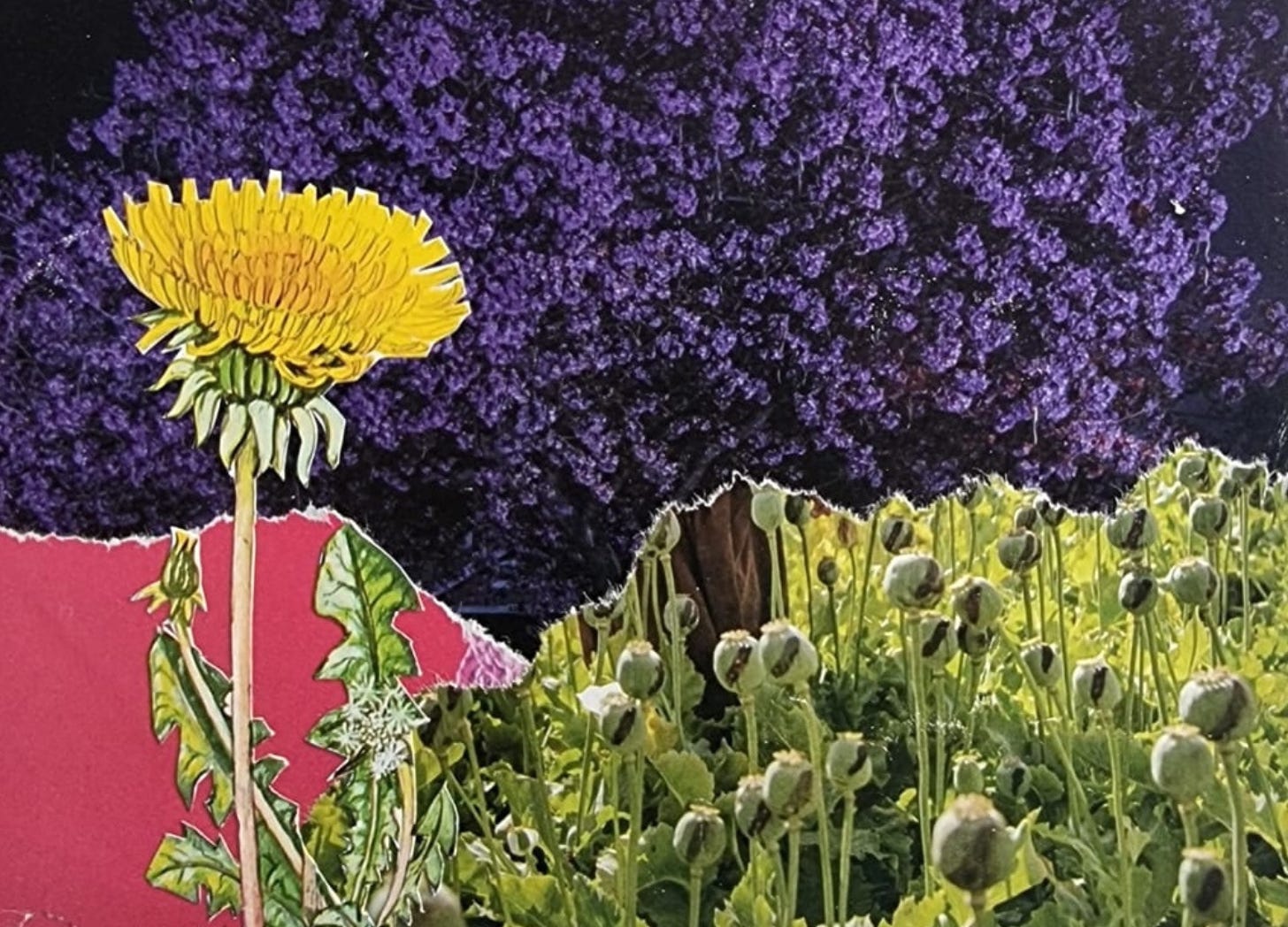
Welcome to The SciArt Curator, your bi-weekly window into the vibrant intersection of science, art, and society.
Part treasure hunt, part investigation, it also grows with your discoveries. If you’ve created or come across a project, call, or event that bridges science and art, drop me a line. I’d love to hear from you and join forces to spread the word.

Plant blindness (recently re-termed Plant Awareness Disparity) refers to our tendency as humans to overlook the plants around us and underestimate their fundamental role in sustaining life on Earth12.
Why does this matter?
Because when plants go unnoticed, they also go undervalued. And when they are undervalued, there is little public interest in protecting them. This is also reflected in how funding and efforts are distributed across research, education, and conservation. The result has serious consequences for biodiversity, ecosystem health, and ultimately human wellbeing.
I first heard the term last year during a talk by Dawn Sanders at the Plant Link Day in Lund. She introduced the concept and presented her multidisciplinary project using art-based methods to explore how humans pay attention to plants.
Since that talk, I’ve been slightly obsessed with the topic. Not only did I want to write about it, but to ACT.
This issue explores plant blindness through the lens of SciArt and highlights projects that use artistic practices to help us notice plants again and reconnect with them. Below is a selection of projects that particularly resonated with me.
Announcement + Invite! Together with Sylwia Orczykowska, a transformative art curator and founder of Art Now, we are developing an international collaborative project exploring plant blindness and awareness.
If you are working at the intersection of art and plants or exploring themes of plant visibility, attention, or human–plant relationships, we would love to hear from you! Send me a message if you’d like to learn more and get involved.
Now, let’s dive in!

Below is a selection of multidisciplinary projects helping us notice and connect with plants.
This landmark art–science collaboration directly addresses the cultural invisibility of plants and invites audiences to engage with plants on their own biological terms.
Led by artists Bryndís Snæbjörnsdóttir and Mark Wilson, together with science educator Dawn Sanders, plant science educator Eva Nyberg, and botanist Bente Eriksen, the project is rooted in collaboration between the Gothenburg Botanical Garden, the University of Gothenburg, and Chalmers University of Technology.
The artworks merge botanical research, electron microscopy, and textile installation to translate microscopic plant structures into large-scale, tactile experiences. The project includes installations, textile works, public engagement activities, and the publication Beyond Plant Blindness.
One of the central works, Searching for Stipa, is a 14-meter tapestry based on scanning electron microscope images of the seed awn of Stipa pennata. Twenty-nine high-resolution microscope scans were digitally assembled and later woven in wool in Norway by Kristina Aas. Installed at the University of Gothenburg, the piece invites viewers to see a plant they would otherwise never notice.
Artist and researcher Erica Seccombe explores the complex relationships between humans and the natural world through imaging technologies, print media, drawing, and scientific visualization tools.
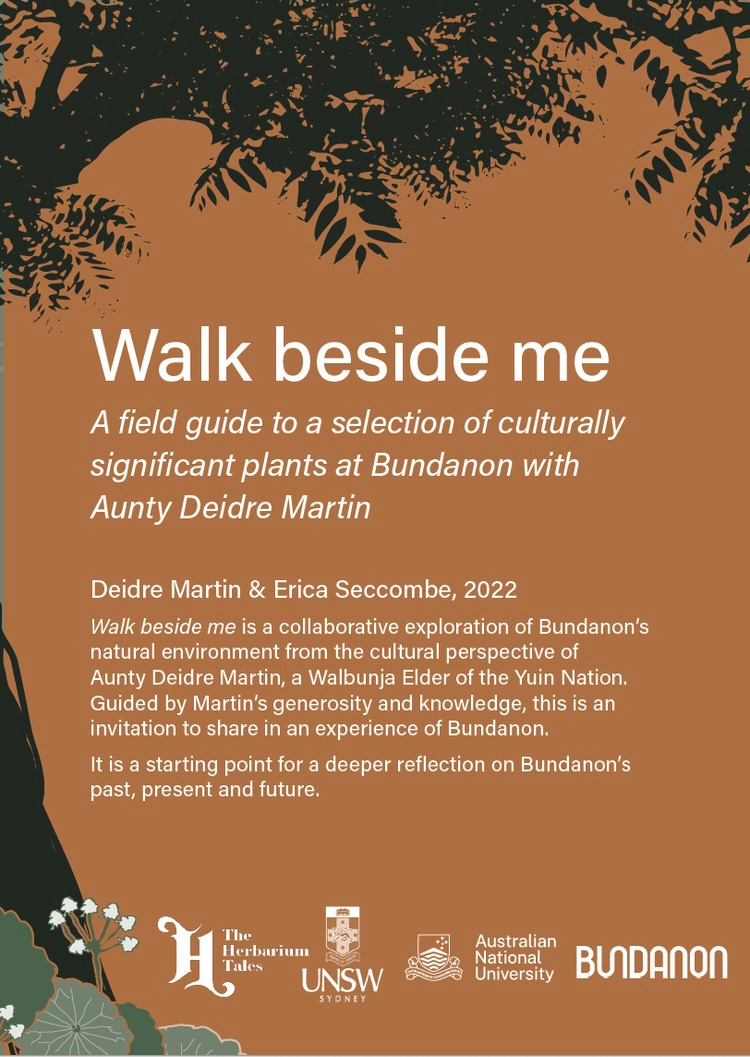
During a residency at Bundanon, and in collaboration with Aunty Deidre Martin, a Walbanga woman from the Yuin Nation, Seccombe developed Planting New Perspectives, an interdisciplinary project bringing together art, science, and Indigenous knowledge to explore plant blindness.
Supported by The Tellus Art Project — a collaboration between UNSW Art & Design, the Sydney Royal Botanic Gardens Herbarium, Bundanon, and Open Humanities Press — the project resulted in multiple outputs, including the field guide and video work Walk Beside Me, and the publication Walk Beside Me: growing an awareness of plants through art and cross-cultural collaboration.
This design-driven project combines botanical archives and visual communication to highlight plants that people routinely overlook in everyday environments.
Artists Anna Kell and Jonathan Frey developed this work during a residency at the Lloyd Library and Museum. Using digitally collaged materials from the library’s botanical collections, they created a series of posters intended to make plants visually present in cultural space.
Importantly, the posters are available as open-source files for educational and personal use, extending the project beyond the gallery into classrooms and homes.
We hope our posters foster not just an aesthetic experience, but the start of an educational one, capable of improving plant literacy and cultivating a greater sense of connection with plants.
Culture is built through the passing down of information and experiences. Our muses remind us that without ‘conscious intention, attention, and effort to preserve it’, the information our brains receive about plants is likely to be discarded; all that green, leafy stuff simply can’t compete with the plethora of extraneous cultural imagery for our attention. Let’s do something—however we can—to make space for the awareness and appreciation of plants - Artists Anna Kell & Jonathan Frey.
Holly Fay’s artistic practice examines ecological systems, lived environments, and the more-than-human world through painting, drawing, and photography.
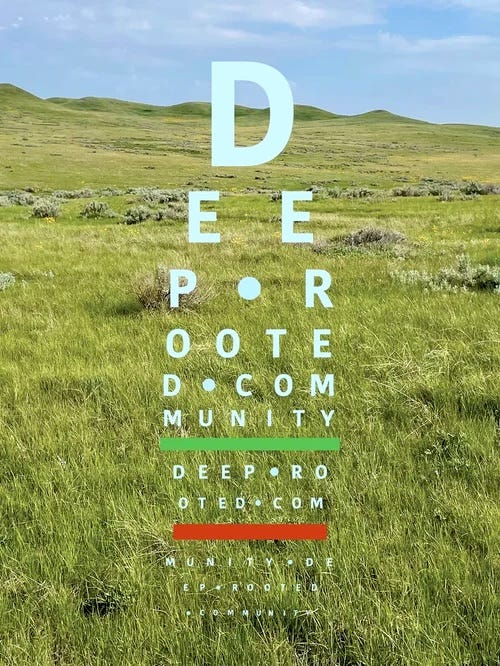
Her project focuses on the grasslands of Regina, Canada — ecosystems often perceived as empty or uninteresting despite their ecological richness and importance.
Through photo prints, Fay reframes these landscapes as intricate, interconnected communities of plants functioning together as an ecological system. Part of this work was included in The Ecology of Freedom, a visual activism broadsides campaign and exhibition in Baltimore (2024).
With less than 20% of natural grasslands intact, this ecoregion has been historically undervalued in its natural state, often viewed as empty, boring, and unproductive. In fact, these beautiful ecoregions not only prevent soil erosion and provide habitat to diverse species, including pollinators and North America’s migrating birds, but also enhance water conservation and are a powerful carbon sink.
My intention for this work is for the grasslands to be seen as an intricate, interconnected system of individual plants functioning within an ecological community - Artist Holly Fay.
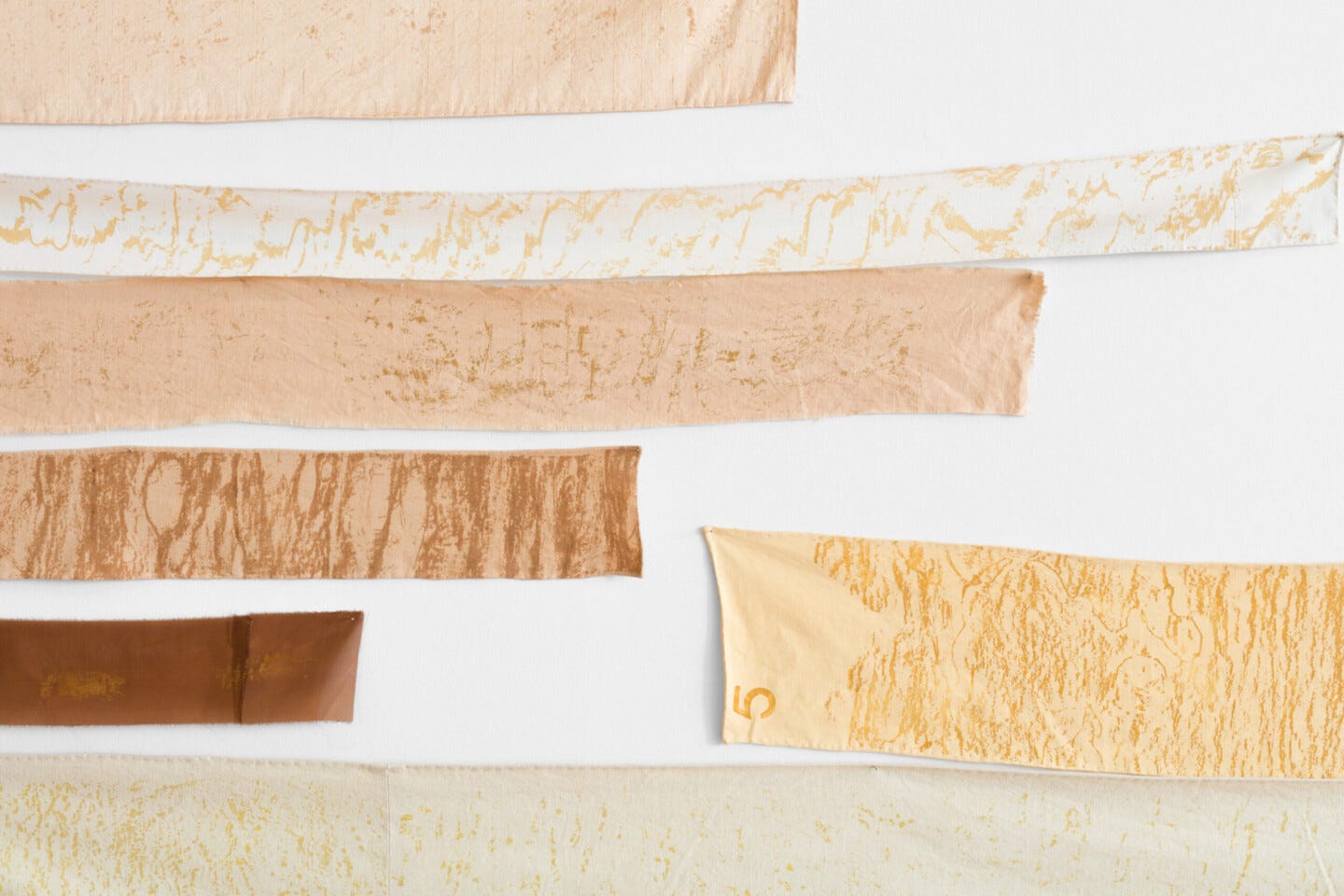
Rebecca Mayo’s participatory project invites people to create frottage rubbings of meaningful trees in their surroundings, encouraging them to observe and physically interact with plants.
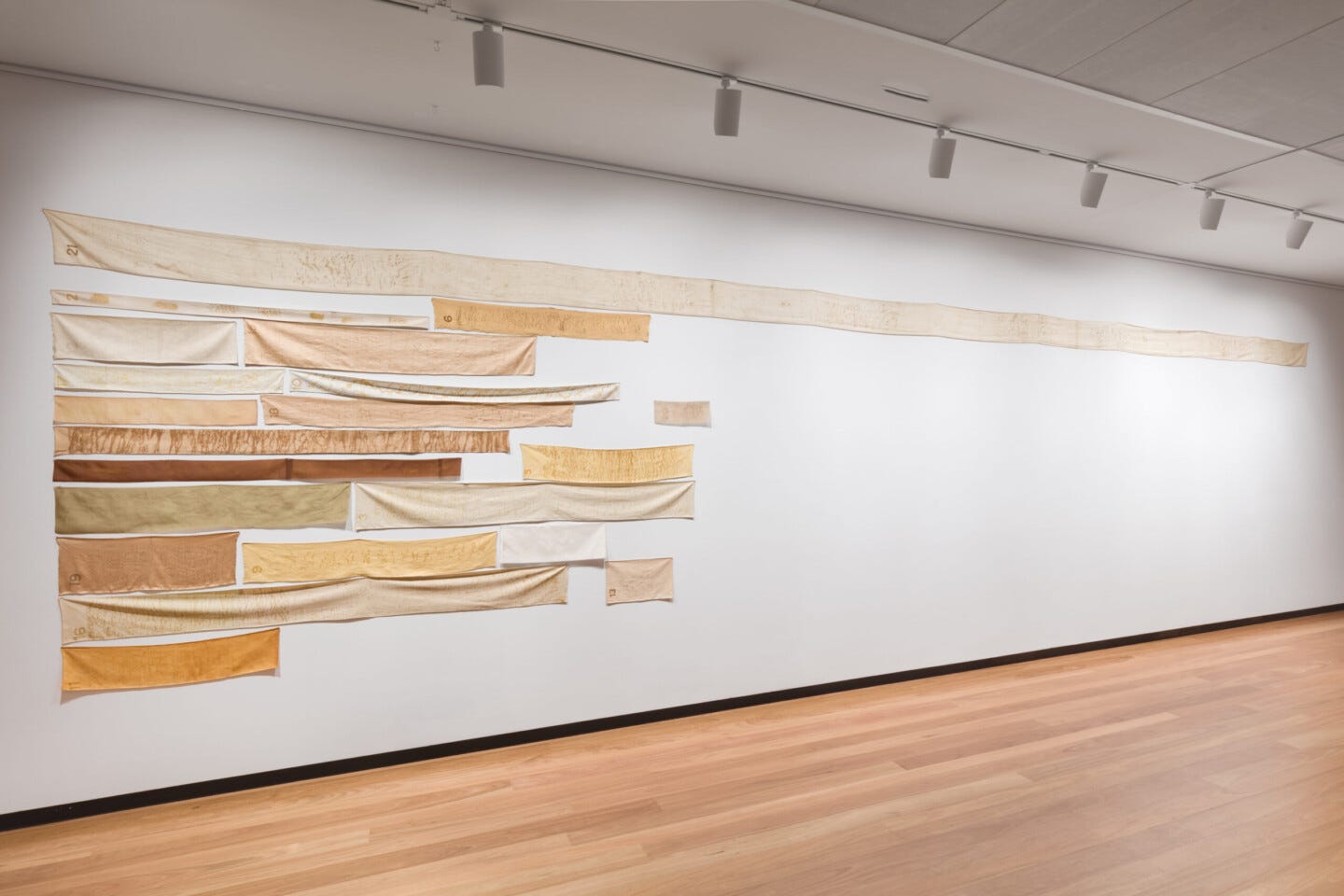
Participants in Tamworth (Australia) were asked to select a tree of personal significance and create a rubbing of its bark, recording the species, location, and their personal connection to it. These rubbings were later transformed into 1:1 scale textiles using screenprinting and natural dyes derived from the same species growing in distant locations across Australia.
The project creates a network of relationships between people, plants, and places, turning personal attention into collective awareness.
When visiting Tamworth, I was struck by its beautiful street trees. Consequently, I invited residents to identify a tree they held dear or considered significant.
The participants in this project have collaborated with me and the trees, revealing that not all humans suffer from Plant Blindness - Artist Rebecca Mayo.

— Curatorial residency by the Schwarz Foundation. Offering emerging art professionals the opportunity to gain experience in the day-to-day running of an exhibition. Deadline to apply: 10 April.
— Berlendis Artist Residency at Spazio Berlendis, Venice, Italy. Up to 6 weeks, for artists of all nationalities; all artistic languages and disciplines. The theme is open. Deadline to apply: April 15.
— Art&Science residencies, by the Embassy of Foreign Artists. Exchanges between scientific and artistic practices to bring new ways of formulating, perceiving, and using research. Up to 3 months, and a monthly stipend of CHF 1400. Deadline to apply: 19 April.
— The Creativity Pioneers Fund 2026. For creative organisations driving social change in their communities. €5,000 grant. Deadline to apply: 24 April.
— Digital Art Prize 2026 by Arab Bank Switzerland. Open to artists worldwide whose practices operate within contemporary digital and technological contexts. USD 10,000 prize. Deadline to apply: 3 May.
— Exhibition: Aquatic Archives of Aftermath. By Robertina Šebjanič, exploring the toxic afterlives of warfare beneath the ocean surface. From 2nd April. CZLO GZ, Zagreb, Croatia.
— Exhibition: Dreaming Cells. By Radhika Patnala exploring biological themes as dynamic landscapes filled with movement, play, biology, and wonder. April 16, BioLabs Heidelberg, Germany.
— Online talk: Care-centered Science Communication. Curator and science communicator Bethan Burnside explores what it means to practise care‑centred science communication. April 15, 12:00 CEST.
— Online talk: The artist and the scientist: knowledge generation from lab to the public. Bioartist Anna Dumitriu and Jane Freeman discuss how collaborations between artists and researchers can open up new ways of thinking about scientific questions, support public engagement with medical research, and create opportunities for cross-disciplinary learning. April 24, 11:00 CEST.

Since launching The SciArt Curator, I’ve been truly blown away by how quickly this community started to shape the project.
Have you created, seen, or heard of a project that bridges science and art? Send it my way! I’d love to feature it and help spread the word.
Are you a writer? Reply to this message and let’s explore how your work might fit in.
If this post resonated with you, please consider forwarding it to a friend. Thank you for reading, commenting, suggesting, and ultimately for being part of this growing SciArt community 💛
See you in two weeks!
Wandersee, J. H., & Schussler, E. E. (2001). Toward a theory of plant blindness. Plant Science Bulletin, 47(1), 2–9
Parsley, K. M. (2020). Plant awareness disparity: A case for renaming plantblindness. Plants, People, Planet, 2(6), 598–601
No posts
Comments
Nothing yet. Say the first thing.
Sign in to join the conversation.