
Few benign conditions frustrate surgeons and patients like pilonidal disease. The classic wide excision leaves an open sacrococcygeal wound that can take months to close and comes back in a fair number of cases anyway.
This peer-reviewed video shows a different approach: obliterating the sinus tract with a 1470 nm diode laser in about half an hour, with the cavity collapsing before the surgeon leaves the room.
Watch the full case on CSurgeries (0.5 CME credit available):
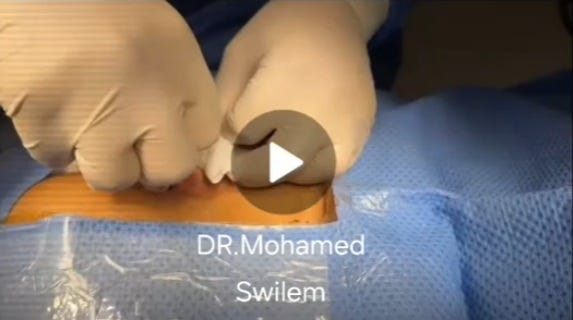
The case
The video, by Dr. Mohammed Ramadan, follows a 32-year-old man with a pilonidal sinus in the sacrococcygeal region, treated under spinal anesthesia in the prone position. The tract measured roughly 3 cm long and 5 mm wide. What makes it worth watching is not a dramatic complication but the opposite: a common, miserable problem handled through a single tract opening rather than a large excision.
The technique, step by step
The sequence is the teaching value here, because the outcome depends on preparing the tract properly before any laser fires. The sinus is first irrigated with hydrogen peroxide to clear debris, then prepped with povidone-iodine and flushed with saline. A curette is used to debride the tract, stripping out granulation tissue and the epithelial lining that would otherwise keep the sinus alive. The external opening is gently widened to admit the laser fiber and to allow postoperative drainage.
Only then does the laser come into play. Ablation is performed with a 1470 nm diode laser at 8 watts, the fiber withdrawn slowly and steadily to deliver uniform energy along the full length of the tract. In the video the cavity collapses almost completely as the lining is ablated, with only minimal bleeding and no large open wound to pack. Total operative time was about 30 minutes.
The step that rewards close attention is the debridement before ablation. Laser energy destroys what it touches, but it cannot compensate for an incompletely cleared tract, and the difference between a durable result and a recurrence often comes down to how thoroughly the lining was removed before the fiber went in.
Why the approach matters
Traditional wide excision, with or without flap closure, is associated with lengthy healing and recurrence rates commonly reported in the 20 to 30 percent range, alongside significant postoperative pain. Laser closure of the tract, often called sinus laser-assisted closure, aims to trade the open wound for a minimally invasive ablation.
The early evidence is encouraging. A multicenter cohort of sinus laser-assisted closure reported complete healing in about 81 percent of patients with recurrence near 10 percent, and series pairing laser with endoscopic debridement have reported mean healing times around 17 days, most patients back to normal activity within a day, and recurrence under 5 percent at six months. These are cohort and early-outcome data rather than large randomized trials, so the technique is still proving itself, but the direction is clear: less tissue destroyed, faster recovery, and a wound that closes on its own.
The full video runs about eight minutes and carries 0.5 AMA PRA Category 1 Credit.
Have a technique worth teaching? Submit it at csurgeries.com.
Source: Ramadan M. Laser ablation of pilonidal sinus using 1470 diode laser. CSurgeries, Colorectal Surgery, published April 25, 2026. Supporting evidence: sinus laser-assisted closure multicentre cohort, PubMed 34993686; SiLaC with EPSiT early outcomes, PMC12062001; laser ablation for recurrent pilonidal sinus, PMC12170725.
No posts
Comments
Nothing yet. Say the first thing.
Sign in to join the conversation.