
Have you ever finally gotten the visibility you'd been chasing, the bigger stage, the bigger audience, more clients, the exact thing you said you wanted, and felt yourself get shrinking instead of getting bigger?
I'm not talking about being humble or gracious. I mean smaller, like you felt yourself contract and suddenly there's less of you available, right when there should've been more of you.
I see this constantly with business owners who are focusing on speaking on bigger stages (and it shows up at higher income levels, the partner of their dreams, and opportunities they salivated for, but let's stick with stages for now).
Their message finally lands, the invitations start coming faster, the audience compounds the way it's supposed to, and instead of expanding into it, they quietly start disappearing.
They let the big invitations sit unopened in the inbox, water down the very opinions that got them noticed so the bigger room has less to come at them for, start posting safer and blander, and let the piece of writing that used to pour out in one sitting sit half-finished for three weeks or never go out at all. Everyone around them assumes burnout, or a confidence problem, or that they've simply lost the plot.
They haven't lost anything though. They contracted.
Because we don't expand to the goals that we have. We shrink to the capacity of our systems... and the foundation we built it all on. (My addition to James Clear’s Atomic Habits quote.)
More specifically, the foundation they built it all on may not have been sustainable, so suddenly it all starts crumbling, like sand slipping through the cracks before the whole house collapses.
If that landed in your body, good. This is structural thing, not a character flaw, and structural things have structural fixes.
Ambition was never the missing ingredient.
Your desire for the goal, or even the inflow of opportunities, was never less, despite what a guru wants to tell you that "you don't want it bad enough." Instead it could come down to:
Your body wasn't prepared for the amount of visibility so it contracted (our bodies love to keep us safe, don't they? Lovely systems, they are) or
Your actual business systems weren't running to handle the amount of visibility, potential clients, or money flowing in.
Both of those are systems, by the way. One runs on your nervous system and one runs on your operations, and every system has a ceiling on what it can hold before something gives.
Take the first one because it's the sneakier of the two. Your body doesn't clock the difference between a bigger stage and a bigger danger. More eyes on you lands as more exposure, more surface area for someone to come at you, and a nervous system that's spent your whole life keeping you safe does the logical thing and pulls you back in where it's quieter.
It doesn't feel like a decision from the inside.
It feels like a weird reluctance to hit publish, a flatness where the excitement used to live, or the sudden and deeply inconvenient urge to go dark the same week your work finally caught up to your desire. Your body is voting for smaller because smaller is the room it knows how to protect you in, and it'll win that vote every time until you show it that being seen won't actually kill you.
You'll convince yourself it's nothing, but suddenly you're tired, need to watch more TV, or may disappear altogether, ghosting the potential connections and opportunities. Meanwhile your brain is doing shame flips, full Olympic-level mental gymnastics, telling you that you're squandering the very thing you begged for, that everyone can see you fumbling it, and that you were probably never cut out for this anyway.
But it's everything you wanted, right? Why oh why(!) aren't you saying yes and jumping on it?
Your body needs a proper edging and some nourishment to know it's safe, little by little until bigger levels don't feel like a threat.
The second reason is more mechanical, and honestly the one you can put your hands on or hire someone for. You build an audience, a body of work, a reputation, on the strength of your talent and your effort, doing everything by hand because by hand is all you had.
Then the thing you worked for arrives.
More people want you, including access to your energy, thoughts, content, and your actual time... yet you're still running the same manual back end you built when a tenth as many people were watching.
OR you have some really great automated systems running, but you were missing some pieces (which means things are falling through the cracks) or simply, the systems you set up literally can't handle the satisfying experience you want your clients to have. You need to adjust those Frankenstein systems (as I've joked after fixing dozens of these over my career for entrepreneurs) into a coherent ecosystem that runs without you.
Hell, even I had to deal with this myself when I built offers around my 1:1 consulting, which I had limited capacity for. I needed to adjust my offers to be a sustainable and semi-scalable version. That was a whole experience I'd helped hundreds of clients with and finally needed to take a dose of my own advice.
You might say,"well, I'll just work harder to keep up."
That's a one way ticket to burnout and burning it all down.
I've heard that answer a hundred times, and more effort is not the answer. You cannot manually handle or effort your way into holding a bigger audience or more opportunities.
You need sustainable systems, structures, and strategies, which happens to be my specialty at Wildly Satisfied, if you're ever interested in talking about it. There is a ceiling built into every system (especially those that run more attached to you), and when the goal grows past that ceiling, something has to give. Usually it's you.
So you shrink. Not on purpose.
Nobody sits down and decides to become smaller, but if you don't have the infrastructure to hold what's coming without needing to be on all the time yourself, you start unconsciously pulling back the parts of you that made people want more of you in the first place. You go quiet at exactly the moment you were supposed to go loud.
You become Visibility Avoidant, as I like to joke.
(Funnily enough, I recognized this was the same behavioral pattern I had when I was "avoidant" in dating and relationships, which I'm happy to say I healed and now secure.
Most people think "avoidant attachment" is avoidant to intimacy and that's ONE version of avoidant behaviors, but I found in my personal experience, I had no problems with intimacy, confrontation or sharing emotions. It was the labor factor that made me avoid. If something felt like someone wanted too much from me or I thought it was going to take a lot of labor, I avoided. That was my dating life for a while and it showed up in this visibility as well. Is this you? I'd love to hear it in the comments if it is.)
I want to be really clear here, because contraction by itself is not the enemy. It's actually built into a healthy rhythm. Expansion, contraction, expansion, contraction, that's the natural pulse of building anything real just like a heartbeat that's shows us we're alive, and there's nothing wrong with a season where you pull in close and consolidate.
We expand and contract, slowly edging ourselves to a higher capacity (not that stupid rhetoric I've heard in the coaching industry around "well push your edge" when it wasn't actually pushing their edge, it was encouraging them jump off the cliff and hope a net or parachute appeared).
The keywords here are "slowly edge" ourselves to a larger capacity. That makes it more sustainable instead of jumping off, hurting ourselves, and then needing massive recovery time that extends possible years of yours life.
On a larger scale this behavior of push past our capacity and not recovering enough (or honoring the contraction and nourishing yourself) until we collapse, then get well enough just to push again is something I call the Collapse and Recovery Cycle.
The hustle culture narrative and productivity rhetoric thrives on it: push until you break, rebuild, and run the same play again, on a loop, because there was never a system underneath you to catch the contraction partway down.
Healthy contraction slightly expands capacity then bounces back easily. Collapse feels like you just keep falling or push past the point of no return as you convince yourself that you'll "recover" this weekend, when you're way past that point.
Without infrastructure, there's nothing to turn the contraction back into expansion, so it keeps going until you cancel the launch, ghost the community, or slink away and stop returning to the thing you built your whole identity on.
Two people can have the same busy month.
One of them expands, contracts and recovers because there's a system holding the parts that don't require them personally. The other one contracts all the way into collapse because they are the entire system, and there was never anything else underneath them. I see this a lot with entrepreneurs who subscribe to the grind mindset.
Which one are you?
I worked with an entrepreneur recently who had exactly this problem showing up in real time.
His speaking schedule was picking up fast, the kind of momentum most people would kill for, and every single thing in his business still ran through almost only his own two hands. He had a minor system for booking, onboarding, and showing up but he had no real constraints on his weeks or on how much he showed up. Not to mention follow-up, content, all of the rest wasn't as systematized or streamlined as he thought.
He wasn't burning out from doing too much work. He was burning out from being the only piece of infrastructure his business had, at the exact moment the business needed to hold more people than one person could ever personally touch.
It's the same trap I wrote about in The Linchpin Problem: make yourself invaluable enough, and you don't just carry the business, you become the single point of failure holding it up and being crushed under the weight.
The fix wasn't a pep talk about capacity or a course on time management, even though we touched on that.
It was mapping the whole ecosystem before touching a single tool, figuring out what needed to run without him so people could still have access to his energy, content, and thinking, without needing access to him personally every single time. It was looking at the types of offers and the business model he had to see if that's where he wanted to grow into.
Not because he mattered less or his clients didn't deserve access to him. This isn't about ego at all. The truth is, his goal and visibility had finally outgrown what he alone could carry, and something else needed to carry it besides his own nervous system.
I know building all of that sounds like more work, not less, but I promise, sometimes it's just a shift in perspective and little clean up. Once you do the front-loaded work though, the ongoing weight doesn't fall on you forever.
Most people, the second they finally admit they need systems, build the smallest, cheapest version that solves this week's problem, and then six months later, when the goal grows again, they're rebuilding the whole thing from scratch. That's not efficient and honestly, I'm tired of it.
That's not sustainable.
There are moments to plan for triage (burnout, exhaustion, etc), then there are moments to plan for what you’re truly building for.
The most effective move is to map out what the whole ecosystem needs to look like for the actual vision, the big one, not just the current inbox, and then build it in phases.
You're not building for who you are right now. You're building for who you're already becoming, so the thing you build this year doesn't have to get torn out next year when you finally get the stage you've been working toward.
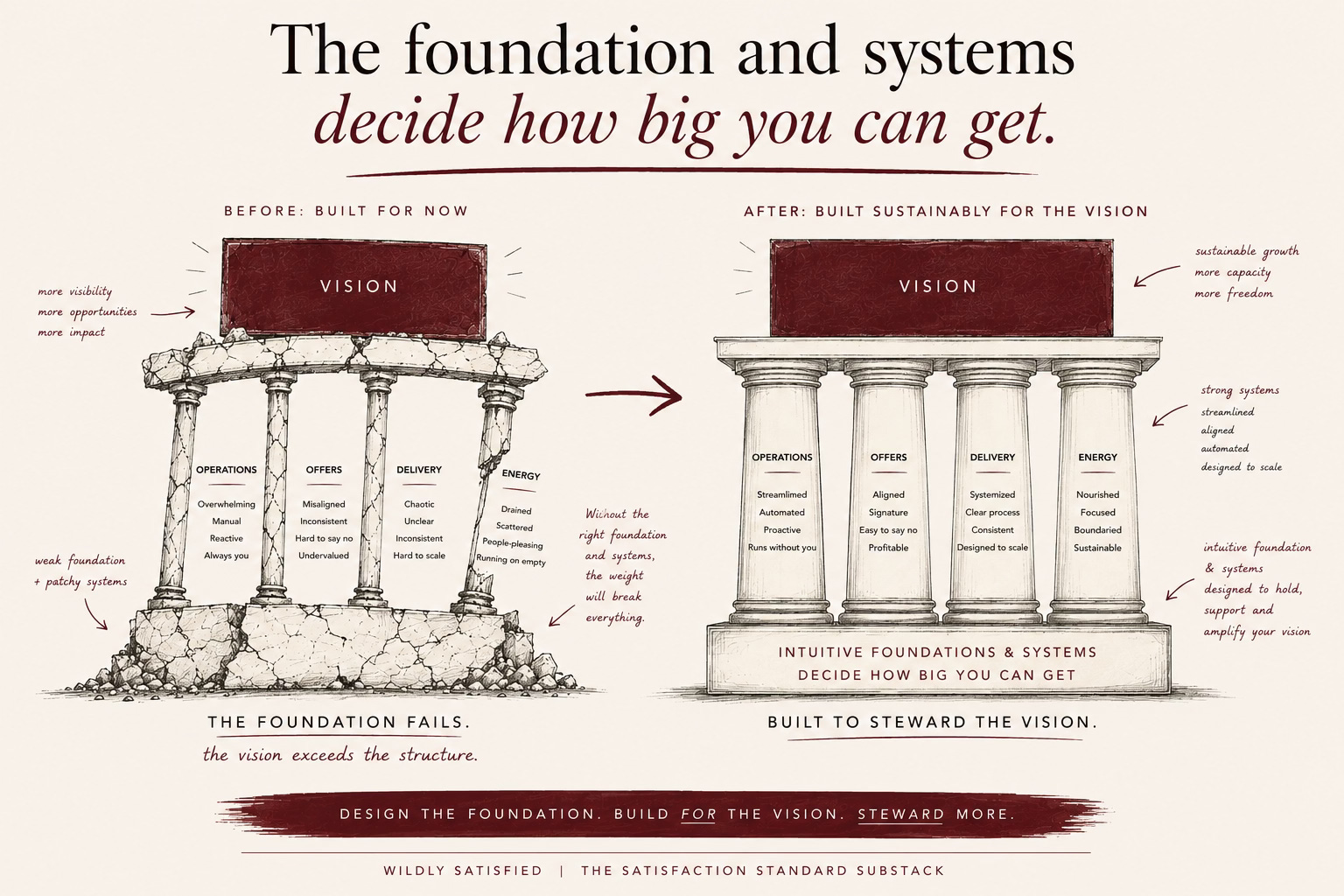
You keep growing without burning it down by finding the one piece of your business that only runs because you personally run it, and fixing that before you add anything else. The practice I run with clients looks like this, and you can do the first pass yourself this week:
Trace the whole journey before you touch a single tool. Walk it from the first moment someone finds you all the way through to long after they've paid, and notice every step that only moves when you personally move it. Most people reach for a shiny new app first. You map first.
Make the actual list. Write down every place where growth requires more of your literal hands: the follow-up, the onboarding, the content, the invoicing, and the thing you keep meaning to hand off and somehow never do.
Find the one that would break first. If the thing you're asking for showed up next month, double the clients, the bigger stage, the launch that actually converts, which item on that list snaps under the weight before anything else does? Ask yourself: "If I had 1,000 people say yes to that, would it hold up? Would it sustain or not?"
Focus on those levels, sometimes that one thing. Not everything. One. Build it to run without you, then come back for the next one when it starts to strain. You are stabilizing in phases, not rebuilding from scratch every time you grow.
Titrate the visibility while you build the back end. Your operations aren't the only thing with a ceiling, your body has one too. Say yes to the next-size stage, let your nervous system learn that being seen there won't kill you, and then reach for the one after that. You're stretching your capacity on purpose, not flooding it and hoping you float.
You are not behind because you didn't work hard enough.
You are not disappearing because you lost your nerve.
You shrank because there was nowhere else for the weight to go and you were holding it all yourself, and that's a foundational problem. A renovation can change that, and that renovation can be for how you nourish yourself and strengthen your capacity, too. It's not just for business systems.
Build somewhere else for the weight to go, and you get to stop getting smaller every single time something good happens to you.
Want the smaller version of this work in your inbox? Little Leaks, Tiny Tweaks is 15-minute newsletter with shifts that compound ease and satisfaction. No $20k coach required.
© Taylor Davis / Wildly Satisfied®. All rights reserved.
No posts
Comments
Nothing yet. Say the first thing.
Sign in to join the conversation.