
Due to audience demand1 I am presenting a Climate Change Policy Analysis substack series based on my Johns Hopkins class AS.425.603. This is a good time to work through this material out loud because I’m updating slides for the January class, and putting the material here forces me to think about it more clearly. Two issues that will require me to create new content are all the Trump rollbacks, and how I might want to use AI in the classroom.
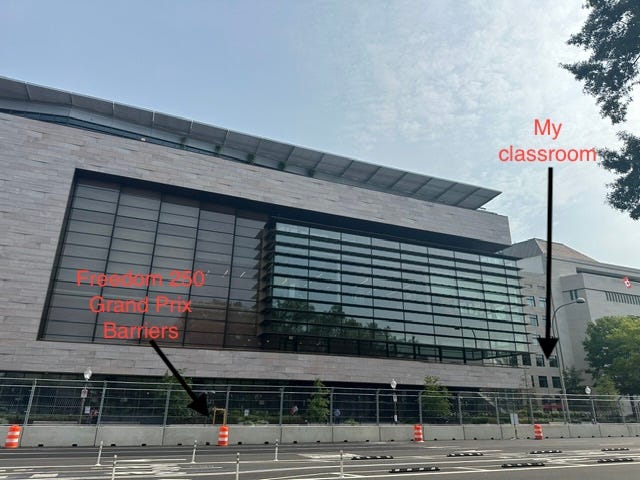
Figure 1: A photo of the JHU Bloomberg Center.2 My classroom is annotated, along with the barriers that have been erected all along the Freedom 250 Grand Prix route.
We start with Lecture 1 where I lay out what the Substack series will cover, and why.
Wildfires. Sea level rise. More intense storms. Heat waves. Threatened ecosystems. I could keep listing climate impacts for a long time. Figure 1 shows the IPCC’s summary “Reasons for Concern” or “burning embers” diagram. This course doesn’t spend much time on the science or impacts of climate change, but it is the underlying rationale behind the relevance of a climate change policy class.
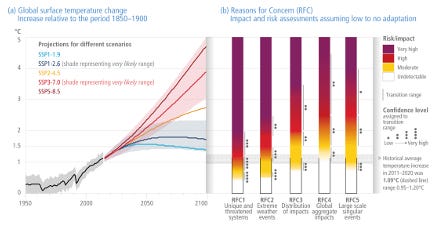
Figure 1: Reasons for Concern Figure. IPCC AR6 WGII, Figure SPM.3, CC BY 4.0 (source).
Global emissions of carbon dioxide (CO2) have not even stabilized yet (though the growth rate has dropped), but we need to reach net-zero carbon emissions to keep CO2 concentrations from continuing to rise (Figure 2). Meanwhile, less than a third of global carbon emissions are covered by any kind of price mechanism (Figure 3).
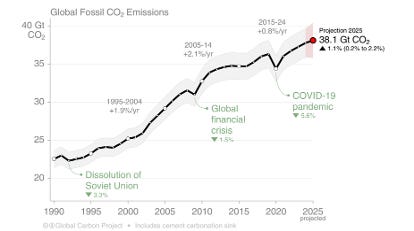
Figure 2: Fossil CO2 emissions by year from the Global Carbon Budget 2025 slide deck, Slide #11, CC BY 4.0 (source).
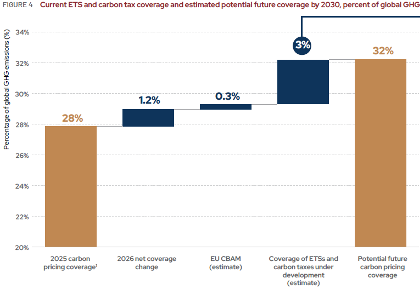
Figure 3: Total emissions covered by cap and trade or carbon taxes. World Bank 2026 State and Trends of Carbon Pricing, Figure 4, CC BY 4.0 (source).
I think that market-based mechanisms are generally the efficient solution to most problems (credit the economist on my PhD committee)3 but I recognize that non-market mechanisms have their place too (credit the political scientist on my PhD committee). Also, a non-optimal policy that can be implemented and moves in the right direction is better than an optimal policy that is just described in peer reviewed papers.4
Meanwhile, my target audience has historically been people who understand that climate change is an issue and want to understand what to do about it (e.g., high-level managers and political appointees at EPA, when EPA is being run by people who actually care about truth). Because of this, I lean towards discussing complexities and pros and cons of various approaches. This is not necessarily the right approach when trying to reach the broader public, though it is the approach I default to as being most true to my inner nature.
One of the things that makes climate change policy analysis so interesting, and yet so challenging to master, is that it covers so many domains of knowledge. A partial list includes:
The science of impacts. Economics. Technology. Crafting legislation. The art of negotiation. Enacting regulations. Law and the Courts. Psychology and communication.
Some of the complexity is visualized in Figure 4.
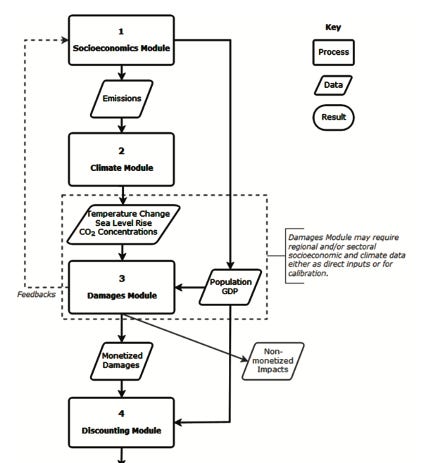
Figure 4: A flow diagram of the modular framework suggested by the National Academies for estimating the Social Cost of GHGs (Figure 2.1). Used with permission of The National Academies Press, from Valuing Climate Damages: Updating Estimation of the Social Cost of Carbon Dioxide, Committee on Assessing Approaches to Updating the Social Cost of Carbon, 2017; permission conveyed through Copyright Clearance Center, Inc. (source).
The best teachers for some of these topics are those who have been in the trenches. For example, real-world policymaking and negotiation require a lot of log-rolling, compromise, and coalition building, and there’s a huge difference between having done this versus just having read about it. This is why for my actual course, I try to have guest lecturers who can address those issues where my expertise is not as deep (I usually try to get someone with experience in international negotiation, someone who has spent time on Capitol Hill, a lawyer, and an expert on the grid). I would be open to having people write guest posts for me, but I have no plans to lobby any of my friends and colleagues the way I do for my class.
I often cite the 1979 Charney Report as the date at which we knew enough to start regulating greenhouse gases (though the history of quantifying the effect that increasing CO2 concentrations would have on global temperatures dates back at least to 1896 with Svante Arrhenius, and Naomi Oreskes documented that climate change was already being discussed in the halls of Congress and the White House by the 1960s). One could also point to the 1992 UN Framework Convention on Climate Change (entered into force in 1994) as a key date for when the world really took the problem seriously.
Given the long history (30 to 60 years) of understanding that climate change is a problem, why is it that we haven’t solved it yet?
The key challenge is CO2. It is a globally well-mixed gas, so solutions need to be global. CO2 accumulates for centuries, making it an intergenerational problem. And CO2 is an inherent product of combustion: we can’t just stick a filter on a tailpipe to fix it, so we need to actually move away from fossil fuels (or use expensive technologies like CCS). Humans aren’t good at global cooperation, humans aren’t good at solutions that require decades of concerted effort, and humans aren’t good at sacrificing easy technologies. This makes climate change a truly wicked problem.
Introduction: That’s this post.
The Economy and the Environment: When regulation is warranted and how to do cost-benefit analysis, relying heavily on OMB Circular A-4.
The Carbon Economy: Emissions past (inventories) and future (projections).
Valuation and Targets: Monetization, value of mortality risk reduction (formerly value of a statistical life), discounting, and alternative approaches to cost-benefit analysis.
Policy Structures: The theory underlying cap and trade, taxes, command and control, subsidies, and other GHG reduction mechanisms.
US Legislation: Waxman-Markey through the IRA.
The Courts and the Clean Air Act: How the Judiciary and the Executive Branch interact (this is where the Endangerment Finding and now the Trump EPA Rescission come into play).
Solutions: Each mitigation option has a cost and a mitigation potential; together, those make marginal abatement curves.
Climate Science & Policy: The role of science beyond saying “this is a problem.”
International Policies: The UNFCCC through Paris and beyond.
Adaptation and Geoengineering: I use an image of Geostorm to illustrate this slide.
State and Regional Policies: Carbon pricing (RGGI, AB32, etc.), electricity portfolio standards, low carbon fuel standards, and climate action plans.
Non-CO2 GHGs: Going beyond CO2 to the other Kyoto gases, CFCs, and climate-relevant pollutants like black carbon, ozone precursors, and aerosol precursors.
Environmental Justice: Environmental Justice is a consideration throughout the class (both for how climate impacts and pollution impact certain populations disproportionately, but also how the costs of climate policy often fall hardest on those same populations as they often spend a large percentage of their incomes on energy) but this lecture focuses on the issue.
I don’t use a textbook for the class, and instead use individual readings divided up into 5 categories, in approximate order of robustness:
Primary Sources: Legislative or regulatory language is exactly what it says, down to the comma.
Major Assessments: The National Academies, the National Climate Assessment, and the IPCC Assessments are generally the best available representation of the understanding of the climate community. It isn’t to say that they are perfect (I have occasional quibbles with IPCC decisions in the area of my expertise), but they are better than any alternative other than spending a decade becoming a world-renowned expert.
Government Documents: Generally, datasets and reports produced by the government are trustworthy and well-documented. However, some caution should be observed: some documents are considered “highly influential scientific assessments” and go through layers of peer review, others not so much.
Peer Reviewed Literature: I consider peer review to be a very valuable high-end spam filter: when it works, it filters out bad science, and the science that makes it through actually gets improved.5 However, any individual paper is just a finding of a small group of scientists, and should be considered only in the context of the broader literature (which is what assessments do).
Gray Literature: Newspaper articles, blogs, NGO publications, and even substack posts can be useful additional information, but should be taken with an even larger grain of salt than a peer-reviewed paper.
For students in the class I ask this on day one, and I’ll ask it here too: what aspects of climate change policy are you most interested in? Also, you can use the comments to ask questions, make suggestions, volunteer to guest post (or guest lecture for my spring course, if you live in DC), or have conversations with each other (just like a Canvas discussion board).
I will aim to get out a lecture every week or two. While the IPCC, World Bank, and Global Carbon Budget all kindly share their work CC BY 4.0, and the NAS has an on-line copyright request system, many of the sources I use for class lectures do not, so we will see what I need to do to work around copyrighted material.
Next up: why are markets good, why do markets fail, and what is the role of government?
Two people. But one of them is a paying subscriber, and I want to reward that!
In class I use a photo of the Khan El-Khalili marketplace to illustrate this point, as a nod to my Egyptian heritage.
We will return to this philosophy many times, whether about the IRA or about the 100-year GWP.
Just the process of getting a paper ready for submission often leads to improving it. Reviewer and editor comments and suggestions usually further improve it, though the occasional annoying reviewer does ask for changes that make a paper worse but you accept just to get the process over with.
No posts
Comments
Nothing yet. Say the first thing.
Sign in to join the conversation.