
Hello Salt & Light Friends,
What we measure often draws our attention. Most people seek progress, whether in personal growth or skill development.
In faith, especially in ongoing repentance, change develops gradually (Matthew 3:8; Luke 3:8). Like a tree that grows unseen and requires care, we also need the Holy Spirit’s guidance to change direction.
While speaking to the crowds, Jesus pivots to a teachable moment.
He presents the Parable of the Fig Tree. Jesus frequently used parables to illustrate spiritual truths through everyday experiences (Psalm 78:2, Proverbs 1:6, Matthew 13:10-13).
Let’s see what the Word has for us today:
Lord give us insight into Word and may we see your heart and stay close to you, renew our minds and draw us closer. Amen.
Then Jesus told this parable: “A man had a fig tree that was planted in his vineyard. He went to look for fruit on it, but did not find any. So he said to the keeper of the vineyard, ‘Look, for the past three years I have come to search for fruit on this fig tree and haven’t found any. Therefore, cut it down! Why should it use up the soil?’ ‘Sir,’ the man replied, ‘leave it alone again this year, until I dig around it and fertilize it. If it bears fruit next year, fine. But if not, you can cut it down.’ ” – Luke 13:6-9
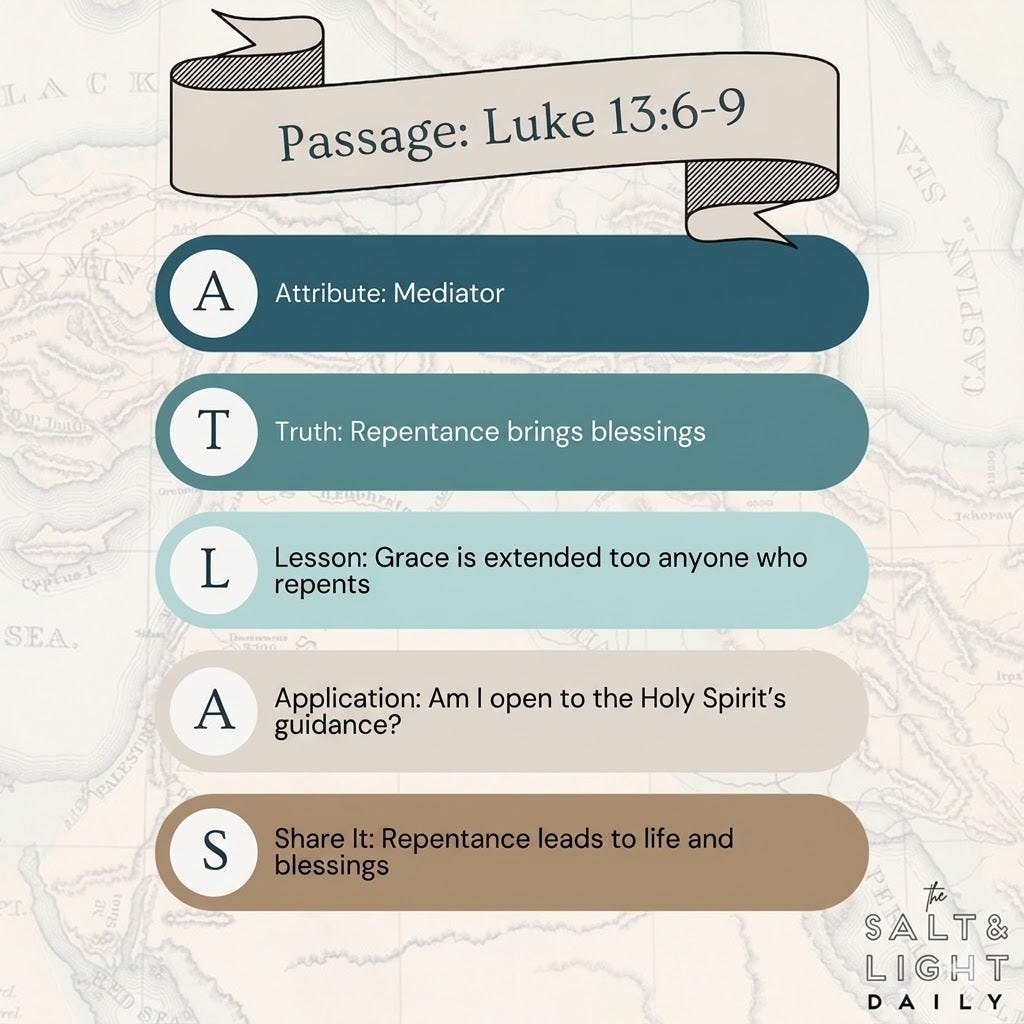
You may wonder about the connection between fig trees and repentance. The relationship is more significant than it first appears.
In an agricultural community, the crowds would have been able to connect the message better than our modern-day culture. We often take for granted the time, seasons, and work needed for food and livelihood to go from field to fork to plate. Today, we can just drive 10 minutes to get food in less than 10 minutes, and it’s hot and ready. In agrarian culture, waiting and acknowledging His Hand in every blessing were more common practices.
Fig trees represented to the people and in the Bible favor and growth, but also consequences (Dt 8:8, Micah 4:4, Matthew 21:17-19).
After Adam and Eve disobeyed God, they experienced shame for the first time and chose fig leaves to cover themselves (Genesis 3:7).
The prophet Amos was a shepherd and a caretaker of fig trees (Amos 7:14). The Lord knows that caretakers often make effective messengers, as they understand what is required for growth. Amos’s main message, like other prophets, was the call to repentance.
A fig tree takes about three years to bear fruit, sometimes sooner, which explains the vineyard owner’s reference to “three years” (Luke 13:7). After the initial fruit bearing, the fig tree produces fruit twice a year for decades. Similarly, the Christian life is expected to be fruitful (John 15:4-5, Galatians 5:22-23).
Fig trees often live for about 70 years, reflecting Moses’s observation that human life spans 70 to 80 years and the importance of using time wisely (Psalm 90:10-12).
If a fig tree remains unproductive for several years, it is removed to allow other plants to grow, and its remains enrich the soil.
The number three is often associated with completeness.
The Triune God—Father, Son, and Holy Spirit—works in unity. “Then God said, ‘Let us make mankind in our image, in our likeness” (Genesis 1:26).
Three also conveys emphasis.
In the Bible, repetition three or more times signals emphasis and stands out. Examples include: Holy, Holy, Holy; the Three Wise Men; and the Third Day.
“‘Holy, holy, holy is the Lord God Almighty,’ who was, and is, and is to come.” (Revelation 4:8).
People of faith have noticed that God called the third day of creation “good” twice (Genesis 1:10, 1:12). This day was marked by the creation of dry ground, fruit, trees, and vegetation. Many see the third day as a time of growth and double blessing, and traditions suggest it was a special day for couples to marry. “On the third day a wedding took place at Cana in Galilee” (John 2:1).
Jonah walked through Nineveh for “three days,” as he called the entire city to repentance (Jonah 3:3). Just as the vineyard worker requests more time (just one more year), Jonah was instructed to give the Ninevites time to repent.
For some, repentance comes quickly; for others, it takes longer. Yet the Lord is patient with everyone:
“The Lord is not slow in keeping his promise, as some understand slowness. Instead, he is patient with you, not wanting anyone to perish, but everyone to come to repentance.” (2nd Peter 3:9)
For as Jonah was three days and three nights in the belly of a huge fish, so the Son of Man will be three days and three nights in the heart of the earth. (Matthew 12:40)
Jesus answered, “I tell you, Peter, before the rooster crows today, you will deny three times that you know me.” (Luke 22:34)
“Two are better than one, because they have a good return for their labor. For if one falls down, his companion can lift him up; but pity the one who falls without another to help him up! Again, if two lie down together, they will keep warm; but how can one keep warm alone? And though one may be overpowered, two can resist. Moreover, a cord of three strands is not quickly broken. (Ecclesiastes 4:12)
“Go through the camp and tell the people, ‘Get your provisions ready. Three days from now, you will cross the Jordan here to go in and take possession of the land the Lord your God is giving you for your own.’” (Joshua 1:11)
On the third day, he will be raised to life. (Matthew 20:19)
As we move from the theme of fruitfulness, it’s important to realize that while God’s intention is for everyone to turn back to Him, in His ultimate plan, He knows not all will choose repentance.
For those hearing Jesus in the first century, linking blessings and growth with repentance made it clear that every good gift comes from God, and sincere repentance brings spiritual results. Those who have waited on God’s favor, like Hannah, know its deep meaning (1st Samuel 1:27). For later generations of believers, this story confirmed that turning back to God opens the door to His blessings—the same message Peter shared at Pentecost:
Peter replied, “Repent and be baptized, every one of you, in the name of Jesus Christ for the forgiveness of your sins. And you will receive the gift of the Holy Spirit.” (Acts 2:38)
In conclusion, the story highlights both the vineyard owner and the keeper. The keeper serves as a mediator, requesting more time so that evidence of repentance may develop. This Mediator is the Lord Himself, the vineyard owner is God the Father and the fertilizer is the Holy Spirit.
For there is one God, and there is one mediator between God and men, the man Christ Jesus, who gave Himself as a ransom for all—the testimony that was given at just the right time. - 1st Timothy 2:5-6
Is now your time to repent? Repentance is the right step if it leads to life with the Savior.
Reflection:
In what ways have you experienced God’s patience?
How do you perceive the connection between returning to God and receiving His blessings?
Thank you to The Narrow Path Collective for your ongoing financial support to The Salt & Light Daily Substack.
Comments
Nothing yet. Say the first thing.
Sign in to join the conversation.