
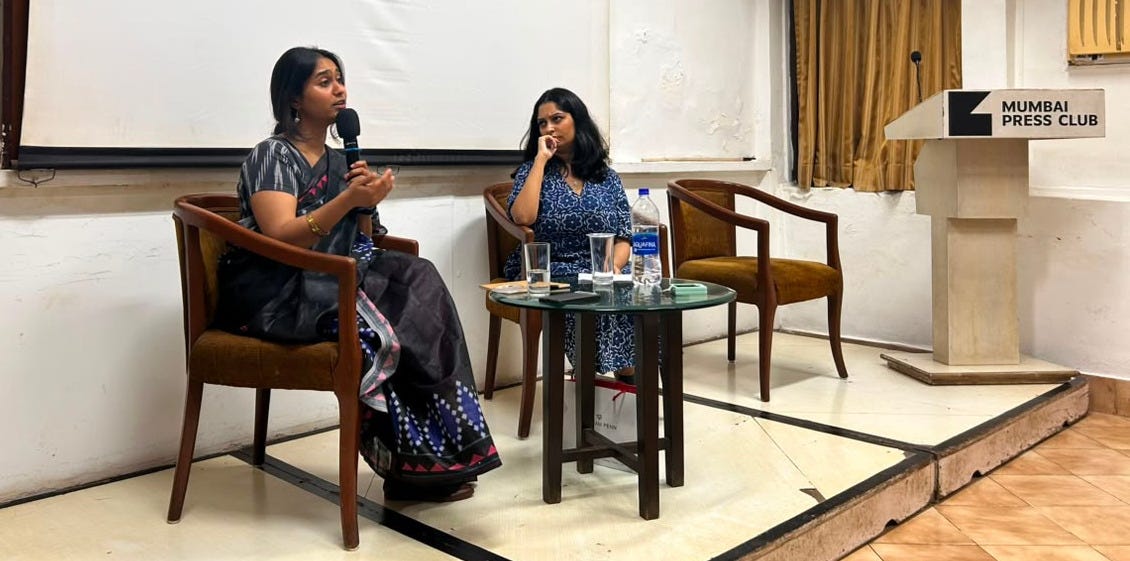
Last week, Vaibhavi Rani Maske, Manager of Policy & Advocacy for Red Dot Foundation Global, gave an expert talk on Gender-Responsive Urban Planning in Mumbai hosted by Vidhi Centre for Legal Policy.
One of the areas she focused on in her remarks was the intersection of crime, urban design, and gender in Mumbai
While the National Annual Report and Index on Women’s Safety (NARI) 2025 found that Mumbai ranked among the top 7 safest cities nationally with a safety score of 70.2%, Maske cautioned the city-level aggregate scores can obscure hyper-local unsafe pockets.
Drawing on Safecity’s crowdsourced, anonymized data on gender-based violence and harassment, she noted that incidents cluster at specific, identifiable points (transit interchanges, poorly lit stretches) rather than distributing evenly. For example, the all-time Mumbai dataset shows a spike from afternoon to evening incidents, but the most recent window (in the last 45 days), it shows a sharp spike between 6 - 8 a.m. instead. This could be a commute-hour risk pattern that most planning frameworks miss entirely because they default to designing safety measures generalised throughout the year to after-dark dangers.
This data insight matters for city planning because it means fixed interventions like lighting schedules, night patrols are built around an assumption that doesn’t match where the risk actually is right now on the streets. Additionally, since this pattern has already shifted once within months, a one-time safety audit at the Development Planning drafting stage would be structurally incapable of catching it.
The discussion incorporated Crime Prevention Through Environmental Design (CPTED) principles - natural surveillance, territorial reinforcement, and maintenance as a practical framework for translating safety data into design interventions, citing examples including Mumbai’s StudioPod, the Urban Vision, Plural, Project Mumbai, ABLE-Framework by IIT Kharagpur, etc.
Maske emphasized that official crime statistics significantly undercount groups absent from safety datasets, including transgender persons, sex workers and informal/gig economy workers. For instance, the National Crime Report Bureau’s Crime in India 2022 report recorded 9 transgender persons among 29,356 total murder victims nationally, and registered 0 cases of rape, sexual assault or mob lynching involving transgender victims that year (NCRB, 2023). Yet, these are groups that are often the most vulnerable to crime, harassment and assault.
Another area she focused on was infrastructure and facilities to protect and promote gender safety and inclusivity. Maske examined Mumbai’s DCPR 2034, which has been noted for reserving land for gender-specific facilities such as multi-purpose housing for working women (RSA 5.2) and women’s skill development centres - Aadhar Kendra (RSA 6.2).
She identified a structural gap between planning, implementation and actual benefit: DCPR’s Accommodation Reservation mechanism depends on private developer participation for construction, and the regulation’s language around facility operation is permissive rather than mandatory. This was substantiated with an analysis of BMC’s Gender Budgeting Statement (2025-26), which showed capital expenditure on the Goregaon West Multipurpose Hostel for Working Women collapsing from approximately Rs. 1.3 crore to Rs. 1 lakh once construction concluded, with no corresponding operational budget line - illustrating that land reservation and service delivery are not automatically linked.
A conclusion Maske shared from her work is that Mumbai’s urban governance can be effective at one-time, visible capital interventions, like land reservations or safety ranking but structurally weaker at the recurring, less visible work of maintenance, staffing, budgetary follow-through that determines whether such interventions translate into real safety and access for women and gender-diverse residents.
Further, there is a lack of knowledge among stakeholders and citizens about existing policies, making it harder for them to be enforced and there is a lack of knowledge sharing among civil society organizations, researchers, practitioners and government bodies. These are key areas for improvement.
She also shared a few examples of relevant organisations in Mumbai:
StudioPod is an award-winning, international planning and urban design practice which has committed to creating equitable, democratic, and sustainable environments in the places we build, based upon people-oriented design principles to foster a sense of community and vitality.
The Urban Vision describes itself as a “Think-Do-Tank on the Future of Cities”. Its mission focuses on investing in infrastructure that improves quality of life distribution, using tools like placemaking and tactical urbanism to achieve livability goals at the neighborhood/block level through partnership with local communities.
Plural, a Mumbai-based urban research and planning practice, identifies and customises “interventions for the myriad of socio-cultural heterogeneity that is Indian cities.”
Project Mumbai works to make Mumbai and the extended Mumbai Metropolitan Region a better place to live, work, play, with every citizen volunteering to help the community. “Project Mumbai seeks to create a collaboration between People (the citizens), Public (the administration), and Private entities (Businesses) to make things work.”
IIT Kharagpur x NIUA’s ABLE-Framework is a joint initiative under the Building Accessible, Safe and Inclusive Indian Cities Project “to propose a framework for universal cities to ensure that everyone, including people with disabilities, the elderly and parents with children, can participate in society and access the built environment, transport, services and urban amenities including recreation and also livelihood and information.”
Developmatrix works in the domain of advising, designing and implementing sustainable, climate mitigating and community development strategies for organisations big and small.
Bombay61 is an innovative and experimental urban solutions think tank. It facilitates urban design and research projects with public participation as the key idea, and has been deeply involved in developing experiential architecture and design projects since 2013.
No posts
Comments
Nothing yet. Say the first thing.
Sign in to join the conversation.