
It’s Book 12 already!
This week - Mindset by Carol Dweck.
It’s been a bit delayed and for that I apologise. I went down the perfectionist rabbit hole when I found out I had a Fixed Mindset…I really wanted to tick the Growth box.
Turns out you can be both! See what you are below.
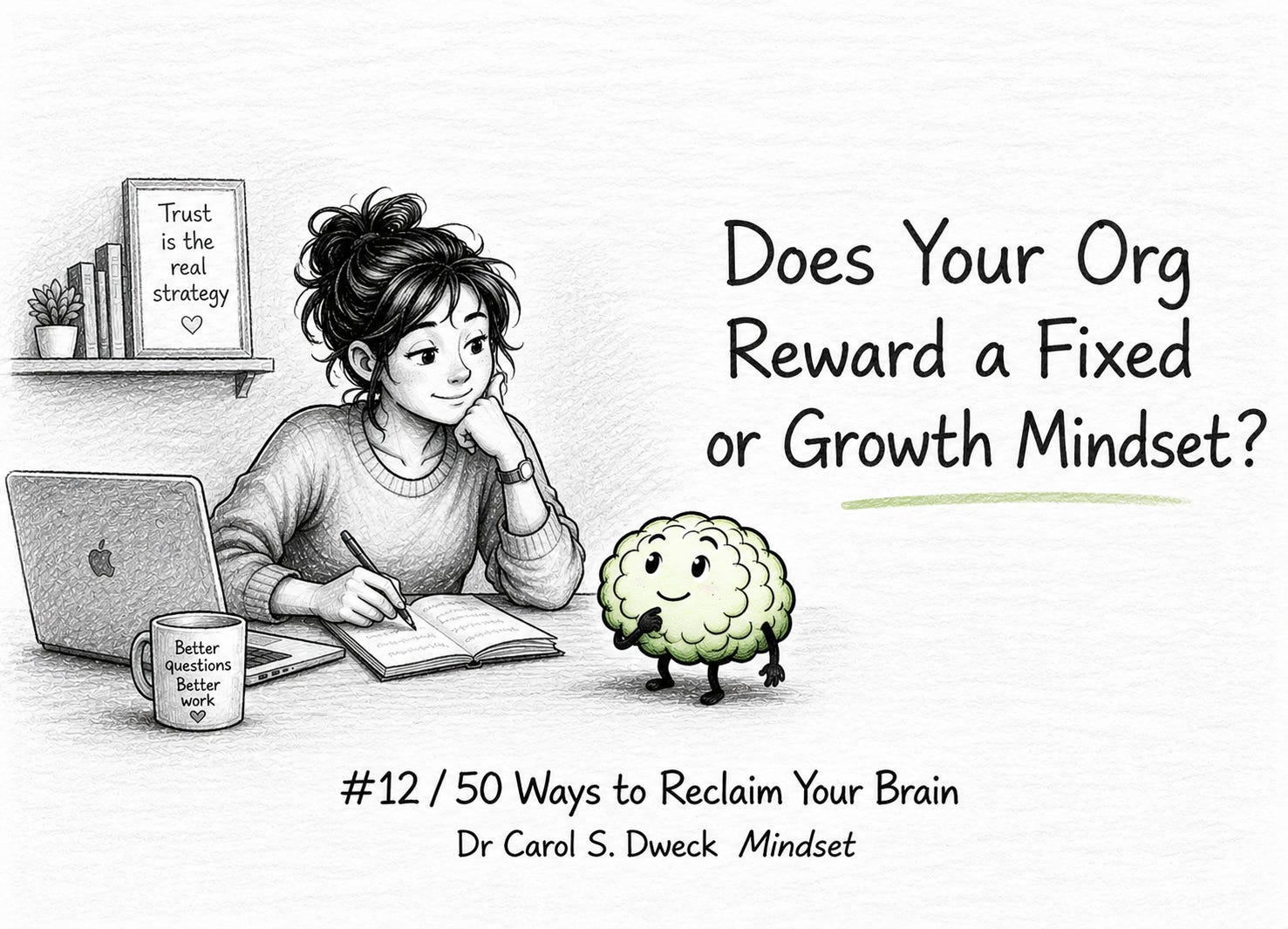
Carol Dweck’s Mindset explains why modern work rewards people who sound certain before it rewards people who think deeply.
Once you see it…you start spotting it in every meeting.
Because once intelligence becomes something people feel they must constantly prove…effort starts becoming socially risky at work.
Dweck’s entire argument is built around two mindsets.
Intelligence is fixed.
Talent is innate.
You either “have it” or you don’t.
Which means effort becomes socially dangerous.
Because if people are naturally brilliant…
they shouldn’t NEED effort.
That is the trap. 🙀
If intelligence is fixed, every meeting quietly becomes a performance review of your intelligence.
Every question becomes a test.
Every mistake becomes exposure.
Every pause risks making you look less capable.
Which is why fixed mindset people become obsessed with proving themselves over and over again.
Not because they are arrogant.
Because they (we) are protecting their (our) identity.
One of Dweck’s strongest lines is:
“Why waste time proving over and over how great you are, when you could be getting better?”
That sentence basically explains half of workplace behaviour.
The interrupting.
The over-preparing. (that’s me!)
The panic when someone asks something unexpected. (me again!)
The inability to say:
“I don’t know.” (me again) (how about you???)
The fake confidence.
The defensive leadership.
The exhausting perfectionism.
Because effort itself starts looking risky.
If you need to practise…
rehearse…
rewrite…
think carefully…
ask for help…
then fixed mindset whispers:
“Maybe you were never naturally good enough in the first place.”
Which is why fast talkers often do well in meetings.
Fast talking PERFORMS certainty.
And certainty performs brilliantly in overloaded workplaces.
Especially on Teams.
Especially under pressure.
Especially in cultures rewarding polished responsiveness.
Meanwhile thoughtful people are often still:
joining dots,
testing ideas,
thinking through consequences,
trying not to say something half-formed.
Which can accidentally LOOK weaker…
even when the thinking itself is stronger.
Growth mindset flips the whole thing.
Ability develops.
Skills grow.
Effort matters.
The goal stops being:
“Protect the image of being clever.”
And becomes:
“Improve.”
That changes everything.
Mistakes become information instead of humiliation.
Questions become useful instead of threatening.
Effort stops reducing status.
The Chrysler example in the book is fascinating because Dweck contrasts “genius cultures” with “growth cultures.”
Lee Iacocca became famous as this superstar leader.
But over time the culture became defensive because nobody wanted to challenge “the brilliant people.”
And once organisations become emotionally attached to genius identities, people stop exposing unfinished thinking publicly.
Which is a disaster for learning.
Malcolm Gladwell is quoted in the book saying:
“As a society, we value natural, effortless accomplishment over achievement through effort.”
YES.
Exactly that.
Modern work still worships “naturals.”
The effortless presenter.
The born strategist.
The person who magically “thinks on their feet.”
Meanwhile visible effort still carries strange social risks.
Rehearsing.
Practising.
Needing thinking time.
Changing your mind publicly.
All somehow less impressive.
Comments
Nothing yet. Say the first thing.
Sign in to join the conversation.