
BY LUCA PACIOLI · THE RUSTBELT READER · A SEMIQUINCENTENNIAL PIECE
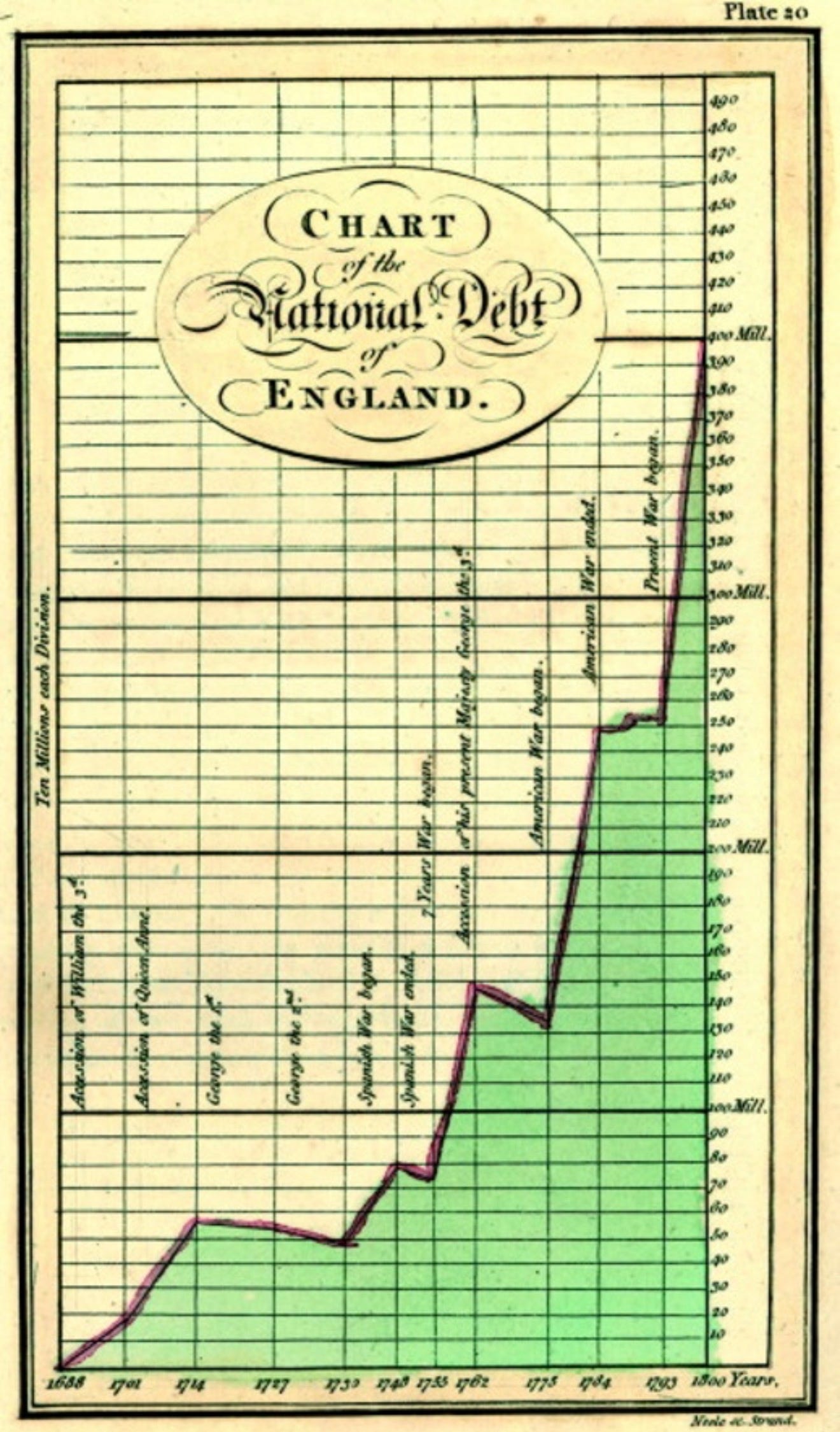
William Playfair’s 1786 chart of the English national debt — drawn by the inventor of the line graph, in the decade this piece is about. The number only climbed. Someone always kept lending.
Every ledger has two columns. 1776 is usually told from one of them — the column of ideas, grievances, rights. The other column, the one with numbers in it, tells you who actually held the debt, and it explains most of what the first column can’t.
Britain owed its war chest to its own bondholders — and passed the bill to the colonies. The Seven Years’ War roughly doubled British debt to finance a continent it now had to garrison. Someone had to service that. Parliament reached for the nearest unencumbered revenue: the colonies, who had benefited from the war and paid almost nothing toward it. The Stamp Act and Townshend duties were not caprice. They were debt service, addressed to the wrong payer.
The East India Company owed a fortune it could not raise — and Parliament covered it twice. By 1772 a London bank collapse had frozen the credit lines keeping the Company solvent. Parliament’s answer came in two entries: a loan of roughly £1.4 million, and the Tea Act, which let the Company dump its surplus into the one market that would read a discount as an insult.1 The Company owed London; London made the colonies pay the freight.
The Continental Congress owed its army’s survival to one man’s signature. By 1781 the United States had no working credit and no tax power. Robert Morris, appointed Superintendent of Finance, floated the government on his own name — personal notes, backed by his own fortune, because the institution that should have existed did not. The $1.4 million that moved Washington to Yorktown was Morris’s paper, a French loan, and coordinated French funds, in roughly equal parts improvisation.2America owed its own solvency to a private citizen because it had none of its own.
The United States owed its war to France — and repaid it in tobacco. Through a dummy trading firm run by the playwright Beaumarchais, French gunpowder and cannon reached the Continental Army before France dared enter the war openly. The debt was to be settled in Virginia leaf, shipped back across the Atlantic. Tea thrown into one harbor; tobacco promised out of another.
France owed its own war debt to a market it never built — and the bill came due on the monarchy. By 1789, Britain’s debt stood at 135 percent of GDP; France’s, less than half that, at 65 percent.3 Britain survived carrying the bigger number. France did not survive carrying the smaller one. What separated them was not the size of the debt. It was who was still willing to hold it.
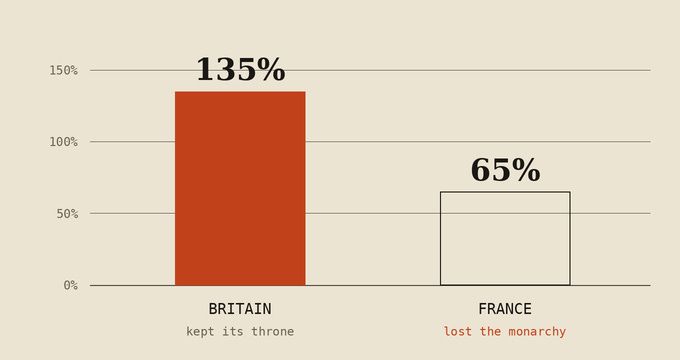
Britain owed and paid. France owed and couldn’t. The difference decided two revolutions, not one.
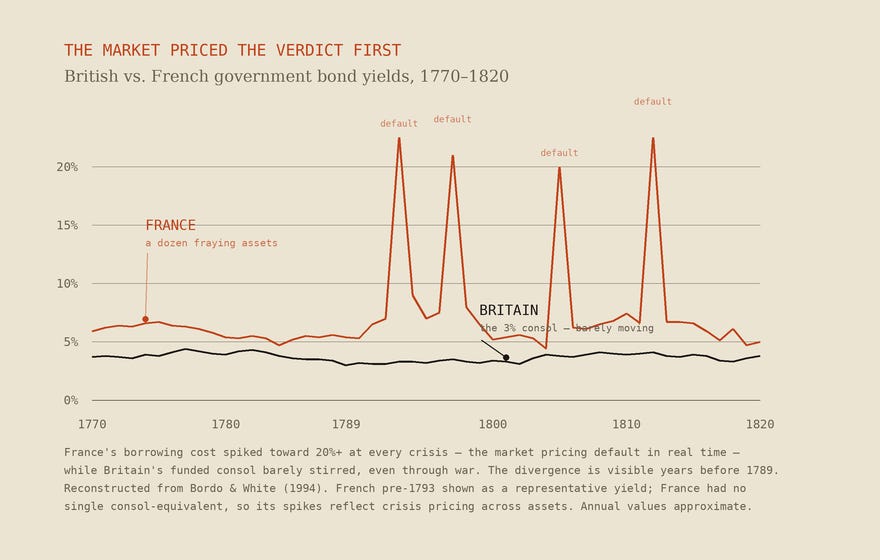
A ledger with only debits is not a crisis yet. It becomes one the moment nobody will extend the credit to close it. Britain reached into the colonists’ pocket because its own bondholders would lend no further without one; it lost the argument but kept the throne, because somewhere a market still trusted its paper. France extracted a monarchy’s worth of goodwill it never repaid; when the bill finally came due, no one — not its own citizens, not its own creditors — was willing to hold French debt on French terms.
Two hundred and fifty years later the question hasn’t changed. Every commitment a government makes abroad, at home, in its own name, is a debit. The only thing that has ever turned a debit into an asset is a matching source of credit — real revenue, a real market, someone still willing to lend. The Founders ran up an extraordinary debt to men, banks, and a foreign crown, and for a decade nobody was sure who would make good on it. What saved the ledger wasn’t the size of the debt. It was that enough creditors, for just long enough, said yes.
Sources. 1. On the EIC’s 1773 loan and the Tea Act as parallel instruments: full sourcing (Koudijs citing Sutherland; UK Parliament; Mill’s History of British India) in the companion essay, “250 Years of Debits and Credits.” 2. On Morris’s financing of Yorktown: C. Ver Steeg, Robert Morris: Revolutionary Financier (1954); E. J. Ferguson et al. (eds.), The Papers of Robert Morris, 1781–1784. 3. F. Velde & D. Weir, “The Financial Market and Government Debt Policy in France, 1746–1793,” Journal of Economic History52 (1992); T. Sargent & F. Velde, “Macroeconomic Features of the French Revolution,” Journal of Political Economy 103 (1995), p. 486.
No posts
Comments
Nothing yet. Say the first thing.
Sign in to join the conversation.