
EDITOR’S NOTE
This essay follows “Why Bother Selling Fannie and Freddie?”, published earlier this week, which argued that the debate over releasing the mortgage giants has been framed around the wrong question. That piece asked what Washington should do. This one asks something harder: given what the government has discovered it is holding, what is it likely to do — and what does that reveal about how modern states behave once they acquire an instrument that works?
By David Loheyde | Pittsburgh, PA
The thirty-year mortgage was built to plant a man’s feet in the soil of America.
That is close to a direct quotation. The federal push into homeownership began as an extension of the anti-communist campaigns that followed the Bolshevik Revolution, and its proponents were explicit about the mechanism. As one organization of realtors put it: “socialism and communism do not take root in the ranks of those who have their feet firmly embedded in the soil of America through homeownership.” The Department of Labor took over the “Own Your Own Home” campaign in 1917. Three decades later, the developer J.C. Nichols, laying out the postwar suburb, said the same thing more plainly: “Here is where we can lick socialism and communism.”
The machinery came earlier and for other reasons — the Depression built it. The FHA was created in 1934 to revive a collapsed housing market, Fannie Mae in 1938 to buy the loans it insured, and the long, self-amortizing mortgage was a New Deal instrument before it was a Cold War one. But the term stretched to thirty years through the veterans’ loan guaranty of the 1944 GI Bill, and the expansion that followed in the 1950s and ‘60s was known, without embarrassment, as the Cold War GI Bill. An instrument built to end a depression was extended to hold a population.
The result is a loan that almost no one else in the world could underwrite. Coming out of the war, no other country was strong enough to stand behind thirty years of household credit at scale — Britain, France, Germany, and Japan were rebuilding, their currencies strained and their balance sheets committed. The thirty-year fixed-rate mortgage is not merely an unusual product. It is a monument to what the American state could underwrite when nobody else could. In 1940, 44 percent of households owned. By 1960, 62 percent did.
And the consequences run far beyond housing. Homeownership is where the median American family keeps its wealth. Mortgage credit is the largest asset class in the country. The suburb, the commute, the school district, the household balance sheet, the entire postwar shape of American life — all of it sits on top of an engineered credit product that exists because a government willed it into being and stands behind it still.
Which is why what is happening now deserves more attention than it gets. The American Dream is going through a capital restructuring.
The machine that issues the mortgage — Fannie Mae and Freddie Mac, seized in 2008 and held ever since — has a capital structure of its own, and that structure is contested. There is a senior claim, and warrants, and a guarantee nobody has priced, and a waterfall that determines who is paid and in what order. The terms have been rewritten three times. They may be rewritten again.
And so the parties gathered around the restructuring of the American Dream’s financing are these: the United States Treasury, a federal regulator, and a handful of hedge funds placing bets on the outcome. The homeowner is the subject of the transaction and absent from the table.
Eighty years later, the inheritance is claimed openly. In November 2025 the director of the Federal Housing Finance Agency posted a picture to social media: Donald Trump standing beside Franklin Roosevelt. The occasion was a proposal for a fifty-year mortgage — Roosevelt had given America the thirty-year loan, the image implied, and Trump would extend it. “Laser focused on ensuring the American Dream for YOUNG PEOPLE,” Bill Pulte wrote, “and that can only happen on the economic level of homebuying.”
The fifty-year mortgage was dead within two months, panned by the industry and quietly shelved. It doesn’t matter. The image is the thing — a claim of inheritance from the man who built the instrument this President now holds.
The first essay in this series traced the roads that made that geography possible. The second traced the credit that filled them. This one is about what happened when the state finally took possession of the machine — and discovered what it was holding.
The historian Charles Maier describes the twentieth-century “project state” — a government that does not merely administer a settled order but pursues transformative projects: mobilizing resources, directing production, planning at continental scale toward chosen ends.
Maier is direct about the generative force. “War makes states,” he writes, “and it makes project-states in particular.” Total war taught the modern state to allocate materials, direct industry, conscript labor, and coordinate an economy toward a single objective. When the war ended, the capacity did not evaporate. The institutions built to win it were turned toward reconstruction, development, and growth.
Once an organization acquires the capacity to direct, its internal logic reorganizes around using it. A state that can only regulate thinks like a referee. A state that can direct begins to think like a planner — and starts looking for things to plan.
America’s plan was the house. The GI Bill turned returning soldiers into mortgage borrowers, financing roughly a fifth of postwar home purchases. The FHA and VA programs were Depression- and wartime-era institutions redirected at peacetime family formation. And the interstate — forty-one thousand miles of it — was justified on defense grounds and named accordingly: the National System of Interstate and DefenseHighways. Eisenhower had seen the Autobahn. He had also, in 1919, crawled across the continent in a military convoy at five miles an hour.
The suburb was not simply a market outcome. It was co-produced — by developers and consumer preference and the automobile, yes, but also by a state that had learned to coordinate at war and turned that capacity toward the American Dream. The capacity came first. The project followed.
Trace the instruments and one commitment runs through all of them, restated by every administration in the language of its own moment.
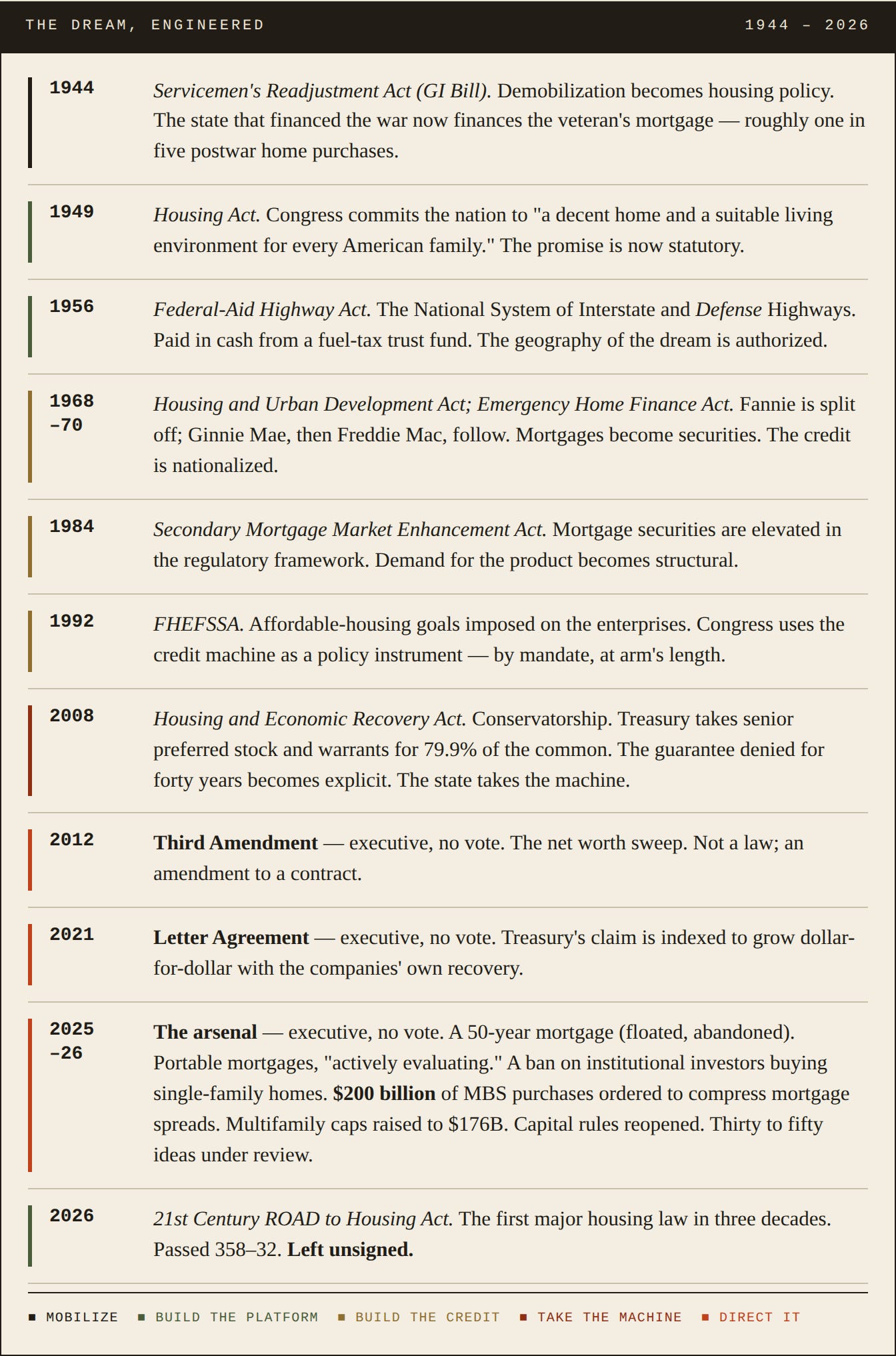
Read down that column and the shape is unmistakable. For sixty years the state pursued the dream through law — chartering, authorizing, appropriating, mandating. Then, in 2008, it acquired something it had never held before.
Not a policy. A company.
Every consequential act since has been executed without a vote.
To understand what was acquired, remember what was denied.
For four decades the arrangement had a peculiar feature: the state supplied the essential input — the market’s belief that these securities were safe — and charged nothing for it. Officially there was no guarantee. Fannie and Freddie were private companies. The federal tie amounted to a $2.25 billion credit line and some charter privileges, and every bond they issued carried a notice stating plainly that the United States did not stand behind it.
The Congressional Budget Office valued the guarantee that did not exist at roughly twenty-five billion dollars a year.
The market knew. The rating agencies knew. The companies levered themselves accordingly. And the taxpayer carried the tail risk of the American mortgage system, uncompensated, for forty years — because acknowledging the guarantee would have meant putting it on the books, and putting it on the books would have meant admitting what had been built.
In 2008 the bill arrived. Treasury advanced roughly $191.5 billion. The disclaimer was retired. What had always been true became visible.
The conservatorship was meant to be temporary — a stabilization, a bridge, unwound once the patient recovered.
The patient recovered. Fannie has posted more than thirty consecutive profitable quarters. Against the $191.5 billion advanced, Treasury has collected roughly $301 billion. On a cash basis the rescue was repaid half again over, years ago.
The arrangement did not end. It deepened.
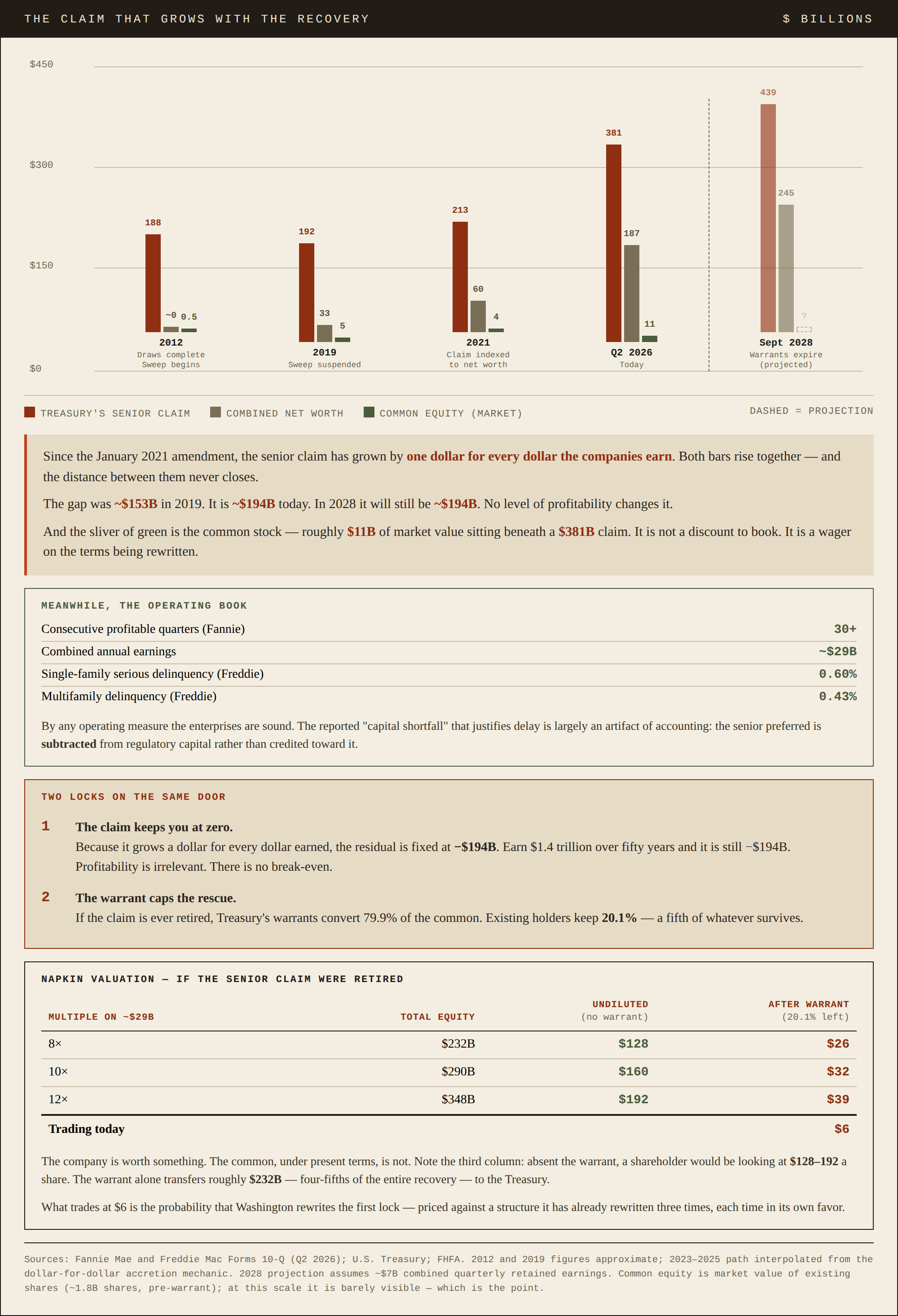
Read that ledger as a shareholder and you get an argument about fairness: a debt repaid, a claim that will not die, an injustice awaiting correction.
Read it as a state and you get something else.
The claim captures the earnings. The guarantee absorbs the risk. Together they make the companies directable — without an appropriation, and without a vote.
That is not a legacy of the crisis. That is an instrument.
In January 2026, with mortgage rates above six percent and affordability dominating the politics of an election year, the President posted this:
“Because I chose not to sell Fannie Mae and Freddie Mac in my First Term, a truly great decision, and against the advice of the ‘experts,’ it is now worth many times that amount — AN ABSOLUTE FORTUNE — and has $200 BILLION DOLLARS IN CASH. Because of this, I am instructing my Representatives to BUY $200 BILLION DOLLARS IN MORTGAGE BONDS.”
-DONALD TRUMP, TRUTH SOCIAL, JANUARY 8, 2026
Read it as a boast about an investment and it is unremarkable. Read the second sentence and it becomes something else.
The appreciation is not cited as a reason to sell. It is cited as authorization to use. Because the companies are worth a fortune and hold cash, therefore they can be directed. The value is not the point. The value is the permission slip.
And notice how the fortune was made. The government’s position appreciated because the senior claim grows a dollar for every dollar the companies earn — the accretion mechanic, running for four more years. This was not a market bet that paid off. It was a structure working exactly as written, converting the enterprises’ profitability into the government’s claim. “I made money by not selling” means, in mechanical terms, that the lock held.
The purchases began within days. Consider what that order actually was: two companies the government does not technically own — whose profits it captures, whose risk it absorbs — directed to deploy their balance sheets to compress mortgage spreads. A monetary intervention, executed without the Federal Reserve, without an appropriation, without a bill. The thirty-year rate fell twenty basis points on the announcement alone.
Then the multifamily caps were lifted to $176 billion, to be met even if the market for such loans was shrinking. Guarantee fees came under review as an affordability lever. An executive order directed the regulator to reconsider the capital rules. And the FHFA director, speaking to a housing conference, described what the enterprises might do next:
They “will probably take ownership in different companies by virtue of companies offering them equity in exchange for Fannie and Freddie doing smart business constructs with them.”BILL PULTE, FHFA DIRECTOR, ON THE MODEL OF THE INTEL DEAL
He summarized the position in four words.
“We hold all the cards.”
This is the project state, awake and using its hands — a mortgage guarantor being reimagined as a vehicle for taking equity stakes in private industry. And it was all happening in the middle of the administration’s own campaign to sell the instruments it was using.
The public offering has since slipped past the midterms. Analysts downgraded the stock on the delay. Even the regulator now says there is no rush.
The market has spent two years handicapping one decision: will Treasury write off its senior claim, or affirm it? Affirm, and the shares are worth almost nothing. Cancel, and they multiply several times over. The bulls have modeled this as a coin flip in a president’s hands.
It is not a coin flip. It is a question about what a state does with a working instrument of power.
States rarely surrender instruments that remain politically useful.
The qualifier matters, because the categorical version is false. Governments do relinquish power, and often. Washington broke up AT&T, privatized Conrail, deregulated the airlines and interstate trucking, and dismantled the wartime price controls once the war ended. Britain sold British Telecom. The record is full of states letting go.
So the question is not whether states surrender instruments but under what conditions — and the pattern is legible. They relinquish what has become burdensome, obsolete, indefensible, or more costly to hold than it returns. The wartime controls were strangling a peacetime economy. The airline regulators had become a visible drag with an articulate opposition.
None of those conditions describes what Treasury is holding. Which raises the question of what, exactly, it is holding.
The market has spent two years handicapping one decision: will Treasury write off its senior claim, or affirm it? Affirm, and the shares are worth almost nothing. Cancel, and they multiply several times over. The bulls have modeled this as a coin flip in a president’s hands.
It is not a coin flip. It is a question about what a state does with a working instrument of power.
Governments possess many kinds of power. They can tax, and they can spend. They can regulate, and they can prohibit. They can go to court. But nearly all of these are slow — they require legislation, or rulemaking, or litigation, and each of them creates a visible cost, an identifiable loser, and an organized opposition. A tax must be voted. A regulation must be noticed and commented upon and defended in court. A spending program must be appropriated, and appropriations expire.
What governments almost never possess is the ability to simply direct an outcome — to pick up an instrument and move a price, this quarter, without a vote.
Call it directive capacity: the power to produce a result by instruction rather than by law.
It has three properties, and they compound. It is fast — results arrive in weeks, not electoral cycles. It is executive — it moves by instruction, bypassing most of the ordinary legislative veto points. And its costs are deferred and dispersed— it requires no appropriation, so the fiscal consequence, if any, arrives later and lands elsewhere.
Directive capacity is the scarcest asset in a modern state’s inventory, and it is scarce for good reason: constitutional systems are built precisely to prevent its accumulation. Taxes must be voted. Regulations must be noticed, commented upon, and defended in court. Appropriations expire.
Which is what makes the conservatorship so remarkable. Through the senior preferred, the guarantee, and FHFA’s conservatorship authority, the executive branch came into possession of directive capacity over the largest asset class in American life — and acquired it not through legislation, but through a rescue.
Test it against the three properties. An order to buy $200 billion of mortgage bonds moves the thirty-year rate within weeks — fast. It requires no vote, because the companies are in conservatorship and the instruction runs through the regulator — executive. And it requires no appropriation, because the companies fund it from their own balance sheets, while the guarantee behind them remains unpriced — deferred cost. The result is visible to the electorate immediately, in the number on a mortgage quote.
There is nothing else in the federal government quite like it. The Federal Reserve is independent by design. Fiscal policy requires Congress. Regulation moves in years. But Fannie and Freddie can be moved in an afternoon, by instruction, and the instruction can be posted on social media.
An instrument that produces visible results, carries no appropriated cost, and bypasses most of the ordinary constitutional veto points is not a burden a state is looking to shed. It is the closest thing a modern executive possesses to a free hand.
This is why the conservatorship persists, and it is why every administration that has approached the file has confronted the same institutional logic. One swept the profits. One studied release and did not release. One left it alone. And this administration — the one that campaigned on ending the conservatorship — has spent its year using the companies harder than any predecessor.
The pattern is not indecision. It is recognition.
To cancel the senior preferred is to hand the accumulated earnings to shareholders, surrender the mechanism of capture, and retain the obligation of the guarantee. It is to sell the lever and keep the liability. A state might do that — states have done stranger things. But it would be doing so in a year when the record shows the instrument being used more actively than at any point in its history.
One document from this year makes the point better than any argument could.
At midnight on July 11, 2026, the 21st Century ROAD to Housing Act became law without a signature. It had passed the House 358 to 32 — the first major housing legislation in three decades, working almost entirely on supply. The President declined to sign it, canceled the ceremony over an unrelated dispute, and let the constitutional clock expire.
Supply is the binding constraint; nobody disputes that. But supply arrives slowly, and there is one thing the ROAD Act cannot touch, noted almost in passing in every account of its passage: Congress does not get a vote on mortgage rates.
The legislature deliberated for thirty years, assembled a bipartisan supermajority, and produced a bill whose effects will arrive after the next election. The executive picked up the instrument and moved mortgage spreads in an afternoon.
That asymmetry is a constitutional fact before it is a housing one. It is what happens when executive capacity outruns legislative capacity — and it is, one suspects, exactly why the instrument is not for sale.
The interstate was built with cash and financed forward with obligation: every mile of concrete a promise to resurface, every subdivision a liability arriving decades later, invisible until it wasn’t. The suburb was built with credit and financed forward with risk: every mortgage a claim on a household’s future income, sold into a market that dispersed the danger until no one could see it whole.
The earlier city contained instability locally. The modern system distributes it. And the state that built the modern system now holds the only instrument that lets it manage what it distributed.
This is the trap the project state builds for itself. Not corruption — nothing so simple. Something more ordinary, and more binding: you learn to coordinate in a war, you turn that capacity toward a dream, the dream requires a machine, the machine requires management, and the tools of management turn out to be more useful than anyone intended.
Meanwhile the restructuring proceeds. The senior claim accretes each quarter. The warrants approach their expiry. Funds that bought the common at a few dollars wait on a decision only one office can make, and the price of their wager moves on social media posts.
The mortgage was engineered so that a family could own a house. The engine that issues it is now a security with a contested waterfall, and the parties negotiating over that waterfall are a Treasury Secretary, a regulator, and a handful of opportunists placing bets. The homeowner, for whom the entire apparatus was built, is not in the room.
The conservatorship was supposed to rescue the mortgage system. It did. But it revealed something larger, and the revelation has outlasted the rescue by seventeen years.
Modern governments rarely abandon instruments that let them govern.
They rename them. They justify them. They inherit them from the administration before, and hand them to the one that follows.
And eventually they forget the instruments were ever meant to be temporary.
WORKS CITED & FURTHER READING
Charles S. Maier, The Project-State and Its Rivals: A New History of the Twentieth and Twenty-First Centuries (Harvard, 2023) — the framework this essay borrows, including the quoted line “War makes states and it makes project-states in particular.” Maier treats war as the paradigmatic generative force, though not the only one; project-states also emerged in postcolonial settings without that inheritance. The reading of American housing finance as one such project is the author’s.
Legislation: Servicemen’s Readjustment Act (1944); Housing Act (1949); Federal-Aid Highway Act (1956); Housing and Urban Development Act (1968); Emergency Home Finance Act (1970); Secondary Mortgage Market Enhancement Act (1984); Federal Housing Enterprises Financial Safety and Soundness Act (1992); Housing and Economic Recovery Act (2008); 21st Century ROAD to Housing Act (became law July 11, 2026).
Treasury and FHFA: Senior Preferred Stock Purchase Agreements (2008); Third Amendment (2012); Letter Agreement (January 2021). Fannie Mae and Freddie Mac Forms 10-Q, Q2 2026. Congressional Budget Office and Congressional Research Service on draws, dividends, and the pre-crisis implicit subsidy.
Statements: Bill Pulte (FHFA), social media posts and remarks at ResiDay, November 2025 – January 2026; President Trump, Truth Social, 2025–2026. Reporting from Fortune, Bloomberg, Politico, The Hill, NPR, CNN, and National Mortgage News.
On the anti-communist origins of federal homeownership policy: the National Association of Real Estate Boards’ “Own Your Own Home” campaign (adopted by the Department of Labor, 1917); J.C. Nichols, Planning for Permanence (1948). On the thirty-year term: Servicemen’s Readjustment Act (1944) and the VA loan guaranty, extended to thirty-year terms during the 1950s; the subsequent expansion was known as the Cold War GI Bill.
Also: Charles L. Marohn Jr., Strong Towns; Kenneth Jackson, Crabgrass Frontier; Robert Caro, The Power Broker; Daniel Fetter, on the 1940–1960 rise in homeownership.
Previously in this series: The Concrete Artery (Part I) and From Local Resilience to National Risk (Part II).
No posts
Comments
Nothing yet. Say the first thing.
Sign in to join the conversation.