
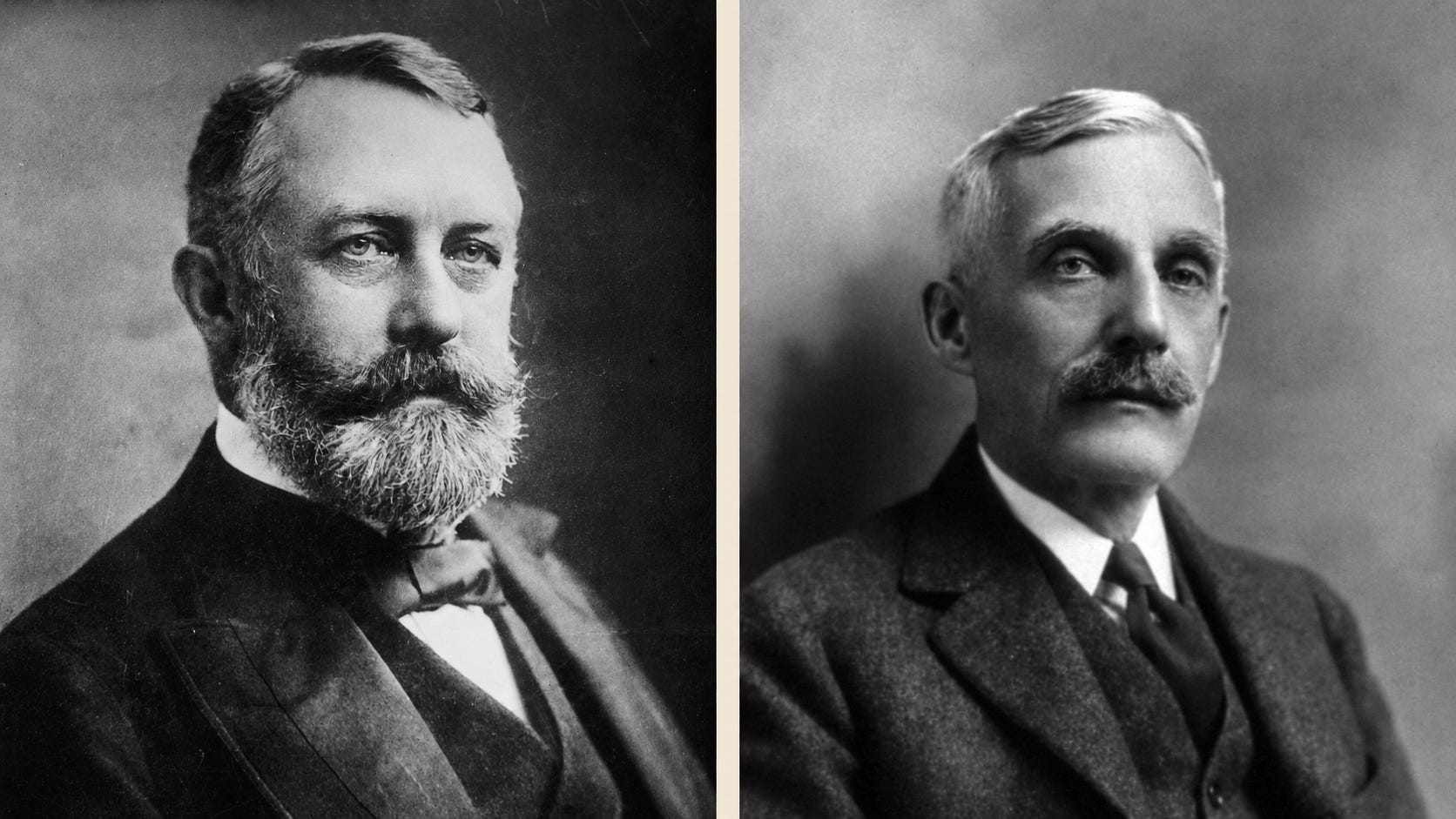
Henry Clay Frick had two great financial relationships in his life.
One was with Andrew Carnegie. They invested in each other’s companies, merged their interests, bound their fortunes together — and then fell out in the most famous feud in American business history, so completely that, in the famous account, Frick’s final answer to Carnegie was that he would meet him in hell.
The other was with the Mellons. It began with a $10,000 loan in 1871 and ended, in any meaningful sense, never — it simply outlived both men and turned into museums.
Same man. Same decades. Same industries, same city, same temper.
The difference was the structure of the backing. That difference is this essay’s whole subject, because it is the mature form of the first house rule — the part the maxim doesn’t state.
Back the man, then the asset. Then stay the banker. And the backing can compound for sixty years.
The first $10,000 was advanced on recognition, not diligence.
Set the scene properly, because the house would later mark it in stone. The Judge — first awakened as a farm boy by the sight of the Negley mansion, then handed a method of escape by a borrowed copy of Franklin’s autobiography, and finally driven at seventeen to stop his father from buying him a farm — was in that same year acquiring the iron-front banking house he would crown with a statue of Franklin above the door. So when the twenty-one-year-old from West Overton walked into T. Mellon & Sons asking to borrow against nothing but his own competence, he was walking under the Judge’s chosen patron saint of exactly that transaction: the tradesman’s boy who compounds. The man Franklin’s book had rescued was about to play Franklin to a boy of his own kind.
Frick came with little experience of the coke business and two things Judge Thomas Mellon could underwrite: connections — the Judge had known his mother, Elizabeth Overholt, as a girl — and what Cannadine calls a determined, persuasive, and audacious entrepreneur after the Judge’s own heart. The money built fifty beehive ovens ahead of the demand the coming Bessemer steel industry would create.
The famous inspection came with the second $10,000. Cannadine quotes James B. Corey’s recommendation: lands good, ovens well built; manager on job all day, keeps books evenings; may be a little too enthusiastic about pictures, but not enough to hurt; knows his business down to the ground; advise making the loan.
Then came the test that made the relationship, because backing is only proven in the drawdown.
The crash of late 1873 arrived two years into the credit and did not relent for six. Coke sold below cost. Frick, in Cannadine’s two-word summary, just survived — and the bank was a reason why. The Judge kept the line open through the trough while Frick used it to do what troughs permit: absorb distressed rivals until the Connellsville field was substantially his.
By thirty he was a millionaire. The house had not merely backed a man. It had financed his assembly.
Now watch what a backed relationship becomes when it works, because every stage is on the books.
First, the client graduates. Frick’s personal borrowings at T. Mellon & Sons ran $71,000 in 1882, $148,000 in 1885 — and $9,000 by 1887, while similar credit continued to the H. C. Frick Coke Company. His personal dependence on the house was receding even as the larger relationship expanded — the shape every lender hopes to see in a maturing account.
Second, the credit becomes trust. In 1876 the Judge introduced Frick to his son Andrew, having just made him a preferred customer with a $100,000 line. It became one of Andrew Mellon’s few truly close friendships — Cannadine calls it the most famous and enduring friendship in Pittsburgh. Frick, six years older, better read — Addison, Macaulay, Chesterfield — and an amateur painter besides, called him Andy. Andrew, all his life, to the end of both their lives, called him Mr. Frick. Whether born of Frick’s seniority, Andrew’s reserve, or simply the settled habit of the relationship, the asymmetry persisted to the end — and it fit the structure: even in conversation, the banker stayed in his lane. The intimacy lived elsewhere — in the Thursday-evening poker games at Clayton with Philander Knox and George Westinghouse that Frick would remember, in his last years, as the old-time jolly evenings. And in 1887, leaving for a summer in Europe, Frick placed his entire stock portfolio in Andrew’s hands with “full authority” to sell at whatever prices he judged proper.
A man’s whole position. Discretionary.
Third, the trust becomes deal flow — and the roll of joint ventures reads like a diversified bank being assembled two names at a time: city banks; coal properties; natural-gas partnerships; the Fort Smith & Western railroad down in Indian Territory; the Overholt distillery of Frick’s own grandfather, bought back into the family circle in 1887; and, in time, Union Steel. Each rated the other in the same register: Frick, invoking Andrew’s name at a business meeting — “a gentleman on whom I can rely.” Andrew, on Frick, always — “a strong character, with good impulses and broad and generous ideals.”
And fourth — the entry that shows the metal — the relationship survived its one recorded insult, from outside. Frick once brought Andrew into a major financing he was helping assemble in New York, and the prominent financier leading the syndicate struck the Pittsburgh banker from the list — not a name the East knew, not a name the East needed. Frick was mortified, and apologized to his friend for a slight that was not his. Mellon’s response was the whole man in miniature: no offense taken at Frick, and — more telling — none carried against the financier either. Years later, when business with the same man made sense, Mellon did the deal without a word about the old list. Pride that costs return was, in his accounting, a form of stupidity — and the covenant against stupidity bound the house first.
That is the compounding curve of Rule I: loan, graduation, trust, reciprocity — and a temperament that refused to let insult compound instead. But the curve is not the lesson.
Carnegie rode the same curve with the same man, higher and faster.
And it ended in the most spectacular falling-out in the history of American capital.
So put the question to the record directly: why did one Frick relationship detonate and the other endure for life?
Cannadine’s ruling is one sentence, and it is the thesis of this essay. Mellon’s business relations with Frick were entirely different from Carnegie’s — and much happier — because Mellon was Frick’s banker, but did not invest much in his companies or play any part in their management.
Read that with a credit officer’s eye, because everything is in it.
Carnegie merged with his man. He put capital inside Frick’s coke company, put Frick inside his steel company, and fused two dominant temperaments into one capital structure — so that every disagreement about price, policy, or pride became a fight over shared property, with no exit that wasn’t a war. The structure guaranteed that the relationship would eventually be tested at its weakest point, ownership, where neither man had ever yielded an inch to anyone.
Mellon backed his man and stayed out of his machine. Be precise about the boundary, because it was drawn with a banker’s pen: the house lent freely to Frick and to the H. C. Frick Coke Company itself — credit, not control — and the Mellons took interests in Connellsville coal alongside him. What Mellon never did was the Carnegie move: major equity inside Frick’s flagship, a seat in its governance, a hand on its management. When the two men owned things together, it was side by side in ventures new to them both, partners from the first dollar — never inside each other’s kingdoms. The friendship and the coke business never held hostages against each other.
Their difference in display helped. Frick wanted culture made visible: Clayton, the European tours, the clubs, the pictures, eventually a Fifth Avenue palace. Mellon came to love pictures too, but never the performance of rank; he preferred influence without spectacle, and would end by placing his collection inside an institution that deliberately omitted his name. They shared an economic creed without competing for the same social role. Carnegie and Frick both needed to be the commanding personality in any room they shared. Mellon was content to be the indispensable one. The structure, in other words, was temperament made institutional.
That is “stick to what you know,” practiced at the level of relationship design. Mellon knew banking — judging men, structuring credit, holding positions. He did not know coke, and never pretended to. The Judge’s original diligence had established the division cleanly: Frick knows his business down to the ground. The house’s business was knowing Frick.
And the covenant ran the other way, too. Colonel Frank Drake, who ran a Mellon company for years, described Andrew’s method with executives: he gave a man terrific authority, never interfered with details, and “would back you against anyone and under all conditions” — until you did something he judged to be wrong or showing poor judgment.
There is the whole rule, in its adult form. The backing is unconditional in loyalty and conditional on judgment. Total support, zero tolerance for stupidity — on either side of the ledger. Frick never gave the house a reason. The house never gave Frick one. For forty-eight years, neither turned a business difference into a contest for control. That restraint — not an absence of ego — is what the structure bought them, and why there was never anything to forgive.
Now run the relationship to its end, because the end is the argument.
The little clause in Corey’s recommendation — too enthusiastic about pictures, but not enough to hurt — was the one item whose eventual scale he misjudged. Frick’s pictures became the Frick Collection. Frick’s example, across forty years of Thursday poker and joint accounts, helped turn his quiet banker into a collector. Andrew Mellon sat among the Frick trustees who preferred John Russell Pope for the mansion’s conversion; Pope was selected in 1932, and the museum opened three years later. In 1936, Mellon chose the same architect for the building he was giving the nation: the National Gallery of Art.
Follow the chain, because nothing in it could have been specified in 1871: a character loan to a coke man became a friendship, became discretionary authority over a fortune, became forty years of shared deal flow, became two of the greatest art institutions in the world — one bearing the client’s name, one deliberately bearing no name at all.
No term sheet reaches sixty years. Only a relationship does — and only a relationship structured to survive its own success.
So state the first house rule in full, the way the file actually teaches it:
Back the man, then the asset.
Decide which role you hold — and if you are the banker, do not become a shadow operator. Give sound judgment its room, and withdraw the backing when judgment breaks.
Then hold, because the returns on a rightly structured backing do not arrive in the loan. They arrive decades later, in forms no one could have underwritten — deal flow, discretion, institutions, a name carried on a museum, a name kept off one.
The asset pays interest. The man, rightly backed, pays compound interest — and the term is measured in generations.
The record throughout is David Cannadine, Mellon: An American Life (Knopf, 2006): the 1871–73 loans and Corey report, the loan balances of 1882–87, the 1876 introduction and $100,000 line, the 1887 “full authority” arrangement, the joint ventures, the mutual verdicts, the Drake description of Mellon’s backing, the banker-not-partner contrast with Carnegie, and the Pope commissions. One disclosure, in the house manner: this is the credit ruling on the relationship, not the moral one. Both men’s shared hardness — toward labor above all — is documented in the same biography and belongs to a different ledger than today’s. Companion piece: “The Mellon Rules.” Accounts of the Corey inspection differ: Cannadine places it before a second $10,000 advance in 1871; the Frick Collection’s institutional history associates it with the original application and dates it to 1870. This essay follows Cannadine. Corrections are welcome and published.
No posts
Comments
Nothing yet. Say the first thing.
Sign in to join the conversation.