

Wes ðu hāl (Be thou hale).
Yesterday morning I was sitting at my computer next to the open door, freezing air bathing my bare feet. The season is turning toward Spring. There is anticipation. My friend Ru was snuggled down on my right arm where she likes to sit while I am typing. We were researching a prayer about ice and snow, fire and storms.
I am studying a fremde (strange) language for my happy space- it is fremde because it is partially familiar, partially foreign.
Familiar: because my ancestors used to speak it and some of the words survived into what we speak today.
Foreign because they spoke it 1500-1000 years ago.
It’s an extraordinary experience reaching back into the past via language because language reveals how people thought. I have a great desire to incorporate what I am learning into my artwork.
See if you can understand this line from the Old English prayer (I’ll leave the translation further down):
"fȳr and hagol, snāw and ċeald īs, windas and stormas"
Something sad happened a moment later. Ru sat up and looked outside intently- and then I heard it- a distant sound illustrating the onomatopoeic Old English name for her species- “hrōc”. Ru flew through the open door like a shot and I followed her outside. The sun was watery and cold as the owner of the cry flew past- a heron. Ru came back to her old perch near the door and I felt a terrible grief for her. Ten years ago a family of 30 rooks would fly hundreds of feet overhead, their distant call like the grinding of ancient rocks. By five years ago our occasional visitors were down to 7 birds. Last year 1 stopped by for a brief visit. But we haven’t seen another for a long time.
A deep mystery is at work in the halls of power where rooks are not represented. Someone somewhere has decided to “eradicate” every last one. Rooks were first brought here in 1862 and were protected until 1919. There were 2789 nests in Hawke’s Bay in 2007, and, after 18 years of killing, only 471 nests at the last count this year. There may or may not be any left at all in the South Island.

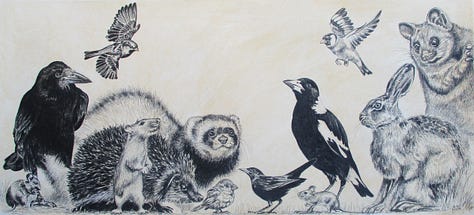
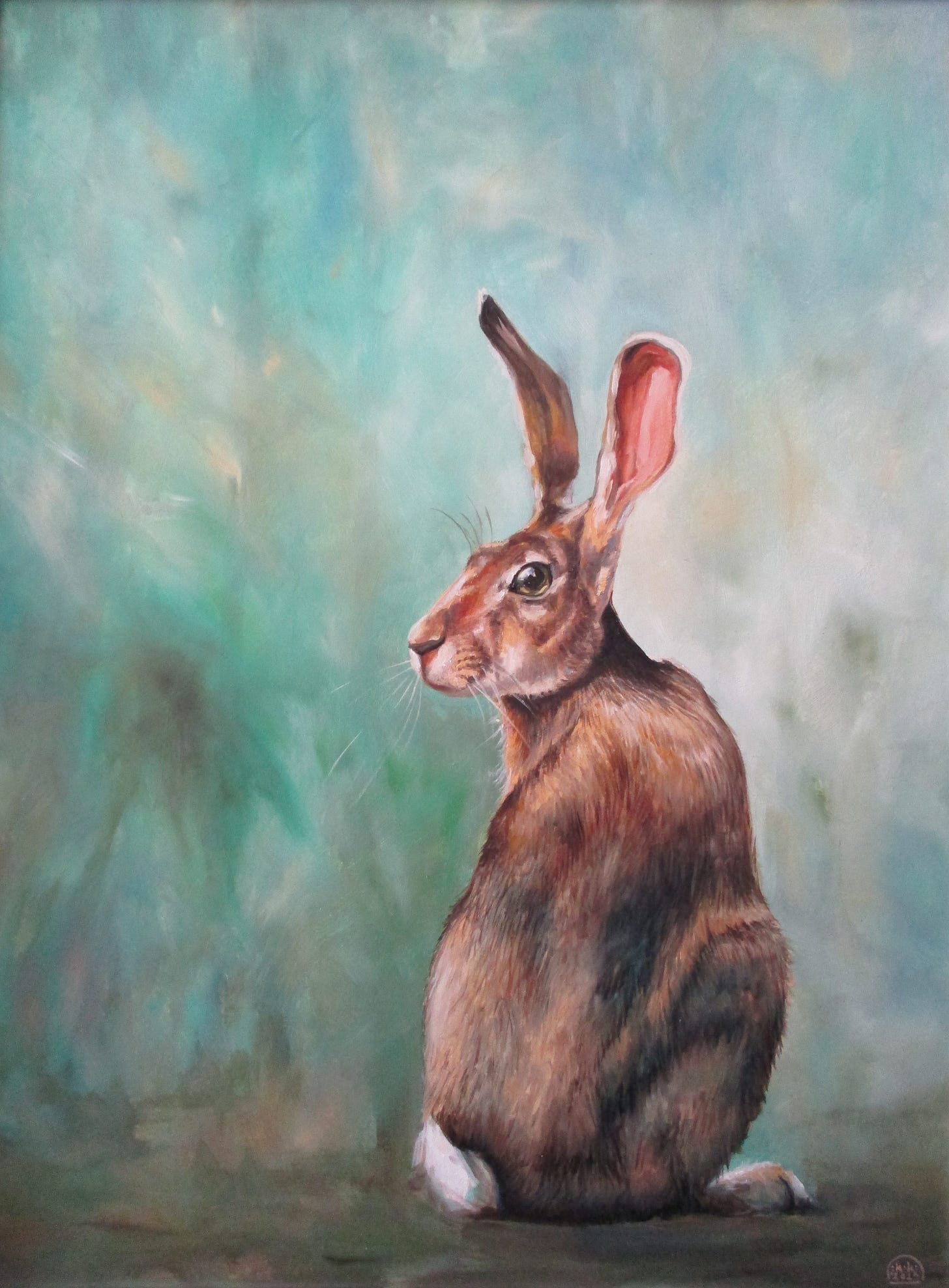
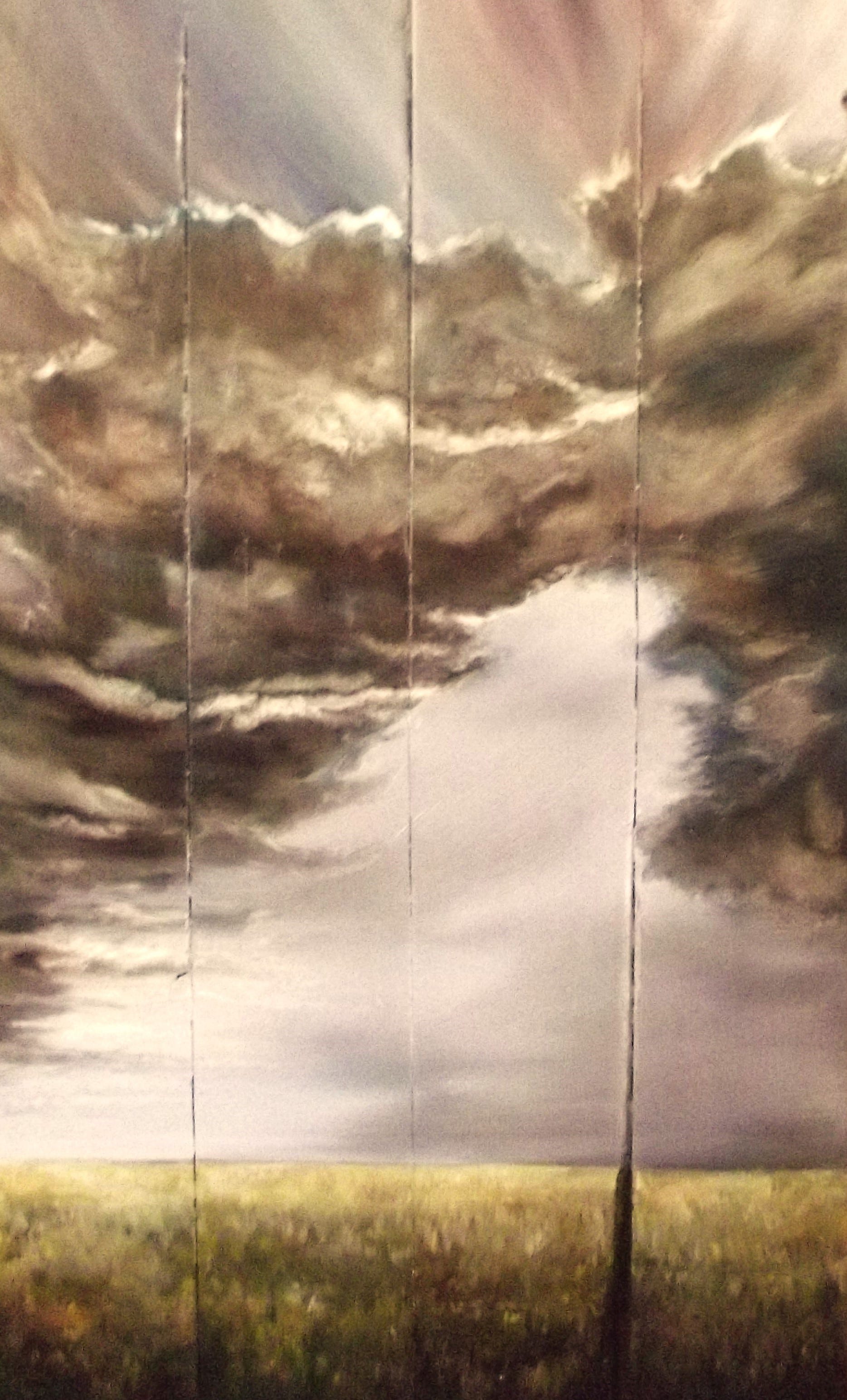
You can see more of the pictures above if you click on them. These two are off to be exhibited at the Art Exhibition at Hereworth School 29th-31st August. I was given two beautiful wooden frames by my dear friend Mirjam at Ingrid’s Picture Framing in Hastings and so these two works were created for the frames, in a back-to-front kind of way.
Translation for the Old English line above:
“fire and hail, snow and cold ice, winds and storms”
I’m researching papers here and overseas on just why rooks are so hated. It turns out they’re not. Studies in New Zealand are at best ambivalent but, in Europe I’m finding many that are positive. Rooks are protected under Appendix III of the Berne Convention on the Conservation of European Wildlife and Natural Habitats. In some parts of Europe and the UK they’re recognised for their control of grass pests (I have identified 19 different families of New Zealand pest insects which rooks love to eat), seed dispersal, amazing nest-building structures, and are even much beloved by enlightened folk who see them as a bird of plenty and consider having a rookery on your property as good luck.
The problem is, when the ground gets too hard, they can’t dig out their preferred food of invertebrates, and so they turn to cereal crops, walnuts, fruit and the like. They have to turn to these or they’d starve to death.
Wouldn’t it be a wonderful world if farmers were supported to pay Nature some wages for the work she has done for free till now? A good permaculture orchard has a row of fruit trees just for the birds who also eat pest insects. A good farmer might plant some walnut trees for the rooks, maybe a strip of oats on the edge of the farm during their hunger months- in much the same manner as riparian plantings along streams include care of fauna as well as of flora and water. And in return the farmer would receive organic biological pest control for his pasture which would preserve a host of biodiversity that would otherwise be adversely affected by pesticides.
Imagine if New Zealand took the money it spends on poison and turned it into walnut trees and fencing on the edges of farming land.
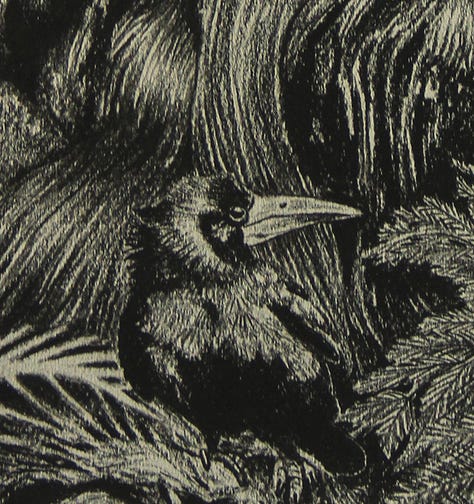
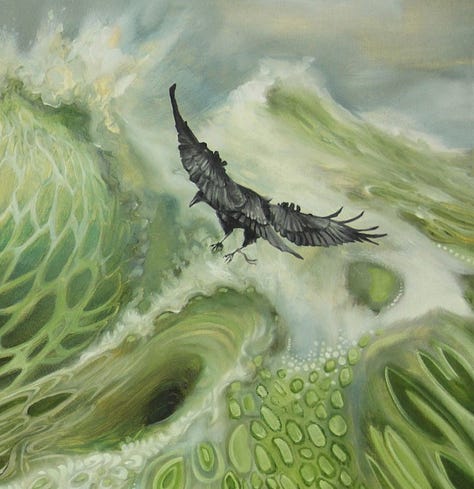

The other complaint is the “tearing up” of pasture when the rooks look for invertebrates. This brings me to an interesting point. The rook is actually a symbol for regenerative farming, something cutting edge for New Zealand and currently embraced in all the best circles overseas.
In fact the rook is a pioneer. How? you ask.
When the rook digs deep into the soil to capture those pesky grass grubs and wireworms which destroy the grass roots, he loosens the (often compacted) soil and stirs up the seeds of many different plants which germinate and grow up in between the grass plants. Farmers of the agrichemical persuasion have been encouraged to maintain a monoculture: ryegrass and clover being the flavour of the century. But YOU try living on only one or two kinds of food and see how far you get. No wonder stock require so many chemicals, vaccinations, drenches and supplementary feeds and interventions.
The thing is, all these other plants: plantain, dandelion, oxtongue, cleavers, amaranth, hawkbit, catsear, mallow, chicory, magenta spreen, fathen, galinsoga, hedge mustard, prickly sow thistle etc, are actually a blessing. (Big shout out to the wonderful Julia Sich and what she brought to New Zealand’s knowledge base). These plants contain constituents for the stock so they can have variety in their diet and can self-medicate naturally, and they bring minerals back to the surface of the soil which have been depleted by relentless industrial farming methods. They also aerate the soil and shade it where it has been exposed.
But instead of finding a way to work with Nature we, in New Zealand, have the word “eradication” and one of its artillery is: DRC1339. I have two government papers which admit between them that the renal failure, this poison bait for the rooks, causes, can take up to 4 days to complete its task and the mother and chicks experience “severe negative welfare impacts over a duration of hours” Page 6 of this MAF paper and pg 11 of this MPI report.
DRC1339, by the way, is banned in Europe.
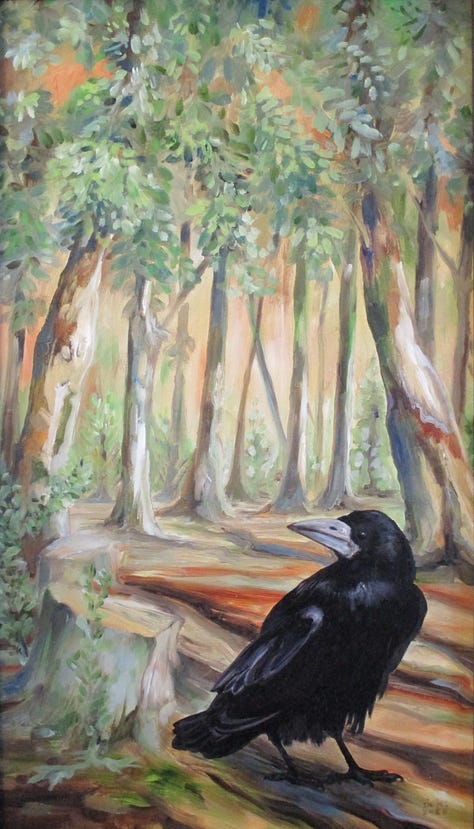
The rook painting at the very top of this missive is headed for the “Hawke's Bay Arts Trail Guidebook Exhibition & Guidebook Launch” from the 5th- 18th September. And this next one below will be exhibited at Arts Inc Heretaunga 1st-13th September.
So I’ve decided to fire an arrow or two into that storm cloud that’s building on the horizon for the last representatives of the corvid family in New Zealand. A group of us are putting together a parliamentary petition to stop the killing: as an appeal to healthier farming practice, as an attempt to bring reason to the ferocious war being waged on nature in this country, and as a voice for these beautiful intelligent birds themselves. There will be bullet points and links to studies, for those who like to be informed. The petition will be advertised in a film made by wonderful local film makers Suden Lakshmanan and Regan Bailey, and on social media and via posters. If you would like to know more you can contact me via Substack or via my website or facebook.
To end on a runic note, I would like to share a link to Colin Gorrie’s fabulous new book Osweald Bera in case there is anyone else out there wanting to start the journey toward reading Beowulf for themselves one day! He works from The Ancient Languages Institute, has a Youtube channel and a fascinating Substack but I warn you- it’s very addictive!! By the way, “rook” in Elder Futhark runes is ᚺᚱᛟᚲ.
Until next time.
Comments
Nothing yet. Say the first thing.
Sign in to join the conversation.