
It is 1763, Walpurgisnacht - May Eve - and it is near the witching hour. Your carriage has drawn up in a courtyard before what looks very much like a gothic church hidden away in pastoral England.
Two masked groundsmen escort your vehicle and driver elsewhere, leaving you stood for a moment on your own. Torches, recessed in niches to either side of the door, flicker and gutter in the damp air casting shadows that dance with devilry about you.
All you know is that the affable Baronet Sir Francis Dashwood has invited you to join him and his fellows for the night, and to partake of their Mysteries…
He might be the British Chancellor of the Exchequer, but Sir Dashwood has the reputation of being a party-animal. This is a church, or at least it is the façade of a church. Indeed, even the very Friars of St Francis of Wycombe, the very people you have come here to meet, are but a façade.
Passing through the door you enter a long narrow tunnel. A hand accosts from an unseen nook, grabs your cloak, and thrusts in its place an eye mask before it points you further down the corridor.
It is now that you hear the first bone curdling shriek. You stop in your tracks, momentarily hovering in a liminal space of indecision and the competing urges to flee or press on.
You would never live it down if you fled, so reluctantly you take another step forward and then another and another. The narrow tunnels play havoc on the senses, strange noises like sobbing or crying are punctuated by the occasional scream which breaks into a cacophony of laughter.
It is now you see pale faces looming at you from the darkness of the passageways. The faces of lost souls. Their eyeless sockets leering at you; their mouths hanging agape wailing in silent torment.
If you have not entered Hell you are, at least, well on the way...
GOING IN BLIND - THE JOURNEY TO HELL
I’ll admit I first read of the Hellfire Club back in my teens as a chapter of the book The Necromancers by Peter Haining; an anthology of diabolic accounts seven pages of which were given to Dashwood’s pet project. And though I have been aware of the presence of the Dashwood Hellfire Club within the esoteric history of Great Britain, I realise that actually I didn’t know much about the notorious group.
When my old friend and fellow esoteric collaborator Ken, of the SittingNow Podcast, asked if I fancied joining him on a filming trip to the notorious caves that were home to the Dashwood Hellfire Club I leapt at the chance. More than that, I thought it’d be a fascinating place to see what ritual insights I could glean from a ‘blind reading’ of the site and, without fore-knowledge, let the site explain itself to me.
How exactly does one do a blind reading for a ritual site? Many might take an approach akin to the popular ghost hunters of TV, leaning into the psychic vibes of a place, their insights fed to them by researchers casually the night before over drinks in a pub. For me, its not about tuning into the vibes, and as I write this I realise, personally the vibes of a place don’t really come into the reading of the ritual activity. It is a little more forensic - to a degree - for we must establish what our senses experience as though we were a ritual practitioner who has simply forgotten their ritual and is trying their best to trigger their memory from the clues around them.
I begin by walking around the space soaking up its angles and vantage points. How does the space look from different places? Is the eye drawn to a specific point, and if so why is that? Are their any alignments that arise - alignments between things, especially between a ritual space and the surrounding space, serve to link the ritual into the wider context. Rituals are all about making links between things, and when we create alignments in a ritual space we automatically imply a link between the things aligned. Then, there is the question of sound; are there acoustical irregularities that might be deliberate?
Next we would take in the symbolism of what is present - or its absence - and make deductions from that. Then we look at the context within which the ritual site exists, socially, culturally and geographically.
All these type of things comes before anything more contrived like counting the numbers of forms or looking for structural symbolism. Because symbols are themselves signifiers of something else, we can then begin to consider if anything we are seeing or experiencing around us is reflective of something else, either visually or sympathetically…
[I’ll leave the technical strategy there and could add more if people are interested in methodology, but suffice to say what follows does not go the way I anticipated, the results are unexpected and really quite eye-opening!]
So it was that yesterday we arrived in Buckinghamshire, England, and the small village of West Wycombe.
Soon enough we parking up our modern day carriage outside the façade of a gothic church, bedecked with a drapery of emerald ivy, adding to the dilapidated affectation of this folly of God. It was the middle of the day and rather than a sinister reception, the courtyard before the church frontage held picnic tables with branded umbrellas. The door to the church was wide open - a gaping maw to hell itself, the teeth of which were the metal stumps of a turnstile. Tokens, like Charon’s Obol are needed for admittance and are available in the cafe/gift shop.
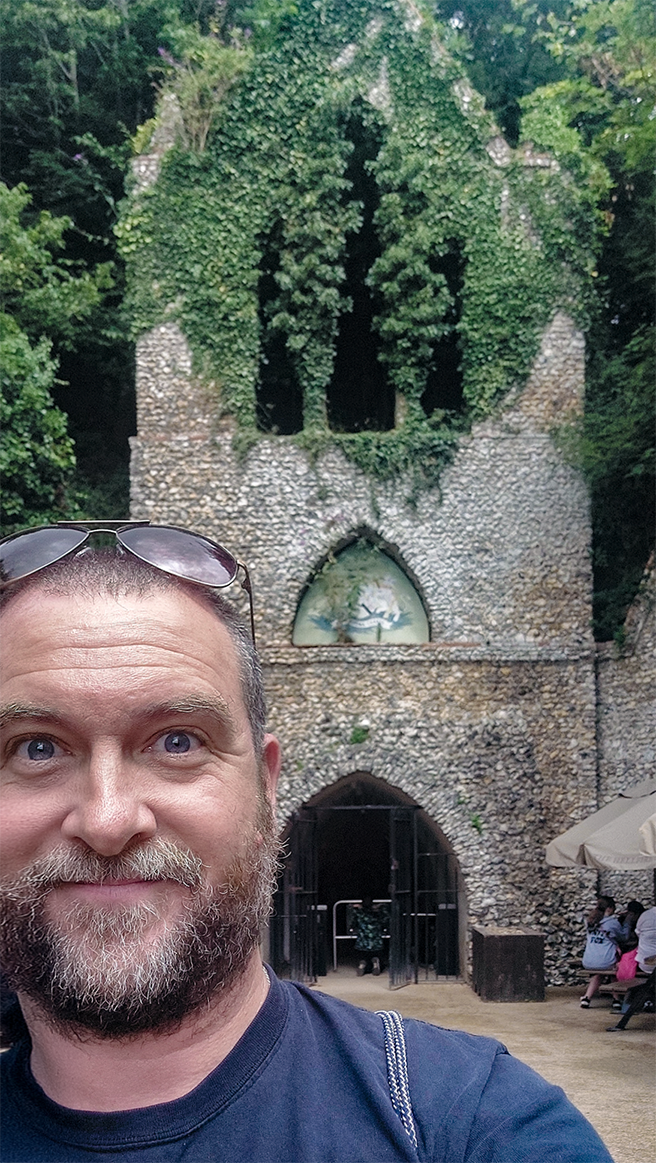
How odd. A place famed for its outrageous satanic orgies, its blasphemous and heretical perversions of Catholicism and regarded by some as one of the most haunted places in the country, is now a proper tourist spot; a place for tired parents awash with crying babies and kids screaming because a wasp stung them over an ice-cream ownership dispute. Hell is what you make it I guess.
We flee to the chthonic sanctuary of the caves. These rough-hewn chalk tunnels are narrow, long and descending. Today they are brightly illuminated with gaudy - though admittedly atmospheric - coloured lights. There is a perpetual crunch of gravel beneath the feet pairs well with the pools of dulcet narration explaining sanitised snippets of the caves history. Occasionally stone walls either block up or reinforce the tunnel sides while plaster or render is roughly applied here and there. In some places girders or beams hold up the ceiling, though nowhere does anything feel unstable.
But in this, came my first observation. Despite the obvious additional of costumed manikins locked behind gates in illuminated nooks, and the plentiful plaques of fun facts, it was, at times, hard to tell what were new repairs and what modifications might actually have been original.
At the time of their excavation, the country was enduring an economic turmoil and Francis Dashwood, the 2nd Baronet of Wycombe, decided to employ his poor locals to create a big long and very straight road - Dashwood Road - so he could keep them in work. These men would also be excavating chalk from the hill under which the Hell-Fire Caves would be formed.
There are maps of the tunnel route to stop people getting lost. Though clearly not to scale they do describe the contents of the known parts of the complex pretty accurately.
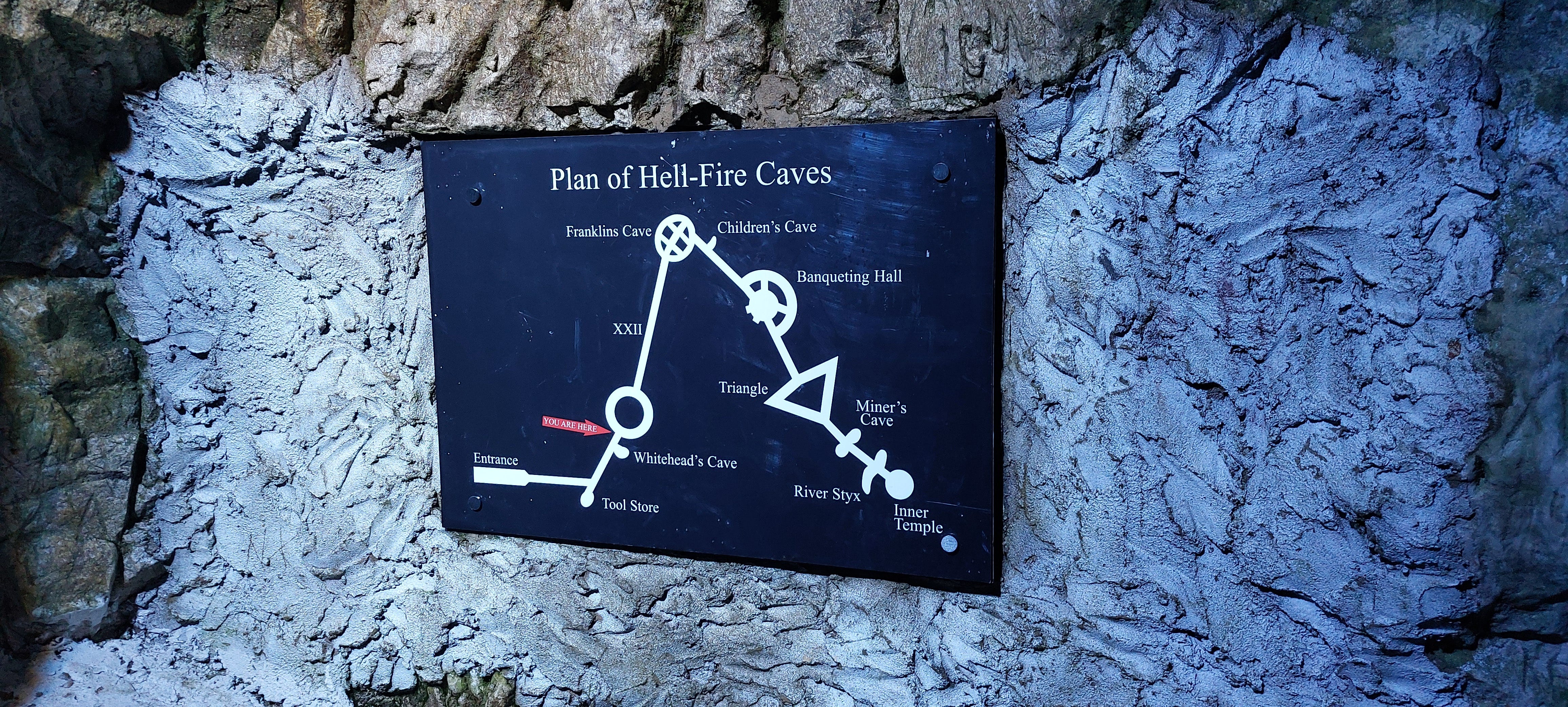
Given that it is pretty much just a single linear route that is either gently sloping up or down depending on direction of travel, getting lost in here should be pretty impossible. However the gently curving walls limit lengthy viewing, and the occasional circular routes do actually befuddle the senses. Disorientation is surprisingly easy to feel. The fact that the tunnels are largely identical in size, shape and materials further adds to this disorientation: everywhere looks the same.
There is only one type of iconography that looms from the shadows… the sinister faces of the damned. These are small faces carved in the chalk, their point of continuity sunken absent eye sockets that form inky black shadows for eyes.
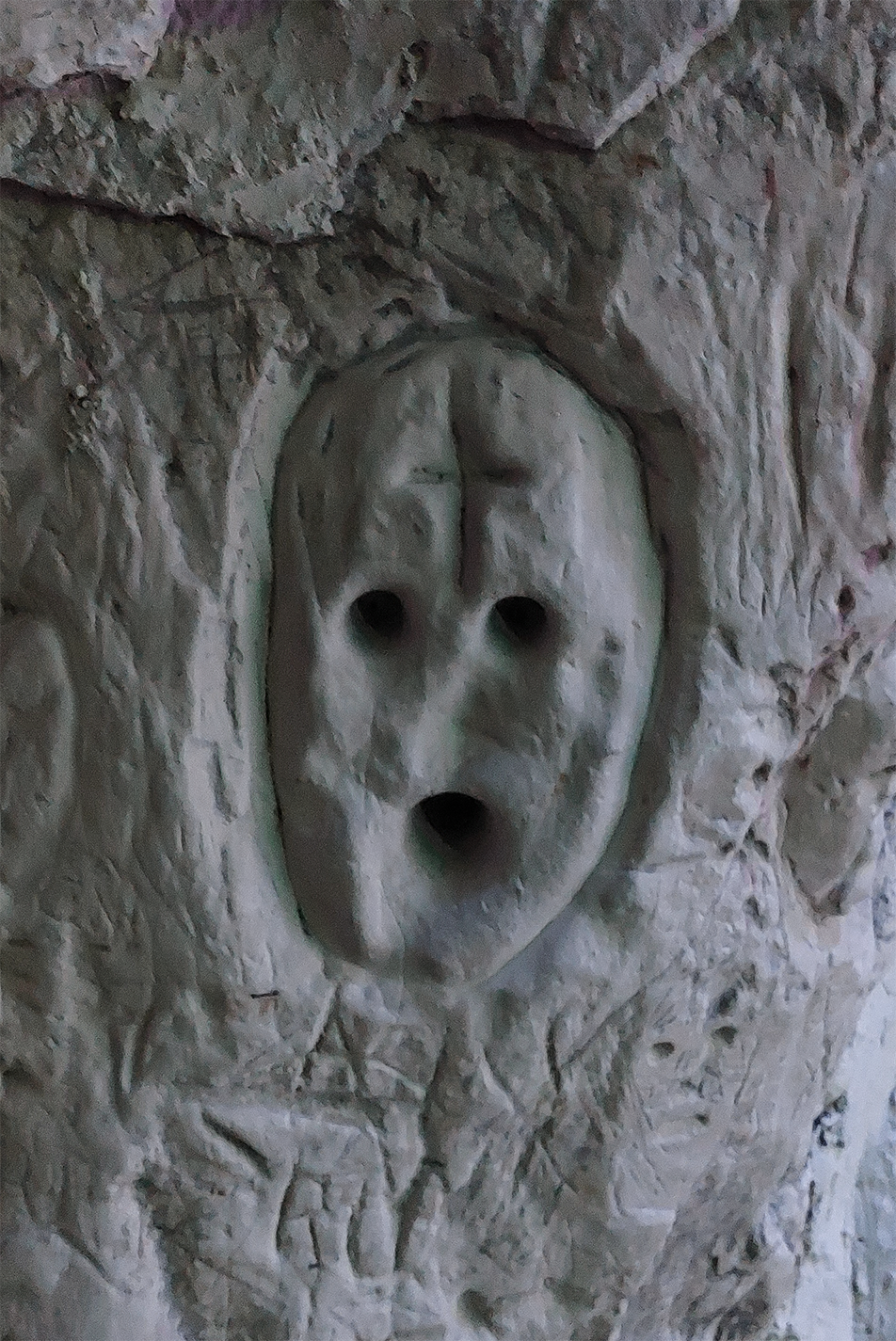
It is possible that the different faces that appear mostly around archways, also serve as guides, but if so I could not easily determine their code. I asked Ken if the faces carved in the chalk were original or modern graffiti and he said they were original. I mean they are pretty horrific, unsurprisingly plentiful and could easily be considered the most modest, even subtle decorations of an infernal nature befitting the theme of the caves. Let’s face it, these are not of superb artistry. They are crude, humble and more folkish than anything else, and they are often rather subtle, just placed at roughly chest height and dotted around willy-nilly.
That said, aside from two specific locations further in, there is no other decoration or iconography in the entire site. The walls are bare and any furnishings that surely must have been here at the time of their usage, did not even leave permanent fixtures. And there really must have been plenty of those as these caves are cold, damp and ‘erotically challenging’. Nothing says ‘devotion to the lord of opulent blasphemy’ like shagging on a cold damp chalk floor.
We progress further in. The first choice that must be made, a good stretch into the tunnels, is a left or right path? As we can see on the map, ultimately it does not matter which route you take you still end up on the slippery slope to hell. Is this a false choice? A moment where apparent agency is thwarted by destiny?
We must assume the guests to such events would not have the benefit of a map, so they would have to tread a path not knowing the destination. And, if you travelled alone (without a colleague taking the alternative route), you might never know you actually came out in the same place as the other curving tunnel.
Deeper and deeper you descend the gently curving tunnels and occasional arches and now, at the very least, there is no way of discerning cardinal directions, north from south, or even really your orientation compared to the entrance.
Next we come to a similar circular structure, though this one is crossed through with a junction. In the present day that junction is inaccessible, being gated off with the iron bars, and is now occupied by the illuminated figure of none other than Benjamin Franklin. Yes, that one. He was a friend of Francis Dashwood and a purported (unsubstantiated) member of the Hellfire Club.
Looking at this space makes me think of a staging point for crossroad encounters, like a guardian of the threshold ordeal or a pact to be made with a Friar dressed in the raiment of the Devil himself. In this space people could crowd around and peer in at the junction and watch the ritualised challenge… but this is clutching at straws, and I think the tactic of using these simple structures to create disorientation feels the most plausible.
If patrons were being led, and unknowing of the layout - not having been granted wall mounted maps like us tourists - they could easily be taken around and across the occasional junctions, most specifically at the criss-crossed ‘Franklin’s Cave’, even being led back to the previous circular junction, and looping around come back once more… causing rising and descending orientations. They might find themselves utterly lost. To the knowing, you would know to just keep going up to get out, but to the unknowing, led on a wild goose chase of rising and descending paths and junctions, it could be an entirely different matter. The sinister chalk faces might serve the knowing as the key to aid navigation or as prompts for ritual pauses and questioning.
After a further corridor we come to the banqueting hall. Probably my favourite space in the caves. Ken asked, ‘Can you see rituals here?’ Yes certainly, the magnificent banqueting chamber is a large circular space with a high conical roof. The sound is superb. You could easily fit 20 or so people around the periphery and still have ritual space in the centre.
There is one entrance into and another exit directly across the chamber. On either side are substantial nooks, large enough to clamber into and stand, almost like cells. These have metal ‘prison’ bars over them and each of the four spaces is occupied by a different classical statue.
Iconography. Great for reading a space. One was Hercules wrestling the Nemean lion, his club held aloft. Next was a woman with a coronet of corn, in her hair holding in one hand some grapes and in the other a shell-like cup. A club = a wand (or phallus) and a cup = a chalice (or vagina/womb). Perhaps I am onto something, I think, musing over the saucy ‘friars of St Francis’. The other two statues, a reproduction of the Venus de Medici… Though this one has no arms with which to preserve her modesty… and then I read on the plaque in the Banqueting Room that the statues had been added recently to occupy the nooks before they were gated off to stop eager-beavers clambering in.
In reality, the plaque tells us, these nooks were chambers wherein club members could withdraw in the company of chosen ladies and, drawing a curtain, enjoy more intimate celebrations. Sex pods, basically. The noises from which would have surely entertained the bawdy friars. There is nothing to indicate where or how curtains would be hung, but let’s go with the museum’s conservative masking of the groups depravity.
Leaving the Banqueting chamber, we proceed down another long corridor that once again brings us to a dilemma of left or right. As we can see on the map these routes actually re-converge, making a mockery of such a decision. However, stood there in the dark, we must presume that the guest or club member would merely see two paths heading off in diametrically opposed directions.
Aside from this disorientation potential, I’ll admit, looking at the map the triangle does seem very symbolic. It could be an arrow pointing towards the Inner Temple. It could be variously the symbol of Fire (an upright triangle, which would suit the person arriving at it on the way in, or a water triangle (a point-down triangle) which has connotations with both Venus, chalices and womb symbology. What makes this all seem a little implausible is that there is nothing by way of symbolism present to help the patrons engaging with the symbolic triangle, beyond walking either one route or the other.
When we try to read ritual sites it’s always important to bring our thinking back to the experience of participants. This is not always in alignment with the overview of designers, looking at sacred geometry that makes space perfectly ruled by ratio and form. However, with sacred spaces, we typically see the application of sacred geometry is somehow capable of being sensorially engaged by those present within the space. The heavy use of sacred geometry and the awareness of its significance for architects means that when it is made in stone, like in churches or palaces like the Alhambra in Granada, Spain, people occupying or moving through the spaces do so in a way that exposes them to the visual perfection, such that it can have a heavenly and aesthetic appeal.
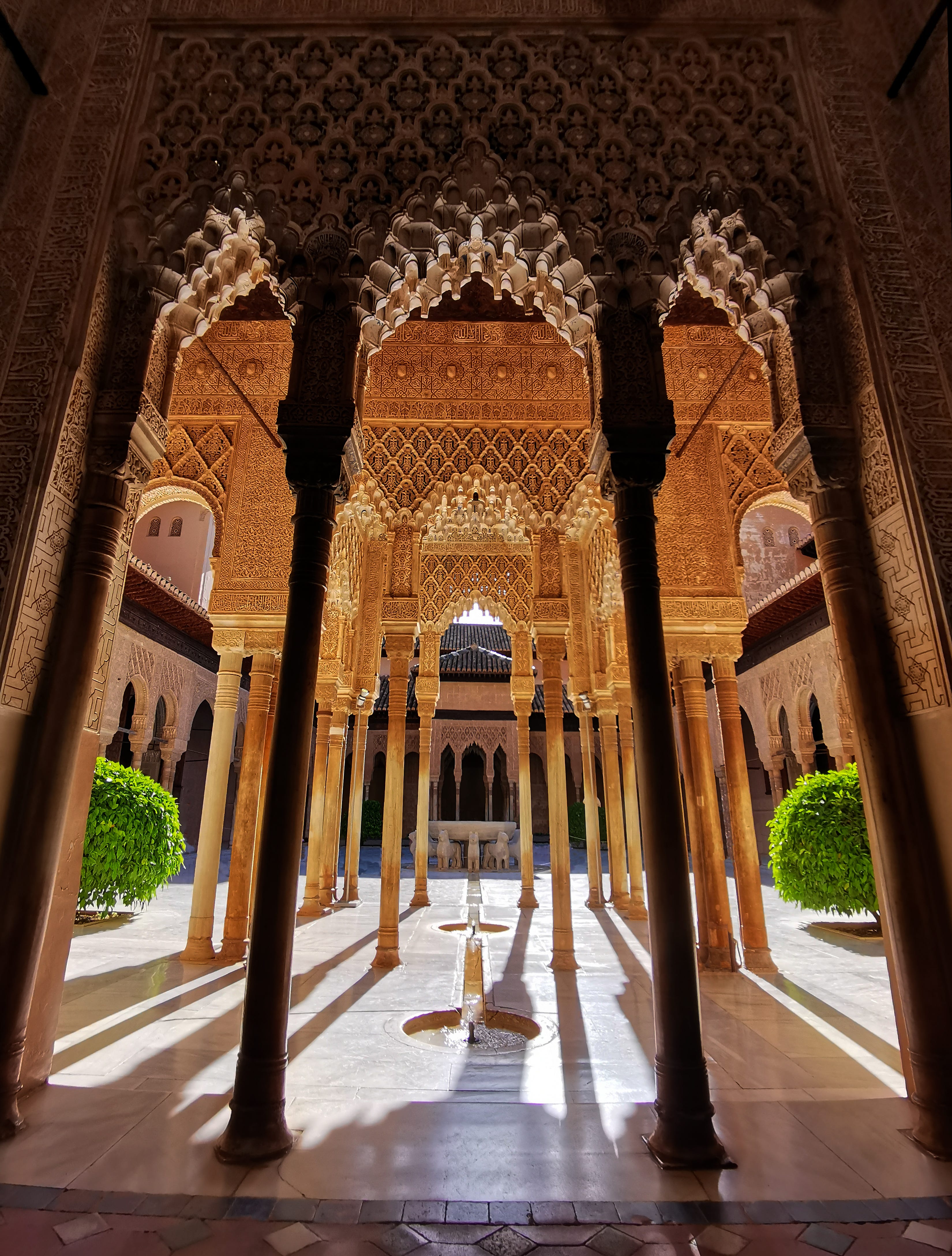
Here in the Hellfire caves, bereft of map, you would not know it was a triangle without walking it carefully over and over again and trying to reflect on its form. There is nothing overtly designed to inspire awe and majesty, and to humble the participant to such a degree, just shifting directions to be walked in the dark.
But here we encounter another point that must be addressed. Sir Francis Dashwood, 2nd Baronet of Wycombe, at one point in charge of the nations finances, was not a poor man. But he was not also as rich as either the Catholic Church or the Moors of Andalusia, and he was funding this himself. We must be careful to acknowledge that even with his wealth, these caves are modest and personal compared with the architectural marvels of the wider world, or even those on his amazing estate.
Or, it could be assumed, it was not important to him that the caves expressed sacred geometry… We’ll come back to this point because such an assumption was clearly wrong…
When I look at the map I do not think of the symmetrical golden-ratio rich, high aesthetics of classical, neoclassical and gothic churches, but of the strange demonic and planetary sigils or even the pictograms of crop circles. Something about sacred spaces with highly organised geometries involving circles and squares are intended to somehow elevate the spirit even if we are unaware of their birds-eye view plan. The Dashwood caves are so much more visceral, tactile and, metaphorically as much as literally, chthonic in their appeal to the senses.
Passing by some gated nooks, again each occupied by a manikin in costume and the tale of their role in the endeavour. Needless to say these niches - of size several people could stand in - were not intended to house manikins. What their function might have been I cannot now discern. They could be pausing points for some interrogation, some threshold password or some specific instruction. Again, if these were once dressed with furniture or drapery nothing but bare chalk walls remain.
There is one point where two of these niches face each other creating a sense of liminality, challenge or guard points on both flanks, but from a blind reading, who knows.
Toward the end of the tunnel we come at last to the river Styx. Now, this was the only element I knew about beforehand. At each side the tunnel opens out into tunnels that curve from view. Their floor is covered with impenetrable water, while the walls and ceiling are clad with faux stalagmites and stalactites.
In the gaudy red and green lamps the whole thing looks rather camp, but this is not say it isn’t actually very cool, and very much reminiscent of a Hammer film set. The strange campy nature of the whole place lends itself not so much to a genuine occult order, but rather to what the Hellfire Club is purported to be: a dilettante’s club in the guise of a ‘secret society’ for people who wanted to dress up in a pseudo-religious regalia, prance around in mock rituals and have a lot of sex and wine. To this end it is fitting that everywhere things are a façade: the church façade at the entrance, a mock spirituality and the faux stalactites surrounding the symbolic ‘river Styx’.
But are these just mockery or are they simply being used as symbolic signifiers in an era when realism was not the necessity it is to our modern sensibilities?
And yet before we come to the ‘big reveal’ of my discoveries in West Wycombe, there is more of our tale I must share with you.
According to the lore of the classical world (a huge influence on a widely travelled Dashwood) when you cross the river Styx, you leave the world of the living and enter the world of the dead, of spirits and demons… Hades or as we now call it: Hell.
Whether used in genuine rituals, or even used in mock rituals, we cannot overlook this most potent of ritual designators. The crossing, even symbolically, of river, particularly this river, serves as psychic threshold. The rules of the world on one side are different to those of the world on the ‘other side’.
In mythology the river Styx is a liminal space - a place one travels through, just as the act of dying is a liminal state as we pass from life to death. Only Charon, the ferryman, persists in Styx, all else are passers-through. For those us fascinated by ritual the subject of liminality is one of the most profound contributors to understanding what rituals are and how they work.
Rituals, as posited by Victor Turner and adopted by manner thereafter, are themselves liminal activities that frame transitional occasions giving us structure in the messiness between what is before and what comes after. When we linger within the ritual we are like Charon, lingering in the liminality ‘betwixt and between’, neither one thing fully but somehow a muddle of both. These liminal places are powerful centres for change.
While I can and frequently wax lyrical on the virtues of ritual liminality, as we are dealing with Styx, we will press on…
Within the liminal threshold of the River Styx, we have a boundary between the living and dead. On the side we arrive from we are clearly coming from a world the rational, stable, scientific and enlightened world of the then ‘modern world’. In Dashwood’s era we were firmly within the Age of Reason and the Age of Enlightenment. What then lies on the other side of so great an ontological boundary as the River Styx of the Hell-Fire Caves? A realm of the irrational? Of superstitions? Delirium and darkness? A realm where passions and senses lauded over the intellect and the conceptual? A realm where magic can happen?
For sure, when we leave the ‘world of man’ and enter the ‘other realm’ by whatever name you might know it, we are outside the domain of laws that govern humanity. Here in the bowls of the earth, in ‘another place’, we might even be beyond God…
Here, we arrive at the end of the caves… and find ourselves standing before the Inner Temple. Here is the secret centre, the ultimate heart of the Friars, the blasphemy at the deepest chamber.
In physicality it is a round chamber, smaller than the banqueting hall, with a lofty conical ceiling. And it is occupied… for there, within the chamber, at least, as of this day, is a huge statue of … the Venus de Milo.
At the heart of the Dashwood cultus, which is splashed around with hellish notions, with Bacchic drunken stupors and licentious women is an ‘Inner Temple’ of Venus, the goddess of love and sexuality. But Venus is not the goddess of the brazen sexuality we see in figures like Priapus or Pan, with its bestial and vulgar engorgements, for the sexuality of Venus is as much love as it is lust…
And then at once the notion of the cave takes on a whole lot more symbolism…
However, it is clear within these caves that there is not a lot to go on, and with the addition of distracting manikins added for historical and folkloric context as part of the wider tale, it is extremely hard to say much more than clearly specific decisions were taken, and so the intentionality itself is apparent even if what was intended is harder to deduce.
But I want to take us away from here swiftly and without ceremony… for, it would turn out this was only the beginning of the adventure in reading the rituals through the edifices of Sir Francis Dashwood. I didn’t know it at the time, But I was about to have an entirely new perspective on matters concerning both the Hellfire Club and more importantly, its founder Sir Francis Dashwood!
Postscript: Please bear in mind that I am approaching this whole area entirely blind, only reading what information appears on the plaques around the museum. Some revelations might not be revelations to others… and I think that one culminating ritual reading might be new to us all…
Comments
Nothing yet. Say the first thing.
Sign in to join the conversation.