
It is a warm summer’s evening and having received a delicious invite, you have your carriage arriving at the stately grounds and seat of the Dashwood family in West Wycombe, here to participate in one of Sir Francis’ famed summer parties.
There will be fine foods, fine music, the chance to take an unchaperoned stroll through beautifully manicured gardens, to pause your paramour and exchange deeply meaningful poetry. Perhaps partake in some frivolous formal dancing with other guests. Also, you witness the fantastic re-enactment of some classical naval siege of some far flung city… for Sir Francis Dashwood has a fully functioning frigate on his lake, and it is fully staffed and armed with canons! How exciting.
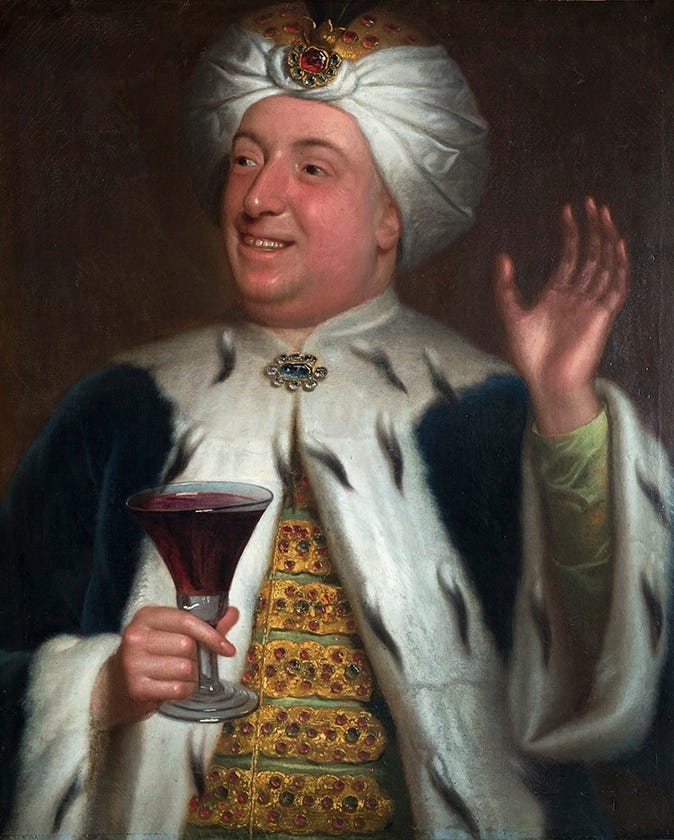
Having done these things, having ducked a quarrel, danced and strolled until your legs ached… at the church on the hill tolls the midnight hour, the party takes a bit of a turn. Oh it had been so fun, and Sir Francis, having seen you, rushed over and embraced you like a long lost family member, his raiment the full turbaned opulence of an ottoman Sultan.
Perhaps you have overdone the punch, or maybe there was something a little off about that salmon mousse… maybe even something distinctly foreign in the chalice Sir Francis tipped into your mouth as he laughed with childish abandon… but the world has become a rather fuzzy place. The lanterns that illuminate the gardens look like the stars of heaven fallen to earth, bringing heaven with them. Nymphs in diaphanous veils dance in long lines near the lake’s edge, their laughter is infectious…
‘This way please’. A serving man appears at your side, and takes your elbow as you stumble on the dew damp steps. He is directing you to the woodland area near the lake… where, if your eyes do not deceive you, a glow bathes the distant canopy…
You will never forget this night. Nor will you know if it really happened. But it was magical. Sir Francis certainly knows how to throw a party…
If you are lucky and Sir Francis catches your eye, you might possibly be invited to attend some of the more risqué entertainments in one of the many temples and sacred spaces that are secreted here and there.
Welcome to the concluding and cumulating climacitic part of my adventures in the mysterious lands of Sir Francis Dashwood, 2nd Baronet of Wycombe. (If you missed the previous two articles, the first explored the Hell-Fire Caves and can be read
here. The second took us up the hill to the church of St Lawrence and can be read here.)
What a place are the grounds and stately seat of the Dashwood family! The most perfect demonstration of how the grounds of stately homes are sculpted into something that blends irregularity with contrived aesthesis. The grounds are littered with small bridges over babbling streams, each quaint and each different. One featured in the film The Labyrinth, with Ken saying ‘it’s definitely that one’ to basically every one we passed.
These reminded me of a ritual idea I put in one of my novels… that a series of bridges should be crossed in the right direction and correct order in order to take the ritualist on a specific journey… I feel like this idea comes from somewhere else but I don’t recall. Anyway, we did not have time to explore the bridges.
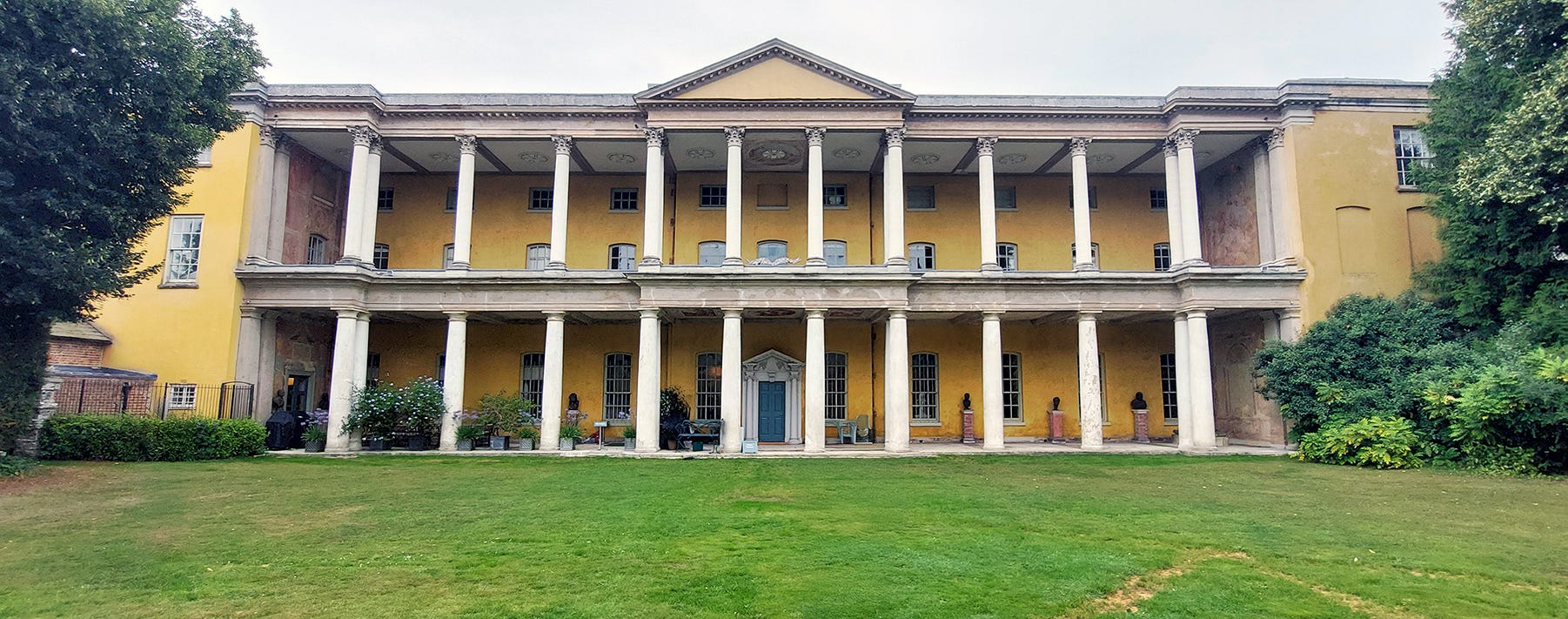
I’ll keep the visit to the house itself quick and we were not allowed to take any photos. We had a guided tour. The guide was really not up for talking about the Hellfire Club side of Sir Francis, though he warmed to us as we went along and let slip a few tidbits. What he did show us were the numerous different statues of Venus, mostly Venus de Medici (for those that are fans of Crowley’s godform of Puella, the daughter in the N.O.X. Signs).
Elsewhere great artworks of Medea, of Cybele, Astarte… but most plentifully always was Venus. Venus occupied pride of place in the house. If there was a centrepiece, it was Venus. It was like the Dashwoods, or at least their most famous scion, our own Sir Francis, was REALLY into Venus…
THE GROTTO OF THE GODDESS
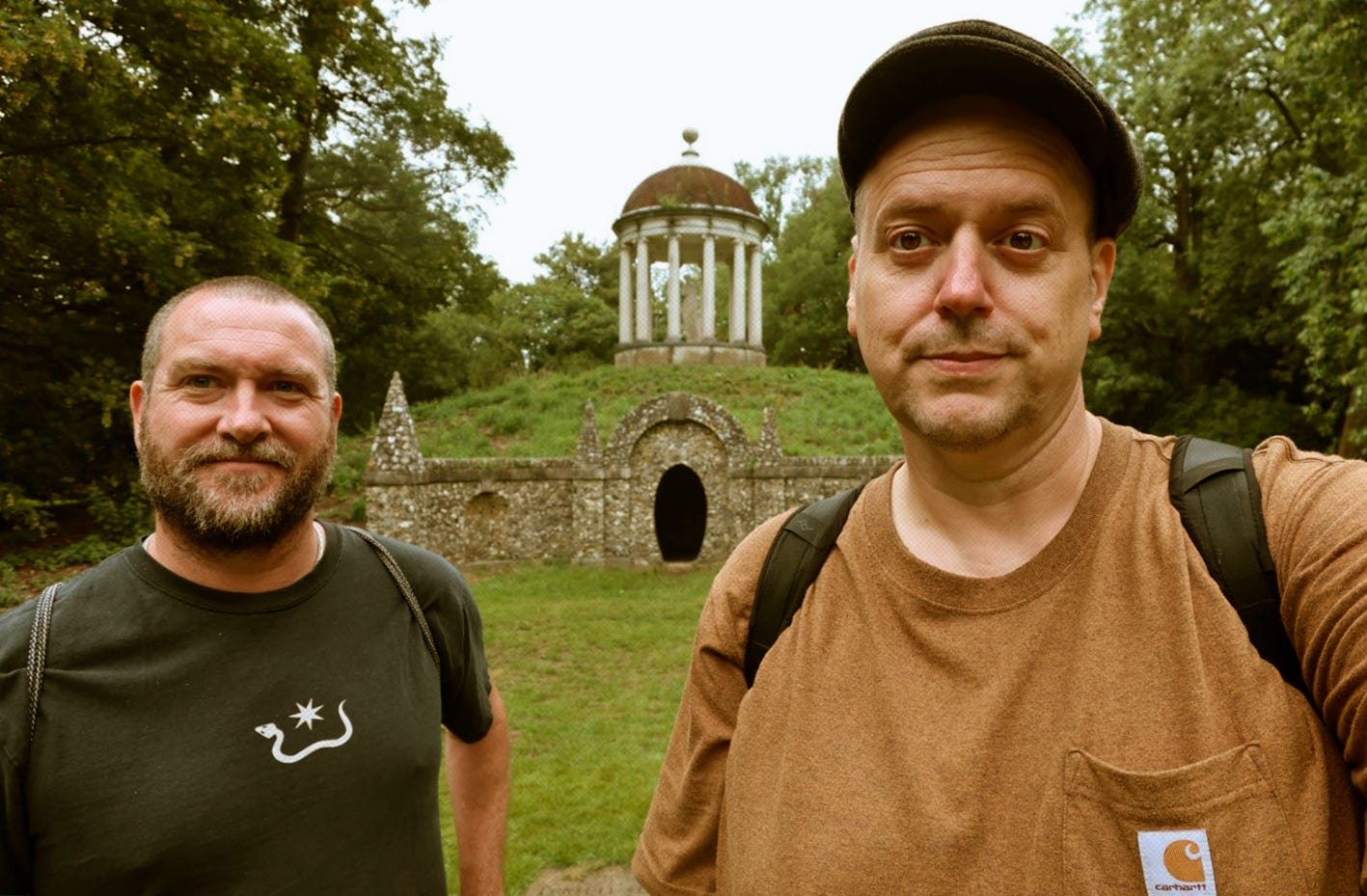
‘I want you to see something and tell me the first thing that comes to mind,’ Ken said as we stomped down across the wondrous gardens. ‘Do you already know what I’m talking about?’ he said in disbelief that I might be so unaware. I really didn’t. We ducked through some trees, crossed a small lawn, crossed one, or maybe two different little bridges.
And then we entered a small grove in the woods and I was confronted with… ‘What do you see?’ Ken asked again. ‘A vulva,’ I replied, knowing as I spoke that it was absolutely the right answer. Here in the grounds of the Dashwood Estate is a temple to Venus, and below the Venusian shrine, an unmistakable sexual doorway to a subterranean grotto:
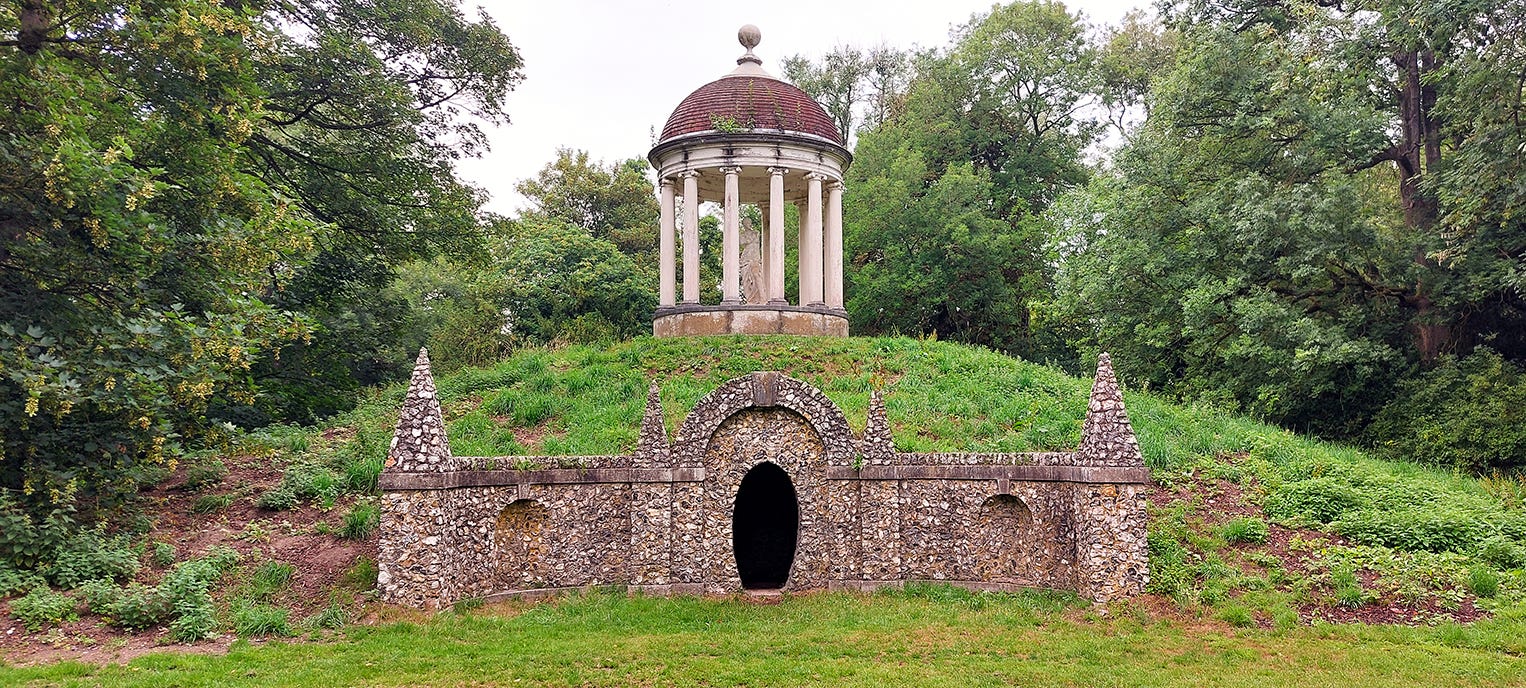
I stood and gawped at it, and then my mind started racing. The vulvic quality is really unmistakable and not coincidence. That means the ‘grotto’ underneath is a vaginal/womb-like space for copulation or gestation. Hmm. Copulation it’ll be, Venus is not a mother goddess.
I go and stand in the space. ‘Francis Dashwood would, allegedly, bring guests that caught his eye into this chamber and they would have sex,’ said Ken - or words to that effect. We both agreed that the space would need considerable dressing because it is dank, chilly and, no matter how spiritually significant, would have the erotic charm of shagging in a carpark.
‘Just like the Hell-Fire Caves,’ I mused. Then it hit me. It was exactly like the Hell-Fire Caves. I stepped outside and looked at the labial/thighs of the grotto’s façade. It is actually incredibly similar to the façade at the front of the Hell-Fire Caves! The same flint construction, the same symmetry, the same flanking walls… even the same little flint cones.
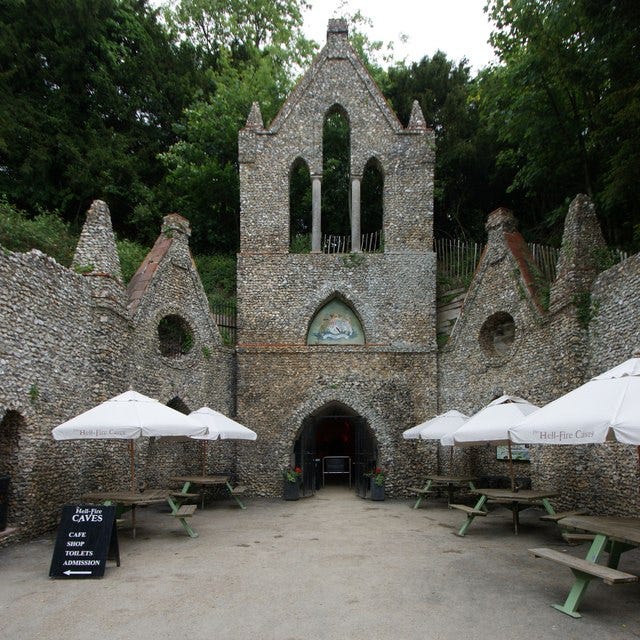
This would mean - in my reading at least - that there is a sympathetic connection between this complex and the caves… At the Inner Temple of which, directly below the church (supposedly), is a temple to Venus, expressed as Venus de Milo.
Is this the microcosm of the Hell-Fire Caves?
That would mean the mound - the Mons Venus, another term for the Mons Pubis - is an analogue for West Wycombe Hill itself… in which case… my eyes looked at the rotunda before me.
A neo-classical temple/shrine of ten pillars housing a copy of the Venus de Milo. And here it the kicker I’ve not read anywhere else… what is the feature at the very top of the dome? Look again.
A golden dome. I said we would revisit it, after a fashion. To me that confirms that the shrine of Venus on the mound is an analogue for church of St Lawrence, and vice versa, which means that the grotto before us is an analogue for the caves. What happens in the caves mirrors what happens in this grotto.
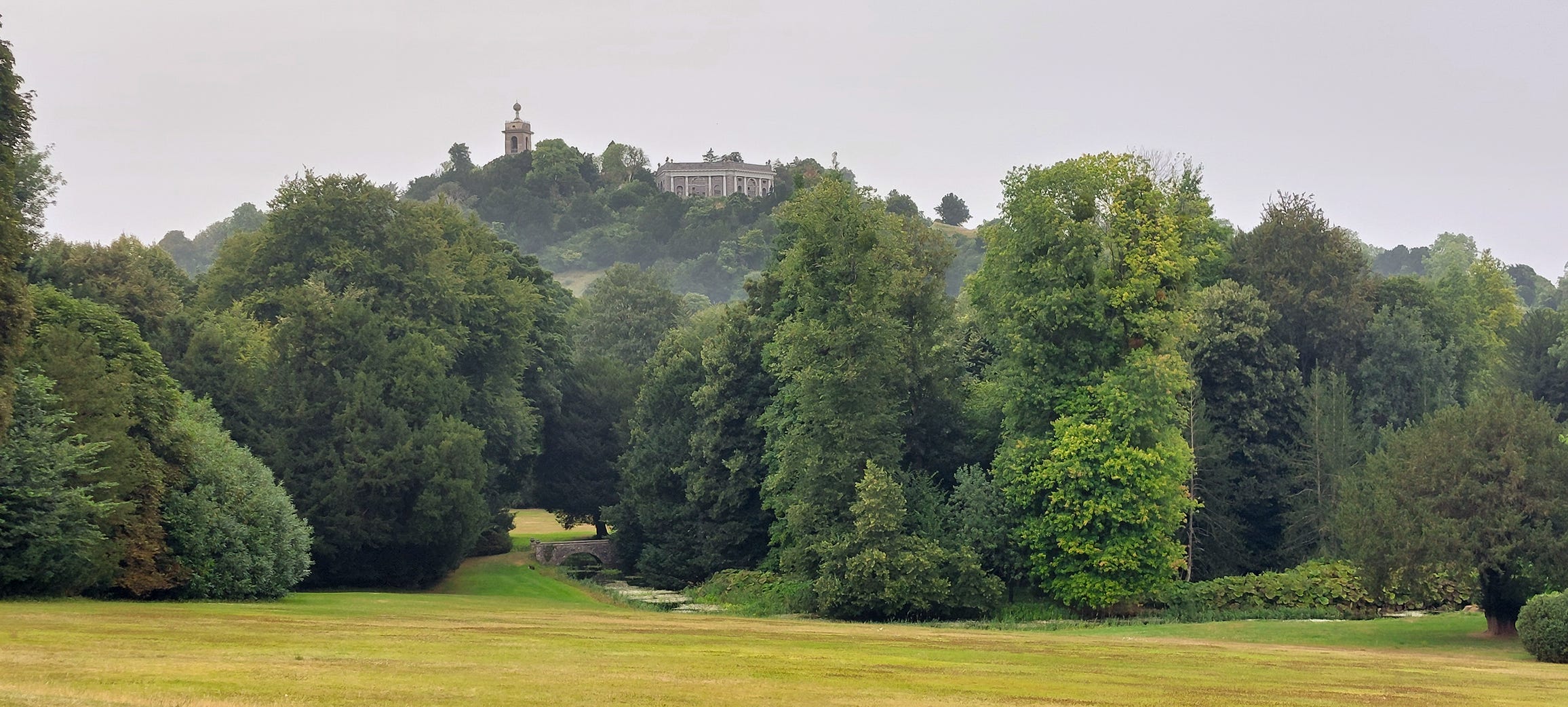
Furthermore, the façade of the church, an entrance that denotes spirituality, likewise suggests the labial façade here is treated as a spiritually charged entrance to something sacred…
And given that this is itself a representation of female sexual anatomy… it would suggest that Sir Francis Dashwood might well have believed that part of a woman’s body to be both sacred and deeply erotic.
I knew I could dig into the ten columns, into the symbolism of the dome, into discerning some qabalistic meaning for the Tipharetic and solar golden orb… but something stopped me. Something more profound and worthy of contemplation. I had been looking for literal alignments between places to form the psychogeography… but this is a psychogeography of reflected symbols. The alignments are avenues of meaning not terrestrial alignments…
Sir Francis Dashwood was a man of the Enlightenment, but he was also a radical libertarian, who found his spirituality through indulgence of the senses. He adorned so many things with indicators of Venus… He literally built temples to Venus. He was not play acting, larping, to create saucy backdrops for his fantasies… nor was he deeply engaged in the more ceremonial aspect of the intellectual side of occultism, how many columns equal what qabalistic meaning (there’s 28 pillars in the front of Dashwood House, 28 days in a lunar cycle, also 28 = 10 Sephers + 18 Paths, the 18th Path is the Moon, therefore this is a lunar house etc…) …
No, it was all more simple, more tangible than that. He was a man who found the Goddess - and Bacchus, let’s give him that - through partying, but through that he clearly had a deep and genuine reverence. I have now read somewhere that the women who purportedly attended the parties both at the gardens and indeed in the Hell-Fire Caves always had their freedom to leave whenever they wished; their autonomy was valued, and presumably coercion was not something the Goddess looked kindly upon, and as such, allegedly, neither did the Friary of St Francis of Wycombe.
It is possible for a person to be spiritual engaged through a process of seemingly indulgent intoxication, with his god Bacchus giving him access through the vine, and his Goddess giving him ecstasy through sex.
I imagine his parties really were great fun, and I imagine that he did not cynically try to harness their power for some agenda, but that his agenda was that a good party was itself a sacrament to his deities. I wrangle with this, as I have known too many purported occultists for whom it is an aesthetic lifestyle that serves as a veil for hedonism. But here, in Dashwood I am confronted with a man who clearly managed to do both, intermingled.
Did he hold satanic rituals? Were there orgies in the dank caverns of the Hell-Fire Caves? I don’t know. Maybe. Nothing in what I saw gave off impression of actual diabolism. He was certainly not a fan of the Catholic Church, and it is known he disrupted a Mass in Italy during his Grand Tour by running amok and shouting ‘il diavolo!’ over and over again. But this was not a man of what we would identify as the satanic trappings of modern horror lore. Luciferian is a better term, but even then, Dashwood was, at heart, a man seduced by the classical world, not by hierarchies of angels, but by orgies and pantheons.
That is when it struck me. Actually, there was a slightly biblical theme going on… for if the Hell-Fire Caves with their river Styx did connote hell, and the church with its golden orb, as the sun and heaven… then the pleasure garden of the Dashwood Estate, with his temple to worship at the vulva of the goddess, was a kind of paradise, where the joy of carnality could be engaged without the shame and guilt of sin.
As I write this something just snagged in my mind… all those little bridges… how many waterways are there in the gardens? A quick look at google reveals… four? And how many rivers did Eden have?
PARADISE FOUND
There I was, all pleased at myself, having made what I thought was a rather witty insight regarding the paradisiacal nature of the stately gardens; in contrast the ‘heavenly’ church on the hill and the devilish caves beneath… in part because I just fell in love with the grounds… after everything I have discussed about the temple of Venus, and imaging the lavish parties… and here I am doing the odd bits of research as I finish this article, and none other than Benjamin Franklin, (purported Friar of Hellfire and later president of a country near Mexico), who once said of his friend’s grounds, ‘The Gardens are a Paradise’.
ADDENDUM: SOME PROBLEMS
The Temple of Venus was largely destroyed by more pious generations of the Dashwood family, until a more recent Francis Dashwood looked favourably upon his ancestral legacy and sought to rebuild what was lost as close to original illustrations of the time. The upshot is we do not know exactly what the original was. Annoyingly I think I saw plans in the house, but they do not seem to be available elsewhere.
No matter how I juggle maps, I can’t make the inner temple fit beneath the church. It might actually sit beneath it and the generic maps are wrong, or, as seems the case it radiates out one side. So far I can only see images that show side views of scans from the caves but nothing overhead, which do not tell us if they align, only that they are a similar length.
But this might not actually matter. It is a disorienting place, and the Dashwood who created it would not have any direct way of verifying if it was correctly situated, meaning it might have simply been enough for them to sincerely believe it was the case.
POST SCRIPT
Thank you for taking the time to read this, and please do leave comments below with any insights or fascinating factoids you might on these topics, I’d love to read them! (its not an algorithm baiting thing, I am just keen!)
And, if people are interested I might prepare a more formal guide to how to make a ritual reading of a place.
Comments
Nothing yet. Say the first thing.
Sign in to join the conversation.