
While the origins of Dead Internet Theory are largely unknown, many point to a 2021 post that appeared on the esoteric board of Agora Road’s Macintosh Cafe. In the post titled “Dead Internet Theory: Most of the Internet is Fake”, a user named IlluminatiPirate claimed:
“There is a large-scale, deliberate effort to manipulate culture and discourse online and in wider culture by utilising a system of bots and paid employees whose job it is to produce content and respond to content online in order to further the agenda of those they are employed by…
In this way, the internet and social media, which was supposed to democratise media by allowing users to create whatever content they wanted, has instead been hijacked by a powerful few…
The post goes on to note how a program called Narrative Science, funded by the CIA investment arm In-Q-Tel, was working with Google to weaponize bot armies in order to shape public opinion and create a TV-like propaganda machine that would in turn manipulate humans to behave like NPC’s.
I have been referring to this phenomenon as a form of mass automated MKUltra. Being that the web was made by CERN on top of the internet created by DARPA, a psyop of this scale may be speculative but has become increasingly conceivable since 2021.
What was previously considered a fringe conspiracy theory began to appear in academic literature by 2023, and by 2025, for the first time, automated traffic surpassed human traffic on the open web. Imperva’s 2026 Bad Bot Report puts it at 53% automated against 47% human, with 40 points of that being outright malicious bots.
Traffic from AI agents alone jumped 7,851 percent over the course of one year. A 2025 report by the Human Defense Platform processed more than one quadrillion interactions across its global customer base and found that bot-generated web traffic is outpacing humans by 8-times.
“Welp, that happened faster than I predicted,” Cloudflare CEO Matthew Prince tweeted. “Thought it would be end of 2027, then early 2027, but agentic traffic [is] growing so fast that bots have now passed human traffic online for the first time in the Internet’s history.”
Today, 74% of newly published web pages include content produced by AI. On LinkedIn, AI generated content makes up 54% of all activity. With somewhere between 54-64% of traffic on X (formerly Twitter), a dying minority of human users are arguing with and having their opinions shaped by machines.
This means Dead Internet Theory is no longer conspiratorial speculation. It’s the current state of the web. All of its users, apps and platforms are fighting an unwinnable uphill battle against slop.
Even a deliberate attempt to create a human only platform failed when Alexis Ohanian and Kevin Rose relaunched Digg in January 2026, closing after just two months due to an overwhelming and unprecedented infestation of bot slop.
As the internet becomes more centralized and dependent on its now rapidly growing AI infrastructure, it is becoming increasingly fragile. Surveillance profiling fuels a $363 billion dollar data mining operation capitalizing on every imaginable human behavior online. This generates massive economic incentive for these corporations to produce more bots that manipulate and analyze human internet activity to profit off our data.
In other words, the internet isn’t free anymore. We are now the product.
And its not just an unstoppable army of slop bots that is contributing to the death of the internet. Add to all of this the reality of the internet also experiencing perpetual memory loss known as “link rot”. A quarter of all web pages that existed at any point between 2013 and 2023 are now simply gone. For sites that existed in 2013, more than a third vanished in ten years. Over half of all Wikipedia articles contain at least one citation pointing to a page that no longer exists. In the legal world, nearly half of all hyperlinks in U.S. Supreme Court opinions already lead nowhere.

If there is such a thing as a digital Library of Alexandria, it is the Internet Archive. We take for granted our access to volumes of patristic writings that would cost thousands to buy, and to nearly one trillion web pages preserved on the Wayback Machine. Even the Internet Archive’s days are numbered. When it isn’t being hacked, it’s being censored or sued. A single centralized institution under attack from every direction at once makes its loss a matter of when, not if.
Every day, for the entirety of our web browsing experience, we are frequently stopped at internet checkpoints and required to pass a number of “Completely Automated Public Turing tests to tell Computers and Humans Apart”—commonly known as CAPTCHAs. In any other context, having to verify our own humanity by repeatedly solving mind numbing puzzles would be seen as a type of humiliation ritual. For us, its an afterthought.
I was not in the least bit surprised to learn that AI bots are now better at solving these reverse Turing tests than most humans are. As it turns out, while we thought we were just clicking images of traffic lights and bridges, we were actually labeling training data for the spam bots that would make CAPTCHAs necessary.
When bots are no longer discernible from humans and nothing to “stop the slop”, there is one industrial-scale “upgrade” to Make the Internet Human Again.
Compared to the annoyance of solving CAPTCHAs, the average smartphone owner has no problem using biometrics to unlock their phones 80 to 160 times per day. To put it plainly, the masses have already been conditioned to use facial and thumbprint scans to browse the internet on pocket surveillance devices they can’t live without.
The Digital ID infrastructure was effectively built and beta tested. Now its being soft launched in the form of “age verification checks” under the guise of “kids online safety”. That’s right, the Epstein class now wants us to believe this is all just a cyber babysitting program.
In the EU, the Commission has asked that every member state have a working, EU-compliant age verification solution available by the end of 2026, built on an app that hooks into national digital identity systems. The UK already runs age checks on large parts of its web under the Online Safety Act.
Likewise, the U.S. House passed a repackaged Kids Online Safety Act 267-117, requiring age verification to access adult content and setting new safety rules for minors on social media. In June 2026 alone, Discord, Reddit, Apple, and Meta positioned themselves as just some of the many big tech companies planning for an age verification system for all their users.
In the United States it’s arriving at the software level through bi-partisan legislation. HB-5511, which will require age data collection on all Operating Systems (including Linux, FreeBSD, and others), was signed by Democrat Governor Pritzker. Texas’s App Store Accountability Act took effect January 1, 2026. Alabama follows suit in January of 2027, Utah in May, and Louisiana in July. These laws push verification out of the website and into the OS itself. It’s the one layer you can’t simply route around by using VPNs (which are also facing state crackdowns). In Brazil, age verification is already required on all operating systems.
Make no mistake, online “age verification” is a Trojan horse for digital ID’s.
Of course none of this would land if we hadn’t been groomed for it over the past fifteen years. It would all be made infinitely more justifiable in the wake of another manufactured crisis. Unlike the global gaslighting campaign we underwent during the Covid scam, implementing the “digital vaccines” will be seamless, painless and with little pushback.
Just do the KYC thing you’ve been doing on financial apps and you can resume arguing with bots and watching AI cat soap operas.
Every step that got us to this point as a society was only made possible after a century of being distracted by mass consumerism. It started with billboards, magazines and radio broadcasts. Then family rituals around the TV. Now the so-called “smartphone” acts as a continuous IV drip of dopamine straight into our hands.
Lord knows what sort of Orwellian nightmares the masses hurry in line for next.
As Elder Aimilianos stated: “The Church and monasticism are not hostilely disposed towards technological progress. On the contrary, monks over the centuries have proved to be powerful agents of scientific and technical invention.” In the medieval West, he notes, “the monks restored civilization, which had been destroyed in the barbarian invasions,” and “the monasteries became focal points for the natural sciences.” He continues:
“…Technology per se is not, of course, harmful, being the fruit of the reasoning and intellect of Man, who was formed in the image of God. But when, unrestrained and unbridled, it rushes headlong towards its destination, then it becomes Luciferous, though not bearing light but rather pitch darkness.”
Drawing on Saint Basil, Elder Aimilianos gives the Orthodox criteria for the proper use of technology: Restraint by choosing tools that preserve “the peace and tranquility” of the spiritual life and spiritual vigilance against the genuine danger, which he refers to as “cunning distraction.”
In 2021, an unverified report documented the following warning from Elder Panagiotis Tsiolis: “Communications will be cut — satellites, phones, and the internet.”
Whether or not something like this might occur in our lifetime, we should be prepared for the worst and not take for granted that the internet is immutable. That’s why I built Permanet.
Permanet is a privacy-focused discussion forum for practical preparedness, digital sovereignty, and self-reliance in local Orthodox Christian communities. It is not a place for apologetics, drama or memeslop. We’re here to build, network, and prepare.
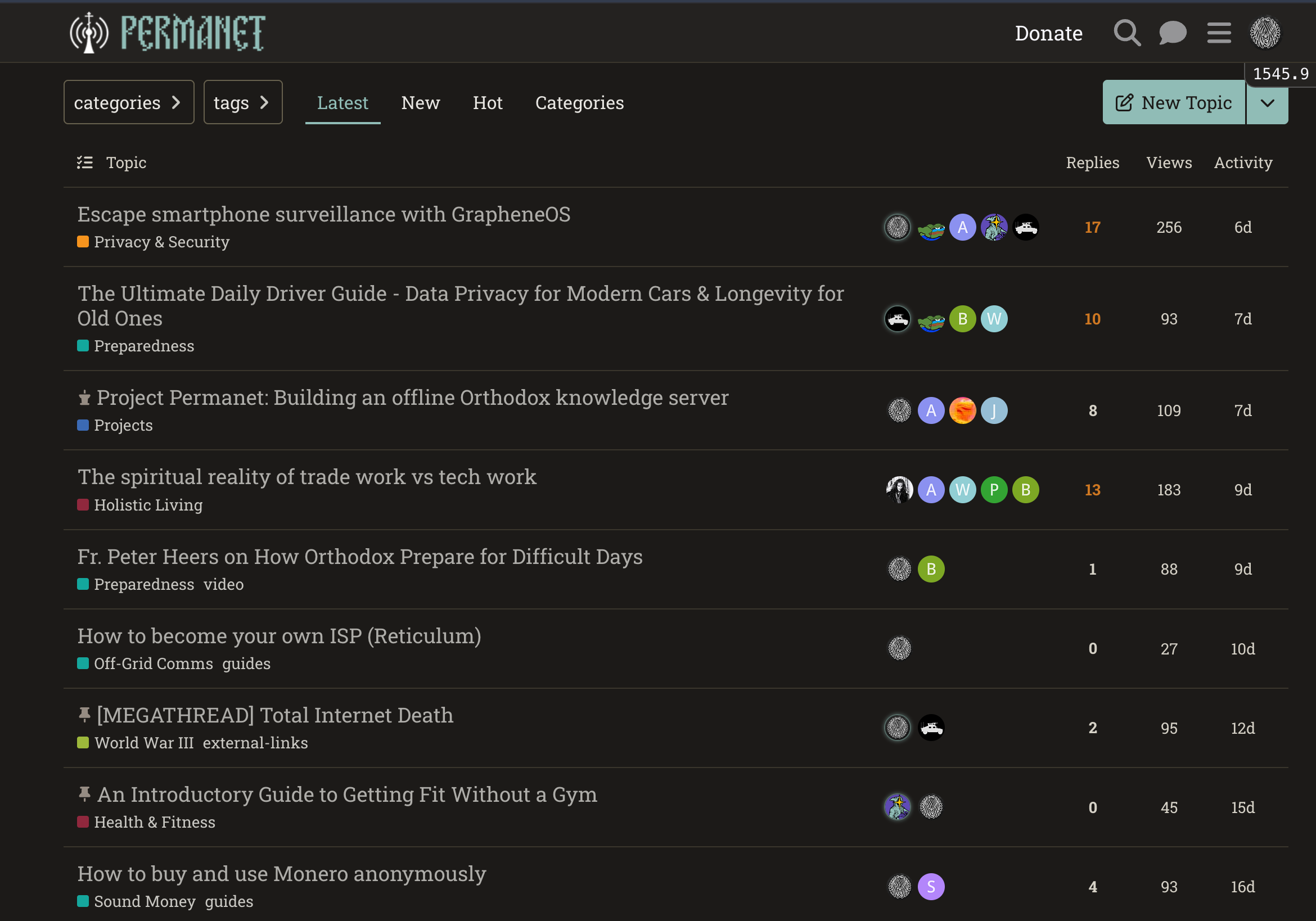
The choice of a forum is itself a small act of resistance, where The Reversion takes on a new meaning. The web’s first native form of community was the message board. Over a decade ago, we abandoned web forums for Discord servers and social media, and if we want Orthodoxy to continue to thrive on a dying internet, we need a full reversion back to self-hosted and decentralized communication protocols.
The site is self hosted and clearly lives on the dying web, therefore it is subject to many of the dangers mentioned here. In fact, just before I planned to launch publicly, the remote data center it lives on suffered a cooling failure that knocked it offline for three days—proving the exact fragility I am warning about.
That is why Permanet was designed from the first day to be more than a discussion board. I built it to be preserved offline, to self-replicate, and to function as the organizing layer for local, off-grid collaboration. Think of it as a temporary space to plan an exit from.
Here’s three things we’re working on.
In #prep:comms we work out how to connect Orthodox communities on a parallel network that survives both natural disaster and human overreach without WiFi or permission from the communications cartels.
Mesh networking makes this a real possibility that can be accomplished right now. Open-source systems like Meshtastic, MeshCore, and Reticulum run on small, cheap, low-power radios that automatically relay each other’s messages across a self-healing web of nodes. End-to-end encrypted, on unlicensed bands, permissionless to operate. A parish or monastery can put one on a roof for the price of a book.
This happens in the Scriptorium.
The free, open-source tool Kiwix lets you download entire wikis, forums, and websites as a single file you can read with no connection at all. I’ve already done this with a complete offline copy of the OrthodoxWiki.
Get started:
How to create ZIM files (offline website and wiki preservation)
Seed torrents of larger libraries and downloads that are shared in Scriptorium
The bigger goal is a portable offline Orthodox knowledge server holding the best of what we collect — a box that contains large collections of literature, maps, survival guides and a wide variety of resources on rebuilding civilization. You can plan work like this in .
The whole point of the gatekept internet is that participation requires surrendering identity. So in the Digital Sovereignty board we work on the opposite: owning your own data, your own identity, and your own infrastructure.
De-Googled phones and hardened operating systems. Self-hosting the services you’d otherwise rent from a company that can be subpoenaed or simply change its mind. Encrypted messaging that doesn’t need a phone number. Sound money that bypasses the banks. It is our duty to not be digital rentoids to corporate landlords who profit off our data.
We are deliberately gathering resources that become more valuable in an offline scenario, not less. A searchable library of skills, texts, maps, and repair manuals is nice to have today and irreplaceable on the day the network isn’t there. If there’s something we’ll need to know how to do, we should like to have already written it down somewhere that doesn’t need a data center’s permission to open.
The forum is built to be archived offline, and it’s built with redundancy in mind so it can be mirrored, replicated, and stored. Every good thread makes the whole snapshot worth more.
The scribal tradition that once belonged to the monks is now open sourced. But AI bots will only multiply as they eat away at any remaining fragments of the internet’s memory. At the same time, the communication cartels we rely on are becoming the infrastructure for our digital prisons.
The temptation is to surrender and become a Luddite. But this is a total cop-out. As Metropolitan Saba stated in a recent post, “The Church is not called to withdraw from the world in fear. Nor is she called to imitate the world in the name of relevance. She is called to bear witness to Christ.” Another quote comes to mind, which is perhaps the most viral Orthodox sentence on the internet:
“It is later than you think, therefore hasten to do the work of God.”
When St. Seraphim Rose uttered these famous words, he wasn’t referring to a specific kind of work. But if preserving his words along with countless others suspended in digital limbo speaks to you, start today.
Join the forum at permanet.xyz. Even if you don’t, you can begin preserving digital content locally where it can’t be taken from you.
This project is my contribution back to the amazing community we’ve built here, with special thanks to my paid supporters who made it possible. I make no money from it and my promise is that it will remain free to use as long as it’s online.
Thanks for reading The Reversion! This post is public so feel free to share it.
Comments
Nothing yet. Say the first thing.
Sign in to join the conversation.